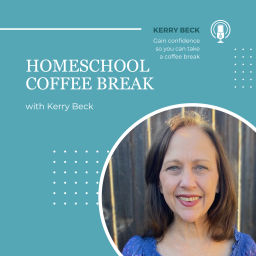
Homeschool Coffee Break
Hosted by Kerry Beck and Beck · Kerry Beck
5.0from 17 ratings
- 212
- Episodes
- 17
- Ratings
- Daily
- Cadence
- 2022
- First episode
About Homeschool Coffee Break
Homeschool Coffee Break helps you stop overwhelm and gain confidence so you know you're doing enough with your kids' education. Our top-notch interviews, practical tips & tricks, and real solutions will give you confidence in your homeschool.
- Publisher
- Kerry Beck
- Category
- education · kids & family
- Language
- en
- Explicit
- No
- First episode
- 21 Jul 2022
- Latest episode
- 13 Oct 2026
Latest episodes
212 episodes in the feed.
13 Oct 2026
208: Stop Holiday Stress Before December Gets Here
It's December 23rd. The kitchen's a mess, your feet are aching, and instead of feeling the peace the season promises, you're sitting on the floor in tears. Holiday stress has a way of hijacking the very joy you're trying to create. It doesn't have to be this way. This episode gives you 3 practical shifts to protect your family's time this Christmas, so you actually experience the peace and joy the season is meant to hold: ✅Why a packed holiday calendar steals your ability to be present & intentional ✅The stop-doing list that creates immediate breathing room without losing any joy ✅How to identify 3 non-essential traditions that are draining you right now ✅Why simplifying Christmas creates the memories that last a lifetime ✅How to shift from holiday stress to spiritual awe & family connection this season Click the link below to sign up for the free class on keeping Christ in Christmas before it fills up. Resources for You FREE class: 3 Clues to Keep Christ in Christmas (https://howtohomeschoolmychild.com/3clues) Show Up Early Bonus: Christmas Acts of Kindness (https://howtohomeschoolmychild.com/3clues) Show Notes: How Did a Season Celebrating the Prince of Peace Become the Most Stressful Month of the Year? Picture this. It’s 11:30 at night on December 23rd. Your kitchen counters are covered with half-baked cookies. There’s sticky flour, unwashed mixing bowls, mountains of unrolled wrapping paper. Your feet are aching and your head is pounding. And instead of feeling the peace of the Christmas season, you’re sitting on the kitchen floor in tears. I don’t know that I was ever literally on the kitchen floor, but I have been there. Felt that. And if you’re looking at your decorated tree with dread instead of joy, thinking about tomorrow’s endless to-do list on Christmas Eve — you are not alone. You’re probably listening to this in October. I know that feels early. But if you haven’t made some decisions now about what December is going to look like, it will come upon you suddenly and you will be on that floor. The Trap Every Christian Mom Falls Into Every Christian mom — every homeschool mom — falls into this trap. Trying to do all the things to make Christmas perfect. When my kids were young, I wanted them to miss nothing. I would stack the schedule with endless to-dos on top of baking and shopping and wrapping and church pageants and family gatherings. I wanted to create the perfect memory. I remember reading Southern Living about having a Christmas decorating evening where everything looks lovely. We never got there. Not once. The sheer volume of tasks takes away your ability to be present in the moment. When your schedule is crammed full, there is literally no physical or mental room for stillness, quiet reflection, or the actual joy of Christmas. What Ma Wilder Did in December 1888 Let me take you back to December 1888. The American prairie — blizzards, isolation, deep financial strain, an agricultural depression. You can read about this in Laura Ingalls Wilder’s books. She tells the story of how her mother Caroline — Ma — handled all those hardships. Ma did not have access to big stores, extravagant decorations, or endless activities. She focused entirely on warmth, simple presents, and deep gratitude for small things. Maybe a single orange. A tin cup. Homemade candy made out of snow. Expectations stripped away all the commercial clutter. And Laura remembered those Christmases. She said it gave her a profound awe and joy for the rest of her life. That’s what simple and intentional did for Laura. And it’s what it can do for your kids too. What We Changed in Our Family I still remember crying in the car on Christmas day feeling overwhelmed. It was at that point that Steve and I decided things needed to change. We agreed we would only do two outside activities as a family during the Christmas season. The rest of the time we would be at home — building a fire, reading a book, spending time with just our family in quiet reflection and awe of Jesus’ birth. That shift changed everything. Make a Stop-Doing List Here’s what I want you to do right now. Grab an index card or a sticky note — something you can put somewhere you’ll see it before you start your holiday planning. Write down three non-essential holiday events or traditions that currently drain your energy or create friction in your home. Maybe it’s elaborate neighbor gifts. Maybe it’s the daily elf on the shelf antics. Complicated craft projects. Being in the Christmas pageant when it means 15 practices that take time away from your family. Write them down. And then cross them off your calendar and your to-do list with zero guilt. When you remove those three things, you create immediate breathing room in your family, in your home, and in your schedule — without sacrificing a single drop of Christmas joy or peace. What happens when you let the calendar run your family? You’re not centering your days on Jesus. And your kids are absorbing your stress instead of your peace. I know that happened to me. Why was I crying in the car on Christmas day driving to my parents’ house? Because I had done way too much. We don’t need more activities to make Christmas meaningful. We need purpose and intentional shifts to protect your family’s time together. We need our kids to grow up experiencing the peace and joy of Christmas. I’m offering a free class at the end of October called Three Clues to Keep Christ in Christmas. You can sign up here (https://howtohomeschoolmychild.com/3clues). I’m going to share the exact shifts we made to go from holiday stress to seasons of deep faith and rest. If you show up five or ten minutes early, there’s a special bonus waiting for you — our Christmas bingo printout to help you stay focused on intentional things. If this helped you, share it with a friend who is already dreading December. And a five-star review or a comment wherever you’re listening would mean the world to me.
6 Oct 2026
207: Christian Alternatives to Halloween for Families
Fall can be full of cozy traditions — and it can also be a chance to point our families toward Jesus instead of fear. In this episode we share simple, Christ-centered ideas you can use at home or in your homeschool as meaningful Christian alternatives to halloween. You’ll hear practical activities — everything from Reformation Day celebrations to service opportunities for your kids — and one “ready-to-use” idea to try this month. ✅ Family Praise Night (dessert + songs + testimonies) ✅ Night bags or luminaries with Bible verses to line your walkways ✅ Heroes of the Faith costume idea and mini-presentations for kids ✅ Harvest (Thanks) Tree, scripture scavenger hunts, and Service Night ideas ✅ How we host a Reformation Day party and a ready-made Reformation unit study Grab the Reformation Day Unit Study (https://c/) mentioned in the podcast. Use coupon code REF26 for the limited-time discount. Show Notes: Christian Alternatives to Halloween: Faith-Filled Fall Traditions for Your Family Hey everyone, Kerry Beck here with Homeschool Coffee Break, where we help you stop the overwhelm so you could take a coffee break. We need a coffee break every once in a while. It is fall time. I got my fall background up here. I love fall. This morning, I went for a walk. I probably could have even put a jacket on, and I live in Texas, and it's still September. I am so excited. So, I don't know what your weather is like, but it has been getting cooler here as well. Today, what I want to do is talk to you about a time in the fall season that Christians often struggle with, and that is Halloween. What are we doing? I want to talk to you about some alternatives to Halloween. We are releasing this, and this Wednesday, we are going to have a Facebook party that will dive more into fall alternatives to Halloween. So I hope you will join me. It is in Facebook. There'll be some freebies in there, but there'll be some great resources as well. Halloween Doesn't Have to Be About Darkness or Fear Today, what I want to share with you are some Christ-centered and some family-friendly alternatives that you can use in your family, in your home, and in your home school as well. And let's talk about fall traditions. If you are listening to this and there is a place to put a comment, leave a comment and let me know what's one of your fall traditions. We all have Christmas traditions, or Thanksgiving traditions. What are some traditions during the fall time? You know, I love the cooler weather. We did decorate pumpkins, and we still decorate pumpkins. My kids carved a pumpkin when they were younger. I remember one time I bought these big jewel stickers and bought one of those small little pumpkins for my two oldest granddaughters. They were probably like 2 and 4, 3 and 5, and they could just put those stickers all over wherever they wanted, and they had their own little decorated pumpkin, their jeweled pumpkin, we could say. What fall traditions do you want your kids to remember? When we lived in Idaho, we went apple picking, and then we would make apple cider right there. Some of y'all might go through those corn mazes. I've done that, not with my kids, but I've done it with Steve and with some adults as well. And then some of you might go to just a pumpkin patch. I know in Dallas, they have a beautiful arboretum completely decorated with all the fall stuff there is. So, what are some family traditions you might have for fall? Christ-Centered Alternatives to Halloween Now let's move on to Christ-centered alternatives to Halloween. You know, the world, it seems like, has hijacked all Hallows' Eve. But we can take it back for holiness and for light. It is a dark holiday now, let's be honest, but we stand for the light, the light of Jesus Christ. And so, let's talk about some alternative things you might do during October, during the last week of October, and how you could really focus on the light of the world. Family Praise Night: Maybe just have some families over and have a family praise night, where everyone brings a dessert, and y'all sing some songs and share testimonies of God's work in your family. Light Bags: Maybe you could do like the light bags, and everyone in your neighborhood just gets the little sandwich bags, and they can decorate it, maybe even cut holes if you want, and put a candle, or if you don't want to do a candle, you could put those little electric candles in there. Then line them up on your sidewalk, or line them up across the front of your house as well. You might decorate them with Bible verses if you want. Heroes of the Faith Costume: Maybe everyone chooses a Bible character and dresses up as a Bible character, and you come ready to tell at least one little fact each child does about the person that they have dressed up. So, they're going to be learning, and they get to dress up as well. Harvest of Blessings Night: I have done this, and I do not have a picture of it. We took a big piece of brown paper wrap paper, and I just drew a tree with branches, but no leaves. Then we cut out leaves out of orange, yellow, brown, those colors, and each leaf, you would write a blessing that you have. You could start it in October and continue it into November during Thanksgiving as well. Be our blessings tree, or our thanks tree. Add to it all season long. And then, at Thanksgiving, be able to sit down and read through some of the blessings that you've had in the past two months. Scripture Scavenger Hunt: You could do a scripture scavenger hunt, where you hide verses around the house, or around the yard, and maybe tied to a little prize or a little treat. But each verse is connected to some themes, the theme of light, the theme of courage, or the theme of God's protection. Service Night: I love this idea, it's called Service Night. Be a light in your community. Maybe you bake some cookies, and you are the light to maybe our first responders that are around there. You could put little verses tied onto some little Ziplocs, like you could put some cookies in there, and put some verses in there that go along with Jesus being the light. So, this teaches our kids the joy of giving instead of always getting. Celebrating Reformation Day: Our Family Tradition I want to share a story of something that we did personally, and that was Reformation Day. We did, I guess most of the ones we did were lunches. We did it at lunchtime, and we celebrated Reformation Day, October 31st, All Hallows' Eve. It's the eve of All Hallows Day on November 1st. And where did this all come about? Now, let me just say, whether you are Catholic, or Protestant, I don't really care. You still need to know what history has to say. I am... we grew up... we lean... we are Protestant, and we taught our kids the Protestant faith. But they still learned the Catholic faith. They learned about it. I wanted them to be able to think through any of those situations, anything like that. So, regardless of what your perspective and your theology is, I think it's important that we share this with our kids. The Story of Martin Luther and the 95 Theses We begin with Martin Luther, because on October 31st in the 1500s, he was a German monk and a teacher. He loved God, and he wanted everyone to understand the Bible. But the church at that time was asking people to pay for their forgiveness, like, give money. They are called indulgences. And many people were very confused about it, and actually some were upset. The poor people felt like they got wrangled around. And so, Martin Luther wrote these statements, 95 statements, and we call them 95 Theses. And explain what he thought the church should fix, and how it should work, and how we needed to rethink some of the things that the church was doing. I'm going to read a few of these. These are not complaints, they are just questions and ideas. Salvation is a gift from God, not bought with money. Repentance means changing your heart, not just giving money. The Pope cannot forgive sins with money. Christ followers should focus on faith and good works, not paying for forgiveness. Preachers should teach God's Word. Money cannot cleanse the soul, only God can. The church should help the poor, not profit from their guilt. Christians should study the Bible for themselves. That was a new concept. We have Bibles everywhere. And yet, they didn't even have it in their own language. That was William Tyndale, was one of the first people that starts translating the Latin Bible, the Vulgate, into English. Eventually, they started translating from the Greek and the Hebrew. He was on the run and ended up dying, but he was one of the first men trying to translate the actual Bible into the English language. The authority of the Bible is higher than the authority of the Pope. On October 31st, 1517, he took this paper and he went and nailed it to the door of the Wittenberg church. The church door, in that time, acted like a bulletin board. So when there were any announcements or notices, people could just go nail them up there, and that's what Martin Luther did. And people began to read these theses, and they shared them widely. This started a movement called the Reformation. Why Reformation Day Matters Today Now, there's a lot more that goes over. That is just a simple view. You can teach it to your kids at different levels, but I think it's important. Why is this important? Because we need to sometimes question our church leaders, even today. You should always go back to the Bible and use the Bible. I mean, if they're doing something that goes against the Bible, then that is something you need to consider. Maybe that's not the place that you need to be attending church. This also eventually helped people read and understand the Bible for themselves in their own language, and it changed church history forever. No matter where you are, and I sort of see the church in Roman Catholicism, Greek Orthodox, and then the Protestant movement. I want to say it was protesting, and that's how we get the word Protestant, protesting Catholics and Roman Catholics, if I remember correctly. You see, the big picture is God used this reformation to bring truth, encourage and revival to that society. It actually makes me think a little bit about today. God is using something evil to bring about truth and courage and revival here in the United States. And hopefully around the world. I mentioned that last week, but you know, you could go and look. There are martyrs that died for their faith. You could go through and study some of them. I think I have the book here. There is Book of Martyrs, but this is a kid's version of Trial and Triumph, and this is stories from church history. This would be a great place for you to get started in sharing stories, and some of them are martyrs, and some of them are people that were just strong and courageous in their faith, and so that would be something that could tie in. That would be an alternative to Halloween, if you want to dive deep into this. How to Host Your Own Reformation Day Party Another thing, and this is what we did, we studied this time period, and then we had a Reformation Day party. We invited families, every family was responsible for bringing one food dish and hosting a booth. That booth could be a game, it could be a craft. We had some stairs up at the front of my house, and so, one of them had them, like, climbing, because at that time in the cathedral, they had to crawl up these stairs when they would go to Rome. We had people making candles at that time, because you needed candles for life. There are all different things you could do. We would always sing some songs, we might even act out a play based on one of our reformers, depending on who we were choosing, whether I think we... I know we did Martin Luther, John Calvin, Martin Bucer, any of those, and then we would always fellowship over a meal. And so that's really cool. How about you weave Reformation history into your home school, even with just one activity? You know, I think it's really important. You could host a party. It's not that hard. You don't have to do all of it. Spread the love and let other people come and bring activities for your kids. Our first one, my kids even dressed up. They made costumes, and they dressed up like a woman back in that time period, or a man. So, enjoy your family fall traditions that creates memories, look for alternatives to Halloween that point your family to Christ, and then celebrate Reformation Day to root your kids in church history. And I would encourage you to plan right now, this week, first week of October, what is one thing that you will do in October that's an alternative to Halloween, if that's something you want to do? Ready-to-Go Reformation Day Resources If you'd like something that's a ready-to-go activities, I have something called a Reformation Day unit study. I pulled it together. You're going to get a book list, you're going to get stories about it, you get a slide presentation on different reformers. We have videos as well. There are recipes in there, and you know, a unit study takes the topic, and then we provide all the different subjects, history, and science, and art, and cooking, and Bible, and character, and literature. You get a little bit of all of that, and then you can pick and choose what it is you want for your family. If you happen to be listening to this, the week that this episode is published, this unit study is on sale, and so you can use the link below to be able to save some money on that Reformation Unit Study (https://howtohomeschoolmychild.com/reformation). You can get it at any time. People have bought it at all times of the year. But, right now, if you'd like to save a little money, just use the link in the coupon code CODE REF26, and you'll be able to save a little bit money as well. Hey, if you have a comment or question, reach out to me, you know, email me, DM me. If you have gotten just one little tip out of here, would you please share this with another Christian mom or another homeschool mom to help them, that would mean the world to me. Or, leave a 5-star review, because that means we can get this out to more and more people. Moms don't have the time to pull all this together, and they just need some creative ideas. Hey, thanks for spending time with me. I am Kerry Beck with Homeschool Coffee Break. We'll talk to you next time.
29 Sept 2026
206: Stop the Chaos With Homeschool Preschool Activities
Your 3rd grader is finally focused. Your toddler has just dumped dry beans on the floor, found a permanent marker, and is wearing a colander as a hat. You're not failing. You're just in a specific season — and homeschool preschool activities are about to make it so much more manageable. This episode gives you 4 practical strategies to keep your little ones engaged while you actually teach your older kids: ✅The special work box trick that creates instant focus in toddlers without buying expensive gear ✅Why Montessori-style real tasks work better than any busy work for preschoolers ✅Simple outdoor missions that burn energy and buy you 15 uninterrupted minutes ✅How to use novelty to keep little ones engaged during high-focus subjects ✅Why this season is shorter than it feels ✅How to stop letting today derail your whole day Click the link below to grab the free resource with 25 homeschool preschool activities to use right now. Resources for You Free resource: 25 Activities to Keep Your Preschooler Engaged While You Homeschool Older Siblings (https://howtohomeschoolmychild.com/homeschool-preschool-activities/)
Reach and audience
Public platform figures. Ratings count people who left a rating, not total listeners.
- Apple Podcasts (US)
- 5.0 / 5
- 15 ratings
- Spotify
- 5.0 / 5
- 2 ratings
Podcast Authority Score: 62 / 100
A composite of feed quality, social presence, YouTube performance and engagement. Read the methodology.
- Quality
- 90
- Social presence
- 0
- YouTube
- 0
- Engagement
- 85


Host of Homeschool Coffee Break?
Claim your podcast to manage its listing and keep your show details accurate.
Pod Engine is an independent podcast discovery and analytics service and is not affiliated with or endorsed by this podcast. Artwork and show content belong to their owners. Full legal notice.
Explore this show
Podcast research with Pod Engine