
We are living in times of unprecedented technological development. Many of the tools and devices we invented 20 years ago are obsolete today. In his internationally best selling book, "Homo Deus: A Brief History of Tomorrow", Yuval Noah Harari observes that this development is continuing in important fields such as genetic engineering, regenerative medicine and nanotechnology. Harari predicts that developments in these fields will transform us into super-humans. We might become biologically enhanced humans, cyborg beings or possibly fully non-organic beings. At the same time though, Harari notes that this technological development, and the unrestrained economic growth needed to support it, are leading us to potential ecological catastrophe. This raises the question, can we keep on growing the economy indefinitely without facing ecological disaster? If our technological development is on a collision course with ecological disaster, maybe our future isn’t just ‘more technological development’ but something else all together? ...To gain a deeper understanding of who we are as Homo Sapiens, Harari looks back to the Cognitive Revolution, 70,000 years ago. Something changed for us in the Cognitive Revolution such that we went on to dominate all other species. Prior to the Cognitive Revolution, our ancestors had the best technology and highest intelligence on the planet for over a million years. Yet we remained an insignificant ape, with little impact on the ecology around us. So what changed? Harari points not to technology, but to changes in the way we cooperate. During the Cognitive Revolution we developed ‘imagined orders’ that enabled large groups of strangers to cooperate together flexibly. Other animals are not able to do this, and this lead to our dominance. ... I really liked Harari’s book. He is an excellent writer and has many great insights. But at the same time, I think he overlooked some aspect of human evolution that if properly considered, would lead to a different most likely future. In this podcast “Homo Deus: Humanity’s Evolution from Social Institutions to World Peace”, we will review the ideas raised in Harari’s book, but also explore alternate possibilities. In particular, could there be another change in the way humans cooperate coming? If our previous major evolutionary step had to do with how we cooperate, maybe our next evolutionary step will too? If you are interested in thinking about the future this podcast is for you.<hr><p style='color:grey; font-size:0.75em;'> Hosted on Acast. See <a style='color:grey;' target='_blank' rel='noopener noreferrer' href='https://acast.com/privacy'>acast.com/privacy</a> for more information.</p>
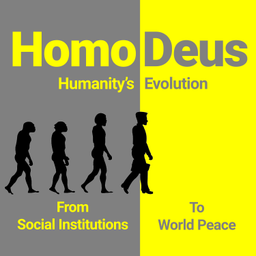
Homo Deus: Humanity’s Evolution from Social Institutions to World Peace
Claim This Podcastby Brian
Podcast Overview
We are living in times of unprecedented technological development. Many of the tools and devices we invented 20 years ago are obsolete today. In his internationally best selling book, "Homo Deus: A Brief History of Tomorrow", Yuval Noah Harari observes that this development is continuing in important fields such as genetic engineering, regenerative medicine and nanotechnology. Harari predicts that developments in these fields will transform us into super-humans. We might become biologically enhanced humans, cyborg beings or possibly fully non-organic beings. At the same time though, Harari notes that this technological development, and the unrestrained economic growth needed to support it, are leading us to potential ecological catastrophe. This raises the question, can we keep on growing the economy indefinitely without facing ecological disaster? If our technological development is on a collision course with ecological disaster, maybe our future isn’t just ‘more technological development’ but something else all together? ...To gain a deeper understanding of who we are as Homo Sapiens, Harari looks back to the Cognitive Revolution, 70,000 years ago. Something changed for us in the Cognitive Revolution such that we went on to dominate all other species. Prior to the Cognitive Revolution, our ancestors had the best technology and highest intelligence on the planet for over a million years. Yet we remained an insignificant ape, with little impact on the ecology around us. So what changed? Harari points not to technology, but to changes in the way we cooperate. During the Cognitive Revolution we developed ‘imagined orders’ that enabled large groups of strangers to cooperate together flexibly. Other animals are not able to do this, and this lead to our dominance. ... I really liked Harari’s book. He is an excellent writer and has many great insights. But at the same time, I think he overlooked some aspect of human evolution that if properly considered, would lead to a different most likely future. In this podcast “Homo Deus: Humanity’s Evolution from Social Institutions to World Peace”, we will review the ideas raised in Harari’s book, but also explore alternate possibilities. In particular, could there be another change in the way humans cooperate coming? If our previous major evolutionary step had to do with how we cooperate, maybe our next evolutionary step will too? If you are interested in thinking about the future this podcast is for you.<hr><p style='color:grey; font-size:0.75em;'> Hosted on Acast. See <a style='color:grey;' target='_blank' rel='noopener noreferrer' href='https://acast.com/privacy'>acast.com/privacy</a> for more information.</p>
Language
🇺🇲
Publishing Since
11/7/2020
1 verified contact email on file for Homo Deus: Humanity’s Evolution from Social Institutions to World Peace
Pitch yourself as a guest, propose sponsorships, or reach out directly to the host.
Recent Episodes
February 15, 2021
#11 Practice Makes Perfect
<p>In episode #10 we completed our review of Harari’s book, but there is still a little bit more to talk about. Throughout this podcast I have referred to re-training our desires and learning new methods of cooperating, but I haven’t discussed many details. In this wrap-up episode, we will consider what this training might look like. What kinds of groups might you join? What are the common pitfalls for these groups? We will finish by considering how this training might be the missing ingredient in our efforts to address climate change.</p><p>For comments and questions: <a href='mailto:brianpracticingforpeace@zohomail.com'>brianpracticingforpeace@zohomail.com</a><br/>Transcript: <a href='https://brianpracticingforpeace.medium.com/11-practice-makes-perfect-ec6b16d07095'>https://brianpracticingforpeace.medium.com/11-practice-makes-perfect-ec6b16d07095</a></p><hr><p style='color:grey; font-size:0.75em;'> Hosted on Acast. See <a style='color:grey;' target='_blank' rel='noopener noreferrer' href='https://acast.com/privacy'>acast.com/privacy</a> for more information.</p>
February 4, 2021
#10 Survival of the Fittest
<p>Having established that humanism is in decline, Harari addresses the question, ‘what new religions or ideologies might fill the resulting vacuum?’ Two religions that are already here and may step forward are Techno-Humanism and the Data Religion. We will discuss the likelihood of these technology-religions succeeding and also loop back to the concept of survival of the fittest. Will humanity really be more fit for survival within the earthly ecosystems if these religions do succeed? Does it even matter?</p><p>For comments and questions: <a href='mailto:brianpracticingforpeace@zohomail.com'>brianpracticingforpeace@zohomail.com</a><br/>Transcript: <a href='https://brianpracticingforpeace.medium.com/10-survival-of-the-fittest-6303e6950d42'>https://brianpracticingforpeace.medium.com/10-survival-of-the-fittest-6303e6950d42</a></p><hr><p style='color:grey; font-size:0.75em;'> Hosted on Acast. See <a style='color:grey;' target='_blank' rel='noopener noreferrer' href='https://acast.com/privacy'>acast.com/privacy</a> for more information.</p>
January 24, 2021
#9 The Risk of Alien Invasion
<p>In chapter 9 of his book, Harari discusses the threats posed by Artificial Intelligence including (1) undermining our understanding of ourselves as individuals, (2) eliminating employment for the majority of humanity and (3) taking over the world and wiping out humans. We will discuss these risks as well as other existential risks faced by humanity such as the eruption of a super-volcano or invasion by an alien species. With all these risks facing us, where should we focus our attention?</p><p>For comments and questions: <a href='mailto:brianpracticingforpeace@zohomail.com'>brianpracticingforpeace@zohomail.com</a><br/>Transcript: <a href='https://brianpracticingforpeace.medium.com/9-the-risk-of-alien-invasion-5e1b1497ada8'>https://brianpracticingforpeace.medium.com/9-the-risk-of-alien-invasion-5e1b1497ada8</a></p><hr><p style='color:grey; font-size:0.75em;'> Hosted on Acast. See <a style='color:grey;' target='_blank' rel='noopener noreferrer' href='https://acast.com/privacy'>acast.com/privacy</a> for more information.</p>
12 total episodes available
Deep-dive analytics for Homo Deus: Humanity’s Evolution from Social Institutions to World Peace
Frequently asked questions
Have a different question and can't find the answer you're looking for? Reach out to our support team by sending us an email and we'll get back to you as soon as we can.
- What is Homo Deus: Humanity’s Evolution from Social Institutions to World Peace?
- How often does this podcast release new episodes?
This podcast updates daily.
- Where can I listen to this podcast?
This podcast is available on 4 platforms including Apple Podcasts, Spotify, and more. You can also use the RSS feed directly.
- Does this podcast accept guests?
No, this podcast does not typically feature guests.
Legal Disclaimer
Pod Engine is not affiliated with, endorsed by, or officially connected with any of the podcasts displayed on this platform. We operate independently as a podcast discovery and analytics service.
All podcast artwork, thumbnails, and content displayed on this page are the property of their respective owners and are protected by applicable copyright laws. This includes, but is not limited to, podcast cover art, episode artwork, show descriptions, episode titles, transcripts, audio snippets, and any other content originating from the podcast creators or their licensors.
We display this content under fair use principles and/or implied license for the purpose of podcast discovery, information, and commentary. We make no claim of ownership over any podcast content, artwork, or related materials shown on this platform. All trademarks, service marks, and trade names are the property of their respective owners.
While we strive to ensure all content usage is properly authorized, if you are a rights holder and believe your content is being used inappropriately or without proper authorization, please contact us immediately at hey@podengine.ai for prompt review and appropriate action, which may include content removal or proper attribution.
By accessing and using this platform, you acknowledge and agree to respect all applicable copyright laws and intellectual property rights of content owners. Any unauthorized reproduction, distribution, or commercial use of the content displayed on this platform is strictly prohibited.