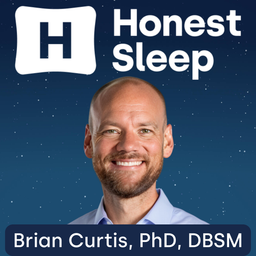
Honest Sleep with Brian Curtis, PhD, DBSM
Brian Curtis, PhD
5.0from 5 ratings
- 16
- Episodes
- 5
- Ratings
- 2023
- First episode
About Honest Sleep with Brian Curtis, PhD, DBSM
Join clinical psychologist Brian Curtis, PhD, for a different kind of mental health podcast: One where you don't just learn about psychological skills, you practice them. If you feel stuck in your life, overwhelmed by thoughts or emotions, unsure of your direction, caught in unhelpful habits, or struggling in relationships, this podcast offers a direct path forward. Each episode is a guided experiment where you'll learn and apply evidence-based tools from the most effective psychological treatments to help you get unstuck and move toward the life you truly want to live. This is not passive listening. You'll be encouraged to pause, reflect, and write in your own "lab notebook" as you practice these skills in real time and test them out in the laboratory of your daily life. This podcast is not a replacement for mental health assessment or treatment, but it is a place to learn and practice science-based psychological skills in an honest, open, authentic, and deeply human way. How would your life change if you were no longer stuck? If you were free to start moving toward the life you truly want to live, rather than continuing to put your happiness on hold? Let's find out together. Welcome to the Honest Mental Health Podcast. Learn more at https://www.honestmentalhealth.com/ Watch each guided experiment on YouTube: https://www.youtube.com/@HonestMentalHealthTherapy
- Publisher
- Brian Curtis, PhD
- Category
- education · health & fitness
- Language
- en
- Explicit
- No
- First episode
- 27 Apr 2023
- Latest episode
- 22 Dec 2025
Latest episodes
16 episodes in the feed.
22 Dec 2025
#12 - Observing Thoughts as Passengers
In this guided experiment, you'll learn and practice a powerful psychological skill for changing your relationship with difficult thoughts without trying to control, suppress, or argue with them. Rather than struggling with your mind, this episode invites you to step back and observe your thoughts as "passengers" in a vehicle you are driving toward the life you truly want to live. You'll be guided to: • Identify recurring thoughts that tend to pull you away from your values • Personify these thoughts as individual "passengers" riding along with you • Practice staying in the driver's seat, even when difficult or critical thoughts are loud • Learn how to respond flexibly to thoughts without letting them dictate your behavior This experiment builds on earlier mindfulness and defusion practices and helps you develop more psychological flexibility so you can continue moving toward what matters most, even when uncomfortable thoughts show up. As always, you'll be encouraged to pause, reflect, and write in your own lab notebook, turning this episode into an active experiment rather than passive listening. Welcome to the experiment. Learn more at https://www.honestmentalhealth.com/
15 Dec 2025
#11 - I'm Aware of Having the Thought That...
In this guided experiment, you'll learn and practice a powerful, evidence-based psychological skill for changing your relationship to difficult thoughts without trying to control, suppress, or eliminate them. Rather than getting caught up in the content of your thoughts, this experiment helps you become more aware of the process of thinking itself. You'll practice observing thoughts as thoughts, bits of language or images arising in your mind, rather than taking them as facts about who you are or what your life means. This episode guides you through a simple but profound three-step process: 1) Identifying a recurring, judgmental thought that tends to keep you stuck 2) Noticing how it feels to fully identify with that thought 3) Practicing increasing levels of distance, awareness, and flexibility in how you relate to it As you work through the experiment, you may notice shifts in emotional intensity, body sensations, and your sense of freedom to choose how you respond — rather than being pushed around by your mind. This practice draws from Acceptance and Commitment Therapy (ACT), mindfulness-based approaches, and decades of research on cognitive fusion and defusion. With regular practice, it can help reduce suffering related to anxiety, self-criticism, rumination, and avoidance, while supporting more flexible, values-based action in daily life. As always, this is not passive listening. You'll be encouraged to pause the audio, reflect, and write your observations in your own lab notebook as you actively test this skill in the laboratory of your daily life. This podcast is not a replacement for mental health assessment or treatment, but it is a place to learn and practice science-based psychological skills in an honest, open, authentic, and deeply human way. Welcome to the experiment. Learn more at https://www.honestmentalhealth.com/ (https://www.honestmentalhealth.com/)
8 Dec 2025
#10 - The Purple Cow
In today's guided practice, we explore one of the most well-studied, and counterproductive, patterns that keeps people stuck: trying to control our thoughts. This experiment begins simply: "For the next two minutes, try not to think of a purple cow." What follows is an experiential deep dive into: · What happens when we try to suppress or avoid certain thoughts · Why this often increases the frequency and intensity of the very thoughts we're trying to push away · How this "rebound effect" shows up in anxiety, trauma, insomnia, OCD, and daily life · A more effective alternative based in mindfulness and cognitive defusion After experiencing thought suppression directly, we contrast it with a second exercise: mindfully observing whatever thoughts arise, without trying to control them, push them away, or make them stop. Across both exercises, you'll use your "lab notebook" to track what you notice, including: · What thoughts arose when you tried not to think of a purple cow · What the quality of your experience was like in each condition · How often the thought appeared when suppressing vs. when observing · How you reacted to these thoughts in each exercise · What this reveals about the process of thinking and the suffering we create through control We then explore the science behind these effects, including: · Why thought suppression reliably increases unwanted thoughts · How it fuels rumination, worry, obsessive thinking, and avoidance · Why controlling thoughts keeps us stuck in long-term suffering · A more workable alternative: noticing thoughts as thoughts · Learning to relate differently to thinking so we can live more freely and intentionally The goal of this episode isn't to get rid of painful thoughts. It's to help you change your relationship to them. So as you go about your day, notice when the mind starts playing "The Purple Cow" game, trying to avoid, push away, or control your thoughts. When it happens, see if you can step back, make a gentle mental note, and return to observing thoughts like waves in the ocean or clouds in the sky: arising, changing, passing on their own. No need to control your thoughts. Just observe. Just notice. Just practice.
1 Dec 2025
#9 - A Light in the Attic
In this guided experiment, we turn on the light in the attic of the mind. If you've ever struggled with worry, rumination, perfectionism, intrusive thoughts, obsessive loops, or getting pulled out of the present moment, this practice may be one of the most important skills you ever learn. In this episode, you'll learn how to: Observe the process of thinking Notice the content of thoughts as they arise and pass away Differentiate thoughts from facts Change your relationship to thoughts rather than trying to control them Reduce the influence of "Judge E." Experience your mind as an open sky or ocean, where thoughts are simply clouds or waves drifting by Build the skill of mindfulness that supports DBT, ACT, and non-dual awareness work You'll be guided through three structured mindfulness-of-thought exercises, each designed to help you see thoughts clearly, gently, and with far less struggle: Prompted thoughts (noticing what appears when you hear certain words) Intentional thinking (reviewing your day and observing the flow of thought) Open awareness (observing thoughts arising and falling in spacious awareness) Throughout the experiment, you'll use your lab notebook to write down what you notice and to track how your relationship to thoughts begins to shift. This is not about clearing your mind or stopping thoughts. It's about discovering, through direct experience, that: You are not your thoughts. You are the awareness in which thoughts come and go. And from this perspective, the freedom to live more consciously, intentionally, and compassionately becomes possible. Listen now, and let's explore this together. YouTube: https://www.youtube.com/@HonestMentalHealthTherapy Podcast: https://podcasts.apple.com/us/podcast/honest-mental-health-with-brian-curtis-phd/id1638878549
24 Nov 2025
#8 - Illuminate the Lighthouse
In this guided experiment, you'll begin learning and practicing the foundational skills of mindfulness: the ability to wake up from autopilot and connect more fully with your life, moment by moment. While aligning your behavior with your core values is essential to building a meaningful life, mindfulness helps you see clearly where you are and how you're moving through each moment, like turning on a light inside the lighthouse of awareness. Through this practice, you will: Strengthen your ability to observe the present moment without judgment Learn to focus and redirect attention (the "spotlight" of awareness) Explore your five senses, touch, sight, sound, smell, and taste, with openness and curiosity Increase emotion regulation, cognitive flexibility, and self-awareness Deepen connection with yourself and others This experiment introduces the "Observe" skill from Dialectical Behavior Therapy (DBT) and sets the foundation for more advanced mindfulness practices in upcoming episodes. As you practice illuminating your experience with awareness, you'll begin to notice what truly matters, and how to live more intentionally in alignment with your values, one moment at a time. Welcome to the experiment. Learn more at https://www.honestmentalhealth.com/
17 Nov 2025
#7 - Measure Pleasure
In this guided experiment, you'll learn a surprisingly powerful method that's been shown to help people reduce symptoms of depression, anxiety, substance use, insomnia, and more, by focusing on one simple idea: Pleasure through measurement. You'll discover how to use daily monitoring (sometimes called a daily diary or tracking log) to increase awareness, motivation, and accountability for your values-based S.M.A.R.T. goals, the ones that truly matter to you. Through this experiment, you'll: Create your own daily tracking sheet ("lab notebook" style) Learn how to monitor meaningful behavior change Identify patterns that move you toward or away from your values Strengthen consistency, satisfaction, and long-term well-being This practice is at the heart of what helps many people move from insight into real, measurable change. By tracking what matters, we begin to see, and feel, our progress. Welcome to the experiment. Learn more at https://www.honestmentalhealth.com/ #Psychology #MentalHealth #Mindfulness #BehaviorChange #Values #ACT #DBT #CBT
7 Nov 2025
#6 - Closing the Gaps with S.M.A.R.T. Goals
In this experiment, you'll take the values and insights from your previous work and begin turning them into real, lived change. You'll learn the difference between values (your ongoing direction) and goals (specific destinations along the way). Then you'll create one clear, realistic, meaningful S.M.A.R.T. goal designed to help close a specific gap between how you want to live and how you're currently living. This experiment supports you in taking the first actionable step toward a more honest, connected, and values-aligned life, one small commitment at a time. Welcome to the experiment. Learn more at https://www.honestmentalhealth.com/ (https://www.honestmentalhealth.com/)
7 Nov 2025
#5 - Judge E and Judge F
In this guided experiment, you'll explore how judgments shape your emotional life, your relationships, and the ways you show up each day. You'll learn to distinguish between Judge E (evaluations—good/bad, should/shouldn't) and Judge F (facts—what is actually happening). You'll be encouraged to: Identify a meaningful "gap" from your values work Notice the judgments you direct at yourself Sort these judgments into evaluations vs. facts Practice replacing evaluative judgments with factual descriptions Discover specific, workable behaviors that support the life you want to live This experiment can reduce shame and self-criticism, increase clarity, and open the door to more compassionate, effective change. Welcome to the experiment. Learn more at https://www.honestmentalhealth.com/ (https://www.honestmentalhealth.com/)
7 Nov 2025
#4 - Mind the Gaps
In this episode, you'll explore the space between the values that matter most to you and how you're currently living your life. Using your Core Values Hierarchy from the previous experiment, you'll learn a simple and powerful way to identify where your behavior is aligned with your values, and where meaningful gaps exist. You'll be guided to: Revisit your ranked core values Reflect on how important each value is to you right now Assess how consistently you're living by each value Identify the "gaps" (or "speed bumps") between intention and action This experiment is not about judgment, criticism, or pushing yourself into perfection. It's about clarity: An honest look at where your time, energy, and attention are going, and where you may want to gently redirect them. Noticing these gaps is the doorway to change. Once you see them clearly, even one small shift can begin to reshape how you move through your day, and how you live your life. Welcome to the experiment. Learn more at https://www.honestmentalhealth.com/ (https://www.honestmentalhealth.com/)
7 Nov 2025
#3 - Building Your Core Values Hierarchy
In this episode, you'll take the next step in clarifying what truly matters to you by identifying your core values: The values that are most central to the life you want to live, and arranging them into your own personal values hierarchy. You'll be guided to: Revisit what emerged during the "Being Remembered" experiment Review the values you selected during "Discovering Your Values" Select the values that feel most important to you Rank these values from #1 to #10 to create your Core Values Hierarchy This process can be surprisingly powerful. When your values are clearly defined, and organized, it becomes easier to make decisions, navigate moments of conflict, resolve internal tension, and move with greater confidence toward the life you want to live. You'll also be invited to notice how different core values may sometimes come into conflict with one another, and how your new hierarchy can help you make choices that feel more authentic, honest, and aligned. This is not about being perfect. It's about being truthful, with yourself. Welcome to the experiment. Learn more at https://www.honestmentalhealth.com/ (https://www.honestmentalhealth.com/)
7 Nov 2025
#2 - Discovering Your Values
In this episode, you'll continue the process of uncovering what truly matters to you by identifying your core values: The qualities that make life feel meaningful, grounded, and authentic. Using a guided exercise adapted from the Personal Values Card Sort (Miller & Rollnick, 2013), you'll explore 100 possible values and notice which ones genuinely resonate with you. Not the values you were taught you "should" care about, but the ones that feel deeply meaningful to the life you actually want to live. You'll be encouraged to: Listen for the values that feel personally important to you Pause the experiment when a value resonates Write those values in your lab notebook Reflect on what patterns you notice in the values you selected As you move through your day after this experiment, you'll begin noticing where these values show up naturally, and where your actions drift away from the life you want to live. This is an invitation to gently, gradually realign your daily behavior with your deepest commitments. This is not about perfection. It's about honesty, curiosity, and beginning again. Welcome to the experiment. Learn more at https://www.honestmentalhealth.com/ (https://www.honestmentalhealth.com/)
7 Nov 2025
#1 - Being Remembered
In this episode, you'll begin exploring what it would mean to live a more authentic, values-based life. Rather than discussing values in the abstract, this guided experiment invites you to reflect deeply on the people who matter most to you, and on how you most want to be remembered by them. You'll be encouraged to: Identify the people you care most about Imagine how you would hope they describe the life you lived Write down their words in your "lab notebook" Reflect on what truly matters to you, and what does not This exercise can help clarify the difference between the things you think should matter and the things that genuinely do matter to you. It can also reveal small, meaningful shifts you can begin making today to move toward a life that feels more honest, connected, and fulfilling. This is not passive listening, it's an active exploration of who you are and who you want to be. Welcome to the experiment. Learn more at https://www.honestmentalhealth.com/
7 Nov 2025
Welcome to the Honest Mental Health Podcast
Welcome to the Honest Mental Health Podcast In this introductory episode, you'll learn what Honest Mental Health is all about, and why this podcast is different from traditional conversations about mental health. Instead of simply listening, you'll be invited to actively participate in guided experiments designed to help you get unstuck and move toward a life that feels more honest, meaningful, and fulfilling. We'll begin by exploring one simple but powerful question: Where in your life do you currently feel stuck? Whether it's emotional overwhelm, relationship struggles, unhelpful habits, stress, burnout, or uncertainty about your direction in life, this podcast offers practical, science-based tools to help you begin making real change. You'll learn how to use a personal "lab notebook" to reflect on your experiences, track your insights, and build new skills you can apply immediately in the laboratory of your daily life. This is not a substitute for mental health assessment or treatment, but it is a place to learn and practice deeply effective, science-based psychological skills in an honest, open, authentic, and human way. How would your life change if you were no longer stuck? If you were free to start moving towards the life you truly want to live? Let's find out together. Welcome to the Honest Mental Health Podcast.
27 Apr 2023
#3 – Spencer Dawson, PhD, DBSM – Behavioral Treatment of Insomnia
In this episode, Brian Curtis, Ph.D. speaks with Spencer Dawson, Ph.D., DBSM. Spencer is a licensed Clinical Psychologist, a board-certified specialist in Behavioral Sleep Medicine, and an Assistant Clinical Professor and Associate Director of Clinical Training in the Department of Psychological and Brain Sciences at Indiana University. Brian and Spencer chat about what the field of Behavioral Sleep Medicine is all about, Spencer’s journey to becoming a specialist in the assessment and treatment of sleep disorders, behavioral perspectives on how to use sleep medications effectively and how to gradually stop taking them if that's a treatment goal, the principles and clinical practice of the gold standard treatment for chronic insomnia in adults: Cognitive Behavioral Therapy for Insomnia (CBT-I) and what it’s like to engage in that treatment, interventions for the clinical condition of paradoxical insomnia (also known as “sleep discrepancy” or “sleep state misperception”), how Daylight Saving Time impacts public health and public safety, and other topics. Resources discussed: The Society of Behavioral Sleep Medicine: https://www.behavioralsleep.org/ (https://www.behavioralsleep.org/) Book: Quiet Your Mind and Get to Sleep by Dr.’s Rachel Manber and Coleen Carney. Book: The One Week Insomnia Cure by Dr. Jason Ellis. Free CBT-I Training: https://cbtiweb.org/ (https://cbtiweb.org/) You can learn more about Spencer and his work by visiting the following: The Sleep Health Center: https://www.sleephealthlou.com/ (https://www.sleephealthlou.com/) The Indiana University Cognitive Behavioral Therapy Training Clinic Spencer’s Twitter: @SleepScientist (https://twitter.com/sleepscientist). If you have a question you would like answered on the Honest Sleep podcast, you can record a voice message by visiting www.honestsleep.com/podcast (https://www.honestsleep.com/podcast) and clicking on the “Start recording” button. Honest Sleep Podcast: https://www.honestsleep.com/podcast (https://www.honestsleep.com/podcast) Twitter: @HonestSleepLLC (https://twitter.com/HonestSleepLLC)
27 Apr 2023
#2 - Jordan Kugler, PhD - Borderline Personality Disorder, Insomnia, Nightmares, and Dialectical Behavior Therapy
In this episode, Brian Curtis, Ph.D. speaks with Jordan Kugler, Ph.D. Jordan is a licensed clinical psychologist and a specialist in Dialectical Behavior Therapy (DBT) with primary interests in suicidal behavior and clinical outcomes for DBT and trauma-focused treatments. This conversation came about from a question received from one of our listeners named Katie, which is all about the relationship between Borderline Personality Disorder, insomnia, and nightmares. As Brian and Jordan go about answering Katie’s question, they talk about Jordan’s background, Dialectical Behavior Therapy, Borderline Personality Disorder, Posttraumatic Stress Disorder, and how to go about assessing and treating ongoing sleep disruption along the way. · You can learn more about Jordan by visiting the website for the Utah Center for Evidence Based Treatment, at www.ucebt.com (http://www.ucebt.com), you can find some videos of Jordan’s clinical presentations by going to YouTube and searching the terms Utah Center for Evidence Based Treatment and Jordan Kugler, or you can get in touch with Jordan directly by email: Jordan.kugler@ucebt.com If you have a question you would like answered on the Honest Sleep podcast, you can record a voice message by visiting www.honestsleep.com/podcast and clicking on the “Start recording” button. Honest Sleep Podcast: https://www.honestsleep.com/podcast Twitter: @HonestSleepLLC
27 Apr 2023
#1 - Joanne Davis, PhD - Treating Post-Trauma Nightmares
In this episode, Brian Curtis, Ph.D. speaks with Joanne Davis, Ph.D. Joanne is the Director of Clinical Training and Professor of Psychology at The University of Tulsa, author of the great book, Treating Post-Trauma Nightmares: A Cognitive Behavioral Approach that was published in 2009, and developer of Exposure, Relaxation, and Rescripting Therapy (ERRT) for treating trauma-related nightmares. You can learn more about Joanne and her work by visiting the following: Joanne's University of Tulsa faculty Page Exposure, Relaxation, and Rescripting Therapy (ERRT) (https://artsandsciences.utulsa.edu/errt/) Joanne's Email: joanne-davis@utulsa.edu If you have a question you would like answered on the Honest Sleep podcast, you can record a voice message by visiting www.honestsleep.com/podcast and clicking on the “Start recording” button. Honest Sleep Podcast: https://www.honestsleep.com/podcast Twitter: @HonestSleepLLC
Reach and audience
Public platform figures. Ratings count people who left a rating, not total listeners.
- Apple Podcasts (US)
- 5.0 / 5
- 5 ratings
Contact Honest Sleep with Brian Curtis, PhD, DBSM
- Guest appearances
- Books guests
Based on episode analysis; this does not confirm that the show is currently accepting guests.
Host of Honest Sleep with Brian Curtis, PhD, DBSM?
Claim your podcast to manage its listing and keep your show details accurate.
Pod Engine is an independent podcast discovery and analytics service and is not affiliated with or endorsed by this podcast. Artwork and show content belong to their owners. Full legal notice.
Explore this show
Podcast research with Pod Engine