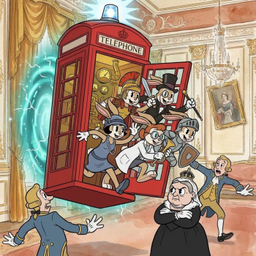
The true, strange, whimsical, overlooked stories from across all of human history — the bits that didn't make the textbooks. Join the rabbits as they discover those nuggets of history that you didn't learn about at school.
New episodes drop twice a week.
Hosted on Acast. See acast.com/privacy (https://acast.com/privacy) for more information.
In 1956, engineer Wilson Greatbatch was building an oscillator to record heart sounds at the University of Buffalo. He accidentally grabbed the wrong resistor from his parts box. Instead of recording heartbeats, the circuit produced electrical pulses that mimicked the heart's rhythm. Greatbatch immediately recognized the potential: a small, implantable device that could regulate irregular heartbeats. He spent two years perfecting the design in his barn workshop, and on June 6, 1960, the first successful implantable pacemaker was installed in a patient. The device worked for 18 months. Today, over 3 million people worldwide depend on pacemakers, with more than a million implanted each year.
Hosted on Acast. See acast.com/privacy (https://acast.com/privacy) for more information.
17 Sept 2026
Tooth Demon
The tooth worm myth is one of humanity's most persistent medical beliefs. From ancient Sumeria to 18th-century Europe, every civilization independently concluded that toothaches were caused by tiny worms eating through teeth from the inside. Elaborate treatments were developed: smoke fumigation to drive them out, heated probes to kill them, even exorcisms. Dentists claimed to extract them and show them to patients (usually small fibers or debris). The myth only died when microscopy revealed bacteria and the chemistry of tooth decay was understood—but it took until the late 1800s.
Hosted on Acast. See acast.com/privacy (https://acast.com/privacy) for more information.
14 Sept 2026
The Giraffe That Fooled an Emperor
In 1414, Admiral Zheng He's treasure fleet — the largest wooden ships ever built, dwarfing anything Europe could produce — encountered envoys from the East African city-state of Malindi (in modern Kenya) while anchored in Bengal. The Malindi ambassadors had brought a gift: a giraffe. Zheng He's diplomats persuaded them to present it to Emperor Yongle. A second giraffe followed. When the animals arrived at the imperial court in Beijing in 1415, they caused a sensation. Chinese scholars consulted their texts and concluded that the giraffe was a qilin — a mythical unicorn-like creature whose appearance, according to Confucian tradition, signified the presence of a sage of utmost wisdom and benevolence. In other words: the giraffe proved that Emperor Yongle was a great and virtuous ruler. The emperor himself, to his credit, was sceptical — he issued a statement playing down the qilin interpretation, saying good government mattered more than supernatural signs. But he didn't stamp out the rumour entirely. The giraffes were painted by court artists and became the most celebrated animals in Chinese history. The episode captures a moment when the world's greatest maritime power was trading with East Africa, centuries before Europeans arrived — and when a confused taxonomy turned a large spotted animal into political propaganda.
Hosted on Acast. See acast.com/privacy (https://acast.com/privacy) for more information.
Contact Horde of Rabbits
Guest appearances
Does not typically book guests
Based on episode analysis; this does not confirm that the show is currently accepting guests.
Host of Horde of Rabbits?
Claim your podcast to manage its listing and keep your show details accurate.
Pod Engine is an independent podcast discovery and analytics service and is not affiliated with or endorsed by this podcast. Artwork and show content belong to their owners. Full legal notice.
Explore this show Podcast research with Pod Engine