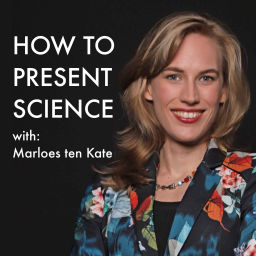
Presentation skills for technical experts and scientists. Get insights and practical tips to ensure your knowledge resonates with your audience and makes impact. Host Marloes ten Kate is a presentation trainer and has trained thousands of speakers worldwide. She is a former science journalist and worked for radio and television programs for the public broadcaster in the Netherlands. She has been a teacher in presentation techniques at the Technical University in Delft and is co-founder of Scientific Storytelling, based in the Netherlands.
Go to www.takethestage.nl to learn more.
Hosted on Acast. See acast.com/privacy (https://acast.com/privacy) for more information.
When you’re presenting, it can feel like your audience is just a wall of motionless eyes, which can be pretty intimidating. You might want to avoid eye contact, but actually creating a genuine connection with your audience is more helpful to reduce your stress levels. In this episode, you’ll learn how to make your presentation feel more like a smooth, relaxed conversation. Whether you’re a beginner or experienced speaker, these tips will help make your talk feel more natural and enjoyable for both you and your audience.
Would you like to enjoy the benefits of one-on-one coaching? Visit takethestage.nl and fill out the contact form!
Hosted on Acast. See acast.com/privacy (https://acast.com/privacy) for more information.
4 Feb 2025
12. Stage anxiety: avoid blackouts
Do you dread the moment when stage fright takes over and your mind goes blank? This episode offers practical strategies to cope with the most stressful moment on stage: the start. Discover how a well-prepared start can set the tone for your entire presentation, learn why memorizing every word might actually work against you, and find out how to end with a strong punchline. These practical tips will help you feel more comfortable on stage.
Would you like to enjoy the benefits of one-on-one coaching? Visit takethestage.nl and fill out the contact form!
Hosted on Acast. See acast.com/privacy (https://acast.com/privacy) for more information.
6 Jan 2025
11. Stage anxiety: how to stay calm
Do you feel nervous when presenting to an audience? Stage fright is a common experience, so you’re certainly not alone. The good news is that your nerves don’t have to hold you back. In fact, you can not only manage your anxiety but even learn to truly enjoy presenting! Discover essential mental and physical strategies to help you deal with those nerve-wracking moments and create an enjoyable experience for both yourself and your audience.
To book training sessions or (online) coaching visit: www.takethestage.nl
Hosted on Acast. See acast.com/privacy (https://acast.com/privacy) for more information.
2 Dec 2024
10. Three engaging ways to start a presentation
Presentation expert [Host Name] shares three engaging ways to start a presentation, leveraging real-world examples to inspire effective science communication.
4 Nov 2024
9. Is jargon providing you status?
Is using jargon giving you more status? Common advice suggests avoiding jargon during presentations, as it can make it harder for your audience to grasp the information. However, some speakers want to signal their expertise. They believe that a presentation lacking jargon may come across as too simplistic and may undermine their credibility. In this podcast, we will discuss the use and function of jargon, focusing on one key question: does it help you gain status?
=== Sources used for this podcast
LinkedIn-poll about status and jargon:
https://l1nk.dev/oUH8e (https://l1nk.dev/oUH8e)
Article about people disliking complex language:
https://neerlandistiek.nl/2022/12/hoger-opgeleiden-hechten-meer-aan-eenvoudige-teksten/ (https://neerlandistiek.nl/2022/12/hoger-opgeleiden-hechten-meer-aan-eenvoudige-teksten/)
Science paper: https://www.aup-online.com/content/journals/10.5117/TVT2022.2.002.MAAT#CIT0031 (https://www.aup-online.com/content/journals/10.5117/TVT2022.2.002.MAAT#CIT0031)
Reading dies in complexity: Online news consumers prefer simple writing
https://www.science.org/doi/10.1126/sciadv.adn2555 (https://www.science.org/doi/10.1126/sciadv.adn2555)
The use of jargon kills people’s interest in science, politics:
https://news.osu.edu/the-use-of-jargon-kills-peoples-interest-in-science-politics/ (https://news.osu.edu/the-use-of-jargon-kills-peoples-interest-in-science-politics/)
Jargon as a barrier to effective science communication: Evidence from metacognition
https://journals.sagepub.com/doi/abs/10.1177/0963662519865687?journalCode=pusa (https://journals.sagepub.com/doi/abs/10.1177/0963662519865687?journalCode=pusa)
Problems with using long words needlessly:
https://onlinelibrary.wiley.com/doi/abs/10.1002/acp.1178 (https://onlinelibrary.wiley.com/doi/abs/10.1002/acp.1178)
Articles about the relationship between low status leads to more jargon:
Authors from lower-status schools included more jargon in their poster titles:
https://journals.aom.org/doi/abs/10.5465/AMPROC.2024.16568abstract (https://journals.aom.org/doi/abs/10.5465/AMPROC.2024.16568abstract)
Archival analyses found a low status → jargon effect across 64 k dissertation titles:
https://www.sciencedirect.com/science/article/abs/pii/S0749597820303666 (https://www.sciencedirect.com/science/article/abs/pii/S0749597820303666)
Hosted on Acast. See acast.com/privacy (https://acast.com/privacy) for more information.
30 Sept 2024
8. Should your story inspire or warn people?
Every good story has a sudden moment of change. It is the most fundamental, important part of any good story. When done properly, this moment underlines the importance of your work. You are able to either inspire people with your message or warn them. For every message and for any kind of information you want to transfer there is a story. In this episode you learn the importance of the so-called ‘motoric moment’ to use storytelling effectively in your communication.
Want to have a session with Marloes ten Kate to brainstorm about your own story? Go to www.scientificstorytelling.org and get in touch!
Hosted on Acast. See acast.com/privacy (https://acast.com/privacy) for more information.
2 Sept 2024
7. The pitfall of trying to reach everyone
Trying to reach "everyone" with your message can be counterproductive. While it’s tempting to create content for a broad audience, doing so can dilute your impact. Instead, discover the power of targeting specific stakeholders with tailored messages to ensure you reach the right people. Whether your goal is to inform, persuade, or inspire, this episode will help you communicate with greater precision and effectiveness!
Need help finding your audience? Reach out to me through www.takethestage.nl (http://www.takethestage.nl)
Hosted on Acast. See acast.com/privacy (https://acast.com/privacy) for more information.
2 Jul 2024
6. The 4 steps to make a story that resonates
Learn how to craft science stories that truly resonate with your audience and align with your goals. You'll cover four essential steps: defining the purpose of your story, ensuring it has a clear key message, finding the right narrative flow, and drawing inspiration from real-life experiences. Through practical guidelines and examples, you'll learn to create compelling and educational narratives that achieve your communication objectives. Whether you're looking to engage the public, educate, or convince people of a certain message, this episode provides the tools you need to make your science stories impactful.
More information: www.scientificstorytelling.org
Hosted on Acast. See acast.com/privacy (https://acast.com/privacy) for more information.
3 Jun 2024
Find the ultimate hero of your story
Delve into the art of storytelling to make science more relatable by choosing the right main character. Discover how to choose the perfect main hero for your narrative. You will learn about the fun side and the potential pitfalls of using non-human entities, such as talking protons, opinionated plants or emotional machines. You may opt to portray yourself as the star of the show. Or go for the viewpoint of someone impacted by your research. Each option has different effects on your audience. Explore techniques for ensuring your science communication captivates and resonates with your audience.
Audio examples:
Once upon a time... Comet landing by European Space Agency (ESA): https://www.esa.int/ESA_Multimedia/Videos/2015/03/Once_upon_a_time_Comet_landing
LHC Noir - Symmetry presents: https://www.symmetrymagazine.org/article/lhc-noir
Hosted on Acast. See acast.com/privacy (https://acast.com/privacy) for more information.
6 May 2024
Craft effective summaries: avoid the pitfall many presenters overlook
A good summary is a very valuable part of every presentation. However, many (even seasoned) speakers provide summaries that are ineffective. In this episode, you will discover a common pitfall observed not only in presentations but also in many reports. Learn a simple technique to create high-quality summaries that serve your audience and make sure they retain the most important information. Using this technique can even enhance the overall quality and flow of your entire presentation.
Hosted on Acast. See acast.com/privacy (https://acast.com/privacy) for more information.
1 Apr 2024
Storytelling: an introduction
As a scientist or science communicator it can be hard to explain your knowledge in a way everyone understands. Storytelling is a great tool to bridge this gap and connect with your audience. It allows you to make your research more accessible and relatable. But what exactly is storytelling? And how does it work when applied in science communication? This episode serves as an introduction to storytelling and offers you techniques that you can apply in your own communication.
Hosted on Acast. See acast.com/privacy (https://acast.com/privacy) for more information.
9 Mar 2024
Great presentations start with the key message
It may sound like weird advice, but a great presentation actually starts with the end. The end of a talk usually is the conclusion or take-home message. By sharing that part already at the start, you are able to create a comprehensible narrative for your audience. In this episode, you will experience the difference it makes. Additionally, you will acquire a specific technique for crafting an effective opening, which can be applied to written communication as well. Not only does this method enhance comprehensibility and logical flow, but it also streamlines the preparation process, ultimately saving you valuable time when preparing a talk.
Hosted on Acast. See acast.com/privacy (https://acast.com/privacy) for more information.
6 Feb 2024
Begin with the end in mind
Before crafting your talk or writing, consider two questions first: What is there to gain for you? What is there to gain for your audience? There are multiple ways to think about this. Doing so will serve as a great guideline for you in designing your communication to achieve the desired results. Even taking just a few minutes to contemplate this will have a significant impact!
More information: www.takethestage.nl
Hosted on Acast. See acast.com/privacy (https://acast.com/privacy) for more information.
Reach and audience
Public platform figures. Ratings count people who left a rating, not total listeners.
Spotify
4.8 / 5
13 ratings
Podcast Authority Score: 13 / 100
A composite of feed quality, social presence, YouTube performance and engagement. Read the methodology.
Quality
13
Social presence
0
YouTube
0
Engagement
32
Contact How to present science
Guest appearances
Books guests
Based on episode analysis; this does not confirm that the show is currently accepting guests.
Host of How to present science?
Claim your podcast to manage its listing and keep your show details accurate.
Pod Engine is an independent podcast discovery and analytics service and is not affiliated with or endorsed by this podcast. Artwork and show content belong to their owners. Full legal notice.
Explore this show Podcast research with Pod Engine