- 17
- Episodes
- Weekly
- Cadence
- 2026
- First episode
About How to Start a Business for Free
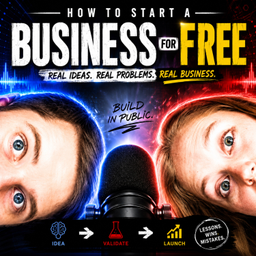
How to Start a Business for Free is a build-in-public podcast documenting the real journey of creating businesses from the ground up using AI, free tools, and relentless problem solving. Each episode follows entrepreneur Derron Amrein as he turns ideas into real companies—sharing the wins, mistakes, pivots, and lessons learned along the way. Instead of talking about entrepreneurship in theory, this podcast shows what it actually looks like to validate ideas, build MVPs, attract customers, develop products, pitch businesses, leverage artificial intelligence, and launch startups with little capital. Whether you’re interested in entrepreneurship, startups, SaaS, AI, product development, small business, no-code tools, marketing, sales, customer validation, or building a business while working a full-time job, you’ll get practical insights you can apply immediately. Current episodes follow the development of Stride Guide, an AI-powered retail platform designed to help independent retailers increase customer traffic, improve retention, train employees, and create more predictable recurring revenue. If you’re looking for honest founder stories instead of overnight success, subscribe and build alongside us. New episodes every week.
- Publisher
- Derron Amrein
- Category
- business
- Language
- en
- Explicit
- No
- First episode
- 18 Jun 2026
- Latest episode
- 20 Oct 2026
Latest episodes
17 episodes in the feed.
20 Oct 2026
Season 2: Volume VII: Don’t Commit to Anyone, Until You Commit To Something
Something changes when your idea starts looking like it might actually work. People start wanting in. They believe in the vision. They can help you scale. They know a team. They want to partner. Sometimes they even offer to work for free. And that can be great. It can also become extremely expensive. Because as the founder, you are already carrying the product risk. You’ve invested the time. The money. The reputation. The learning. The uncertainty. So before somebody gets payroll, equity, access, or influence, I’m learning to ask a much more important question: What have they actually committed? In this episode of How to Start a Business for Free, I’m talking about why enthusiasm isn’t evidence, why “I’ll work for free but you need to pay my team” deserves serious scrutiny, and why the same validation principles I built into RESORSA apply to the people around the company too. Project before partnership. Milestone before equity. Evidence before payroll. And sometimes one of the best due-diligence tools available to a founder is simply saying: “No.” Then watching what happens next. This isn’t about distrusting everyone. The right people can change a company. It’s about letting trust and commitment grow at the same speed as the evidence. Before you commit to anyone, commit to something. The problem. The customer. The work. The evidence. Then make people earn their way into the cap table, payroll, or inner circle. Season 2, Volume VII. Keep building.
12 Oct 2026
Season 2: Volume VI: I Built the Room. Now I Have to Earn the Community
Last week, I said RESORSA needed to focus on activation, retention, and revenue instead of endlessly building more features. So naturally… I built a Discord server. But this one has a purpose. This week, we launched RESORSA’s Discord infrastructure, deployed a dedicated community bot, connected it to R_, and built guided onboarding, project-feedback spaces, resource exchanges, and weekly build sprints. We also connected the community to RESORSA’s acquisition and onboarding experience. The idea? Give builders somewhere to ask questions, exchange feedback, find resources, and make progress together. But there’s a problem. A Discord server isn’t automatically a community. A bot isn’t retention. An invitation isn’t a customer. And building something doesn’t mean anybody needs it. Meanwhile, RESORSA’s External Evidence Layer also took a meaningful step forward, successfully recording a real GitHub ecosystem evidence check inside the Executive Ledger during production testing. In this episode of How to Start a Business for Free, we’re talking about building a community around a product, connecting people to real evidence, and the difference between creating infrastructure and creating actual value. Because I can build the tools. I can automate the workflows. I can create the channels. But I can’t manufacture trust. And that’s the next experiment. Season 2, Volume VI. I Built the Room. Now I Have to Earn the Community. Keep building.
5 Oct 2026
Season 2: Volume V: THE MARKET JUST REWROTE MY ROADMAP
I thought I knew exactly what I was building next. Then four Stride Guide pilot opportunities showed up. Suddenly, a project that had been sitting behind RESORSA moved straight back to the front of the roadmap. But not because it needed more features. It needs to become deployable. There is a massive difference between a prototype that works in development and a product you can hand to a retailer several states away and trust on a real store floor. So Stride Guide’s next chapter is about the unglamorous stuff: Calibration. Reliability. Android deployment. Authentication. Tenant isolation. Remote support. Recovery. Real field data. Meanwhile, RESORSA has almost the opposite problem. The web app is live. The iOS app is live. The backend has passed more than 2,000 tests. I can keep adding features. But the most important questions now are about users. Do they activate? Do they reach value? Do they return? Do they upgrade? Will they pay? So this week I changed the development priorities. Stride Guide gets resources for production readiness. RESORSA gets resources for activation, retention, and revenue. Some other ideas can wait. In this episode of How to Start a Business for Free, we’re talking about why startup roadmaps should never become sacred, what “focus” actually means when the bottleneck changes, and why real evidence should be allowed to completely rewrite what you planned to do next. Because a roadmap is just a hypothesis. The market gets veto power.
28 Sept 2026
Building software by listening for customer pain
Somewhere on the internet right now, somebody is probably describing the exact problem your business is supposed to solve. And most founders will never see it. Last week, I realized RESORSA needed more than a good product. It needed a distribution machine. This week, I started connecting the two. I built Odea. Odea is an admin-only RESORSA workflow designed to find relevant conversations where people are already talking about problems, help me understand and respond to them, and turn useful customer-problem signals back into evidence inside a Build. That last part is the important one. Because distribution shouldn’t just create traffic. It should teach you something. We’re also deliberately not letting Odea run wild. Direct Reddit publishing is disabled. Responses remain supervised. Communities and keywords can be excluded. Opportunities can be skipped. Connections can be paused. And the entire capability has a production kill switch. In this episode, we get into why I’m building Odea, the difference between customer evidence and AI-generated assumptions, and how any founder can use the same strategy without writing a single line of code. Because you probably don’t need another AI-generated customer persona. You need to find the actual person experiencing the problem. They’re already talking. The question is whether you’re listening.
21 Sept 2026
Building RESORSA: S2, Vol. III | Nobody Is Coming to Find Your Product
I spent a lot of time figuring out whether I could build RESORSA. Now I’m running into a completely different problem: How do I get people to actually find it? This week moved RESORSA beyond just product development. I worked on the native iOS app and App Store path while simultaneously experimenting with Google Ads, TikTok, LinkedIn, X, Reddit, Product Hunt, pilot follow-ups, and founder-to-founder knowledge sharing. And somewhere in the middle of it, something clicked. Every startup has to build two products: The thing that creates value. And the machine that gets people to the thing. The dangerous part is that founders can hide inside the first one forever. There is always another feature to add, another bug to fix, another screen to polish. Distribution doesn’t let you hide. People either click or they don’t. They either sign up or they don’t. They either come back or they don’t. And even those signals have to be interpreted correctly. A cheap click isn’t a customer. Traffic isn’t validation. Attention isn’t retention. In this episode of How to Start a Business for Free, we’re getting into the next stage of building RESORSA: treating distribution exactly like product development. Small hypotheses. Cheap experiments. Real evidence. No pretending we know the answer before the customer gives it to us. Because building something people want is only half the job. Nobody is coming to find it for you.
14 Sept 2026
Season 2: Volume II: Letting Real Users Break Your Product
You can write hundreds of automated tests and still build the wrong thing. This week, RESORSA crossed 1,100 passing tests. But the most important test came when a real pilot user created a Build and started putting the system through an actual workflow. Some things worked exactly as intended. R_ challenged assumptions, preserved uncertainty, and pushed toward real customer evidence. Then the user tried to stop. And RESORSA kept pushing. That small interaction exposed something no automated test could: software can function exactly as designed and still create the wrong experience. In Season 2, Volume II of How to Start a Business for Free, we get into pilot testing, customer validation, RESORSA’s evolving Free and PRO model, permanent benefits for its founding pilot users, and why founders need people willing to break their assumptions. The lesson this week is simple: Your pilot isn’t there to prove you were right. It is there to find where you’re wrong while being wrong is still cheap.
9 Sept 2026
Season 2: Volume I: Building RESORSA.ai
Season Two starts with a completely new experiment. While building Stride Guide, I realized something: Information isn’t scarce anymore. Direction is. We have AI, Google, YouTube, Reddit, books, open-source software, and more knowledge available to us than any generation of entrepreneurs before us. But none of that necessarily tells you: What should I actually do next? That problem became RESORSA, an AI-powered platform being built to help entrepreneurs and builders challenge assumptions, gather evidence, validate ideas, use the resources they already have, and determine the next meaningful step. In this episode, we unpack where RESORSA came from, why the lessons from Season One led directly to its creation, and the philosophy behind KNOW / THINK / DON’T KNOW. We also explore a dangerous side of AI: it can be incredibly good at helping you execute an idea without ever asking whether you should be building it in the first place. RESORSA is being built around a different question: “But does this solve the customer’s problem?” There’s just one catch. RESORSA itself is currently an assumption. I THINK builders need this. I THINK the problem is real. I THINK people will use it. Eventually, I THINK people will pay for it. But none of those belong in the KNOW column yet. That’s what Season Two is about. We’re documenting RESORSA as it happens: the pilot testers, feedback, development, costs, mistakes, rejections, pricing, pivots, wins, and eventually whether we can turn this platform into a real business. No retrospective success story. No pretending every decision was part of some master plan. You’re joining while we still don’t know the ending. Season One asked: Can I build it? Season Two asks something much harder: Can we prove it should exist? Welcome to RESORSA. Let’s build.
24 Aug 2026
Volume X: Season Finale | The Real Cost of Starting a Business
Can you actually start a business for free? Five months ago, I set out to find out. I wanted to take a real idea, build it, document the process, and eventually open the books. Ten episodes later, Season One of How to Start a Business for Free is complete. And technically? I failed. Stride Guide didn’t cost $0. But somewhere along the way, I realized $0 was the wrong goal. The better question became: How far can you get before money actually becomes the thing stopping you? This finale is about resourcefulness—using AI, free tools, books, open-source resources, DIY development, experts, cold outreach, experimentation, and relentless learning to find another route when the conventional one costs more than you can afford. We discuss building Stride Guide from a conversation with my dad into an almost-finished MVP involving software, pressure mapping, electronics, a 24×24 sensor architecture, load cells, ESP32 development, PCB design, CAD, customer retention, associate training, lead generation, branding, and more. We also discuss what didn’t work: money spent too early, trademark and patent work, and why some bad expenses become entrepreneurial tuition. One of my favorite examples is our $0 Leads Engine, built rather than immediately paying for another lead-generation platform. But this isn’t about being cheap. Sometimes learning it yourself is resourceful. Sometimes building it yourself is resourceful. And sometimes paying someone who already knows what they’re doing is the most resourceful decision you can make. Season One was: From Idea to MVP. Five months ago, Stride Guide was a conversation. Today, it’s almost a product. But an MVP isn’t a successful business. A prototype isn’t revenue. And customers don’t care how hard I worked to build it. So now the question changes: Will anybody actually want it? Future seasons will document the answer as it happens—the pilots, pricing, customer conversations, rejections, iterations, mistakes, wins, and hopefully our first paying customer. I don’t know where this ends. Neither do you. That’s the point. Season One complete. Keep building.
17 Aug 2026
Volume IX: Look What We Built | From an Idea to an MVP
Five months ago, Stride Guide was a conversation between a father and son about one question: “What’s my value proposition?” Today, it’s becoming a real product. In Volume IX of How to Start a Business for Free, we’re looking backward before the Season One finale. No new framework. No manufactured startup epiphany. Just progress. We examine how a simple business idea evolved through market research, customer discovery, AI, software development, pressure mapping, electronics, ESP32 development, PCB design, CAD, manufacturing research, branding, intellectual-property work, cold outreach, prototypes, and countless iterations into an almost-finished MVP. More importantly, we look at what now exists that didn’t exist five months ago: a business, brand, software, hardware, designs, prototypes, documentation, relationships, systems, content, technical knowledge, and a developing product. This episode also introduces the larger structure behind How to Start a Business for Free. These first ten episodes weren’t the entire journey. They were Season One: From Idea to MVP. The next challenge is completely different: What do you do once you’ve actually built the product? Pilots. Pricing. Sales. Customers. Feedback. Revenue. Iteration. That’s where the next phase begins. But first, there’s unfinished business. In Volume X, we’re opening the books. Actual money invested. Hours. Free resources. Money saved. Cold outreach. Books. AI. Prototypes. Rejections. Wins. The patent application. The expenses worth making, and the ones that weren’t. No hypothetical startup budget. The actual cost of taking Stride Guide from an idea to an MVP. Before you listen to the finale, make your prediction: How much do you think it cost? Follow How to Start a Business for Free for the Season One finale.
10 Aug 2026
Volume VIII: You Don't Have to Know How to Do Everything | AI, Bootstrapping & Knowing When to Hire
Can you really start a business for free? Yes..... but “free” doesn't mean doing everything yourself. In Volume VIII of How to Start a Business for Free, we're tackling one of the hardest decisions entrepreneurs, startup founders, and small business owners face: When should you keep learning and building something yourself, and when should you bring in an expert? While developing the Stride Guide MVP, the project moved deeper into electronics and PCB design. What started as learning about pressure sensors eventually meant understanding ESP32 microcontrollers, multiplexers, circuit architecture, BOMs, Gerber files, component placement, manufacturing requirements, and more. AI made learning those skills dramatically faster. But eventually another realization surfaced: Knowing enough to understand something doesn't mean you should spend the time mastering it. This episode explores bootstrapping, AI-assisted entrepreneurship, opportunity cost, MVP development, outsourcing, product development, hardware startups, and why your time should be treated like startup capital. We also discuss a powerful third option between DIY and outsourcing: Learn enough to intelligently work with someone who knows more than you. You'll hear how AI can help entrepreneurs become better customers of experts, why expensive doesn't automatically mean overpriced, why cheap doesn't necessarily mean valuable, and why founders should understand what they're paying for before writing the check. If you're starting a business, building an MVP, launching a startup, experimenting with SaaS, developing a physical product, using AI to build a business, or trying to bootstrap with limited capital, this episode is for you. We also connect the lessons from the first eight volumes and ask a bigger question: Is one of the most important entrepreneurial skills knowing what you should stop doing yourself? Two episodes remain in Season One. And in Volume X, we're opening the books. Every dollar spent. Every free resource. The prototype components. The domains. The trademark. The patent application. The mistakes. The money saved. And what it actually cost to try to start a business for free. Subscribe and follow the build in real time. Until next week... Keep building.
3 Aug 2026
Volume VII: Analysis Paralysis
How much research is enough before it’s time to build? In this episode of How to Start a Business for Free, I share one of the biggest lessons I’ve learned while building my startup, Stride Guide: there comes a point where research stops helping and starts holding you back. After months of studying entrepreneurship, AI, product development, customer validation, electronics, software, retail, and startup strategy, I realized I wasn’t missing information—I was avoiding the next step. Building. We dive into why entrepreneurs fall into analysis paralysis, how perfectionism quietly kills momentum, and why your first MVP isn’t supposed to impress anyone. It’s supposed to answer questions. If you’re starting a business, building a startup, launching SaaS, developing an AI product, creating an MVP, validating a business idea, or trying to escape the endless cycle of planning, this episode is for you. In this episode: * Why research can become procrastination * The psychology behind analysis paralysis * Building an MVP instead of chasing perfection * Lessons learned while developing Stride Guide * Using AI to accelerate learning and product development * Why founders must fall in love with building—not just learning * How to know when it’s finally time to launch Whether you’re an entrepreneur, founder, small business owner, software developer, engineer, maker, or someone dreaming of starting a business with little or no money, you’ll walk away with practical insights you can apply immediately. Because the only thing better than a perfect idea… is an imperfect product that actually exists. Subscribe for weekly episodes documenting the real journey of building businesses from scratch using AI, free tools, customer validation, and continuous learning. Every episode shares real wins, real mistakes, and real lessons as they happen.
24 Jul 2026
Volume VI: Building Stride Guide for Free
I thought I was building a foot scanner. I wasn’t. Everything changed when my dad, an independent shoe store owner, asked one simple question: “What’s my value proposition?” That question led me down a path that completely transformed my understanding of entrepreneurship. I realized the real problem wasn’t shoe fitting—it was helping retailers create more consistent foot traffic, stronger customer retention, better associate training, and more predictable recurring revenue. In this episode, I share how Stride Guide evolved from a simple idea into a much bigger vision, why I believe entrepreneurs should fall in love with the problem instead of the solution, and the expensive lessons I learned from pursuing trademarks and patents too early. If you’re building a startup, validating a business idea, creating an MVP, or trying to grow a small business, this episode is for you. In this episode: * Why most entrepreneurs solve the wrong problem * How one question changed my entire business * The evolution of Stride Guide * Customer retention vs. customer acquisition * Training employees with AI * Why I now see trademarks and patents as entrepreneurial tuition * The importance of talking to customers before building products If you’re interested in entrepreneurship, startups, AI, SaaS, product development, retail innovation, customer experience, or building a business from scratch, subscribe and follow along as I document every win, mistake, and lesson in real time. Because the best businesses aren’t built by protecting ideas—they’re built by solving real problems.
17 Jul 2026
Volume V: The Value Equation
Most entrepreneurs think they’re selling a product. They’re not. In Volume V of How to Start a Business for Free, we explore one of the most important lessons in business: People don’t buy products. They buy relief. Using a simple brownie-and-milk analogy, we break down why customers willingly pay more to eliminate discomfort, reduce risk, and make their lives easier. From there, we dive into the real value equation—why the market decides what’s valuable, why entrepreneurs are rarely their own customers, and how getting out from behind your own way of thinking can completely change the way you build a business. We also discuss why brainstorming should have no limits, why you should “flip every table” when searching for your value proposition, and how books like The Mom Test, Building a StoryBrand, Traction, and Alex Hormozi’s $100M series helped shape the way I think about creating value. Whether you’re launching your first business, building your next product, or simply trying to understand why people buy what they buy, this episode will challenge the way you think about entrepreneurship. Because businesses don’t make money by selling products. They make money by making someone else’s life a little better.
17 Jul 2026
Volume IV: Standing on the Shoulders of Giants
Some of the best business advice I’ve received didn’t come as an answer. It came as a book recommendation. In Volume IV of How to Start a Business for Free, we explore what it means to stand on the shoulders of giants: learning from people who have already made the mistakes, tested the ideas, and earned the lessons we’re still trying to understand. This episode examines why books can shape our thinking differently than quick videos, podcasts, or AI-generated answers. A good book doesn’t just give you information. It gives you access to years (sometimes decades) of someone else’s experience. We discuss why successful entrepreneurs often point people toward deeper resources instead of shortcuts, how one recommendation can lead to an entirely new way of thinking, and why getting out from behind your own perspective is essential for building something valuable. Along the way, we connect lessons from books that have shaped my business and personal journey, including: The Mom Test Traction Building a StoryBrand $100M Offers and $100M Leads Atomic Habits The Measure of a Man A Guide to Quality Control Friends, Lovers, and the Big Terrible Thing I’m Glad My Mom Died What Color Is Your Parachute? and the Bible. These books cover business, leadership, discipline, quality, addiction, resilience, identity, faith, and personal growth. Together, they reinforce one central lesson: Your greatest investment is not your business. It’s yourself. Businesses can fail. Products can change. Markets can shift. But every lesson you absorb becomes part of the value you carry into whatever you build next. If you’re trying to grow as an entrepreneur, leader, parent, spouse, or person, this episode is an invitation to read more deeply, challenge your assumptions, and borrow wisdom from people who have already walked the road ahead. You don’t have to learn every lesson the hard way. Sometimes, you just need to know which book to open next.
2 Jul 2026
Volume III: Learn Something, Learn Anything
What if the greatest investment you could make in your business cost absolutely nothing? In Volume III of How to Start a Business for Free, we explore why curiosity—not capital—is the ultimate competitive advantage. This episode isn’t about raising money, writing business plans, or finding the perfect idea. It’s about becoming the kind of person who naturally discovers opportunities because you’ve trained yourself to see what others overlook. We discuss why you should learn yourself before you learn business, how observing and helping people reveals hidden opportunities, and why collecting problems is far more valuable than collecting ideas. We also share the story of how a simple decision to learn CAD software unexpectedly led to professional opportunities, and how a personal challenge to start Stride Guide for zero dollars resulted in building an AI-powered lead engine capable of scraping, extracting, organizing, enriching, reasoning over, and prioritizing sales leads—all after roughly 24 hours of focused learning. Along the way, we connect lessons from The Mom Test, Building a StoryBrand, Traction, Alex Hormozi’s frameworks, and Atomic Habits into one practical philosophy: Learn relentlessly. Observe carefully. Help people generously. Solve meaningful problems. Because the businesses that change lives don’t start with brilliant ideas. They start with curious people who refuse to stop learning. If you’ve ever wondered whether you have what it takes to build something meaningful, this episode is for you. One lesson. One problem. One opportunity at a time.
25 Jun 2026
Volume II: Scrappy Beats Rich
In this episode, podcast hosts break down one of the biggest lessons I’ve learned as an entrepreneur: resourcefulness beats resources. We dive into the early days of Kicks-Stand, how I built and tested products with almost no budget, why I walked around the state fair handing out hundreds of prototypes, and the surprising lesson I learned from receiving only three survey responses. They’ll talk about minimum viable products, customer discovery, market validation, gathering meaningful data, and why acting on information is far more important than collecting it. If you’ve ever felt like you don’t have enough money, experience, or connections to start a business, this episode is for you.
18 Jun 2026
Volume I: The Story of the Bounce
Most entrepreneurs think the thing standing between them and success is money. More funding. Better equipment. A bigger budget. But what if the real obstacle is waiting for permission? In this episode of Story of the Bounce, we explore the hidden cost of seeking validation, why so many great ideas never leave the starting line, and how successful builders learn to move before they feel ready. Through personal stories, lessons from business, and hard-earned insights, you’ll discover why action beats approval every time. If you’ve been waiting for the right opportunity, the right connection, or someone to tell you you’re ready—this episode is for you.
Contact How to Start a Business for Free
- Guest appearances
- Does not typically book guests
Based on episode analysis; this does not confirm that the show is currently accepting guests.
Host of How to Start a Business for Free?
Claim your podcast to manage its listing and keep your show details accurate.
Pod Engine is an independent podcast discovery and analytics service and is not affiliated with or endorsed by this podcast. Artwork and show content belong to their owners. Full legal notice.
Explore this show
Podcast research with Pod Engine