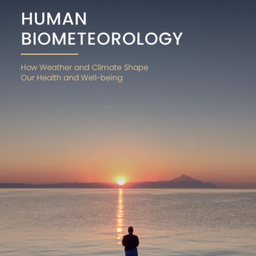
A 9 episdoes Deep Dive AI-generated podcast where hosts discuss the book "Human Biometeorology" written by Andreas Matzarakis
https://matzarakis.4lima.de/humanbiometeorology.htm
Andreas Matzarakis is a bio- and environmental meteorologist at the University of Freiburg. He works on thermal comfort, heat stress and climate adaptation, and develops tools such as RayMan and the modified PET for practical use.
Where the numbers in this book come from, how to find them yourself, and how to tell a reliable source from a confident one. How a finding actually reaches the people who need it, through journalists and broadcasters rather than through journals. What to do with the feeling that follows from knowing all of it. The Biowetter, the daily bulletin that puts everything in this book to work, one region and one day at a time.
23 Oct 2026
8. Climate Change and Action
Climate change has run through every chapter of this book in the paragraphs headed 'In a changing climate'. This part puts it in one place and asks the questions that follow. How does a warming climate actually reach a human being? What do the extremes do, and why do they do it in cascades? What can be avoided, what can only be adapted to, and where does adaptation stop? And finally, the one instrument that turns all of this into something that reaches a person on the day it matters: the heat action plan.
23 Oct 2026
7. Climate as a Resource
Almost everything so far has been about load: heat, cold, radiation, particles, noise. That is the half of the subject that gets funded. It is not all of it. Climate is also something people seek out. They travel for it, they are sent to it by a doctor, they build whole towns on it.
What a healthy climate is, how it has been used as treatment for two hundred years, what happens to the body in thin air, and why the tourist season of half of Europe is quietly moving.
23 Oct 2026
6. Living in Cities
More than half of humanity lives in cities, and the share is still rising. A city is not simply a place where people happen to be; it is a climate of its own, built by accident out of stone, asphalt, geometry and engines. It is warmer than the land around it, especially at night. It is drier. It has less wind and more shadow, and the shadow falls in the wrong places.
What a city does to the air, what happens inside a single street, what a park or a tree is actually worth, what a city does with its rainwater, what people built before there was a word for any of it, and what can be done now.
23 Oct 2026
5. Other Stimuli and Health
Not everything that reaches us through the atmosphere is heat, light or something we breathe. Sound arrives through the same air. Illness follows the seasons. Half the population says the weather can be felt in the body, and the studies find something smaller and less tidy than that. Insects that carry disease move north as the winters soften. And all of it lands unevenly: some people carry far more of the load than others.
23 Oct 2026
4. The Air Pollution Effect Complex
This is the part of the atmosphere that we take inside us. An adult moves something like twelve thousand litres of air through the lungs every day, and whatever is in that air comes with it. Particles, gases, ozone, the smoke and dust that arrive from other continents, the air in our own rooms, and pollen. Unlike heat and radiation, most of what follows is not natural. It was put there, which means it can be taken away again.
23 Oct 2026
3. The Actinic Effect Complex
Radiation does not warm us only. A large part of what the sun does to a body happens chemically, in the skin, in the eyes and in the inner clock, and it happens quietly. The damage of a July afternoon shows up in the evening, or thirty years later. What the sun sends us, and on the part of it — the part we can neither see nor feel — that does the most lasting damage.
23 Oct 2026
2. The Thermal Effect Complex
This is the part of the subject that touches everyone, every day. Heat and cold decide how we sleep, how we work, how the circulation copes and, in the end, how long some of us live. It is the most challenging and most important in the discussion about global warming and human health. How the body exchanges heat with the air around it, how we put that exchange into a number, and then heat, humid heat, cold, the cold stimulus, adaptation, and work.
23 Oct 2026
1. Foundations
Before we can ask what weather and climate do to people, five things need to be clear. What the atmosphere is. What separates weather from climate. Where this field came from. How the climates of the world are characterized. And along which paths the atmosphere actually reaches and reacts with us.
Contact Human Biometeorology by Andreas Matzarakis
Guest appearances
Does not typically book guests
Based on episode analysis; this does not confirm that the show is currently accepting guests.
Host of Human Biometeorology by Andreas Matzarakis?
Claim your podcast to manage its listing and keep your show details accurate.
Pod Engine is an independent podcast discovery and analytics service and is not affiliated with or endorsed by this podcast. Artwork and show content belong to their owners. Full legal notice.
Explore this show Podcast research with Pod Engine