- 12
- Episodes
- 1
- Ratings
- Weekly
- Cadence
- 2026
- First episode
About Humanity Leads
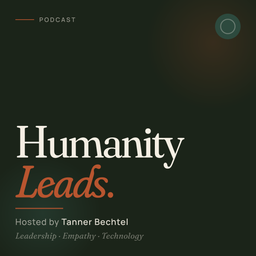
Humanity Leads exists because the leadership conversation got too focused on tools and not enough on people. Founded by Tanner Bechtel — global technology executive and a sought-after voice on empathy, culture, and the human implications of AI — the platform spans a weekly podcast, executive coaching and consulting practice, and a growing archive of essays on leadership and technology. The thesis is simple and stubborn: the next decade of work won't be won by the leaders who automate the most. It will be won by the ones who stay most human while everything around them changes.
- Publisher
- Tanner Bechtel
- Category
- business · technology
- Language
- en
- Explicit
- No
- First episode
- 25 Jun 2026
- Latest episode
- 13 Oct 2026
Latest episodes
12 episodes in the feed.
13 Oct 2026
How to Tell a Failure Story That Makes You More Likable (The Pratfall Effect)
The pratfall effect explains why admitting a mistake can make people trust you more — and how to tell a failure story in 60 seconds without losing credibility. In 1966, psychologist Elliot Aronson found that a brilliant quiz contestant who spilled coffee on himself became more likable. An average contestant who did the same became less likable. That fine print is the whole episode. In part two of the Humanity Leads storytelling series, Tanner Bechtel shows why opening with your wins makes people quietly root against you — and why opening with a healed scar builds trust faster than any success story. You'll learn: - The pratfall effect, and the competence catch almost everyone leaves out - What Harvard Business School research found when successful people shared their failures - Sara Blakely's dinner-table question: "What did you guys fail at this week?" - The Four Lines: what broke, what it cost, what I saw, what I do now - How to answer "Tell me about a time you failed" in a job interview It works in a team meeting, a one-on-one, a job interview, or at the kitchen table. What's one scar you'd be willing to share? One sentence in the comments. RESEARCH MENTIONED - Aronson, Willerman & Floyd (1966), "The effect of a pratfall on increasing interpersonal attractiveness," Psychonomic Science - Brooks et al. (2019), "Mitigating malicious envy: Why successful individuals should reveal their failures," Journal of Experimental Psychology: General - Sara Blakely on her father's dinner-table question (CNBC): https://www.cnbc.com/2019/04/03/self-made-billionaire-spanx-founder-sara-blakely-sold-fax-machines-before-making-it-big.html (https://www.cnbc.com/2019/04/03/self-made-billionaire-spanx-founder-sara-blakely-sold-fax-machines-before-making-it-big.html) - Johannes Haushofer's CV of Failures, inspired by Melanie Stefan's 2010 Nature column (Times Higher Education): https://www.timeshighereducation.com/news/princeton-academics-failure-cv-sparks-debate-success (https://www.timeshighereducation.com/news/princeton-academics-failure-cv-sparks-debate-success) THE STORYTELLING SERIES Part 1 — How to Communicate Better Using Steve Jobs' Rule of Three → https://youtu.be/uiRHZd4MnUY (https://youtu.be/uiRHZd4MnUY) Part 3 — You Are Not the Hero of Your Story → coming next week Subscribe to Humanity Leads with Tanner Bechtel for weekly episodes on leadership, intentional living, and technology worth your time → https://www.youtube.com/channel/UCTtBdPZ5DHO4NdiAiEVbC1w?sub_confirmation=1 (https://www.youtube.com/channel/UCTtBdPZ5DHO4NdiAiEVbC1w?sub_confirmation=1) #HumanityLeads #Leadership #PratfallEffect
7 Oct 2026
How to Communicate Better Using Steve Jobs' Rule of Three
How to communicate better? Steal Steve Jobs' most powerful tool — the rule of three. In this episode of Humanity Leads, Tanner Bechtel breaks down how Steve Jobs used three simple ideas to launch the iMac, introduce the iPhone as three revolutionary products in one, and deliver the unforgettable Steve Jobs speech at Stanford. You'll learn why our brains remember threes, how to simplify any message, and how to use this for public speaking, presentations, and everyday leadership. If you want stronger communication skills, better presentation skills, and messages that actually stick in a world of endless scroll — this is your playbook. What are YOUR three? Drop them in the comments. Subscribe to Humanity Leads with Tanner Bechtel for weekly episodes on leadership, intentional living, and technology worth your time. https://www.youtube.com/@HumanityLeadsHQ (https://www.youtube.com/@HumanityLeadsHQ)
18 Sept 2026
Why Your Explanations Fail (And How to Fix Them)
When someone doesn't understand your explanation, adding more detail can make things worse. Here's how to explain complex ideas clearly without losing the accuracy people need. In this episode of Humanity Leads, Tanner Lee Bechtel draws on Steve Jobs's communication examples to explore a practical leadership skill: giving people a familiar way into a complicated subject. We work through three questions: • What's familiar? • What's different here? • Where does the comparison stop working? You'll learn how to replace jargon with a concrete example, use an analogy without making a false promise, and recognize when a simpler explanation has left out a detail that matters. The goal is to help people understand an idea well enough to question it, contribute their judgment, and use it responsibly. Try this before your next meeting: explain one thing you know well without using its specialist name. Add one limitation your listener needs to understand. Then ask, “What would you expect this to do?” Their answer will show you where to revise. What do you explain often that people still find confusing? Share it in the comments. Subscribe to Humanity Leads for practical conversations about leadership, executive presence, and communicating with care. #CommunicationSkills #ExecutivePresence #Leadership
15 Sept 2026
Why You Ramble in Meetings--and How to Fix It
Learn how to stop rambling in meetings without sounding abrupt or leaving out what matters. If you’ve ever given a good answer—and then kept talking until your point disappeared—this episode is for you. I’m Tanner Bechtel, and this is Humanity Leads. In this episode, we’ll work through practical communication skills that help you give a clear answer, keep the necessary nuance, and recognize when it’s time to let someone else respond. You’ll learn: A simple structure for answering questions: answer, reason, next step. Why a neutral face doesn’t automatically mean you need to explain more. How to be concise while being honest about uncertainty. What to say when you catch yourself rambling. A practice exercise you can try before your next meeting. These communication tips are about making your meaning easier to understand while keeping your warmth and personality. That’s a useful kind of executive presence: people leave the conversation knowing what you meant. What question tends to make your answers longer than you intended? Share yours in the comments—please keep names and workplace details private. Subscribe for more conversations about leadership, communication, and the human side of work: Humanity Leads on YouTube (https://www.youtube.com/channel/UCTtBdPZ5DHO4NdiAiEVbC1w) Follow me on Instagram: @humanityleadsHQ (https://www.instagram.com/humanityleadsHQ/) #CommunicationSkills #ExecutivePresence #HumanityLeads
1 Sept 2026
Never Run Out of Things to Say Again — Just Picture This House
Tanner Bechtel shares a unique approach to engaging in meaningful conversations, using a visual map of six places that typical human conversations can go. Each place represents a different aspect of a person's life, allowing for deeper and more enjoyable conversations and a system of never running out of things to talk about. Takeaways Engage in meaningful conversations by exploring six key areas of a person's life. Listening and genuine curiosity are essential for building real human connections during conversations. Chapters 00:00 The Art of Conversation 03:09 The Visual Map of Conversation 03:40 The House: Home and Origins 04:40 The Chimney: Work and Profession 05:35 The Jet: Travel and Exploration 06:34 The Golf Club: Hobbies and Play 08:03 The Trophy: Accomplishments and Pride 09:30 The Light Bulb: Ideas and Convictions
27 Aug 2026
Experts Series: Agentic AI
The conversation delves into the topics of assurance and observability, the impact of AI on enterprise networking, the role of Model Context Protocol (MCP) in enterprise integration, the future landscape of AI and enterprise, the importance of humanity in the age of AI, fear and opportunity in the age of AI, agentic AI and its applications, learning and leading in the age of AI, and personal leadership and responsibility. Takeaways AI's impact on enterprise networking The importance of humanity in the age of AI Chapters 00:00 Understanding Assurance and Observability 02:34 The Impact of AI on Enterprise Networking 04:28 Model Context Protocol (MCP) and Enterprise Integration 07:45 The Future Landscape of AI and Enterprise 10:18 The Importance of Humanity in the Age of AI 12:06 Fear and Opportunity in the Age of AI 14:51 Agentic AI and its Applications 17:21 Learning and Leading in the Age of AI 20:29 Personal Leadership and Responsibility
18 Aug 2026
The Four Traits of Insecure Leaders
In this episode, Tanner explores the subtle nature of insecurity in leaders and its impact on team dynamics. It delves into behavioral indicators of insecurity, the impact on team dynamics, and the difference between genuine courage and the performance of confidence. The key takeaways include the recognition of insecurity in leaders and the importance of self-awareness in leadership. Takeaways Insecurity in leaders can manifest in subtle and harmful ways Self-awareness and self-doubt are part of leadership, but should not be projected onto the team Chapters 00:00 The Subtle Nature of Insecurity in Leaders 03:02 Behavioral Indicators of Insecurity in Leadership 08:20 Impact of Insecurity on Team Dynamics 12:04 The Difference Between Courage and the Costume of Courage Find Humanity Leads on Youtube, Spotify, Apple Podcasts and wherever else you go for great podcasts.
31 Jul 2026
The Presentation Mistake Smart People Keep Making
The conversation focuses on the art of effective presentation, emphasizing the importance of starting with change, treating the first 90 seconds as valuable attention, creating meaning, distinguishing between slides and the presentation, the role of AI in presentation creation, and ending with a clear ask. Takeaways Start with change Treat the first 90 seconds as expensive borrowed attention Chapters 00:00 Starting with Change 04:40 The First 90 Seconds 05:44 Creating Meaning 06:54 Slides vs. Presentation 08:51 AI in Presentation Creation 10:14 Ending with a Clear Ask
27 Jul 2026
Executive Presence Starts When You Stop Asking Permission
Tanner shares a powerful experience of standing up for his process in the face of opposition, leading to a valuable lesson in executive presence. He emphasizes the importance of calibrated confidence, clear communication, and taking responsibility for recommendations. Takeaways Calibrated confidence Clear communication Chapters 00:00 The Power of Executive Presence 05:35 The Essence of Executive Presence 07:29 The Translator's Mountain 09:24 The Human Side of Leadership 10:22 Practical Application of Presence 11:18 The Language of Confidence 16:43 The Source of Executive Presence 19:10 Becoming Unforgettable 22:03 Taking Responsibility
16 Jul 2026
Treat Your Employees Like Children
In this episode, Tanner explores the challenge of culture change and the science behind behavior learning. It debunks the myth of change failure and emphasizes the importance of modeling and repetition in shaping organizational culture. Takeaways Culture change requires modeling and repetition Behavior is learned through observation Chapters 00:00 The Challenge of Culture Change 03:13 The Science of Behavior Learning 11:04 The Myth of Change Failure 13:24 Culture Watches Behavior 16:45 Modeling and Psychological Safety 19:30 The Power of Repetition Sources: Bandura, Ross & Ross (1961) — Bobo doll (https://www.simplypsychology.org/bobo-doll.html) Carla Shatz coined "fire together, wire together" (https://womenofscienceblog.com/carla-shatz-cells-that-fire-together-wire-together-said-carla-not-hebb/) Mark Hughes (2011) — 70% change-failure myth (https://www.tandfonline.com/doi/abs/10.1080/14697017.2011.630506) Brown & Treviño (2005) — ethical leadership / social learning (https://www.sciencedirect.com/science/article/abs/pii/S0749597805000397) Chartrand & Bargh (1999) — the chameleon effect (https://philpapers.org/rec/CHATCE-6) Sy, Côté & Saavedra (2005) — the contagious leader (https://www-2.rotman.utoronto.ca/~scote/SyetalJAP.pdf) Edmondson (1999) — psychological safety (https://journals.sagepub.com/doi/10.2307/2666999) Google Project Aristotle — re:Work (https://rework.withgoogle.com/intl/en/guides/understand-team-effectiveness) Deci & Ryan — Self-Determination Theory (https://selfdeterminationtheory.org/SDT/documents/2000_RyanDeci_SDT.pdf) Lally et al. (2010) — 66 days to a habit (https://onlinelibrary.wiley.com/doi/10.1002/ejsp.674)
8 Jul 2026
How to Stop Judging People Instantly (The Empathy Map Exercise)
In this episode Tanner delves into the power of empathy and its critical role in leadership, emphasizing the need to understand and connect with others on a deeper level. It highlights the Bart Simpson exercise and the empathy map as tools for cultivating empathy and understanding. The episode also explores the impact of judgment, the iceberg principle, and the distinction between empathy and sympathy. It concludes with a focus on empathy as a practice and the competitive advantage it offers to leaders. Takeaways Empathy is a powerful tool for understanding and connecting with others. Leaders who prioritize empathy and understanding will have a competitive advantage in the age of AI. Chapters 00:00 The Power of Empathy 03:22 The Bart Simpson Exercise 05:15 The Empathy Map 07:32 The Weight of Judgment 10:13 The Iceberg Principle 11:10 Empathy vs. Sympathy 12:22 The Age of AI and Empathy 14:58 Empathy as a Practice 16:37 The Leader's Advantage
25 Jun 2026
The Four Questions
The most effective leadership framework I've ever used, I didn't find in a boardroom. I built it at my kitchen table — for nine-year-olds. Every night at six o'clock, before anyone picked up a fork, my kids knew four questions were coming. I thought I was making dinner. I was building leaders. In this first episode of Humanity Leads, executive coach and 20-year technology leader Tanner Bechtel breaks down a simple, repeatable leadership framework — four questions that quietly build self-awareness, accountability, gratitude, and a genuine instinct to serve. Then he shows why the sharpest leaders ask the same four questions of themselves, their teams, and anyone they're trying to develop. The four questions: What are you most proud of? What would you change? What are you grateful for? What did you do to help someone? The thesis underneath it all: the best leadership frameworks aren't invented in conference rooms — they come from being a good human first. As work gets more automated and more uncertain, the leaders who know how to measure their humanity, not just their output, are the ones this decade will belong to. Your challenge this week: pick one of the four questions and ask it in your next 1:1. Then notice what changes. If this resonated, subscribe and turn on notifications so you don't miss the next episode — and leave a comment with the question you're going to ask first. LISTEN & CONNECT Apple Podcasts: Spotify: Newsletter: Web: humanityleads.com (http://humanityleads.com) Instagram: @HumanityLeadsHQ LinkedIn: #Leadership #ExecutiveCoaching #HumanityLeads
Reach and audience
Public platform figures. Ratings count people who left a rating, not total listeners.
- Apple Podcasts (US)
- 5.0 / 5
- 1 ratings
Contact Humanity Leads
- Guest appearances
- Does not typically book guests
Based on episode analysis; this does not confirm that the show is currently accepting guests.
Host of Humanity Leads?
Claim your podcast to manage its listing and keep your show details accurate.
Pod Engine is an independent podcast discovery and analytics service and is not affiliated with or endorsed by this podcast. Artwork and show content belong to their owners. Full legal notice.
Explore this show
Podcast research with Pod Engine