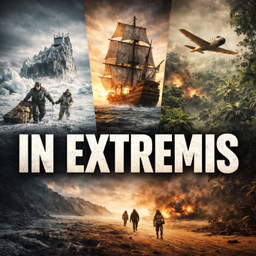
A narrative history podcast about people pushed to the absolute edge. Hosted by Australian author Tom Trumble (Penguin Random House), In Extremis tells longform stories from WWII, the Cold War, and beyond — survival, mutiny, betrayal, leadership under pressure. Military history told as gripping human narrative. Coming soon: Shackleton and Mawson in Antarctica. Nancy Wake — the White Mouse. The assassination of Reinhard Heydrich. The Cuban Missile Crisis. Chernobyl. The Mutiny on the Batavia. Also coming: Amelia Earhart. Vivian Bullwinkel. Captain Richard de Crespigny. The Thai cave rescue.

In Extremis - Stories from the Edge of History
Claim This Podcastby Tom Trumble
Podcast Overview
A narrative history podcast about people pushed to the absolute edge. Hosted by Australian author Tom Trumble (Penguin Random House), In Extremis tells longform stories from WWII, the Cold War, and beyond — survival, mutiny, betrayal, leadership under pressure. Military history told as gripping human narrative. Coming soon: Shackleton and Mawson in Antarctica. Nancy Wake — the White Mouse. The assassination of Reinhard Heydrich. The Cuban Missile Crisis. Chernobyl. The Mutiny on the Batavia. Also coming: Amelia Earhart. Vivian Bullwinkel. Captain Richard de Crespigny. The Thai cave rescue.
Language
🇺🇲
Publishing Since
4/2/2026
Reach the team behind In Extremis - Stories from the Edge of History
Verified contact details for this show aren't on file yet — sign up to get notified when they land.
Recent Episodes

July 17, 2026
The Old Man and the Longest Race - Part 1: The potato farming, gumboot wearing, ultradistance runner.
<p><strong>SHOW NOTES - CLIFF YOUNG EPISODE 1</strong></p><p><strong>The Underdog</strong></p><p>In April 1983, a 61-year-old potato farmer from Beech Forest lined up alongside elite ultramarathoners for the inaugural Westfield Sydney to Melbourne ultramarathon—864 kilometres across Australia. Nobody took him seriously. Except the runners themselves.</p><p>This is the story of how an old bloke in gumboots almost didn't make it through the first night, nearly hit by a semi-trailer and forced to rest on baked beans, setting up one of sport's greatest comebacks.</p><p><strong>PEOPLE</strong></p><ul><li><strong>Cliff Young</strong> – 61-year-old potato farmer, Beech Forest, Victoria</li><li><strong>Siggy Bauer</strong> – 1000-mile record holder</li><li><strong>Robert Bruner</strong> – 200km Sri Chinmoy Festival champion</li><li><strong>George Perdon</strong> – Australian ultradistance runner, Fremantle to Sydney record</li><li><strong>Tony Rafferty</strong> – Irish expat, rival ultramarathoner</li><li><strong>John Hughes</strong> – New Zealand runner, cocky frontrunner</li><li><strong>John Toleman</strong> – Running coach, race organiser</li><li><strong>Martin Noonan</strong> – Westfield marketing executive</li><li><strong>Wally Zunneberg</strong> – Cliff's trainer and support crew</li><li><strong>Mary Young</strong> – Cliff's mother</li></ul><p><strong>TOPICS</strong></p><ul><li>The 1983 Westfield Sydney to Melbourne ultramarathon</li><li>Cliff's failed 1000-mile run attempt (November 1982)</li><li>The water tank incident (January 1983)</li><li>Ultramarathon training and preparation</li><li>Support crews and logistics</li><li>The psychology of the underdog</li><li>Running on the Hume Highway in 1983</li></ul><p><strong>TIMESTAMPS</strong> (approximate)</p><ul><li>0:00 – Opening: Westfield Shopping Centre, April 26, 1983</li><li>3:45 – The field: Siggy Bauer, Robert Bruner, George Perdon, Tony Rafferty</li><li>7:20 – Cliff Young introduced</li><li>10:15 – How the race came to be: Toleman, Perdon, Rafferty rivalry</li><li>15:30 – Martin Noonan's vision</li><li>18:00 – The test run: Noonan and Cliff</li><li>22:15 – The gumboots press conference</li><li>26:00 – The 1000-mile run (November 1982)</li><li>30:15 – The water tank disaster (January 1983)</li><li>34:00 – Race day begins</li><li>36:45 – The mad dash: Hughes, the cracking pace</li><li>38:30 – The semi-trailer near-miss and Wally's alarm mistake</li><li>40:00 – END OF PART 1</li></ul><p><strong>RESOURCES</strong></p><ul><li>"Cliffy: The Cliff Young Story" by Julietta Jameson</li><li>"Cliffy's Book" by Cliff Young</li><p><br></p></ul>

July 1, 2026
The Man Who Saved the World — Part 2: 85 Seconds to Midnight
<p>On the night of September 26th, 1983, Stanislav Petrov stood alone in a Soviet bunker outside Moscow while every alarm in the building screamed that America had launched its missiles.</p><p>He didn't make the call.</p><p>This is the second and final part of the story of the man who may have saved human civilisation.. and was punished for it.</p><p>In this episode:</p><p>What was the Perimeter system — and why did the Soviets build it? The answer reveals everything about how close the world came to automated annihilation, and why the decision that night rested on one man's shoulders rather than a machine's.</p><p>Why was Petrov different from every other officer in that bunker? His upbringing, his education, and the family trauma that shaped him all suggest the system had produced exactly one person capable of doing what he did.</p><p>What happened when he was proved right? A reprimand. </p><p>And what became of Petrov after the Soviet Union collapsed is covered.</p><p><br></p><p><strong>Primary and secondary sources for this episode:</strong></p><p>The principal secondary sources for this episode and its companion are:</p><p><strong>Taylor Downing, </strong><strong>1983: Reagan, Andropov and a World on the Brink</strong><strong> (2018)</strong> — the most comprehensive single-volume account of the 1983 war scare.</p><p><strong>Nate Jones (ed.), </strong><strong>Able Archer 83: The Secret History of the NATO Exercise that Almost Triggered Nuclear War</strong><strong> (2016)</strong> — a collection of declassified primary documents, including CIA assessments, NSA intercepts, and internal NATO communications, assembled by the National Security Archive. </p><p>Additional material drawn from:</p><p>Petrov's own interviews, particularly his 2013 BBC interview on the thirtieth anniversary of the incident, and the 2014 documentary The Man Who Saved the World.</p><p>David Hoffman, The Dead Hand (2009) — Pulitzer Prize-winning account of the Soviet nuclear programme and the 1983 war scare.</p>

June 25, 2026
The Man Who Saved the World — Part 1: Stanislav Petrov and the most dangerous moment of the Cold War
<p>Shortly after midnight on the 27th of September 1983, a forty-four-year-old Soviet military officer named Stanislav Petrov was sitting in a reclining chair in a bunker eighty miles south of Moscow when his early warning system told him that the United States had launched a nuclear missile at the Soviet Union.</p><p>He had minutes to decide whether to believe it.</p><p>This is the first of a two-part episode on Stanislav Petrov and the most dangerous moment of the Cold War that almost nobody has heard of. In this episode we set the scene: who Stanislav Petrov was, what he was doing in that bunker, and why the autumn of 1983 was the most terrifying season of the entire Cold War.</p><p>Along the way we cover:</p><p>The OKO satellite network — the Soviet early warning system that Petrov had helped build, and that he was now being asked to trust with the fate of civilisation.</p><p>The near-misses that preceded 1983 — Vasili Arkhipov and the Soviet submarine B-59 during the Cuban Missile Crisis, the man who refused to authorise a nuclear torpedo launch when his captain was convinced the war had already started. And Zbigniew Brzezinski, who in 1979 got out of bed at 3am and decided not to wake his wife before calling the president to recommend a retaliatory nuclear strike — only to be told, thirty seconds later, that someone had accidentally loaded a training tape into a NORAD computer.</p><p>The state of the world in 1983, Reagan's Evil Empire speech, the Strategic Defense Initiative, the deployment of Pershing II missiles to West Germany, and why the Soviet Union read all of these not as defensive posturing but as the systematic assembly of a first-strike capability.</p><p>Yuri Andropov: the former KGB chief who succeeded Nikita Brezhnev as General Secretary in November 1982. A dying man, conducting the business of running a nuclear superpower from a hospital clinic, connected to a dialysis machine, watching Ronald Reagan describe his country as the focus of evil in the modern world.</p><p>Korean Air Lines Flight 007: shot down by a Soviet interceptor on the 1st of September 1983, killing 269 people including a US Congressman. The event that poisoned an already toxic relationship just weeks before Petrov's night in the bunker.</p><p>And Reagan himself: who despite his bellicose rhetoric was privately horrified by Pentagon officials who believed nuclear war was winnable. "I can't believe that this world can go on beyond our generation," he said in a radio address from Camp David, "without someday some fool or some maniac or some accident triggering the kind of war that is the end of the line for all of us."</p><p>The episode ends where it began — in Serpukhov-15, with Stanislav Petrov staring at a screen that now reads not launch, but missile attack.</p><p>What he does next is the subject of Part 2.</p><p>Content note: this episode contains discussion of nuclear weapons, mass casualty scenarios, and Cold War geopolitical history. No graphic content.</p><p><strong>Primary and secondary sources for this episode:</strong></p><p>The principal secondary sources for this episode and its companion are:</p><p><strong>Taylor Downing, </strong><strong>1983: Reagan, Andropov and a World on the Brink</strong><strong> (2018)</strong> — the most comprehensive single-volume account of the 1983 war scare.</p><p><strong>Nate Jones (ed.), </strong><strong>Able Archer 83: The Secret History of the NATO Exercise that Almost Triggered Nuclear War</strong><strong> (2016)</strong> — a collection of declassified primary documents, including CIA assessments, NSA intercepts, and internal NATO communications, assembled by the National Security Archive. </p><p>Additional material drawn from:</p><p>Petrov's own interviews, particularly his 2013 BBC interview on the thirtieth anniversary of the incident, and the 2014 documentary The Man Who Saved the World.</p><p>The Reagan Presidential Library's archive of public papers and radio addresses.</p><p>David Hoffman, The Dead Hand (2009) — Pulitzer Prize-winning account of the Soviet nuclear programme and the 1983 war scare.</p><p><br></p>
15 total episodes available
Similar Podcasts
Discover related shows you might enjoy

Chanticleer
Australian Financial Review

If You're Listening
ABC Australia

The Grade Cricketer
RARE

The Money Café with Alan Kohler
Intelligent Investor

Bizarre with Mick Molloy and Titus O’Reily
Sport Bizarre

Trapped
Australian War Memorial -Tom Trumble

Ukraine: The Latest
The Telegraph

The Rest Is Politics: US
Goalhanger

The Rest Is History
Goalhanger

We Have Ways of Making You Talk
Goalhanger

The Daily
The New York Times

Heavyweight
Pushkin Industries
Deep-dive analytics for In Extremis - Stories from the Edge of History
Frequently asked questions
Have a different question and can't find the answer you're looking for? Reach out to our support team by sending us an email and we'll get back to you as soon as we can.
- What is In Extremis - Stories from the Edge of History?
- How often does this podcast release new episodes?
This podcast updates daily.
- Where can I listen to this podcast?
This podcast is available on 4 platforms including Apple Podcasts, Spotify, and more. You can also use the RSS feed directly.
- Does this podcast accept guests?
No, this podcast does not typically feature guests.
Legal Disclaimer
Pod Engine is not affiliated with, endorsed by, or officially connected with any of the podcasts displayed on this platform. We operate independently as a podcast discovery and analytics service.
All podcast artwork, thumbnails, and content displayed on this page are the property of their respective owners and are protected by applicable copyright laws. This includes, but is not limited to, podcast cover art, episode artwork, show descriptions, episode titles, transcripts, audio snippets, and any other content originating from the podcast creators or their licensors.
We display this content under fair use principles and/or implied license for the purpose of podcast discovery, information, and commentary. We make no claim of ownership over any podcast content, artwork, or related materials shown on this platform. All trademarks, service marks, and trade names are the property of their respective owners.
While we strive to ensure all content usage is properly authorized, if you are a rights holder and believe your content is being used inappropriately or without proper authorization, please contact us immediately at hey@podengine.ai for prompt review and appropriate action, which may include content removal or proper attribution.
By accessing and using this platform, you acknowledge and agree to respect all applicable copyright laws and intellectual property rights of content owners. Any unauthorized reproduction, distribution, or commercial use of the content displayed on this platform is strictly prohibited.