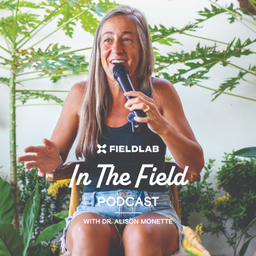
"In The Field," hosted Dr. Alison Monette, ND is where the wisdom of nature meets the language of science — and where the real conversation about human health begins. Made for the curious, lifelong learner, each episode explores relevant health topics through the lens of biophysics and decentralized health, cutting through the noise of centralized medicine to get to the truth of what your body needs. Complex ideas become practical wisdom you can bring into your day — connecting the dots between biophysics, light, and the rhythms that drive true health.

In The Field with Dr. Alison Monette
Claim This Podcastby Fieldlab
Podcast Overview
"In The Field," hosted Dr. Alison Monette, ND is where the wisdom of nature meets the language of science — and where the real conversation about human health begins. Made for the curious, lifelong learner, each episode explores relevant health topics through the lens of biophysics and decentralized health, cutting through the noise of centralized medicine to get to the truth of what your body needs. Complex ideas become practical wisdom you can bring into your day — connecting the dots between biophysics, light, and the rhythms that drive true health.
Language
🇺🇲
Publishing Since
4/20/2026
Reach the team behind In The Field with Dr. Alison Monette
Verified contact details for this show aren't on file yet — sign up to get notified when they land.
Recent Episodes

July 14, 2026
Ep. 013: Movement vs Exercise — What Actually Builds True Health
<p><strong>Does exercise actually make you healthy?</strong> We've been taught that diet and exercise are the foundation of health—but what if that isn't the whole story?</p><p>In this episode, we explore the difference between exercise and movement, why more exercise isn't always better, and how your environment, redox potential, and overall health determine whether exercise supports or depletes your body. We discuss our own journeys from CrossFitters to rethinking what it means to move well, why some people feel worse despite exercising every day, why some people only feel good if they exercise and why movement—not structured workouts—may be a better strategy for building true health.</p><p>If you've ever wondered whether you're exercising for health or simply because you think you should, this conversation will challenge the way you think about exercise, your routine and health more broadly.</p><p>In Part 2, we dive deeper into the biophysics of cellular function, how your response to exercise could be a major clue about your deeper health, the impacts of chronic over-exercising, and best practices for incorporating movement in your day in a way that supports true health. </p><p>If you’d like to hear the Part 2 deep dive discussion, become a member <a href="https://fieldlab.mn.co/plans/1903955?bundle_token=180260f0f3488d6e30a110c55270dd5b&utm_source=manual" target="_blank" rel="noopener noreferer">here</a>.</p><p>[Medical Disclaimer: This podcast is intended for informational and educational purposes only and does not constitute medical, health, or professional advice and no doctor/patient relationship is formed. Any reliance on information provided through the podcast is solely at the user’s own risk. The content of this podcast is not intended to be a substitute for professional medical advice, diagnosis, or treatment. Users should not disregard or delay in obtaining medical advice for any medical condition they may have and should seek the assistance of their health care professionals for any such conditions. If you think you’re having a medical emergency, please contact your healthcare provider or call 911 immediately.]</p>

July 6, 2026
Ep. 012: Food Isn’t Just Fuel — It’s Information
<p>Food is central to the conversation around health in the modern world. </p><p>Within that conversation, food is understood exclusively through the narrow lens of energy, nutrients and biochemistry. A paradigm given to us by many decades of biochemical-based, centralized science.</p><p>To most, this framework may not seem obvious. But consider the language we use to describe food–terms like calories, macronutrients, and micronutrients dominate the discussion. These are all words that describe food through a biochemical, energetic lens. </p><p>The tricky part is that this isn’t wrong. Food has these properties; it contains energy, macronutrients and micronutrients. It does play a role biochemically. But, it’s not the whole story. By stopping at the biochemical, energetic layer and assuming we know all there is to know, we’ve created an understanding of food, health and human function more generally that is entirely insufficient. </p><p>If you’re following along, you know that humans are much more than biochemical machinery. We are biophysical beings built by the decentralized network of nature. The same applies to food and how we utilize it.</p><p>In today’s episode, we are here to push back and expand your perspective on food and health in general. Our bold statement is that food goes beyond energy, macro/micronutrients, and biochemistry.</p><p>Food is information. </p><p>This opens up a whole new conversation about electrons and protons, the mitochondria, redox, timekeeping, circadian function and seasonal eating. To us, this is actually a far, far more interesting way to look at food and brings us much closer to the truth. And we feel confident that you will agree after listening to the conversation.</p><p>In Part 1, break the paradigm of food as a purely energetic, biochemical story. We detail where that idea came from, where it falls short and how to reframe your thinking around food as supporting your deeper health, but not creating it. </p><p>In Part 2, which is available exclusively to Premium members, we hang out at the cell level, looking at food from the perspective of the mitochondria–how they use the information in food to fine tune function, where the information is buried and the practical implications of what and when to eat. </p><p>If you’d like to hear this discussion <a href="https://fieldlab.mn.co/plans/1903955?bundle_token=180260f0f3488d6e30a110c55270dd5b&utm_source=manual" target="_blank" rel="ugc noopener noreferrer">become a member.</a></p><p>[Medical Disclaimer: This podcast is intended for informational and educational purposes only and does not constitute medical, health, or professional advice and no doctor/patient relationship is formed. Any reliance on information provided through the podcast is solely at the user’s own risk. The content of this podcast is not intended to be a substitute for professional medical advice, diagnosis, or treatment. Users should not disregard or delay in obtaining medical advice for any medical condition they may have and should seek the assistance of their health care professionals for any such conditions. If you think you’re having a medical emergency, please contact your healthcare provider or call 911 immediately.]</p>

June 29, 2026
Ep . 011: Do Calories Matter?
<p>Many years and untold sums of money have been spent training people to believe that the following is consensus science: food is the ultimate source of energy and that humans “burn” <strong>calories</strong> to “fuel” the living state. </p><p><br></p><p>We’ve been taught there is a caloric equilibrium–a perfect balance between what is required and what is consumed; taught that there is a universal caloric requirement that never changes; and taught that everything you need to know about food can be found on a nutrition label. </p><p><br></p><p>This has created the widespread belief that an excess of dietary calories will always result in weight gain. By extension, the reverse has to be true: calorie restriction will always equal weight loss. What we've created isn't a model; it's become a culture. Nobody agrees on the “optimal” diet, but everyone seems to agree that calories matter. And our experience in the field supports this reality as patients are constantly asking: How many calories should I consume? </p><p><br></p><p>But patients today aren’t asking because they are curious or trying to be proactive; they are asking because they are frustrated. </p><p><br></p><p>They eat less and less, and restrict more and more. Some see zero change. Others feel worse. And some even gain weight. </p><p><br></p><p>They are confused: isn’t weight loss supposed to be as simple as “calories in, calories out”? When I restricted calories in the past, I always lost weight–what is going on? Do calories actually matter?</p><p><br></p><p>Well, these are the questions we set out to answer in today’s episode.</p><p><br></p><p>Our bold statement is this: creating a calorie culture was a major disservice to our understanding of human function, the role of food and how to maintain or restore health. Biophysically, calories are not a useful model and looking at food and human function purely from an energetic perspective is a half-truth. The mitochondria do not “burn” calories; in fact, they don’t even know what calories are. Food is fundamentally electrons and protons; energy AND information. It’s a much more complicated story than we’ve been given; reducing it to the simplicity of calories isn’t just inaccurate, it could actually be harmful.</p><p><br></p><p>In Part 1, we answer the question everybody is asking right off the bat: do calories matter? We then detail the emergence of the calorie culture; delve into Dr. Alison’s experience with calories as a registered dietitian and naturopath; why calorie restriction once worked; what is at the root of weight gain and obesity; why calorie restriction no longer works; and why it may even be harmful. </p><p><br></p><p>In Part 2, we dive deeper into the biophysics of food going beyond energy into the realm of information theory, elucidating its true purpose; frame weight gain–and subsequently weight loss–through the lens of redox potential; the protective purpose of excess mass, especially in the modern world; and outline a framework for restoring your connection to nature in a way that supports weight loss. This was an amazing discussion and one that we are certain people won’t want to miss. Part 2 is available exclusively to Premium members–to become a member, join here:<a href="https://fieldlab.mn.co/plans/1903955?bundle_token=180260f0f3488d6e30a110c55270dd5b&utm_source=manual" target="_blank" rel="ugc noopener noreferrer">https://fieldlab.mn.co/plans/1903955?bundle_token=180260f0f3488d6e30a110c55270dd5b&utm_source=manual</a></p><p><br></p><p>[Medical Disclaimer: This podcast is intended for informational and educational purposes only and does not constitute medical, health, or professional advice and no doctor/patient relationship is formed. Any reliance on information provided through the podcast is solely at the user’s own risk. The content of this podcast is not intended to be a substitute for professional medical advice, diagnosis, or treatment. Users should not disregard or delay in obtaining medical advice for any medical condition they may have and should seek the assistance of their health care professionals for any such conditions. If you think you’re having a medical emergency, please contact your healthcare provider or call 911 immediately.]</p>
13 total episodes available
Similar Podcasts
Discover related shows you might enjoy
Deep-dive analytics for In The Field with Dr. Alison Monette
Frequently asked questions
Have a different question and can't find the answer you're looking for? Reach out to our support team by sending us an email and we'll get back to you as soon as we can.
- What is In The Field with Dr. Alison Monette?
- How often does this podcast release new episodes?
This podcast updates daily.
- Where can I listen to this podcast?
This podcast is available on 4 platforms including Apple Podcasts, Spotify, and more. You can also use the RSS feed directly.
- Does this podcast accept guests?
No, this podcast does not typically feature guests.
Legal Disclaimer
Pod Engine is not affiliated with, endorsed by, or officially connected with any of the podcasts displayed on this platform. We operate independently as a podcast discovery and analytics service.
All podcast artwork, thumbnails, and content displayed on this page are the property of their respective owners and are protected by applicable copyright laws. This includes, but is not limited to, podcast cover art, episode artwork, show descriptions, episode titles, transcripts, audio snippets, and any other content originating from the podcast creators or their licensors.
We display this content under fair use principles and/or implied license for the purpose of podcast discovery, information, and commentary. We make no claim of ownership over any podcast content, artwork, or related materials shown on this platform. All trademarks, service marks, and trade names are the property of their respective owners.
While we strive to ensure all content usage is properly authorized, if you are a rights holder and believe your content is being used inappropriately or without proper authorization, please contact us immediately at hey@podengine.ai for prompt review and appropriate action, which may include content removal or proper attribution.
By accessing and using this platform, you acknowledge and agree to respect all applicable copyright laws and intellectual property rights of content owners. Any unauthorized reproduction, distribution, or commercial use of the content displayed on this platform is strictly prohibited.