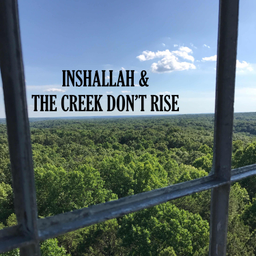
Inshallah & The Creek Don't Rise
Hosted by Inshallah and The Creek Don't Rise · Lyn Rye
5.0from 1 ratings
- 16
- Episodes
- 1
- Ratings
- Monthly
- Cadence
- 2025
- First episode
- 3K
- YouTube views
About Inshallah & The Creek Don't Rise
Exercises in American truth-telling. After all, truth comes before reconciliation. What could truth & reconciliation look like in America? There's a lot of stories that need to be told, stories that often come from "the wrong side of the tracks." Turns out a lot of communities are in crisis. Turns out a lot of our struggles are connected. Turns out, we need each other. A lot. Inshallah & the creek don't rise, we can actually do something about that. Audio & written versions available on Substack. Audio available on all podcast streaming platforms. Video versions are also available at https://www.youtube.com/@lyn_rye_music. lynrye.substack.com (https://lynrye.substack.com?utm_medium=podcast)
- Publisher
- Lyn Rye
- Category
- news · society & culture
- Language
- en
- Explicit
- No
- First episode
- 7 Jan 2025
- Latest episode
- 2 Aug 2026
Latest episodes
16 episodes in the feed.
2 Aug 2026
Notes on Resilience
This essay series often connects stories from different communities in crisis. The question of resilience comes up a lot when talking about crisis. The word can definitely get weaponized, especially by schools and workplaces and recovery programs, particularly against young people growing up in hardship. Living in poverty? You just need to be more resilient. Traumatized? You just need to be more resilient. Resilience has been weaponized to measure the individual against their circumstances, and therefore not being resilient enough becomes a personal failing. Within systems like schools and corporations and clinical spaces, resilience has sometimes become a code word for, “We don’t want to see your suffering.” “Stop being a problem.” “Be easier.” “Need less.” And so, the word resilience has also faced a lot of backlash, especially in progressive spaces and social media. As one organizer friend said during a recent conversation, “The schools in our neighborhood are always ‘resilience this’ and ‘resilience that,’ but has anyone stopped to ask why our kids have to be so resilient? They shouldn’t have to be this resilient. They shouldn’t have to go through the stuff they go through.” However, resilience always returns as an inevitable question during adversity. Many communities and people are going through suffering that is unjust, that they shouldn’t have to face. But how do we survive this? The question can be practical. How do people give their communities the best fighting chance on a day-to-day basis? What does that look like? What does that take? But the question can also be existential. What does it mean to suffer? What are the choices we can make when faced with unimaginable pain? What is the human spirit, where do people find the strength to carry on? In this essay, I would like to propose a concept of resilience that avoids weaponization but does not avoid the inescapable questions we face as humans who suffer. I would like to propose a model of resilience that everyone can participate in, not just the individuals who are the most stoic, tough, long-suffering, or heroic. What if we think of resilience more as the ability to protect the good, rather than the ability to endure the bad? What if resilience is not about your ability to get yelled at without crying, Or get cut without forming a scar. What if resilience is not about your ability to numb any signs of suffering in front of others, Or shrink your needs to fit the size of negligence. What if resilience is not about being able to take abuse without flinching, Or hide the cracks of a broken heart. What if resilience is not the ability to be palatable during adversity, Or give birth without a single stretch mark. What if resilience is not the ability to smile while insulted, Or survive the storm without being weathered. What if resilience is not about suffering the unimaginable and somehow remain unchanged, As if you owed it to the world to hide all of its consequences. What if we accepted that people are not going to make it through unscathed, And are going to bleed, despair, go mad, go quiet. Because these are what the evils of the world do to humans, And no amount of resilience can spare the cost of what is done. What if, instead, resilience is about the ability to protect the good things, The silent sacred things within yourself and the world That need tended. What if resilience is opening the door for neighbors even when you’re having a bad day. What if resilience is still watering the garden on the day of a funeral. What if resilience is still saying “thank you” on a crowded bus. What if resilience is a love called maintenance (https://www.best-poems.net/u-a-fanthorpe/atlas.html) That remembers to change the furnace filters and prune the trees and apply grout To the rickety structures of life that hold us all. Resilience protects the hand that feeds. Resilience protects the heart’s ability to feel. Resilience patches the roof And lets a field lie fallow Every now and then. Resilience is whatever good comes to help When the crying and the scars and the big feelings and the big needs and the flinches and the flashbacks and broken hearts and broken smiles and stretch marks and weather marks All come to light. Resilience is not the absence of consequences and costs. Resilience is the good that comes to meet it. Resilience does not control what wild and wounded guests arrive at the front door. Resilience is the ability to run the guesthouse regardless (https://www.poetry.com/poem/28064/the-guest-house). I used to work with an underground railroad for queer people fleeing Iraq, Afghanistan, and Syria. There was a gay couple from Syria that I worked with for three years. They now live safely in Canada, but their journey was extremely harrowing. They lost family members to the Assad regime and to ISIS. Then some family found out about their relationship and tried to get them killed by falsely reporting them as draft evaders from Assad’s army. They were tortured in a Syrian military prison. One of the men, who I’ll call M., was then forced into military service. After his discharge, the two planned their escape. When they fled across the Turkish border the guards shot at them. They faced homelessness and starvation in Istanbul. When they tried to cross the Mediterranean into Europe, the trafficker manning their boat beheaded someone to show who was in charge. In Greece, M. was captured by a different ring of traffickers and escaped by jumping out of a second story window. The couple spent years in hiding, running from safe house to safe house, before securing a sponsorship in Canada. Some years later, over late night coffee at a cafe in Toronto, I was talking with the couple about courage. M. said, “I’m not brave, I am always the weak one.” I looked at him, stunned. I said, “You’re one of the bravest people I know.” “Really?” he said. “Me?” I met his gaze, this man who had survived war and torture and betrayal and kidnapping and hunger and hiding and running and not knowing whether he would ever be safe again and being told by the world that his sexuality made his life worthless. “Yes, you,” I said. “But I get scared so easily,” he said. “Courage isn’t always the absence of fear,” I said, “sometimes it’s the decisions you make even when you’re scared.” “But I cry at everything,” he said. “The fact that you’re still able to cry after everything that happened to you is nothing short of a miracle,” I replied. This is the kind of resilience I am talking about. Through everything M. suffered, he never lost the good things about him. His softness and gentleness, his gigantic heart, his delicate nature, his sweetness and sass. What he took to be signs of weakness, I took to be signs of success. His fears and tears were not failures, they were merely his humanity showing as he survived the unthinkable. M., who had proven himself capable of both daring feats and steadfast patience, still thought himself weak because he feels so deeply. But in my idea of resilience, he is one of the strongest people I’ve ever met. I currently live and work at a sanctuary house for LGBTQ+ asylum seekers in Chicago. Most food in the house we share communally. This is a practical necessity in a house where people are sharing kitchen space and refrigerators. Sure, everyone can have a couple things just for themselves, labeled with their name in Sharpie, but the basics have to be communal. For years, we upheld our food sharing system with no problem. People in the house came and went, people in the house had their conflicts with each other, but the food sharing held. No matter how bad the conflicts got, people still shared the rice and beans and eggs and milk. Then a group of five guys moved into the house all at once. We had never had so many men in the house before. Some big drama erupted between them and one morning I came into the kitchen to find gallon after gallon of individually labeled milk, carton after carton of individually labeled eggs - the guys had divvied up all the food, refusing to share with each other because they were fighting. This was surprising, petty, and also practically impossible. There is not room in our kitchen for every person to have their own individual gallon of milk. The way I’m thinking about resilience, this group of men was less resilient than all prior groups in the house, not because they had conflict, but because as soon as they had tension they failed to protect the good things that literally fed them. Resilience in this case is not the absence of conflict. It is whether or not the beneficial structures of life come to a sudden, screeching halt when there’s strife. All the previous years in the house showed that it was possible to protect the collective good even while enduring interpersonal troubles. I’d like to think that this is a type of resilience that everyone can participate in. I’d like to think that this type of resilience involves skills that can be taught, learned, practiced, nurtured. You don’t have to be someone who never cries, who never gets mad, who never has a bad day, who hides all your emotions, in order to stay committed to the idea that the big bag of communal rice is for everyone. You don’t have to be at peace with everyone all the time to still use the same bottle of cooking oil. You don’t have to get along with everyone to still maintain the essential rhythms of daily life. So my test of resilience is not how tough and unfeeling can you be - it’s…what does it take to knock you so off course that you can’t even share a container of salt with someone? What kind of stress makes all your good habits go out the window? What kind of stress makes all your good character traits dissolve? During Ramadan I attended a talk led by Muslim Black Panther elders who had spent decades as political prisoners. The elders discussed spiritual preparation for calamity and what it means to be ready for extreme times. One elder told the story of surviving torture in prison, stripped of his clothing, chained to a table, beaten by guards. He recounted how even then, he still prayed salaat. He described how he unnerved the prison guards who were torturing him, how stunned they were that even under these circumstances he refused to give up his daily prayers. By protecting this habit, by protecting this aspect of his character, he made the guards feel less powerful, even for just a moment. My grandfather got into a horrific car accident towards the end of his life. He was seriously debilitated in the wreck and fought an uphill battle to keep living until his body finally gave way. He lost the ability to walk, read, and eventually, eat. During his final struggles, he showed tremendous grace. The healthcare workers who interacted with him frequently described him as their favorite patient. They described how he fought for every scrap of life he could get, refusing to give up despite the odds, and how grateful and kind he was. He showed wonder at the simple pleasures he could still enjoy, namely the company of his loved ones, and reminders of the beauty of the world, like a cut flower, or a sunny day. My grandfather grew up near a watermelon patch and always loved the fruit. When he lost the ability to eat, he cajoled people to give him a little piece of watermelon just to keep on his tongue, just to taste. He would just savor it and smile. Both of these elders passed their tests of resilience with flying colors. Both protected their humanity in the face of suffering and death. Both decided who they were going to be during their worst hours. And who they were was beautiful. They struck awe into the hearts of all who witnessed. Maybe resilience is prayers whispered into cuffed hands. Maybe resilience is the taste of watermelon. Poems referenced: “Atlas” by U.A. Fanthorpe, https://www.best-poems.net/u-a-fanthorpe/atlas.html (https://www.best-poems.net/u-a-fanthorpe/atlas.html) “The Guest House” by Rumi, https://www.poetry.com/poem/28064/the-guest-house (https://www.poetry.com/poem/28064/the-guest-house) Music in the audio version: “Asr” by Lyn Rye, From My Palms Aurora Threads (https://lynrye.bandcamp.com/album/from-my-palms-aurora-threads) This is a public episode. If you would like to discuss this with other subscribers or get access to bonus episodes, visit lynrye.substack.com (https://lynrye.substack.com?utm_medium=podcast&utm_campaign=CTA_1)
3 Jun 2026
Rural Indiana Report-Back
I spent the first 22 years of my life in Indiana. I’ve maintained connections there even since moving to Chicago. For the past three years I’ve attended an annual conference organized by the IU Center for Rural Engagement. The conference brings together people from all disciplines and fields (literally) who are fighting for the well-being of rural and small town Indiana. At this yearly convergence, I’ve met nurses who formed underground networks in counties that lost *all* of their maternal healthcare post-Roe. I’ve met queer organizers from Spencer, Indiana, the smallest town in the U.S. with an LGBTQ+ community center and Pride festival. I’ve met university students collecting oral histories of Black rural elders. I’ve met community members who are sustaining their county’s only women’s recovery house by hunting wild game, growing vegetables, and baking bread. In other words, I’ve met people who are the definition of rural resilience. They rarely get any spotlight. But I think we could all learn something from them. Every conference I’ve attended since 2024 has been deeply impactful. But this year had bite. So much funding has been lost. The state of Indiana has gleefully slashed budgets in tandem with the federal government. An already-patchy safety net has had giant holes punched through it as life continues to get more unaffordable. Can you guess what Indiana’s minimum wage is? It’s $7.25. Yep. You read that correctly. Around 41% of jobs in Indiana don’t pay living wages. What happens when almost half of the employment in the state does not cover basic necessities? Take another guess - how many new data centers have been proposed in Indiana recently? 36. Thirty. Six. Is it all connected? You tell me. The bleak news is nothing new. Rural and small town America have faced challenges for decades. Hundreds of rural hospitals nationwide have closed and roughly 30% more are at risk of closing soon. Over half of all recorded drug overdoses in the U.S.A. have occurred just within the past 5 years, with fentanyl-laced meth being one of the main culprits, hitting rural America especially hard. Rural America often has higher rates of homicide, incarceration, suicide, overdose, and poverty than urban America, despite our society’s obsession with demonizing urban life. Academics and activists speak of this as the rural “sacrifice zone.” Again, nothing new. What is new is that more and more of the country is waking up to the fact that rural America is a frontline. It has been for decades, but our society too often does not pay attention. Our collective neglect has built cover for power to move in the shadows. The zeitgeist may not pay attention to rural America, but Meta and Google sure do. Oil and coal industries sure do. Rare earth mining companies sure do. Cartels sure do. The lifestyle of urban America is maintained in part by the natural resources and labor of rural America. Not only that, people in power rely on having a place where things can be made invisible. Reservations for Indigenous people? The infrastructure of mass incarceration? Pipelines? Nuclear plants? The Silk Road of drug cartels? The scariest environmental degradations? The human trafficking of agricultural labor forces? The roll-back of child labor laws? Cancer rates that should be a “canary in the coal mine” for us all? A nation with lots of skeletons needs a closet. Rural America is too often a place where collective sins get disappeared. Thanks to the amount of media attention towards data centers, more and more people are paying attention to rural areas. However, the media doesn’t always tell the stories of the kind of people you can meet at this yearly conference in rural Indiana. It doesn’t always reflect the decades of experience in rural survival that people are bringing to these most recent fights. I’m no media outlet, but if I can offer any platform whatsoever to highlight how people are fighting back on the frontlines of Indiana, I’ll do it. If we turn away, we do so to our own detriment. Ok, let’s get into it. This is a public episode. If you would like to discuss this with other subscribers or get access to bonus episodes, visit lynrye.substack.com (https://lynrye.substack.com?utm_medium=podcast&utm_campaign=CTA_1)
23 Feb 2026
Projecting 2026
Reflections on what it means to fight a world-building project, and why our stories matter during the fight. At the beginning of last year I released an essay called Projecting 2025. Today I am revisiting that essay and sharing new observations as we move deeper into 2026. We discuss White Christian Nationalism as a world-building project. We discuss the "iceberg" model of conflict and what it means to take responsibility for our own stories floating beneath the water as we fight the good fight. This is a public episode. If you would like to discuss this with other subscribers or get access to bonus episodes, visit lynrye.substack.com (https://lynrye.substack.com?utm_medium=podcast&utm_campaign=CTA_1)
18 Dec 2025
"Truth Comes Before Reconciliation: An Exercise in American Truth-Telling"
On November 7th, the Nebraska Journal on Advancing Justice published an article that I wrote about the history of Nemaha County, Nebraska, where my mother’s family has been farming for six generations. The article explores what local and family history reveal about America and how the future of family farmland in Nemaha County points towards bigger questions about the future of rural America. The article offers its research and storytelling as a model for truth-telling in America on our long, ongoing road to reconciling injustice. The article was the result of 1.5 years of research. I wrote the first draft in the days between Juneteenth and July 4th, 2024, inspired by a quote I read in a book by civil rights leader Reverend William J. Barber II about how this period of days between Juneteenth and July 4th should be time when Americans dedicate themselves to the pursuit of true freedom for all. At first, I just shared the research with my family. But then a family member tipped me off that a journal at the University of Nebraska College of Law was accepting submissions of non-traditional scholarship. I sent a draft to the Nebraska Journal on Advancing Justice the day my maternal grandfather died, November 16th, 2024. We layed him to rest in Nemaha County shortly thereafter. The piece is dedicated to him. I had no idea I was going to submit this research to a law journal when I wrote it and did not format it with legal scholarship in mind. In a profound vote of confidence about the eventual value of the piece, which I’m sincerely grateful for and humbled by, the editorial team at NJAJ worked with me for the entire year to make the research ready for a law journal. Law journals require a citation for (basically) every single sentence and the citation must specify a page number and sometimes even a specific paragraph. The work had well over 100 sources. As you can imagine, going back over the research to make it law-journal-ready was an arduous task. However, I am glad that the work was pored over by a team of lawyers for the last year. In an age of misinformation, it feels significant that this work was picked through with such a fine-toothed comb. This is not a claim that the article therefore contains watertight, objective, and absolute truth. On the contrary, it is a comment the our methodology of assembling stories. We examined every single thread of information using the journal’s standards for evidentiary burden, asking, “does this story really exist in this source the way we’re telling it?” We changed the document many times to reflect new and deeper understandings. We collected photos of physical documents that only exist in local libraries or family archives. We laid out the map: “This story is documented here. This story is documented here.” You could retrace every single one of our steps if you wanted to. The result is what I’ve been calling my “recreational dissertation.” It is a repository for a tremendous amount asking, seeking, thinking, reading, talking, digging, feeling, and writing. I am going to make other media with this material - media that is more conversational, accessible, and bite-sized. But as the research exists in it’s full form, it’s basically a short book. An audio book you can finish on a few commutes. A slim volume about hyperlocal history you’d find at an independent bookstore. Frankly, I think the research itself is a good read. Yes, it’s dense, but at its core, it is just a lot of stories. A local legend who was fabled to rescue people on the Underground Railroad from drowning in the Missouri River? Secret hobo hieroglyphics? Meth moguls? A cameo appearance by Willie Nelson? This history isn’t exactly dry. It is also important. One of the quotes that I include in the article is from a 1965 speech by Dr. Martin Luther King Jr. Dr. King said: “I fear I am integrating my people into a burning house. We are walking into a place that does not understand that this nation needs to be deeply concerned with the plight of the poor and disenfranchised.” In the article I refer to this speech to make the following point: if dominant/white society is a burning house, rural and small town America is where you can smell the smoke. I recently saw a video by a scholar named Dasia Sade (https://www.youtube.com/watch?v=VEtEvnhziPM&t=2527s) in which she references this exact same speech from Dr. King. In her video she states: “The house is on fire, so my culture is water. Water and escape. Resistance or escape. That’s it. The people who understand the importance of our culture being water right now are who I am looking for. That’s where I’m at.” Same. Big same. That’s ultimately the goal of all of this work - building a culture of water in the midst of a burning house. If that goal speaks to you, I hope you consider spending some time with this article. To read the full text, go to this link: https://digitalcommons.unl.edu/njaj/vol2/iss1/4/ (https://digitalcommons.unl.edu/njaj/vol2/iss1/4/) Otherwise, sit back and listen to the full audio version attached to this Substack post and available on Spotify, YouTube, and Apple Podcasts. With gratitude, -L.R. This is a public episode. If you would like to discuss this with other subscribers or get access to bonus episodes, visit lynrye.substack.com (https://lynrye.substack.com?utm_medium=podcast&utm_campaign=CTA_1)
16 Nov 2025
Teargas in Chicago, Cartels in Nebraska
A very 2025 story about the failures of people in power and how urban and rural struggles are connected. This is a public episode. If you would like to discuss this with other subscribers or get access to bonus episodes, visit lynrye.substack.com (https://lynrye.substack.com?utm_medium=podcast&utm_campaign=CTA_1)
14 Sept 2025
I have thoughts about the Charlie Kirk assassination
CONTENT WARNING: Graphic language, descriptions of violence Social media and traditional media alike are buzzing with discourse about the assassination of Charlie Kirk. Most of the discourse I’ve seen seems to focus on Charlie Kirk’s character and hand-wringing about political violence. I see all the signs of classic online discourse - people present their hot take and then defend it against detractors. I have seen very little conversation so far that goes deeper and considers, whatever your hot take is, what is the ethical framework you are using to reach that conclusion? What is the worldview that informs your belief? And how does your position serve some kind of strategy about building the world you would like to see? In other words, the bigger questions about ethics and strategy. I often find that conversations on social media fail to examine ethics and strategy. I think this is one of the reasons why social media discourse frequently fails us, leaving us with in-group jargon and sectarian talking points, but not much of a holistic understanding of our neighbors’ worldviews or strategies to solve problems. I would like to see us collectively discuss: what are the ethical frameworks and worldviews that say the assassination of Charlie Kirk is justified? What are the ethical frameworks and worldviews that say his killing is not justified? I would also like to see us discuss: What is politically strategic about the assassination of Charlie Kirk? And what are the strategic pitfalls of the assassination of Charlie Kirk? I ask these questions not as some sort of intellectual “gotcha.” I don’t have the “right answer” either. This is not me pushing up my glasses and going “well, actually…” I ask these questions because I think they are unfortunately very relevant to our current trajectory as a society. I think we are headed into times where more deadly violence is going to happen. I think we will continue to be in the position of responding to violent attacks and, potentially, weighing whether to participate in violence. I think these are questions that people who are in community with each other should discuss. Whoever’s fate is intertwined with yours when the proverbial s**t hits the fan…we should talk about this stuff. Now. We should start working through some of the differences we have about these issues. I care about ethics and strategy because I think it’s going to matter. In this essay I’d like to offer some potential answers to my own questions, not necessarily as an exposé about my own beliefs, but as examples of what a deeper discussion could yield. Off the top of my head, here are some ethical frameworks or worldviews that might justify the assassination of Charlie Kirk: Let’s start with the “violence against fascists is justified” argument. This is the idea that you cannot defeat fascists with persuasion. Whether the violence is in the future or now, it really only is violence or the adequate threat of violence that reigns them in, so the argument goes. There is the argument that fascism is distinct from most other “political differences” or “differences of opinion.” A comedian and influencer named Mohawk Johnson recently posted a video (https://www.instagram.com/reel/DOhK8XHjdZC/?igsh=MWFyeG92MGdrYzZwZQ==) on Instagram articulating this exact point. Mohawk Johnson states: “Instead of saying ‘Charlie Kirk had ideologies or beliefs that I don’t agree with but that doesn’t mean he deserves to die,’ I want you to say what the beliefs are…Don’t be vague…I want you to hear yourselves. And if you still feel that way, fine. But instead of saying Charlie Kirk had different beliefs, say, ‘Charlie Kirk believed that gay people deserve to be stoned to death, but that doesn’t mean he deserved to die.’ Say that. Type it in the comment section. Type, ‘Charlie Kirk believed that the Civil Rights movement was a mistake, but that doesn’t mean he deserved to die.’ Say, ‘Charlie Kirk said that women aren’t good for anything but breeding and they don’t deserve human rights, but I don’t believe he deserved to die.’ Say the stuff he said. Say, ‘Charlie Kirk believed that it was okay that children died from gun violence, because as long as we got to have the Second Amendment that was the price we have to pay, but I don’t believe he deserved to die.’ Say, ‘Charlie Kirk called for public executions…and said that we should bring children to those executions, but I don’t believe he deserved to die…Say the s**t he said, and if you still believe it, fine. But say what the f**k he believed instead of hiding behind the word ‘belief.’” I don’t know how Mohawk Johnson would describe his own worldview. But there is a worldview which argues that the battle with fascism is not really a “sectarian” conflict, it’s not a conflict between social groups that somehow need to find a way to co-exist in the end. It sees fascism as an existential threat. Now and always. This worldview argues that we need to get over any squeamishness about killing fascists and recognize that it is a justifiable form of violence. This ethical framework says: If you’re okay with “historical” versions of fighting fascism, you need to understand you are living through history right now. Another rise of fascism is here and now. Then there is the “oppressed groups will strike back” argument. This line of thinking goes that if you publicly call for certain groups of people to be harmed or killed, then it should be no surprise if someone is violent towards you as an act of preservation and protection. Threatened people defend themselves. Oppressed people eventually lash out. There’s only so far you can push people until they push back. This is nothing new and no cause for pearl-clutching, so the argument goes. Then there is the argument that “people in positions of power are fair game for political violence.” This ethical framework asserts that “ordinary people” or “civilians” should not be targeted for killing, no matter how abhorrent their personal worldviews are, but people in power are acceptable targets. It’s why someone might believe it is fair game to kill Charlie Kirk but not the college students who came to listen to him. It is the ethical bedrock beneath the idea that even oppressed people have the moral responsibility of picking the right targets for their resistance. Slave owners, imperial officers, politicians, cops, corporate executives, soldiers, prison guards, domestic abusers, militias…these people wield direct power over life and death and therefore their life and death is fair game. This argument does not justify assassination for “thought crimes” but rather for “power crimes.” It’s not so much that a target deserves death for their personal beliefs but rather because of their positions of power. This worldview acknowledges the reality that plenty of oppressed people also hold views that are misogynistic, homophobic, or prejudiced towards another ethnic, religious, or racial group. This worldview holds the ethical line that you don’t kill people for being wrong, you kill them for being powerful and dangerous. And to that point, propagandists are sometimes considered powerful and dangerous, and have been punished for their use of that power, even if their influence over life and death is more indirect. One prominent example is the radio DJs (https://unictr.irmct.org/en/news/three-media-leaders-convicted-genocide) who were successfully prosecuted for their role in the Rwandan genocide. Charlie Kirk could certainly be viewed as something of a radio DJ for white Christian nationalism. Off the top of my head, here are some ways that one might view the assassination of Charlie Kirk as strategic: Some people might believe that it is time to give a warning to fascists, to let them know it is possible to kill them. Others might believe in the strategy of using assassinations to inspire insurrection. This strategy is less about proving a point to the enemy and more so about proving a point to the populace - “You can fight back.” The strategy has historical precedent. Assassinations of imperial officials helped spur decolonization in many countries. Assassinations of British officers in India (https://www.timesnownews.com/lifestyle/people/the-1909-murder-that-shook-the-british-empire-and-changed-indias-freedom-fight-forever-article-152744559) come to mind in particular. But this is also the logic behind the “accelerationist” perspective on the far right. This might be a good moment to mention that the exact political orientation of Charlie Kirk’s assassin is still unclear. Early media reports labelled him as left-wing “antifa” based on what was found written on his bullet casings, but other people have asserted that the bullet casings were references to alt-right memes and that he might be a “groyper (https://legalunitedstates.com/what-is-a-groyper/).” For those who are unfamiliar, “groypers” are a faction of the far right led by influencers like Nick Fuentes, who believe in “accelerating” a race war, and who frequently viewed Charlie Kirk as being too mainstream. We don’t know the killer’s true motives at this point in time, but we can still safely state that multiple political perspectives may view assassinations as a strategy to foment insurrection. Off the top of my head, here are some ethical frameworks and worldviews that might say the assassination of Charlie Kirk is not justified: One such perspective is that “many people deserve to die but we do not deserve to become their executioners.” This is a point of view that I see articulated by death penalty abolitionists in particular. These activists often acknowledge that there will always be crimes so heinous that death feels fair - but do we deserve to become their executioners? As individuals and as a society, do we deserve to take on that moral injury to our own humanity? Earlier this year I had the unique experience of talking down a teenage boy who intended to kidnap and kill the man who raped his mother. Our conversation focused on exactly this point - maybe the man did deserve to die, but the boy did not deserve to become a killer. Thankfully, the boy changed his mind and decided to seek justice and support his mother in other ways. Recently, I was struck by the case of Brian Dorsey (https://www.kcur.org/news/2024-04-10/missouri-executes-brian-dorsey-for-murdering-his-cousin-and-her-husband-in-2006), a man who was executed in Missouri in April of 2024. Dorsey had killed two people in a drug-fueled rage in 2006. He was not innocent. But a diverse array of people, including people who are not ordinarily death penalty abolitionists, advocated for his life to be spared. Apparently he had undergone a transformation in jail to such an extent that prison staff viewed killing him as “pointless cruelty.” The pleas from the prison staff to halt his execution were exactly this argument - “Don’t make us become killers.” This argument also points to the example of Shalom Nagar (https://www.economist.com/obituary/2024/12/11/shalom-nagar-was-picked-by-lottery-to-kill-adolf-eichmann), a man who was the final prison guard and eventual executioner of Adolf Eichmann, one of the primary Nazi architects of the Holocaust. Eichmann did not experience any transformation while imprisoned in Israel and remained unrepentant to the end. But Nagar was still profoundly traumatized by the experience of being his jailer and killer. His bond with Eichmann was bizarrely intimate - Nagar was tasked with eating the first few bites of Eichmann’s food at every meal to make sure Eichmann was not being poisoned. The two spent 24-hour shifts together in incredibly close quarters, usually mere feet away from each other. Nagar, at the age of 26, begged to be spared from the task of executing Eichmann, telling Israeli authorities that he was not capable of hanging anyone, even an unrepentant Nazi. But his superiors made their orders clear, and he was chosen to complete the task. Eichmann refused a blindfold and looked Nagar in the eyes as he pulled the trapdoor. Nagar was then tasked with taking down Eichmann’s body, wrapping it in sheets, and pushing it on a stretcher into an oven for cremation. Taking down the body involved lifting Eichmann’s head which drove trapped air out of the body in a booming cry. Nagar broke down, shaking all over, and was unable to put Eichmann’s body in the oven. The experience gave him nightmares and terrors for years. Not everyone who kills another human being is an executioner. Some people are just survivors. Take the case of Joan Little (https://www.cbsnews.com/news/joan-littles-1975-murder-trial-a-milestone-on-several-fronts/), a Black woman from North Carolina who killed a white prison guard while he was threatening her with an ice pick and sexually assaulting her. Joan Little stood trial for murder in 1975 but was acquitted. Joan Little survived her attack by taking a life, but I suspect the psychological experience was very different from that of a pre-meditated execution. Not all killing creates the same type of moral injury. Even some types of pre-meditated murder do not appear to damage people’s humanity. I think of the teenage girl Nazi assassins during WWII as a prime example. Throughout Europe there were these assassin cells made up of teenage girls that were instrumental in resistance to Nazi occupations, using their easy access to Nazi officials to conduct covert assassinations. When I was in Serbia in 2019, I had the honor of meeting a woman who had been part of one of these teenage girl assassin cells during WWII. Her granddaughter was in the process of interviewing the few teenage girl Nazi assassins who were still alive. These interviews painted a picture that, while the whole of WWII was traumatic, obviously, the act of killing Nazis did not appear to cause the same kind of “moral injury” to these girls as the execution of Eichmann later caused to Shalom Nagar. If I had to guess, I would guess that, even though war involves pre-meditated murder of your opponents, people who face invaders often have moral clarity about the war they are fighting: “these are the enemy combatants, they are armed and dangerous, we have no choice but to fight in order to defend our lives and homes,” etc. etc. etc. War is hell no matter what, but sometimes you don’t have a choice - hell simply arrives on your doorstep. It appears to be a different experience for us humans when we willfully kill a person who is an active threat, compared to when we willfully kill a person who has been neutralized, who stands before us no longer armed and dangerous but instead bound in chains. Things change when a soldier from the battlefield becomes a prisoner of war. Or, as the case may be, perhaps we experience moral injury when we willfully kill a person whose rhetoric calls for violence against others but has never wielded a weapon other than words, a person who is the PR for violence rather than the violence itself. In this worldview, maybe Charlie Kirk did deserve death, but we do not deserve to become his executioners. Maybe the Tucker Carlsons, Glenn Becks, Alex Jones, Rush Limbaughs, and Joe Rogans of the world don’t deserve life, but we do not deserve to carry the burden of their deaths. Another perspective says, yes, some people in positions of power might be fair game for death. But deciding at what proximity to power the penalty of death kicks in is actually extremely difficult, and people who pretend it is simple are fooling themselves. One need only look to revolutions in Cuba, China, Russia, France, and Cambodia to see that many people have grappled with this question: how close did you have to be to power to be purged? No one ideology has asked this question either, this has been a reality faced by all different flavors of regimes and rebellions. Syria seems to be in the middle of asking itself these questions right now with the recent toppling of the Assad regime and the installation of former militants as the ruling party. Truth and reconciliation efforts after wars and genocides have also dealt with these questions - just think of the lengthy reckonings that happened in Rwanda, Bosnia, and Colombia, for example. When a war or genocide sweeps up an entire society, who gets punished and how? Do beliefs and rhetoric count? Or does only the body count count? Which words and which actions are considered crimes? Who is a civilian and who is a combatant? This is a worldview that is able to distinguish between different types of political violence. It is a worldview that can speak to the incredibly human reasons why those teenage girls in WWII had a different experience killing Nazis than Shalom Nagar had in an Israeli prison some decades later. Or why Joan Little was no executioner for killing her rapist, but the teenage boy I spoke to would have become one had he killed his mother’s rapist. This ethical framework or worldview might urge caution - do not believe it is easy to draw the line about who deserves death and who deserves life. Do not hasten putting yourself in that position. Be careful what you wish for. Urge caution when it comes to meting out death. Outside of direct self-defense and “just” war, those decisions can cause tremendous moral injury and trauma, and potentially damage collective humanity when permitted on a large enough scale. Off the top of my head, these are some of the potential strategic pitfalls of the assassination of Charlie Kirk: One argument might be that killing people as a way to try and kill ideas rarely works. This argument might point out that killing the propagandist accomplishes very little unless you topple the “regime” that the propaganda is serving. You cannot kill ideas, you can only defeat oppressors until they no longer have any power to oppress. Sometimes this involves violence, like civil war or revolution. But it doesn’t always take violence to make certain regimes, political parties, or extremist movements crumble. There’s no one way to achieve this tactical defeat, this rendering of a political movement as ineffectual or obsolete. You can’t actually get rid of what they think you can just make sure they don’t have any ability to do, so the argument goes. But in this line of thinking, a person like Charlie Kirk did not have the right type of power for his targeting to be strategic. The power of white Christian nationalism, the ability of that belief system to build an even stronger apparatus of power, has not been altered by Kirk’s death, one might argue. One might argue that killing Charlie Kirk has not hurt their infrastructure of power at all and that their ability to do has not been undercut. This line of thinking also ties into the idea that media personalities and activists who are killed often turn into martyrs. They are often the public face of an ideology, the object for people’s emotional attachment and investment in the cause. Their deaths often play out differently than people in other positions of power, like, perhaps, the CEO of UnitedHealthcare, who almost no one has turned into a martyr. Some also may question the strategy of trying to hasten an insurrection in the U.S., pointing towards arguments that the general population is not organized enough yet for that to make sense. Or who may want to exhaust other strategies before opening the gates to the hell that is war. Those who open those gates can’t always control what comes through. Time to log off Okay, time to put down the phone and go talk to people. I asked the questions I wanted to ask. My own off-the-dome answers to those questions are by no means exhaustive. I hope you can think of plenty more. I also hope that reading this essay has felt different for your heart and body than consuming social media content about this exact same topic. I hope this space was one where you could think and feel freely and where listening was not threatening. My hope is that, no matter where your train of thought is at, you will take it offline and talk with the people who are shoulder-to-shoulder with you. Ethics and strategy matter. Talk about this stuff now. This is not the last we will see of it. — Episode image is undated photo of women Yugoslav Partisans, WWII This is a public episode. If you would like to discuss this with other subscribers or get access to bonus episodes, visit lynrye.substack.com (https://lynrye.substack.com?utm_medium=podcast&utm_campaign=CTA_1)
24 Aug 2025
The Bullet From Behind
A concert I was scheduled to play in Glencoe, IL sparked backlash due to my stances on Palestine. The day of the concert and the aftermath proved an interesting case study in the politics of outrage, conflict, and "the bullet from behind." This is a public episode. If you would like to discuss this with other subscribers or get access to bonus episodes, visit lynrye.substack.com (https://lynrye.substack.com?utm_medium=podcast&utm_campaign=CTA_1)
8 Jun 2025
This Eid I Wore a Crocheted Shawl
Lyn Rye reflects on the Eid Al-Adha story, sharing personal experiences and insights on facing nightmares with pureness of heart, drawing inspiration from Imam Khalifah Williams and Mrs. E.
5 Mar 2025
"please look."
Watch the video version here. (https://www.youtube.com/watch?v=zprGnJwUYcI&feature=youtu.be) Gather around children, it’s story time. [Hi, Sweetpea (the cat).] Okay, story time. So I grew up in a small town in Indiana called Bloomington. And in 1968, I believe, there was a firebombing of a Black-owned bookstore. And after the firebombing, the original owners of the bookstore dedicated the lot where their store had been to become “People's Park.” And they worked with the city to designate the lot as a park that was for the people, by the people, of the people, and wrote it into the deed or agreement to ensure that the People's Park would be open to all people. So, fast forward to my childhood. I grew up during a period of time in Indiana where we were seeing waves of both the meth epidemic and the opioid epidemic. We were also seeing the economic downfall of so much of rural and small town America. We were also seeing nationwide and worldwide wealth inequality get worse. We were also seeing housing crises get worse. I mean, it was everything all at once. And so homelessness in the area skyrocketed. Not only that, but because Bloomington was a university town and hypothetically had more resources, more social organizations, things like that, small towns elsewhere in Indiana would buy people on the street bus tickets and send them to Bloomington. Rather than face their own people who are hurting and suffering within their own communities, they would to send them to Bloomington. But even the resources that we had in Bloomington got overwhelmed, because when the entire state sends people, it wasn't actually a solution. Anyway, unsurprisingly, because People's Park was open to everybody, there were lots of people who lived in People's Park. This wasn't the only place where homelessness was occurring, where there were tents, where there were people living, but People's Park became kind of a focus point. And it also became symbolic because around People's Park there was a bunch of gentrification happening in this university town. People's Park was very close by to the university. And so as we're seeing all of these compounding social crises and homelessness on the rise in Bloomington, People's Park became this area where the state (as in like the city government and the cops, just the government in general) really started to be aggressive about social cleansing. It was sort of like, “we can't have these two things so close to each other,” right? “We can't have this big push at gentrification happening right next to this really high concentration of people hurting in these particular ways.” This was all over town. Encampments started to get swept and the aggression and violence increased, which doesn't solve anything. But the more that people were pushed from place to place in town and kicked out of People's Park, people would get shunted into the woods. But this is where things really turned dark and violent. Because once people were invisibilized in the woods, that's where violence against homeless people really could kick off. And that people could get away with it. And there's been a series of homeless encampments deep in the woods being set on fire. My understanding is that there's a variety of people who have done this. Some off-duty cops and also just some right-wing vigilante types. [Bye, Sweet Pea (the cat).] Yeah, uh pouring accelerant on homeless encampments and setting them on fire in the woods. And as this started to happen, it meant that people understood: once the homeless encampments get successfully broken up in town, the alternative in the woods is so much worse. And so much darker. And people aren't gonna make it out alive. So people increased their defense of homeless encampments in town, resisting sweeps, resisting having the encampments dismantled. And there was a showdown at People's Park - I remember - in 2017, right before I moved away. Where again, people understood this was sort of like the last line of defense. And a prison guard plowed his car through the people who had gathered at People's Park to try to defend it from a sweep. Yeah. He plowed his car through the crowd. He missed me by about that much and took the person right next to me. Thankfully no one was killed. I have told these stories to people in my life in Chicago. People have kind of been surprised and shocked. Not about the whole story, because this happens in Chicago too. Encampments get broken up, homeless people get pushed around all the time. It’s the element of…once you push people into the woods, they become truly invisible. And that this is just a regular thing: that people get pushed into the woods and then set. on. fire. And also people have been really shocked, like, “why hasn't any news covered this? I’m shocked that i've never heard about this!” I’m not shocked. There's so much happening in rural America and small town America that no one is paying attention to. And I didn't even have proof. I didn't even have a news story to point to, to show people in my life in Chicago that this was a real thing, that i wasn't making this up. Until just now. There was a story that was published that was about yet another encampment set on fire on December 18th, 2024. And it had pictures. And I want you all to see this. Please look at this. I've never been able to show people pictures before. But this is what it is. Please just look. I don't know what else to say or to ask. I'm not sure there even is an ask, this is a much bigger thing than all of us. Bu please look. Because you can. Please look. And thank you for listening. Photo credits: Jeremy Hogan/The Bloomingtonian Read the original news story here. (https://bloomingtonian.com/2024/12/19/police-investigate-fire-at-westside-homeless-encampment-believed-to-be-intentionally-set/) This is a public episode. If you would like to discuss this with other subscribers or get access to bonus episodes, visit lynrye.substack.com (https://lynrye.substack.com?utm_medium=podcast&utm_campaign=CTA_1)
3 Mar 2025
A Little Mosque on the Prairie
For those of you who are not familiar, the start date and end date of Ramadan changes from year to year. The Islamic calendar is a little bit different from the Gregorian calendar. In 2025, Ramadan is basically the entire month of March. But it used to be over the summer. Some of you may know I'm a musician. I have done quite a bit of touring. And so there was a period of years where I would frequently be touring during the summer - during Ramadan. And I've toured quite a number of rural areas. So I have found myself in situations where it's time to break my fast and I'm in the middle of…rural North Dakota. For those of you who don't know, usually the first thing that you do to break your fast in Ramadan is eat a date (the fruit) and water. There was this one time on tour where I found myself in the middle of rural North Dakota having to figure out how to break my fast just with what was available at a gas station. And I made the decision that the thing that was the closest to breaking my fast with a date and water was…Twizzlers! I mean, it's wrinkly, it's fruit-flavored (the legal definition of fruit here is a little squishy). So yeah, my North Dakota gas station iftar was Twizzlers and water. The most interesting thing, though, is that I later learned that the very first mosque built in the U.S.A. is in…rural North Dakota. That’s right. Ross, North Dakota, population 89, is home to the very first mosque in America, built in 1929. This claim comes with a little bit of an asterisk. Muslims have been in America for a long time, much longer than 1929. Most were people from West Africa brought to the U.S. as slaves or people from the territories of the Ottoman Empire who immigrated. However, these early Muslim communities generally did not have their own mosques. They congregated in buildings that also had other uses or prayed outside. Ross, North Dakota was definitely not the first place in the U.S. where Muslims congregated for Friday prayers. But the first building to be constructed new, with the express purpose of being a mosque, was indeed in Ross, North Dakota. How did this come about? The answer is: Syrian homesteaders. That’s right, at the turn of the 20th century, a community of Syrian immigrants began to settle in North Dakota, and they built a little mosque on the prairie. This community of people from Syria filed claims under the Homestead Act to receive farmland in North Dakota. Many people from Norway, Germany, Ukraine, and other parts of Europe had been doing the same since the end of the Civil War. However, due to the U.S. government’s institutional racism, Syrians only became eligible for U.S. citizenship in 1909, so Syrian homesteaders arrived to North Dakota later than their European counterparts. The land made available to settlers through the Homestead Act was the result of the mass displacement and death inflicted upon Indigenous peoples. Many people forget that as the U.S. was fighting the Civil War it was simultaneously fighting multiple other wars against Indigenous nations. As the U.S. government claimed victory over the Southern Confederacy it also claimed victory over vast territories of Indigenous land. The federal government passed the Homestead Act in 1862, the railroad companies moved in, and westward expansion accelerated. The Syrian community in North Dakota were a relatively late addition to this westward expansion and one that has largely been forgotten. Very few descendants of the original homesteaders are left in the area. The current Muslim population of North Dakota is estimated to be 540 people, or 0.1% of the state’s population. However, enough descendants retained a connection to Ross that, when the original building of the mosque was torn down in 1979, they raised funds to build a small memorial building in its place. This new building is rarely used for congregational prayer but serves as a museum and visitor’s center for the cemetery that is still maintained on the mosque grounds. Prayer rugs are still available for any visitors who choose to pray. In 2016, a journalist who was covering the fracking boom in North Dakota stumbled upon this mosque and its history and wrote a feature about it in The New Republic. The journalist, Cary Beckwith, remarked at how striking it was to find a forgotten piece of North Dakota’s history while writing about a new chapter in the state’s life, one that was bringing more immigrants than the state had seen in a long time. Beckwith noted that while covering the fracking boom they had heard Spanish, Amharic, Bulgarian, and French Creole - but no Arabic. North Dakota, at the time was one of the states who voiced support for Donald Trump’s proposed “Muslim ban” and the governor of North Dakota had sworn to refuse Syrian refugees in the state. Beckwith documented that some of the workers on the oilfields were unimpressed with the historic mosque nearby, with one worker saying, “Somebody should blow that f****r up.” As of 2025, the mosque is still standing. Google reviews from visitors are overwhelmingly positive, from Muslims and non-Muslims alike, who are touched and delighted to find such an unexpected landmark, learn about its history, and take some time for prayer or reflection. I hope it is still standing the next time I find myself in North Dakota during Ramadan. For me, it is a reminder of how disconnected most of us are from the history of the land where we live, and how much of that history is rural. To me, this little mosque in Ross, North Dakota is a reminder that rural America can be such a sign post, pointing to things past, things present, and things yet to come - for those who are willing to notice. SOURCES: https://newrepublic.com/article/128726/north-dakota-prairie-became-home-americas-first-mosque (https://newrepublic.com/article/128726/north-dakota-prairie-became-home-americas-first-mosque) https://www.atlasobscura.com/places/oldest-mosque-in-the-united-states (https://www.atlasobscura.com/places/oldest-mosque-in-the-united-states) https://news.prairiepublic.org/show/dakota-datebook-archive/2022-05-02/first-mosque (https://news.prairiepublic.org/show/dakota-datebook-archive/2022-05-02/first-mosque) https://worldpopulationreview.com/state-rankings/muslim-population-by-state (https://worldpopulationreview.com/state-rankings/muslim-population-by-state) https://worldpopulationreview.com/us-cities/north-dakota/ross (https://worldpopulationreview.com/us-cities/north-dakota/ross) This is a public episode. If you would like to discuss this with other subscribers or get access to bonus episodes, visit lynrye.substack.com (https://lynrye.substack.com?utm_medium=podcast&utm_campaign=CTA_1)
8 Jan 2025
Inshallah & The Creek Don't Rise: An Introduction
Lynrye hosts the conversation on 'Inshallah & The Creek Don't Rise', exploring the intersection of spirituality and personal growth with a focus on finding inner peace in uncertain times.
7 Jan 2025
Projecting 2025
Hosts Ali Abunimah and Dena Takruri explore the complex geopolitical landscape of the Middle East in 2025, shedding light on the key trends and implications for the region's future.
7 Jan 2025
Understanding Rural America: A Zine
Inshallah & The Creek Don't Rise host [name] explores the complexities of rural America through the lens of a zine, shedding light on the often-overlooked perspectives of rural communities.
7 Jan 2025
Wilmington, 1898
Historian and author, Lynne Rae Johnson, delves into the tumultuous events of Wilmington, 1898, revealing the hidden stories and lasting impact of that pivotal moment in American history.
7 Jan 2025
AEAB (All Empires Are Barmy)
Hosts Lynrye and guests share insights on the cyclical nature of empires and the importance of humility in leadership, exploring the consequences of unchecked ambition and the value of self-awareness.
7 Jan 2025
Be the means
Lynrye explores how her spiritual journey and community involvement inspire personal growth and resilience in the face of adversity, empowering listeners to find their own path to transformation.
Reach and audience
Public platform figures. Ratings count people who left a rating, not total listeners.
- YouTube views
- 3,338
- Score snapshot 15 Sept 2025
- Apple Podcasts (US)
- 5.0 / 5
- 1 ratings
Podcast Authority Score: 33 / 100
A composite of feed quality, social presence, YouTube performance and engagement. Read the methodology.
- Quality
- 39
- Social presence
- 0
- YouTube
- 68
- Engagement
- 0
Contact Inshallah & The Creek Don't Rise
- Guest appearances
- Does not typically book guests
Based on episode analysis; this does not confirm that the show is currently accepting guests.
Questions about Inshallah & The Creek Don't Rise
Who hosts Inshallah & The Creek Don't Rise?
Inshallah and The Creek Don't Rise host the show. Published by Lyn Rye.
How often do new episodes come out?
The show publishes monthly, based on its RSS feed.
Does Inshallah & The Creek Don't Rise take guests?
The show does not typically feature guests, based on episode analyses.
Host of Inshallah & The Creek Don't Rise?
Claim your podcast to manage its listing and keep your show details accurate.
Pod Engine is an independent podcast discovery and analytics service and is not affiliated with or endorsed by this podcast. Artwork and show content belong to their owners. Full legal notice.
Explore this show
Podcast research with Pod Engine