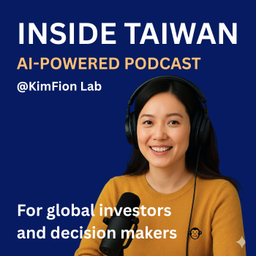
Inside Taiwan distills 200 stories a day from over 30 trusted Traditional Chinese and English sources into a ten-minute executive briefing on semiconductors, AI, and energy, shaping the world’s most valuable supply chain. It’s an AI-powered signal over noise for global investors and decision-makers. New episodes every Monday to Thursday, weekly.

Inside Taiwan
Claim This Podcastby KimFion Lab
Podcast Overview
Inside Taiwan distills 200 stories a day from over 30 trusted Traditional Chinese and English sources into a ten-minute executive briefing on semiconductors, AI, and energy, shaping the world’s most valuable supply chain. It’s an AI-powered signal over noise for global investors and decision-makers. New episodes every Monday to Thursday, weekly.
Language
🇺🇲
Publishing Since
10/6/2025
1 verified contact email on file for Inside Taiwan
Pitch yourself as a guest, propose sponsorships, or reach out directly to the host.
Recent Episodes

January 29, 2026
Why Is The Global AI War Now A Battle Of 'Ferrari vs. Prius'?
<p>Why Is The Global AI War Now A Battle Of 'Ferrari vs. Prius'?</p><p>This episode of Inside Taiwan analyzes the new Pax Silica alliance between the U.S. and Taiwan and Jensen Huang’s updates on Nvidia operations. We examine the shift in investor sentiment toward AI monetization, the looming memory chip shortage reported by SK Hynix, and China’s energy-backed strategy to bypass export controls.</p><p>What is the Pax Silica declaration regarding the semiconductor supply chain?<br>It is a bilateral agreement to secure the chip industry against geopolitical risks. The U.S. State Department designated Taiwan a vital partner. Taiwanese companies plan to invest $250 billion in the U.S. while American firms like Nvidia and Micron are investing over $15 billion in Taiwan.</p><p>Did Nvidia confirm new AI chip orders from Chinese tech giants?<br>No. CEO Jensen Huang confirmed that reports of H200 orders from Alibaba and ByteDance are fake news. He stated the chip is waiting for regulatory approval in Beijing. Nvidia is instead focusing on Taiwan with a new $105 million headquarters approved by the Ministry of Economic Affairs.</p><p>Why are investors reacting differently to Meta and Microsoft AI spending?<br>Wall Street now demands immediate revenue from AI investments. Meta stock jumped nearly 20 percent because AI improved ad targeting revenue. Microsoft stock fell because investors did not see a quick enough payoff from its heavy spending on OpenAI and supercomputers.</p><p>How does the AI boom affect the global supply of memory chips?<br>A shortage of standard chips is emerging. Samsung and SK Hynix are converting production lines to make high-bandwidth memory for AI servers. SK Hynix reported that PC and smartphone manufacturers are finding it difficult to secure standard DRAM components.</p><p>What is the impact of data center expansion on industrial power equipment?<br>Demand for backup power is surging. Caterpillar reported a 23 percent increase in sales for generator sets driven by data center construction. This AI-driven demand is helping the industrial giant offset trade headwinds in other sectors.</p><p>How is China circumventing U.S. restrictions on advanced AI hardware?<br>China is adopting a brute force strategy using domestic chips and massive energy supplies. They are also exporting efficient software models like Deepseek to global markets. This creates an alternative ecosystem for countries that do not require top-tier U.S. hardware.</p><p>Listen to the full analysis on the Inside Taiwan podcast.</p>

January 28, 2026
Why Are Memory Makers Suddenly Holding the Cards in AI’s Next Chapter?
<p>How can investors map the AI empire being built through chips, power grids, and policy?</p><p>Inside Taiwan tracks the physical foundations of AI: chip export rules, China’s self-sufficiency push, Intel’s 18A manufacturing test, OpenAI’s government data center strategy, and the looming power crunch, globally. We also examine a new lawsuit over AI hiring scores and what it signals about trust, transparency, and control right now.</p><p>Q1. What is the AI Overwatch Act, and what would it change if enacted?<br>It would give Congress a 30-day window to review and potentially block licenses for exporting advanced AI chips to China and other adversaries. The committee advanced it by 42-2, and the latest version also bans Nvidia’s top-end Blackwell chips.</p><p>Q2. What should investors watch in the Nvidia H200 export debate?<br>Watch policy volatility and enforcement friction. The U.S. approval framework is now contested politically, and reported Chinese customs uncertainty shows how “allowed” can still mean delayed, constrained, or repriced in practice.</p><p>Q3. What does Alibaba’s reported T-Head IPO preparation signal for China’s chip ecosystem?<br>Alibaba is reportedly preparing to restructure T-Head, including partial employee ownership, before exploring an IPO. For investors, it is a signal that China is mobilizing capital markets to accelerate domestic chip design across data center, AI, and IoT processors.</p><p>Q4. What is the investor-grade read on Intel’s Panther Lake and “18A”?<br>This is a manufacturing execution story. Intel has acknowledged yield challenges and says yields are improving monthly. The key is whether improving yields translate into competitive cost, reliable volume, and credible foundry traction versus leading incumbents.</p><p>Q5. What are the two constraints investors should treat as non-negotiable: energy and trust?<br>Energy is the hard ceiling: one industry estimate projects data center electricity use could more than double from about 460 TWh (2022) to over 1,000 TWh by 2026. Trust is the hard floor: a lawsuit alleges Eightfold AI created secret applicant “scores” without proper disclosures, highlighting rising legal and compliance costs for AI adoption.</p><p>【About the Show】Inside Taiwan distills 200 stories a day from over 30 trusted Traditional Chinese and English sources into a ten-minute executive briefing. It’s an AI-powered signal over noise for global investors and decision-makers navigating the world’s most valuable supply chain. New episodes every Monday to Thursday, weekly.</p>

January 22, 2026
How can investors map the AI empire being built through chips, power grids, and policy?
<p>How can investors map the AI empire being built through chips, power grids, and policy?</p><p>Inside Taiwan tracks the physical foundations of AI: chip export rules, China’s self-sufficiency push, Intel’s 18A manufacturing test, OpenAI’s government data center strategy, and the looming power crunch, globally. We also examine a new lawsuit over AI hiring scores and what it signals about trust, transparency, and control right now.</p><p>Q1. What is the AI Overwatch Act, and what would it change if enacted?<br>It would give Congress a 30-day window to review and potentially block licenses for exporting advanced AI chips to China and other adversaries. The committee advanced it by 42-2, and the latest version also bans Nvidia’s top-end Blackwell chips.</p><p>Q2. What should investors watch in the Nvidia H200 export debate?<br>Watch policy volatility and enforcement friction. The U.S. approval framework is now contested politically, and reported Chinese customs uncertainty shows how “allowed” can still mean delayed, constrained, or repriced in practice.</p><p>Q3. What does Alibaba’s reported T-Head IPO preparation signal for China’s chip ecosystem?<br>Alibaba is reportedly preparing to restructure T-Head, including partial employee ownership, before exploring an IPO. For investors, it is a signal that China is mobilizing capital markets to accelerate domestic chip design across data center, AI, and IoT processors.</p><p>Q4. What is the investor-grade read on Intel’s Panther Lake and “18A”?<br>This is a manufacturing execution story. Intel has acknowledged yield challenges and says yields are improving monthly. The key is whether improving yields translate into competitive cost, reliable volume, and credible foundry traction versus leading incumbents.</p><p>Q5. What are the two constraints investors should treat as non-negotiable: energy and trust?<br>Energy is the hard ceiling: one industry estimate projects data center electricity use could more than double from about 460 TWh (2022) to over 1,000 TWh by 2026. Trust is the hard floor: a lawsuit alleges Eightfold AI created secret applicant “scores” without proper disclosures, highlighting rising legal and compliance costs for AI adoption.</p>
66 total episodes available
Deep-dive analytics for Inside Taiwan
Frequently asked questions
Have a different question and can't find the answer you're looking for? Reach out to our support team by sending us an email and we'll get back to you as soon as we can.
- What is Inside Taiwan?
- How often does this podcast release new episodes?
This podcast updates daily.
- Where can I listen to this podcast?
This podcast is available on 4 platforms including Apple Podcasts, Spotify, and more. You can also use the RSS feed directly.
- Does this podcast accept guests?
No, this podcast does not typically feature guests.
Legal Disclaimer
Pod Engine is not affiliated with, endorsed by, or officially connected with any of the podcasts displayed on this platform. We operate independently as a podcast discovery and analytics service.
All podcast artwork, thumbnails, and content displayed on this page are the property of their respective owners and are protected by applicable copyright laws. This includes, but is not limited to, podcast cover art, episode artwork, show descriptions, episode titles, transcripts, audio snippets, and any other content originating from the podcast creators or their licensors.
We display this content under fair use principles and/or implied license for the purpose of podcast discovery, information, and commentary. We make no claim of ownership over any podcast content, artwork, or related materials shown on this platform. All trademarks, service marks, and trade names are the property of their respective owners.
While we strive to ensure all content usage is properly authorized, if you are a rights holder and believe your content is being used inappropriately or without proper authorization, please contact us immediately at hey@podengine.ai for prompt review and appropriate action, which may include content removal or proper attribution.
By accessing and using this platform, you acknowledge and agree to respect all applicable copyright laws and intellectual property rights of content owners. Any unauthorized reproduction, distribution, or commercial use of the content displayed on this platform is strictly prohibited.
