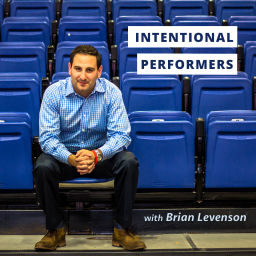
Podcast thumbnail for Intentional Performers

Intentional Performers

Claim This Podcast

by Brian Levenson

5.0(4 reviews)
399 episodes
Updated Weekly
Accepts GuestsHas SponsorsLocation 🇺🇸

Podcast Overview

I created this podcast because I believe that much can be learned from digging deep with intentional performers. You can learn more about me and my company at www.strongskills.co.

Language

🇺🇲

Publishing Since

1/1/2017

1 verified contact email on file for Intentional Performers

Pitch yourself as a guest, propose sponsorships, or reach out directly to the host.

Recent Episodes

Episode thumbnail for Goodbye for Now, Grateful Forever

November 13, 2024

Goodbye for Now, Grateful Forever

Episode thumbnail for Tanya Vogel on Creating a Culture of Community

November 6, 2024

Tanya Vogel on Creating a Culture of Community

Tanya Vogel has had quite a career in athletics and she’s kind of just getting started with her impact and influence in not just athletics, but beyond it as well. She’s been a distinguished leader in collegiate athletics for nearly 3 decades. Recently, she concluded her tenure as the Director of Athletics at George Washington University; she served in that position for 7 years. Her journey at GW began in 1992 as a student and All-American soccer player. She’s in GW’s hall of fame and she earned multiple degrees at GW including a BS, and MS, and an MBA. So, Tanya is a learner, which is going to be the core of today’s conversation; she loves to learn, she loves to grow. Additionally, she was recognized for her playing career becoming the first women’s soccer player to be inducted into the GW athletic hall of fame in 2002. She became their head coach at the age of 25. So, Tanya at GW is certainly an icon and somebody that the Athletic Department for a long time has looked to for leadership as a player, as a coach, and as an athletic director. In that athletic director capacity, she cultivated a culture of excellence resulting in 19 conference championships and a cumulative GPA of 3.62 among student athletes. One of the things that’s going to be abundantly clear in today’s conversation is that Tanya is a competitor; she loves to win, and she cares deeply about human beings and developing them and cultivating them and pouring into student athletes. She’s a recognized national figure; she’s served on key NCAA committees and chaired the Atlantic 10 Athletic Director’s Council. She’s also a graduate of the Georgetown Transformational Leadership Coaching Program and she’s an ICF certified coach. We’ll talk a little bit about her journey to becoming an executive coach, and I may have actually played a small part in that journey and maybe a spark to have her explore that journey. In addition to her coaching practice, she serves as a consultant for the Pictor Group, which helps her continue her commitment to leadership and organizational development, specifically within the athletic world. So, Tanya is a competitor, she’s a leader, she’s a coach, she’s been essentially the CEO of an athletic department (that’s what the role of an athletic director is), and she has seen just about everything when it comes to collegiate athletics. So, this is a conversation about culture, this is a conversation about leadership, this is a conversation about mindset, and most of all it’s a conversation of two friends chopping it up and chatting about what they’re passionate about, which is people. Tanya had a number of amazing insights during our conversation. Some of them include: “I don’t make too many decisions without processing, without thinking through things” (8:05). “I felt like I took [George Washington athletics] about as far as I could take it” (10:00). “I feel like comfort and discomfort overlap” (12:35). “I’m comfortable in discomfort, and I can be uncomfortable in comfort” (13:35). “Our competitive advantage is going to be seen in how we treat one another” (14:55). “Culture is people” (22:30). “It can’t just be high fives and I love you” (25:30). “Confidence and motivation come from within” (27:30). “Just be insanely curious” (28:05). “I work really hard to gather the data and do the research” (32:10). “When you’re a head coach, you’re not going to be liked” (34:20). “Leadership is not about being liked” (34:40). “Every job I’ve gotten is by somebody that’s known me” (40:30). “Be great where you’re at” (42:05). “Mentors play a huge role in our growth and development, but advocates are key [too]” (47:15). “Genuinely, most people want to feel useful” (55:55). “I have this burning desire to go into the grave still learning; I just want to do that forever” (1:01:45). “94% of women in the C-Suite have competed in athletics” (1:08:55). Additionally, you can find the Ripple Impact website here and connect with Tanya on LinkedIn. Thank you

Episode thumbnail for Joe Quitoni on Creating a Cultural Vibe

October 30, 2024

Joe Quitoni on Creating a Cultural Vibe

Joe Quitoni is the Founder and CEO of Unify Align. Unify Align collaborates with clients to reimagine the people and customer experience, delivering real-world solutions that supercharge business growth. Joe knows a thing or two about collaborating with clients, specifically around people and customer experience. Throughout his career, he has used his skills in organizational transformation to create game-changing advantages for some of the world’s biggest brands. Before starting Unify Align, he put in over 20 years at the Ritz Carlton hotel company, where he served as the Director of Human Resources before jumping over to the brand’s consulting firm, The Ritz Carlton Leadership Center, where he led the team as Global Head of Delivery. For those unfamiliar with what they do at The Ritz Carlton when it comes to the leadership center, think of it similarly to what Disney does; both of these organizations are known for customer service, so they actually train other businesses and other organizations on how they can serve. So, certainly if you’ve ever been to a Ritz Carlton, you have a sense of what the vibe is there. We’re going to talk about vibe quite a bit in today’s conversation. When he was working at Ritz Carlton, he transformed and evolved their approach and methodology, which created dramatic positive impact to the clients and businesses that they served. But Joe isn’t your typical corporate suit; he is someone who is unique in the way he thinks and how he delivers information. He brings a modern twist to the world of consulting; he’s armed with a Master of Science in Industrial/Organizational Psychology and applies an innovative methodology to his work, where he delivers successful outcomes for a diverse portfolio of companies and clients. We’ve talked offline about some of those; they are truly remarkable. He works with startups, he works with Fortune 500 giants, he’s even worked with sports organizations, and he is someone who cares deeply about leadership, connection, inspiration, motivation, and really thinks about how an environment, how a vibe, how a culture, can drive not just customer experience, but employee experience as well. He’s known for his keynote speeches, which is actually how I found him, and also working alongside all kinds of different leaders inside organizations to ultimately help them develop what he calls “a very intentional vibe.” Joe had a number of amazing insights during our conversation. Some of them include: “This word culture has been around for decades, but we have evolved tremendously as a society” (6:55). “The simplest way you can define culture is it’s everything in the environment” (7:20). “This word ‘vibe’ is… the energy, the attitudes, the beliefs that influence shared motivation, productivity, and engagement in an environment” (8:15). “This feeling of empowerment certainly allows for that authenticity to come through” (12:20). “A purpose statement creates a sense of pride, it’s inspirational, it’s motivational, and it shifts the headspace of an employee” (13:55). “You can’t just have the words; you as an organization need to clearly define what your perspective is of that belief and then you have to take it one step further; you have to attach specific behaviors” (15:15). “I like to center the vibe around the employee” (17:10). “When we’re talking about the word experience, consistency is the most important word in that” (18:25). “Far too often, people mistake customer service and customer experience as the same thing” (18:50). “Every single interaction… should have a beginning, should have a middle, and should have an end” (19:25). “I don’t want people to fit the mold; I’m a huge fan of diversity of thought and challenging the status quo” (26:05). “Accountability is one of the biggest reasons as to why something sticks or why it doesn’t” (28:15). “When you’re practicing accountability, I think it’s a coaching moment” (31:45). “Any time we engage in work, it’s always a

399 total episodes available with 1 transcripts

Deep-dive analytics for Intentional Performers

Frequently asked questions

Have a different question and can't find the answer you're looking for? Reach out to our support team by sending us an email and we'll get back to you as soon as we can.

What is Intentional Performers?

I created this podcast because I believe that much can be learned from digging deep with intentional performers. You can learn more about me and my company at www.strongskills.co.

How often does this podcast release new episodes?

This podcast updates weekly.

Where can I listen to this podcast?

This podcast is available on 9 platforms including Apple Podcasts, Spotify, and more. You can also use the RSS feed directly.

Does this podcast accept guests?

Yes, this podcast regularly features guests.

Legal Disclaimer

Pod Engine is not affiliated with, endorsed by, or officially connected with any of the podcasts displayed on this platform. We operate independently as a podcast discovery and analytics service.

All podcast artwork, thumbnails, and content displayed on this page are the property of their respective owners and are protected by applicable copyright laws. This includes, but is not limited to, podcast cover art, episode artwork, show descriptions, episode titles, transcripts, audio snippets, and any other content originating from the podcast creators or their licensors.

We display this content under fair use principles and/or implied license for the purpose of podcast discovery, information, and commentary. We make no claim of ownership over any podcast content, artwork, or related materials shown on this platform. All trademarks, service marks, and trade names are the property of their respective owners.

While we strive to ensure all content usage is properly authorized, if you are a rights holder and believe your content is being used inappropriately or without proper authorization, please contact us immediately at hey@podengine.ai for prompt review and appropriate action, which may include content removal or proper attribution.

By accessing and using this platform, you acknowledge and agree to respect all applicable copyright laws and intellectual property rights of content owners. Any unauthorized reproduction, distribution, or commercial use of the content displayed on this platform is strictly prohibited.