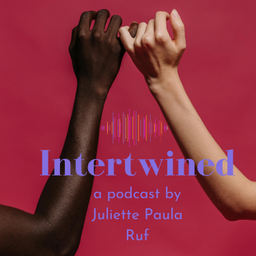
Intertwined is a podcast about what happens when Indigenous people, cultures, and knowledge meet the Western world. We dive into the past and present—colonial histories, scientific research, and international efforts—to understand how these worlds have collided, clashed, and can come together. It’s time to move beyond stereotypes and build new ways forward, together.
-----
Follow the podcast on instagram: podcast_intertwined
-----
Picture from Pixels (Rocketmann Team)
Editing and Music from Descript
Indigenous Airwaves: CONCIP’s Mission to Communicate - with Lucymar Carvajalino Palechor & César Nicolás Rojas Escamilla
Today I’m joined by César Nicolás Rojas Escamilla (a researcher from the National University of Colombia) and Lucymar Carvajalino Palechor, two representatives of CONCIP, the National Commission for Indigenous People’s Communication of Colombia. Together, we explore the incredible diversity of Indigenous peoples in Colombia and the groundbreaking work of the organization. The existence of an Indigenous commission for communication was never a given and it holds immense power. Through CONCIP, Indigenous communities can decide how they want to be represented in the world and denounce the abuses they face.
-----
"El Buen Vivir" episode 1: https://www.youtube.com/watch?v=eMf7XMtAHIM (https://www.youtube.com/watch?v=eMf7XMtAHIM)
CONCIP YouTube channel: https://www.youtube.com/@CONCIP-Colombia/featured (https://www.youtube.com/@CONCIP-Colombia/featured)
CONCIP website: https://concip.org/ (https://concip.org/)
17 May 2026
IWGIA: How Anthropologists Started Defending Indigenous Rights - with Geneviève Rose
Today, I’m joined by Geneviève Rose from IWGIA—the International Work Group for Indigenous Affairs—an organization founded in the late 20th century by anthropologists who decided to step beyond academia and into advocacy.
Together, we explore the origins of IWGIA as well as the critical work they do, from documenting Indigenous struggles to addressing Indigenous rights, with a focus on issues such as gender equity and climate finance. We will also look at how perceptions of Indigenous peoples and their rights have shifted since the start of the organization.
-----
IWGIA website: IWGIA - IWGIA - International Work Group for Indigenous Affairs (https://iwgia.org/en/)The Indigenous World 2026 (IWGIA's year book): The Indigenous World - IWGIA - International Work Group for Indigenous Affairs (https://iwgia.org/en/resources/indigenous-world.html)
29 Mar 2026
Who Controls the Water? Indigenous Participation in Governance Systems - with Laila Kasuri
In this episode, I’m joined by Laila Kasuri to discuss her paper "A Systemic Review of Indigenous People Participation in Dominant Systems of Water Governance", which looks at Indigenous participation in dominant water governance systems. The conversation explores how and to what extent Indigenous communities are included in water governance, the challenges they face, and examples from around the world.
---
Our conversation is based on: Kasuri, L., & Watkins, —. (2025). A systematic review of Indigenous peoples’ participation in dominant systems of water governance. Nature Water ->A systematic review of Indigenous peoples’ participation in dominant systems of water governance | Nature Water (https://www.nature.com/articles/s44221-025-00580-y)
8 Feb 2026
Biochar : An Ancient Practice Against Global Soil Degradation – with Anneke Trux
Today I’m joined by Anneke Trux, co-lead of the GIZ projects ProSoil and Soil Matters, funded by the BMZ, the EU, and the Gates Foundation, to talk about soil and biochar. Biochar is a pre-Columbian indigenous technology that is now beingused to tackle soil degradation in different regions of the world. Together, we explore how this technology works and what it can offer modern farmers, including women farmers.
-----
ProSoil: https://www.giz.de/en/projects/soil-protection-and-rehabilitation-food-security
Soil Matters: https://www.giz.de/en/projects/soil-matters-innovations-soil-health-and-agroecology
7 Dec 2025
A Story of Indigenous Land Justice - with Jazzy Rasolojaona
Jazzy Rasolojaona from Natural Justice discusses Indigenous land rights across Africa, highlighting community pressures and land grabbing in Madagascar, in this interview episode.
11 Nov 2025
When Women Shape Biodiversity – with Mrinalini Rai
Mrinalini Rai, founder of Women4Biodiversity, discusses the crucial connection between women and biodiversity, highlighting challenges and the impactful initiatives of Women4Biodiversity in this interview episode.
16 Aug 2025
Between Worlds: An Indigenous Voice for Biodiversity - with Viviana Figueroa
Host [Host Name] interviews Viviana Figueroa, an Indigenous Omaguaca woman and UN diplomat, about her people's connection to land and biodiversity.
12 Jul 2025
Untangling the Link Between Indigenous Peoples and Biodiversity – with Álvaro Fernández-Llamazares
Álvaro Fernández-Llamazares examines the widely repeated statistic about Indigenous territories holding 80% of the world's biodiversity, exploring its accuracy and implications for conservation science in this interview.
11 May 2025
Restoring Land with Indigenous Knowledge: The Indigenous Biocentric Restoration Approach — with Yon Fernández-de-Larrinoa
Today, I’m joined by Yon Fernández-de-Larrinoa, Head of the Indigenous Peoples Unit at the FAO, to explore another way of doing land restoration: the Indigenous Biocentric Restoration. The idea is simple — Indigenous cultures often perceive and relate to the land in fundamentally different ways. Because of their deep, long-standing relationship with their territories, their knowledge of the land can be more rooted and nuanced than what’s found in textbooks. Together, we’ll explore the different facets of this approach, its challenges, and what Yon believes are some of the keys to success when doing restoration.
26 Apr 2025
Indigenous Forest Guardians or Destroyers? A More Nuanced Story — with Fergus O'Leary Simpson
Are Indigenous peoples always forest guardians? Or can they also become forest destroyers? In this episode, we explore the complex and nuanced reality behind these labels, through the case study of the Batwa community in the Democratic Republic of Congo. My guest, Fergus O'Leary Simpson, joins me to discuss his recent research showing why the answer is not as simple as it seems — and why understanding the social and economic context is key.
-----
Our conversation is based on the article 'Indigenous forest destroyers or guardians? The indigenous Batwa and their ancestral forests in Kahuzi-Biega National Park, DRC' (Simpson et al., 2024). We also reference Braiding Sweetgrass by Robin Wall Kimmerer during the discussion.
6 Apr 2025
Through Western Eyes: How Perceptions of Indigenous Peoples Have Shifted Through History - with Jeremy Narby
In this first episode, I’m joined by Jeremy Narby to discuss how the perception of Indigenous peoples and their shamans has evolved over the past 450 years, as well as in more recent history. We also explore how combining Indigenous and Western worldviews can lead to a richer understanding of the world around us.
Who has been a guest on Intertwined
Names identified in recent episode analyses. Showing up to five guests.
Jazzy Rasolojaona
Mrinalini Rai
Viviana Figueroa
Álvaro Fernández-Llamazares
Reach and audience
Public platform figures. Ratings count people who left a rating, not total listeners.
Spotify
5.0 / 5
6 ratings
Podcast Authority Score: 5 / 100
A composite of feed quality, social presence, YouTube performance and engagement. Read the methodology.
Quality
9
Social presence
0
YouTube
0
Engagement
0
Host of Intertwined?
Claim your podcast to manage its listing and keep your show details accurate.
Pod Engine is an independent podcast discovery and analytics service and is not affiliated with or endorsed by this podcast. Artwork and show content belong to their owners. Full legal notice.
Explore this show Podcast research with Pod Engine