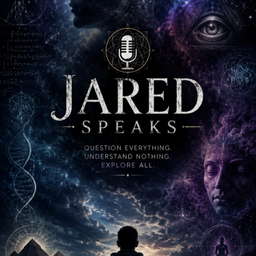
A deep exploration of consciousness, the human mind, and the unseen layers of reality. “Jared Speaks” dives into paranormal experiences, spirituality, dreams, synchronicities, ADHD, and the mysteries of perception itself. Each episode challenges how we interpret reality, blending curiosity, introspection, and open-minded discussion. This is not about answers—it’s about questioning everything you think you know about being human and the mind behind it.
Episode 27: Past Lives — Memory, Consciousness, and the Cases That Are Hard To Explain Away
A small child, somewhere between two and five years old, starts talking about another life. Not in a vague, imaginative way. Specifically. Names. Places. How they died. Family members from a previous life they should have no way of knowing about. And when researchers go back and check the details — they match.
This is not a ghost story. This is documented, peer-reviewed research conducted by a University of Virginia psychiatrist named Ian Stevenson over a forty-year career, investigating over three thousand cases across the world. Today we go deep into what he found and why it is so difficult to explain away.
In this episode I walk through two of the strongest documented cases in the research. James Leininger, an American boy born in 1998 who from age two described a World War Two plane crash in specific detail — naming the ship, naming a fellow pilot, describing his cause of death — and whose claims were verified against real military records. And Ryan Hammond, who pointed to an unnamed extra in a photograph from a 1932 Hollywood film and described that man's specific life in detail that researchers could only verify through original investigation, finding correspondences that had never been publicly documented.
I also get into how this research connects to the bigger thread this show has been building for twenty seven episodes. The near death experience episode asked whether consciousness is produced by the brain or received by it. The hard problem of consciousness episode asked why there is a felt experience at all rather than just physical processes running in the dark. Past life research adds a third piece to that puzzle. Whatever consciousness is, the strongest cases in this research suggest it might not be as tightly bound to a single lifetime as the standard picture assumes.
I also get honest about what this evidence does and does not prove, the important difference between spontaneous childhood memories and adult hypnotic regression, and the personal angle of what holding this question open changes about how I think about the connections and recognitions in my own life.
28minutes. Real cases, real research, and the question underneath all of it.
Follow on Spotify, Apple Podcasts, iHeart Radio, YouTube. Leave a rating if you can. New episode every single day.
27 Jun 2026
Episode 26: Are We Living in a Simulation? The Argument That Refuses to Die!
What if everything you’re experiencing right now — this conversation, your memories, the feel of your chair — is running on someone else’s computer?
In Episode 26 of Jared Speaks, we finally give the full treatment to one of the most provocative ideas in philosophy and science: Simulation Theory. Starting with Oxford philosopher Nick Bostrom’s groundbreaking 2003 trilemma, we explore the chilling statistical argument that we’re far more likely to be simulated minds than “base reality” humans.
We dive into why Elon Musk puts the odds of us living in base reality at one in a billion, why Neil deGrasse Tyson thinks it’s more likely than not, and how physicists like Max Tegmark see the universe as fundamentally mathematical. From quantum observer effects and Planck-length “pixels” to Mandela Effects, déjà vu, and synchronicities — could these be glitches in the code?
We also examine the serious criticisms, the striking parallels with ancient spiritual traditions (Maya, Plato’s Cave, Buddhist impermanence), and the most important question of all: Even if it’s true… does it actually change how you should live?
A mind-bending, balanced, and surprisingly practical deep dive into the argument that won’t go away.
Drop your take in the comments: Do you think we’re in a simulation? And does it matter?
26 Jun 2026
Episode 25: Who Were You Before The World Told You Who To Be?
Think about a version of yourself that existed before anyone had the chance to tell you who you were supposed to be. Before a teacher said you were too much. Before someone laughed at something you were genuinely excited about. Before you learned that certain parts of you made people uncomfortable and quietly tucked them away.
Before all of that — there was a version of you.
This is the episode I have been building toward for twenty five episodes without ever landing directly on it.
I get personal in this one in a way I have not quite done before. I talk about the goofy, playful side of me that stopped coming out in front of most people after someone made it clear it was not welcome — and how I have been carrying that quiet decision ever since without realizing how much it cost. I talk about the mirror life, spending most of my existence adjusting to fit whatever room I was in, and the point I hit where I could not easily tell anymore where the adjustment ended and the actual self began.
We connect this directly to the ego episode, where we talked about the identity the mind builds from external feedback rather than genuine self-knowledge. And to the shadow work episode, where we talked about everything that got buried because the world made clear it was not acceptable to show. And to the masking conversation in the autism episode, because what I am describing is a version of what almost everyone does to some degree — not just people on the spectrum, but anyone who ever learned that their unfiltered self did not land the way it needed to in order to belong.
I also talk about my kids and what it means to watch them exist in the unfiltered version of themselves before the world really gets to them, and what I am trying to do differently so that when the feedback comes it informs them rather than replaces them.
This one is the emotional center of what this whole show has been about from the beginning. Not the biggest ideas. The most personal ones.
26 minutes. Real, underneath, and closer to the bone than usual.
Follow on Spotify, Apple Podcasts, iHeart Radio, YouTube. Leave a rating if you can. New episode every single day.
Contact Jared Speaks
Guest appearances
Does not typically book guests
Based on episode analysis; this does not confirm that the show is currently accepting guests.
Host of Jared Speaks?
Claim your podcast to manage its listing and keep your show details accurate.
Pod Engine is an independent podcast discovery and analytics service and is not affiliated with or endorsed by this podcast. Artwork and show content belong to their owners. Full legal notice.
Explore this show Podcast research with Pod Engine