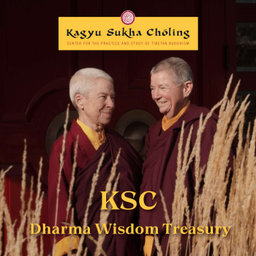
About KSC Dharma Wisdom Treasury: The Three Vehicles of Buddhism
A Living Archive of Kagyu Sukha Chöling's Dharma Teachings with Lamas Yeshe Parke and Pema Clark, The KSC Dharma Wisdom Treasury is the digital home for teachings offered at the KSC Dharma Center in Ashland, Oregon — preserved, restored, and shared for the benefit of all beings.
This collection brings together foundational and transformative teachings from KSC's Lamas beginning with "The Three Vehicles of Buddhism". The episodes within each turning: first, second and third, are labeled for continuity. It is suggested to begin with the first episode of the first turning and listen through the second and third in succession.
This evolving treasury invites you to deepen your understanding of the Dharma and engage with practices that support a life of compassion, clarity, and awakening.
May these teachings be of benefit to your path.
The Four Preliminaries: Awakening Your Buddha Nature Through Tibetan Buddhist Practice
Have you ever wondered what it takes to truly transform your mind and heart? The Vajrayana Tibetan Buddhist tradition offers four uncommon preliminaries that guide practitioners through a profound journey of awakening.
The first practice involves taking refuge and generating bodhicitta—awakening the heart and mind. Through verbal meditation, visualization of the Refuge Tree, and physical prostration, practitioners reconnect with the three jewels (Buddha, Dharma, Sangha) and three roots (lamas, yidams, and Dharma Protectors). This honors thousands of practitioners who came before.
Next comes Vajrasattva, where visualization and mantra recitation purify negative habits and past actions. The third practice, Mandala, develops generosity by creating a pure universe filled with beauty while relinquishing attachment to material things.
Finally, Guru Yoga deepens the teacher-student relationship. As Tibetan yogi Shabkar expressed: the teacher guides initially, dharma teaches in the middle, and eventually the student becomes their own teacher.
These practices all point toward Mahamudra - the "Great Seal" that reveals your Buddha nature. Rather than creating something new, you're simply removing obscurations that prevent you from seeing what's already there. Your enlightenment potential exists right now, accessible through dedicated practice and guidance.
Key Takeaways:
• **Enlightenment is already within you, not something to be created** — Buddhist practice focuses on removing mental obscurations to reveal your existing Buddha nature, rather than developing something entirely new.
• **The teacher-student relationship is a tool for transcending the illusion of separation** — Through devotion and projection work with a spiritual guide, students eventually recognize the teacher's enlightened qualities as their own, dissolving the boundary between self and other.
• **Your mind's problems stem from constant labeling and judgment** — Most mental suffering is self-created through unnecessary conceptualization, making the inward shift away from external distractions essential to liberation.
14 Jul 2026
Faith as Experience: From Heart's Whisper to Meditation's Grace
Lamas Pema and Yeshe explore four foundational Buddhist contemplations designed to redirect perspective: recognizing the preciousness of human life, contemplating impermanence and mortality, acknowledging that suffering pervades all existence, and understanding that all actions carry consequences. These directly parallel the Buddha's Four Noble Truths. They introduce Mahamudra—our fundamental nature, which is empty, spacious, and infused with kindness and compassion.
The teaching emphasizes that faith and blessing aren't static concepts but evolve through experience, revealing themselves in unexpected moments when we stop trying to control outcomes.
Tune in to hear how these spiritual practitioners navigate the distinction between confidence and arrogance, trust and knowing.
• **Faith operates at everyday levels (loyalty, trust) and gradually deepens through lived experience rather than requiring immediate certainty or rigid doctrine**
• **Blessing functions as unexpected grace that emerges through openness and contemplative silence rather than being actively pursued or demanded**
• **Buddhist and Tibetan meditation practices are presented as practical pathways to discover one's "authentic nature" rather than as purely philosophical or religious concepts**
14 Jul 2026
The Guru-Student Relationship: Foundation of Vajrayana Practice
This exploration of Vajrayana Buddhism reveals how the tradition uniquely weaves together disciplined conduct, compassionate attitudes, and profound meditation methods. Drawing on teachings from masters like Patrul Rinpoche and Trungpa Rinpoche, the discussion unpacks how the guru relationship evolves across Buddhist paths—from teacher in Hinayana, to spiritual friend-physician in Mahayana, to the Vajra Master who functions as teacher, magician, and surgeon.
The conversation dives into three types of faith: lucid faith (clear-headed appreciation), examining faith (observing a teacher's qualities), and trusting faith (belief in cause and effect). Through the Tibetan concept of "jinlap," we learn how blessing works as an overwhelming atmosphere transmitted to receptive students. (It's about opening ourselves to receive what's being offered.)
The teaching emphasizes that students must carefully examine teachers by verifying authentic lineage, compassion, and accurate Dharma transmission. Because genuine spiritual guidance requires both the teacher's offering and the student's receptivity, this mutual examination supports authentic transformation.
**Listen to discover how your own Buddha nature serves as your ultimate guru.**
Key Takeaways:
• **Faith in Buddhism requires active examination, not blind belief** — practitioners must carefully scrutinize their teacher's lineage, compassion, and qualifications rather than accepting them uncritically.
• **The guru-student relationship's power depends entirely on the student's perception** — the teacher's transformative ability is contingent on how the student receives and interprets their guidance, not on inherent authority.
• **Receptiveness and emotional openness are prerequisites for spiritual transformation** — reduced reactivity and lowered defenses allow practitioners to actually absorb teachings, making the student's psychological state as important as the teacher's knowledge.
Reach and audience
Public platform figures. Ratings count people who left a rating, not total listeners.
Apple Podcasts (US)
5.0 / 5
2 ratings
Spotify
5.0 / 5
1 ratings
Contact KSC Dharma Wisdom Treasury: The Three Vehicles of Buddhism
Guest appearances
Does not typically book guests
Based on episode analysis; this does not confirm that the show is currently accepting guests.
Host of KSC Dharma Wisdom Treasury: The Three Vehicles of Buddhism?
Claim your podcast to manage its listing and keep your show details accurate.
Pod Engine is an independent podcast discovery and analytics service and is not affiliated with or endorsed by this podcast. Artwork and show content belong to their owners. Full legal notice.
Explore this show Podcast research with Pod Engine