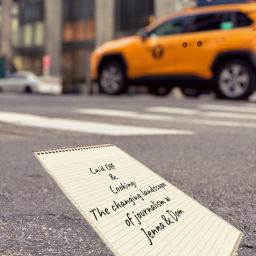
Don’t Bury the Lede takes you inside journalism: the decisions, the pressures, and the people behind the stories shaping what you see every day.
Hosted by award-winning journalists Jenna Flanagan and Domenic Camia, the show pulls back the curtain on how the news really works, why public trust has fractured, and what’s at stake for democracy when facts are harder to agree on.
Through candid, insightful, and often funny conversations with journalists, editors, creators, and media thinkers, Don’t Bury the Lede explores the future of news in a rapidly changing digital world.
Events make news. People make journalism.
New episodes every week.
Ever wonder who really decides what becomes “news”?
In this episode of Laid Off and Looking, we go inside the assignment desk, the nerve center of every newsroom with Professor Benjamin Davis, award-winning journalist and Chair of Multimedia Journalism at Morgan State University.
Davis has worked at ABC News, MSNBC.com, and NPR, and he’s here to break down the uncomfortable truth:
👉 The stories you see (and the ones you don’t) are shaped by business pressures, predictability, executive preferences, trending topics, and now… AI.
🔍 In This Episode, We Explore:
00:00 - Start
00:37 - Intro
01:46 - “Yellow Journalism” History Lesson
05:56 - Interview Begins
08:14 - Stacking the Rundown
11:12 - Selling a Story
14:02 - How to Know When You’re Show is Bad
16:30 - How to Do Local News
18:04 - Harsh Truths
20:23 - Citizen Journalists
32:51 - Follow the Technology
36:40 - What We’re Missing
40:00 - Oh Lord These People
42:56 - The Risks of Freelancing
46:01 - AI in the Newsroom
51:58 - Why Did You Become a Journalist?
🎧 Professor Benjamin Davis
Professor Davis is a veteran journalist, educator, newsroom leader, and soon-to-be founder of a citizen-journalism app designed to empower the public ethically to tell stories newsrooms can’t or won’t.
💬 Why this episode matters
The public often believes “the media refuses to cover certain stories.”
This conversation explains why newsrooms make the decisions they make, what’s missing, and how journalism must evolve if it wants to survive the era of distrust and digital chaos.
22 Nov 2025
Can TV News Be Fixed?
Ever wonder why the news, especially TV news is the way it is?
This week on Laid Off and Looking, veteran TV news director and journalism educator turned media critic, Jennifer Schulze shares some frank words on how broadcast journalism went off track.
From shrinking newsrooms and corporate pressure to the obsession with “going viral,” Schulze explains how decades of cutbacks and bad incentives turned a public service into a ratings race. She also reflects on what it takes to rebuild trust and why the next generation of journalists might still be our best hope.
🎙️ In this episode:
00:00 - Start
01:00 - Intro
02:10 - No More Breaking News @Brodmop on TikTok
06:38 - Ratings Or Information?
09:24 - The Billionaire Influence
10:30 - What Really Broke TV News
17:44 - What It Takes to Stay Employed
19:39 - Fake News Catastrophe
23:08 - Trusting Local News
25:57 - The Op-Ed Albatross
35:58 - Information Curation is Still Needed
46:08 - Paywalls Were A Mistake
47:46 - Is This Still A Safe Career?
52:33 - Credits
If you’ve ever worked in a newsroom, watched one fall apart, or wondered who still believes in journalism, this conversation is for you.
17 Nov 2025
The Emotional Toll of Journalism
Most people think journalists are trained to stay detached, to report the story, and not feel it.
But what happens when the story breaks you?
In this episode we talk with journalist and researcher Louisa Ortiz Pérez, founder of the Media Resilience Network, who launched a groundbreaking survey exploring the emotional toll of journalism during the era of layoffs, audience distrust, and constant crisis coverage.
Louisa reveals what her data shows about:
🧠 Burnout, anxiety, and “moral injury” in the newsroom
💔 How layoffs and social media toxicity are reshaping reporters’ sense of purpose
🎙️ Why many journalists feel silenced, even in organizations built to tell the truth
🌍 And what needs to change to make journalism sustainable again
This conversation is candid, compassionate, and deeply human: a look at what it really means to do the work of journalism when the industry itself is falling apart.
How do we rebuild trust, without breaking the journalists who keep us informed?
00:00 - Start
02:11 - Jenna Remembers the Trauma of Sandy Hook
08:05 - Technology Changed the Game
11:08 - When You Are the Story
14:31 - You Shouldn’t Have to Shrug It Off
17:04 - Journalism Can Make You Sick
18:26 - Put Your Foot Down
22:37 - A Human Condition: A Play About Journalism
25:06 - Take the Veneer Off
27:28 - We Can’t Be Unseen
35:35 - Journalists Need 2 Things to Heal
44:49 - The Algorithm IS NOT Your Friend
48:08 - Only People Not Bots Can Do Journalism
52:29 - PTSD Should Be Recognized
55:15 - Why Did You Become a Journalist?
Media Resilience Network
https://mdrnet.org/
Take the Survey:
https://docs.google.com/forms/d/e/1FAIpQLSdAXBQMP8wgy_ecx2dh4WeqAb3fSUyIh8fndSkZrYBGR22yNg/viewform
Reach and audience
Public platform figures. Ratings count people who left a rating, not total listeners.
YouTube views
12,287
Score snapshot 15 Sept 2025
Apple Podcasts (US)
5.0 / 5
6 ratings
Spotify
5.0 / 5
2 ratings
Podcast Authority Score: 48 / 100
A composite of feed quality, social presence, YouTube performance and engagement. Read the methodology.
Quality
43
Social presence
0
YouTube
72
Engagement
60
Host of Laid Off and Looking?
Claim your podcast to manage its listing and keep your show details accurate.
Pod Engine is an independent podcast discovery and analytics service and is not affiliated with or endorsed by this podcast. Artwork and show content belong to their owners. Full legal notice.
Explore this show Podcast research with Pod Engine