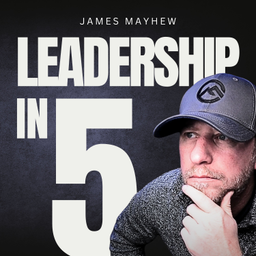
Execution without excuses. Five minutes. One insight. No wasted words.
Leadership In 5 is the podcast for founders and executives who are done with vague advice and tired of hearing “just communicate better” like it’s a strategy.
I’m James Mayhew. I’ve served as Chief Culture Officer, coached hundreds of leaders, and made the thousand-plus execution mistakes so you don’t have to. I work with high-growth companies that are scaling fast — but who still want to lead with values, not ego.
Each episode delivers one sharp insight you can act on. You’ll hear practical guidance built on clarity, not charisma. No theory. No fluff. Just real leadership tools that work in real companies with real people.
This show exists to help you stop over-functioning, stop repeating yourself, and stop holding it all together just to keep the wheels turning. You deserve a business that works without breaking you.
The show is grounded in The IDP Way, a leadership system built on Integrity, Dignity, and Prosperity. If those words resonate, you’ll feel at home here. And if they challenge you? Even better. Growth starts with honesty.
Want a free companion to the show?
Download "99+ Questions That Create Clarity" at NextQuestionGuide.com
It’s the simplest tool I know to start shifting your team from confused to confident.
Thanks for listening... and for leading.
There are times in a business where things just feel off.
You see it in the numbers. You feel it in how your team is working together. Decisions take longer than they should. Conversations don’t feel as direct as they used to.
And as a leader, you know something’s not right—but you can’t always explain what it is.
What’s happening underneath that isn’t usually obvious.
It’s not just a process issue. It’s not just a communication problem.
It’s what starts to replace trust when it’s not there—or when it’s been broken.
Suspicion.
Not all at once. Not loudly. It builds through assumptions, side conversations, and people trying to make sense of things on their own.
And once it takes hold, it starts to change how people think, how they communicate, and how they show up to their work.
The hard part is that most leaders don’t see it when it’s starting. They feel the effects of it long before they recognize what’s actually happening.
And by the time it’s obvious, it’s already spread.
In This Episode You’ll Learn
What suspicion actually looks like inside a company (beyond obvious conflict)
Why teams start misinterpreting decisions and losing alignment
How rumors, assumptions, and silence reshape communication
The operational impact of suspicion on speed, confidence, and execution
Why leaders often miss the early signs—and where to look instead
Reflection Questions
Where in your company do things feel off but you haven’t clearly named why?
Links & Resources
JamesMayhew.com (JamesMayhew.com)
The right question changes everything.
Grab the free Next Question Guide → NextQuestionGuide.com (NextQuestionGuide.com)
Connect on LinkedIn → linkedin.com/in/jamesmayhew (linkedin.com/in/jamesmayhew)
28 Apr 2026
83. The Trust Problem Most Business Owners Don’t See
Is trust earned, or is it given?
Most people answer that question quickly. They feel confident about their position, often shaped by past experiences where trust was broken or protected.
But leadership changes the reality of that question.
Because when you hire someone, delegate responsibility, or place someone into a role, you are extending trust before proof exists. You don’t get the luxury of waiting for trust to be earned first. The decision itself requires trust to move ahead of certainty.
This episode walks through a real leadership moment where a room full of leaders believed trust had to be earned — until one owner explained why he had already moved beyond that idea. From where he sat, trust had to be extended first.
That shift matters more than most leaders realize.
Because once trust exists, leadership responsibility begins earlier than expected. And what happens next determines whether that trust grows into strength… or opens the door to something else entirely.
Reflection Questions
Is trust earned, or is trust given — and why do you believe that?
Where did your belief about trust come from?
When you hire or delegate responsibility, do you recognize that trust has already been extended?
What responsibility begins the moment trust is given?
What happens next in your organization after trust is extended — growth, clarity, hesitation, or erosion?
Links & Resources
JamesMayhew.com (JamesMayhew.com)
The right question changes everything.
Grab the free Next Question Guide → NextQuestionGuide.com (NextQuestionGuide.com)
Connect on LinkedIn → linkedin.com/in/jamesmayhew (linkedin.com/in/jamesmayhew)
21 Apr 2026
82. Hiring and Culture: The Two Responsibilities That Decide Your Future
Most leaders believe they carry dozens of responsibilities. Meetings, strategy, hiring, operations, customer issues — the list never seems to end.
But when you step back and look closely, leadership responsibility becomes clearer than most people expect.
There are two responsibilities leaders don’t get to hand off.
The first is hiring with excellence. Every person brought into the organization becomes part of the standard others experience. Hiring is never neutral. It always moves the company in one direction or another.
The second sits right beside it: building and protecting culture. Not just creating it — protecting it. Culture is defended in the moments when behavior falls short and leaders decide whether to address it or ignore it.
In this episode, you’ll hear why accepted feedback isn’t the same as improvement, why correction must lead to clear action, and how consistent standards create stability long before financial results ever show up.
Because when hiring is done well and standards are protected consistently, companies begin to change from the inside out. Stability forms. Development becomes possible. And over time, performance and profitability follow.
These responsibilities aren’t extra work.
They are the work that makes everything else possible.
In This Episode You’ll Learn
Why hiring decisions are never neutral
The difference between building culture and protecting it
The hidden risk behind feedback that is accepted but not acted on
Why standards must be defended in real-time moments
How strong hiring and protected culture create stability before results show up
Why development only becomes possible when preventable problems are reduced
How consistent standards eventually shape financial outcomes
Reflection Questions
Where in your company have hiring decisions been treated as short-term solutions instead of long-term standards?
When behavior falls short, do you address it immediately or allow uncertainty to grow?
Have you mistaken agreement for improvement?
What patterns in your company exist today because standards weren’t defended earlier?
If your culture were tested tomorrow, would your standards hold or shift?
Links & Resources
The right question changes everything.
Grab the free Next Question Guide → NextQuestionGuide.com (NextQuestionGuide.com)
Connect on LinkedIn → linkedin.com/in/jamesmayhew (linkedin.com/in/jamesmayhew)
Learn more → JamesMayhew.com (JamesMayhew.com)
Reach and audience
Public platform figures. Ratings count people who left a rating, not total listeners.
Apple Podcasts (US)
5.0 / 5
3 ratings
Contact Leadership in 5
Guest appearances
Does not typically book guests
Based on episode analysis; this does not confirm that the show is currently accepting guests.
Host of Leadership in 5?
Claim your podcast to manage its listing and keep your show details accurate.
Pod Engine is an independent podcast discovery and analytics service and is not affiliated with or endorsed by this podcast. Artwork and show content belong to their owners. Full legal notice.
Explore this show Podcast research with Pod Engine