- 13
- Episodes
- Weekly
- Cadence
- 2025
- First episode
About Leading in Balance
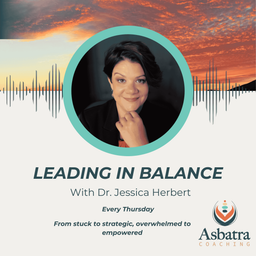
You've built a career. You've proven yourself. And now everything is changing—your role, your company, maybe your entire sense of what's next. Leading in Balance is the podcast for experienced leaders who refuse to let transition define them, but are ready to redefine themselves. Host Dr. Jessica Herbert, an ICF Professional Certified Coach who has spent 27+ years working with high-impact leaders in high-stress environments, knows the territory. She's lived the burnout, learned the patterns, and now guides leaders through the ambiguity with both analytical precision and human understanding. Each episode tackles the real issues: setting boundaries that actually hold, navigating difficult conversations with clarity, and creating space for the creativity and connection that transactional leadership steals. You'll walk away with reflection activities and practical tools to shift from surviving change to designing what comes next. Because balance isn't about doing it all—it's about choosing what matters.
- Publisher
- jessica herbert
- Category
- business · education · society & culture
- Language
- en
- Explicit
- No
- First episode
- 28 Dec 2025
- Latest episode
- 4 Jun 2026
Latest episodes
13 episodes in the feed.
4 Jun 2026
Travel, Data, and Efficiency: Vacation as a Habit Reset
Most executives come home from vacation heavier, more tired, and further from who they want to be—then call it "earned." This episode dismantles that logic with the actual behavioral science on travel and habit change, and lays out the three-shift framework for using your next trip as the highest-leverage performance week of your year. If you've ever booked a flight to escape your life instead of build it, this one's for you. WHAT YOU'LL LEAVE WITH Why the habit discontinuity hypothesis gives you a roughly three-month window to rewrite your defaults—and why almost nobody uses it The difference between escape-based travel and build-based travel, and why one gains you weight while the other gains you compound returns The three-shift framework: travel toward a metric, install one new behavior, stage your re-entry before you leave Why "the scale always goes up after vacation" isn't a discipline problem—it's an operating system problem THE RESEARCH This episode is grounded in the habit discontinuity hypothesis, originally developed by behavioral psychologist Bas Verplanken and colleagues. Their work shows that major context-altering life transitions—moving, starting a new job, traveling—temporarily decouple environmental cues from automatic behavior, opening a window where new habits can be installed. Key findings referenced: Verplanken & Roy (2016) — Field experiment with 800 households showing behavior change interventions are significantly more effective when delivered during life transitions, with a window of opportunity lasting up to three months post-relocation Walker, Thomas & Verplanken (2015) — Foundational work establishing that habit discontinuity precedes habit change Research on cue-dependent memory and routine reactivation explaining why old habits reassert themselves the moment you return to the original environment CONNECT WITH JESSICA If you're navigating transitions and need support redefining what progress actually looks like, follow Dr. Jessica Herbert on LinkedIn or Substack to learn about masterminds, group coaching workshops, and one-on-one programs. We don't just talk about patience—we set micro-milestones, experiment, and build tolerance for the timeline without the guilt. LinkedIn: https://www.linkedin.com/in/drjessicaherbert (https://www.linkedin.com/in/drjessicaherbert/) Substack: https://asbatracoaching.substack.com/ (https://asbatracoaching.substack.com/)- Join the community for deeper discussions and downloadable worksheets Leave feedback: Use the thumbs up/down button in your podcast app or comment on Substack (https://asbatracoaching.substack.com/) EPISODE CREDITS Host & Producer: Asbatra Coaching Episode Length: 16 minutes
28 May 2026
The Pause as Leadership Logic
EPISODE OVERVIEW After a two-month break from the podcast, we're back—and not with an apology. This episode unpacks why strategic pauses aren't a detour from leadership but a function of it, what Brené Brown's "Day 2" framework reveals about the messy middle of building anything meaningful, and the calibration that's reshaping this entire show going forward. If you've been performing leadership instead of practicing it, this one's for you. What You'll Hear Why 77% of workers are running on burnout fumes—and what the research actually says about strategic pauses The 52/17 productivity pattern that separates peak performers from the perpetually exhausted How "Day 2" thinking explains why so many leaders quit right before the breakthrough The difference between visibility and value (and why we keep confusing them) Why engagement matters more than algorithms—and what's changing here because of it Research or Other Content Referenced American Psychological Association — Stress in America survey on workplace burnout Draugiem Group productivity research — The 52/17 work-rest pattern of peak performers INSEAD studies on executive sabbaticals and strategic vision Tony Schwartz and The Energy Project — Wave-based performance frameworks Brené Brown — "FFTs" and "Day 2" concepts from Dare to Lead IF THIS EPISODE RESONATED Share it with one leader who's stuck in their own Day 2 and needs permission to pause. Subscribe so you don't miss the AMA announcement and the next round of conversations on what authentic, sustainable leadership actually looks like. CONNECT WITH JESSICA If you're navigating transitions and need support redefining what progress actually looks like, follow Dr. Jessica Herbert on LinkedIn or Substack to learn about masterminds, group coaching workshops, and one-on-one programs. We don't just talk about patience—we set micro-milestones, experiment, and build tolerance for the timeline without the guilt. LinkedIn: https://www.linkedin.com/in/drjessicaherbert (https://www.linkedin.com/in/drjessicaherbert/) Substack: https://asbatracoaching.substack.com/ (https://asbatracoaching.substack.com/)- Join the community for deeper discussions and downloadable worksheets Leave feedback: Use the thumbs up/down button in your podcast app or comment on Substack (https://asbatracoaching.substack.com/) EPISODE CREDITS Host & Producer: Asbatra Coaching Episode Length: 14 minutes
12 Mar 2026
The Small Wins That Actually Matter (When Nothing Feels Like Progress)
EPISODE SUMMARY You're in the messy middle of transition. You've applied to 50 jobs with no offers. You've tried multiple activities and nothing has clicked yet. You're learning a new role but still feel behind. And it feels like nothing is happening. But here's the truth: Progress isn't always visible. That doesn't mean it's not happening. This episode is about recognizing the small wins you've been dismissing. Because small wins aren't consolation prizes—they're how real progress happens. They rebuild confidence. They create momentum. They sustain you when the big win hasn't come yet. Jessica shares her story of cleaning out a garage in 115-degree Phoenix heat—where some days, getting one bin sorted was a win. After the tenth trip to donation, she finally saw the progress. But if she'd waited for the "after" to feel good about it, she would have missed the small wins that kept her going. You've been building capacity this whole time. You've navigated extended transitions, rebuilt routine, addressed financial anxiety, broken the comparison noise, and shown up day after day even when nothing felt like it was working. That's not nothing. That's everything. And now you're ready for Phase 3: Designing What's Next. RESEARCH & RESOURCES MENTIONED Teresa Amabile (Harvard Business School): The Progress Principle - Single most powerful motivator is progress (even small, incremental). When people feel they're making progress (even small ways), motivation/creativity/engagement increase. When stuck, everything declines. To sustain motivation during difficult uncertain work, make progress visible—notice it, name it, celebrate it. BJ Fogg: Tiny Habits - Small actions compound over time. Success breeds success. Small wins create momentum. Make it easy to win early and often—every small win builds belief (self-efficacy) that you CAN do this. That belief carries you through hard middle. Albert Bandura: Self-Efficacy Research - Self-efficacy = belief in your ability to succeed. Most powerful way to build it: mastery experiences (small successes proving you're capable). In transition, self-efficacy takes hit. Only way to rebuild: small wins—noticing small actions where you showed up, tried, learned, did something hard. The Momentum Principle (Physics) - Objects in motion stay in motion. When stuck, even small movement matters. Small actions break paralysis. Once in motion, staying in motion easier than starting from stillness. Small wins create momentum that carries you forward when motivation fails. THIS WEEK'S REFLECTION ACTIVITY Download the Small Wins Tracker & Progress Recognition worksheet (https://drive.google.com/file/d/1m0LbHaKv7I1NiGUJsLflSdgv6OnPuM0Q/view?usp=drive_link) CONNECT WITH JESSICA If you're navigating an extended transition and need support redefining what progress actually looks like, visit Asbatra.com (https://www.asbatra.com/) to learn about one-on-one coaching. We don't just talk about patience—we set micro-milestones, experiment, and build tolerance for the timeline without the guilt. Website: https://www.asbatra.com/ (https://www.asbatra.com/) Substack: https://asbatracoaching.substack.com/ (https://asbatracoaching.substack.com/)- Join the community for deeper discussions and downloadable worksheets Leave feedback: Use the thumbs up/down button in your podcast app or comment on Substack (https://asbatracoaching.substack.com/) EPISODE CREDITS Host & Producer: Asbatra Coaching Episode Length: 26 minutes
5 Mar 2026
When Everyone Else Has Moved On (But You're Still Here)
EPISODE SUMMARY You're in transition. And everyone else keeps moving. Former colleagues get promoted. Peers land new roles. LinkedIn is full of announcements—new jobs, six-figure consulting businesses, speaking engagements, awards. And you're still here. Still looking. Still figuring it out. Still in the middle. Every time you see someone else's win, a voice in your head asks: "What's wrong with me? Why is everyone else figuring this out except me?" Here's the truth you need to hear: Their timeline isn't your timeline. You're comparing your messy middle to their curated highlight reel. And that comparison is stealing energy you need to actually move forward. This episode is about breaking the noise. The LinkedIn comparison spiral. The family and friends who mean well but contribute to comparison. The constant pressure to perform like everyone else is thriving while you're struggling. It's about knowing when to engage and when to step back. And it's about focusing on YOUR circle of control instead of everyone else's highlight reel. Because comparison during transition is toxic. And you can't move forward while you're constantly looking sideways at everyone else's path. RESEARCH & RESOURCES MENTIONED Leon Festinger: Social Comparison Theory - Humans have inherent drive to evaluate ourselves; when we lack objective measures, we compare to others. Upward comparison (to people "ahead") can motivate or destroy depending on whether you believe you can reach their level. Downward comparison (to people "behind") temporarily boosts self-esteem but doesn't help you move forward. Temporal Comparison Research - Comparing current self to past self (rather than to others) is associated with higher wellbeing, lower anxiety, and more sustainable motivation. Keeps you focused on your own trajectory instead of everyone else's timeline. Reference Group Theory - Who you compare to matters enormously. Comparing to immediate circle (former colleagues, peers) feels personal. Comparing to strangers broadcasting wins on LinkedIn—you're comparing to a curated performance designed to impress. Social Media and Wellbeing Research - More time on social media during transition = worse feelings. Constant exposure to others' highlight reels while living in your messy middle creates toxic comparison cycle. THIS WEEK'S REFLECTION ACTIVITY Download the Comparison Audit & Circle of Control worksheet (https://claude.ai/chat/7e46ecdb-117c-49ea-8d02-cd1ea02306a1) CONNECT WITH JESSICA If you're navigating an extended transition and need support redefining what progress actually looks like, visit Asbatra.com (https://www.asbatra.com/) to learn about one-on-one coaching. We don't just talk about patience—we set micro-milestones, experiment, and build tolerance for the timeline without the guilt. Website: https://www.asbatra.com/ (https://www.asbatra.com/) Substack: https://asbatracoaching.substack.com/ (https://asbatracoaching.substack.com/)- Join the community for deeper discussions and downloadable worksheets Leave feedback: Use the thumbs up/down button in your podcast app or comment on Substack (https://asbatracoaching.substack.com/) EPISODE CREDITS Host & Producer: Asbatra Coaching Episode Length: 33 minutes
26 Feb 2026
The Financial Anxiety That's Keeping You Up at Night
EPISODE SUMMARY Financial anxiety during transition is real. When your income changes—whether you planned for it or not—everything shifts. For a majority of Americans, basic needs suddenly feel unaffordable. Housing. Food. Healthcare. The things you used to take for granted now keep you up at night. And here's what nobody tells you: There are plenty of resources out there about how to save money, create budgets, and plan financially. But almost no one tells you how to deal with the emotions during the transition—the fear, the shame, the constant mental calculation of "Can I afford this?" The anxiety that wakes you up at 3am doing math in your head. This episode isn't about teaching you to budget. It's about identifying what makes YOU feel financially secure so you can focus on those things during transition. It's about asking what you're actually willing to do. It's about separating scarcity thinking from strategic thinking. And it's about making financial decisions from strategy—not panic. Because financial anxiety and financial reality aren't always the same thing. And when you can separate fear from facts, you can think clearly instead of just reacting. RESEARCH & RESOURCES MENTIONED Morgan Housel: "The Psychology of Money" - Financial decisions are based on psychology, not spreadsheets. Your relationship with money is shaped by background, experiences, and fears. What feels secure varies by person—you must understand YOUR psychology to make strategic decisions. Sendhil Mullainathan & Eldar Shafir: "Scarcity: Why Having Too Little Means So Much" - Scarcity limits mental bandwidth through "scarcity capture"—constant worry creates cognitive load that prevents strategic thinking. Financial anxiety depletes your ability to make good decisions. Mike Michalowicz: "Profit First" - Business financial strategy adapted for personal use: create separate accounts for different purposes (rent, basic needs, flexible spending). Physical separation reduces anxiety and prevents constant mental math. Wallace Wattles: "The Science of Getting Rich" - Abundance thinking vs. scarcity thinking. Shift from "There's not enough" to "What resources can I create or reallocate?" Not toxic positivity—strategic questioning. Annie Duke: "Quit: The Power of Knowing When to Walk Away" - Strategic resource reallocation. Calculate expected value going forward, not backward. Moving to cheaper location, taking interim work, or changing lifestyle isn't failure—it's smart strategy. THIS WEEK'S REFLECTION ACTIVITY Download the Financial Security Inventory worksheet (https://drive.google.com/file/d/12niN1ur_piqNthfXuqA5Cw-CBL8q9OP7/view?usp=drive_link) CONNECT WITH JESSICA If you need support navigating financial anxiety and making strategic decisions under pressure, visit Asbatra.com (https://www.asbatra.com/)to explore one-on-one coaching. We separate fear from facts, identify what actually creates security for you, and build strategic plans that give you runway without compromising what matters. It's for people who want to make financial decisions from strategy, not panic. Website: www.asbatra.com (https://www.asbatra.com/) Substack: https://asbatracoaching.substack.com/ (https://asbatracoaching.substack.com/) - Join the community for deeper discussions and downloadable worksheets Leave feedback: Use the thumbs up/down button in your podcast app or comment on Substack EPISODE CREDITS Host & Producer: Asbatra Coaching Episode Length: 33 minutes
19 Feb 2026
Rebuilding Routine and Rituals When Your Days Have No Structure
EPISODE SUMMARY When you lose the external structure of work, role, or identity, your days can feel formless. And formless days lead to anxiety, low motivation, and the feeling that you're wasting time—even when you're technically "free." Jessica experienced this twice: once in January 2025 when federal contracting changes collapsed her business structure overnight, leaving her in crisis with no sleep, negative thoughts, and paralysis. And again in September 2025 when she intentionally chose a six-month sabbatical in Costa Rica—same loss of structure, completely different experience. The first felt like failure. The second felt like permission, recovery, and the restoration of creativity she thought she'd lost. This episode is about the difference between those two experiences—and how to rebuild routine that serves you instead of constrains you. Because structure isn't the enemy. Rigidity is. You need anchors, not schedules. Rituals, not routines. Rhythm, not rules. If you're newly unemployed with empty days, retired without knowing what to do with unscheduled time, or between roles and can't seem to get anything done—this episode will show you how to create meaningful structure without replicating the old job. RESEARCH & RESOURCES MENTIONED Wendy Wood - Habits research and why losing external structure removes behavioral triggers Francesca Gino & Michael Norton - The psychological power of rituals vs. routines; how rituals reduce anxiety and create meaning University of Pennsylvania Study - Temporal structure and wellbeing; predictable patterns reduce anxiety and increase life satisfaction Retirement Adjustment Research - Bridge activities that create structure and meaning without performance pressure THIS WEEK'S REFLECTION ACTIVITY Download the Building Your Daily Anchors worksheet (https://drive.google.com/file/d/1AwzcwHQnnnw5IH44cTiG6p82DX0G8HES/view?usp=drive_link) CONNECT WITH JESSICA If you're realizing you need support rebuilding structure that serves you instead of constrains you, visit Asbatra.com (Asbatra.com) to explore one-on-one coaching. We design anchors, create rituals, and build rhythm that reduces anxiety without creating rigidity. It's for people who want days that feel meaningful—not just productive. Website: www.asbatra.com (www.asbatra.com) Substack: https://asbatracoaching.substack.com/ (https://asbatracoaching.substack.com/ )- Join the community for deeper discussions and downloadable worksheets Leave feedback: Use the thumbs up/down button in your podcast app or comment on Substack (https://asbatracoaching.substack.com/) EPISODE CREDITS Host & Producer: Asbatra Coaching Episode Length: 34 minutes
12 Feb 2026
When the Transition Takes Longer Than You Thought (And You're Still Waiting)
EPISODE SUMMARY You thought this transition would take three months. Maybe six. But here you are—eight months in, twelve months in, maybe longer—and you're still in the middle. You're starting to wonder: What's wrong with me? Why is this taking so long? Why can't I just figure it out? Here's the truth: You're not failing. Extended transitions are normal. Most transitions take 18-24 months to fully stabilize—not the three to six months we expect. This episode is about surviving the extended timeline without losing yourself, redefining what progress actually looks like, and building the resilience to stay in the middle without collapsing back to the old or forcing a premature new. If you're laid off and still looking, retired and still aimless, or in a new role that still doesn't feel right—this one's for you. RESEARCH & RESOURCES MENTIONED Nancy Schlossberg's Transition Theory - Framework for understanding transitions through the 4 S's: Situation, Self, Support, and Strategies Harvard Business Review (2023): "Why Career Transition Is So Hard" - Research showing career transitions typically take 18-24 months to stabilize because they involve identity work, not just job search Annie Duke: "Quit: The Power of Knowing When to Walk Away" - Strategic resource reallocation and why taking interim roles can be the smartest move during extended transitions THIS WEEK'S REFLECTION ACTIVITY Download the Redefining Progress worksheet (https://drive.google.com/file/d/1thPD6HA5kyallvMpexbsnUUwhhoDcM9D/view?usp=drive_link) CONNECT WITH JESSICA If you're navigating an extended transition and need support redefining what progress actually looks like, visit Asbatra.com (https://www.asbatra.com/) to learn about one-on-one coaching. We don't just talk about patience—we set micro-milestones, experiment, and build tolerance for the timeline without the guilt. Website: https://www.asbatra.com/ (https://www.asbatra.com/) Substack: https://asbatracoaching.substack.com/ (https://asbatracoaching.substack.com/)- Join the community for deeper discussions and downloadable worksheets Leave feedback: Use the thumbs up/down button in your podcast app or comment on Substack (https://asbatracoaching.substack.com/) EPISODE CREDITS Host & Producer: Asbatra Coaching Episode Length: 33 minutes
5 Feb 2026
Permission Granted: Why You're Allowed to Want Something Different
EPISODE SUMMARY Fifteen years. That's how long Jessica ran her company before she finally admitted to herself: I want something different. Not because the work wasn't important. Not because she'd failed. But because it had stopped feeling like hers. The creativity and innovation that launched the business had been replaced by limitations defined by someone else. It had become a job. And she didn't want it anymore. But admitting that felt like betrayal. Like failure. Like quitting. This episode is the bridge between recognizing you're in transition and actually navigating it. It's about giving yourself permission to want something different than what you've been working toward—even when you've invested years, money, identity, or reputation into the path you're on. Using Annie Duke's framework from "Quit," this episode reframes quitting as strategic resource reallocation rather than failure, and teaches you how to calculate expected value, set kill criteria, and create backup plans so you can walk away from bad bets without guilt. If you've ever wanted something different but felt like you weren't allowed to—this episode is for you. RESEARCH & RESOURCES MENTIONED Annie Duke: "Quit: The Power of Knowing When to Walk Away" - Framework for skillful quitting as strategic resource reallocation. Core concepts: kill criteria, expected value calculations, sunk cost fallacy, loss aversion, endowment effect, status quo bias, backup plans, and embracing the quitter identity. IDEA Analytics (www.analyticsbyidea.com) now focuses on organizational change management projects involving digital transformation, talent acquisition, and leadership development. THIS WEEK'S REFLECTION ACTIVITY Download the Permission Exercise Worksheet (https://drive.google.com/file/d/192IGt4cfaI6vXqa28Elhcvq405DWT2_b/view?usp=drive_link) CONNECT WITH JESSICA If you need support navigating financial anxiety and making strategic decisions under pressure, visit Asbatra.com (https://www.asbatra.com/)to explore one-on-one coaching. We separate fear from facts, identify what actually creates security for you, and build strategic plans that give you runway without compromising what matters. It's for people who want to make financial decisions from strategy, not panic. Website: www.asbatra.com (https://www.asbatra.com/) Substack: https://asbatracoaching.substack.com/ (https://asbatracoaching.substack.com/) - Join the community for deeper discussions and downloadable worksheets Leave feedback: Use the thumbs up/down button in your podcast app or comment on Substack (https://asbatracoaching.substack.com/) EPISODE CREDITS Host & Producer: Asbatra Coaching Episode Length: 39 minutes
29 Jan 2026
The Performance Trap: When Proving Yourself Becomes the Problem
Episode Summary Here's the paradox I see constantly: A leader's role becomes uncertain. And what does that leader do? They work harder. More projects. Longer hours. Yes to everything. They're exhausted, overwhelmed, and burning out—but they keep performing. Because if they can just prove their value, maybe they'll be safe. Except the harder they perform, the more unsustainable it becomes. It's a trap. And if you're in it right now, you probably know it—but you don't know how to stop. This episode unpacks why successful leaders double down on performance during transitions, what the research says about the addictive nature of the validation cycle, and how to start untangling your worth from your output. Resources Mentioned • Emily and Amelia Nagoski, Burnout • Carol Dweck, Mindset • Brené Brown, Atlas of the Heart • Adam Grant, Think Again This Week's Reflection Activity: Download the Performance Inventory Worksheet (https://drive.google.com/file/d/1sANQmqUOVKBJceRUKBFITYYcoBfFWLKf/view?usp=drive_link) CONNECT WITH JESSICA If you need support navigating financial anxiety and making strategic decisions under pressure, visit Asbatra.com (https://www.asbatra.com/)to explore one-on-one coaching. We separate fear from facts, identify what actually creates security for you, and build strategic plans that give you runway without compromising what matters. It's for people who want to make financial decisions from strategy, not panic. Website: www.asbatra.com (https://www.asbatra.com/) Substack: https://asbatracoaching.substack.com/ (https://asbatracoaching.substack.com/) - Join the community for deeper discussions and downloadable worksheets Leave feedback: Use the thumbs up/down button in your podcast app or comment on Substack (https://asbatracoaching.substack.com/) EPISODE CREDITS Host & Producer: Asbatra Coaching Episode Length: 31 minutes
22 Jan 2026
Decision Fatigue Isn't Your Problem (Decision Avoidance Is)
Episode Summary Three weeks. That's how long a highly competent executive spent deciding whether to apply for a new role. Not because she lacked information—she had plenty. She couldn't decide because the decision felt like it was defining who she was becoming. This episode tackles why smart, capable people suddenly can't make decisions during transitions—and why "just decide already" is useless advice. We'll dig into the difference between decision fatigue and decision avoidance, what the research actually says about why your brain freezes when stakes feel high, and why you're probably waiting for certainty that will never arrive. Then we'll flip the script entirely: instead of trying to make the "right" decision, you'll learn how to design a 30-day experiment. Resources Mentioned • Sheena Iyengar, The Art of Choosing • Dr. Maya Shankar on uncertainty and the brain • Daniel Kahneman, Thinking Fast and Slow • William Bridges, Transitions This Week's Reflection Activity Download the Decision Archaeology Worksheet (https://drive.google.com/file/d/1zTQAyVMq4_Ly3dpmJBxU5IqscoYliSUp/view?usp=drive_link) CONNECT WITH JESSICA If you need support navigating financial anxiety and making strategic decisions under pressure, visit Asbatra.com (https://www.asbatra.com/)to explore one-on-one coaching. We separate fear from facts, identify what actually creates security for you, and build strategic plans that give you runway without compromising what matters. It's for people who want to make financial decisions from strategy, not panic. Website: www.asbatra.com (https://www.asbatra.com/) Substack: https://asbatracoaching.substack.com/ (https://asbatracoaching.substack.com/) - Join the community for deeper discussions and downloadable worksheets Leave feedback: Use the thumbs up/down button in your podcast app or comment on Substack (https://asbatracoaching.substack.com/) EPISODE CREDITS Host & Producer: Asbatra Coaching Episode Length: 30 minutes
15 Jan 2026
When Your Title Was Your Identity (And Now You're Not Sure Who You Are)
Episode Summary "So, what do you do?" I was at a dinner party two years into my transition out of law enforcement when someone asked me that question. And I froze. Not because I didn't have an answer—I had plenty. I froze because for the first time in 25 years, I didn't lead with my title. And without it, I wasn't entirely sure who I was. This episode is about the identity crisis nobody warns you about: what happens when the professional shorthand you've used for decades suddenly doesn't fit anymore. We'll dig into why your brain is wired to resist this shift, why you can't think your way into a new identity (you have to live your way into it), and how to start separating who you are from what you do. Asbatra Worksheet: Identity Inventory (www.asbatra.com/podcast) Resources and Research: Dr. Maya Shankar, A Slight Change of Plans (podcast on identity and change) Herminia Ibarra, Working Identity, www.herminiaibarra.com Erik Erikson's identity development theory, which you can read more about here: Maehler, D. B., & Hernández-Torrano, D. (2025). Identity development research: a systematic review of reviews. Self and Identity, 24(8), 907–942. https://doi.org/10.1080/15298868.2025.2549770 Mentioned in this episode: About Leading in Balance
8 Jan 2026
Boundaries, Worth, and Saying Yes to You
Episode 2: The Boundary You Keep Breaking (And What It's Really Protecting) Episode Summary You've set the boundary. You meant it this time. And then someone called with a "quick question" and forty minutes later you're sitting in a parking lot wondering why you can't just say no. This episode is about the real reason your boundaries keep failing—and it's not because you lack willpower. I share my own breakdown moment (literally, in my car), unpack what behavior research actually says about why motivation alone won't save you, and walk through a practical framework for boundaries that stick. We'll talk about what boundaries are really protecting, why transitions make this harder, and how to design your way around the guilt instead of trying to white-knuckle through it. Asbatra Worksheet: The Boundary Audit Research/Book References: Book: Fogg, BJ. Tiny Habits: The Small Changes That Change Everything. Found on Amazon at: https://www.amazon.com/Tiny-Habits-Changes-Change-Everything/dp/0358003326 Brené Brown resources on setting boundaries include books Daring Greatly, Atlas of the Heart, and more than one podcast you can find at www.brenebrown.com Mentioned in this episode: About Leading in Balance
28 Dec 2025
Introducing Leading In Balance
Leading in Balance with Dr. Jessica Herbert From stuck to strategic. From overwhelmed to empowered. Episode Summary: In this introductory episode, Dr. Jessica Herbert explores the often-overlooked “murky middle” of leadership transitions. Whether you’re facing a new role, a reorganization, retirement, or a personal shift, this episode offers a candid look at the challenges and opportunities that come with change. Jessica shares her own story, outlines the four phases of transition, and introduces the podcast’s unique structure—combining real stories, research, and actionable reflection activities. Key Topics Covered: The discomfort and uncertainty of leadership transitions Personal stories of change and self-discovery Why traditional leadership advice often falls short The four phases of transition: Recognizing you’re in transition Navigating ambiguity and exploration Designing intentional living and leadership Sustaining change and integration The importance of reflection and actionable insight How to redefine success and set new boundaries Reflection Activity: Jessica invites listeners to pause and reflect on three key questions: What has changed in the last 6–12 months that’s making you question your identity as a leader? What are you afraid will happen if you address this transition head-on? If you could design your next chapter without anyone else’s expectations, what would it look like? About the Host: Dr. Jessica Herbert is an ICF professional certified coach, data scientist, and thought leader with 27 years of experience working with leaders in high-stress, high-impact roles. Connect & Learn More: • Be sure to subscribe to Asbatra Coaching on Substack New episodes every Thursday: On Substack or on Spotify Join the conversation: https://asbatracoaching.substack.com/ Work with me: www.asbatra.com (http://www.asbatra.com) or www.drjessicaherbert.com (http://www.drjessicaherbert.com) For coaching, workshops, and retreats, visit www.asbatra.com (http://www.asbatra.com), or www.asbatra-retreats.org (http://www.asbatra-retreats.org), to schedule your call with Jessica today. Closing Thought: “Insight without action is just entertainment. You’re here for the transformation.” Thank you for listening to Leading In Balance! Mentioned in this episode: About Leading in Balance
Contact Leading in Balance
- Guest appearances
- Does not typically book guests
Based on episode analysis; this does not confirm that the show is currently accepting guests.
Host of Leading in Balance?
Claim your podcast to manage its listing and keep your show details accurate.
Pod Engine is an independent podcast discovery and analytics service and is not affiliated with or endorsed by this podcast. Artwork and show content belong to their owners. Full legal notice.
Explore this show
Podcast research with Pod Engine