- 16
- Episodes
- 4
- Ratings
- Monthly
- Cadence
- 2025
- First episode
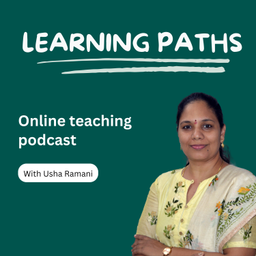
About Learning Paths
AI is already in our classrooms with our learners using it. How then do we leverage it to amplify teachers and learners ?" What becomes the role of a teacher when AI can give instant answers, explain differently and is accessible at any time of the day?? Is giving access to AI to students in exam prep desirable ?/ these are the questions on everyones mind. Because AI is changing the way we teach and learn. And this is the context of our podcast. Welcome to LEARNING PATHS !
- Publisher
- Usha Ramani Vemuru
- Category
- education
- Language
- en
- Explicit
- No
- First episode
- 6 Jul 2025
- Latest episode
- 3 Sept 2026
Latest episodes
16 episodes in the feed.
3 Sept 2026
When the answer is no longer enough
If answers are available everywhere, what exactly is the teacher's role? But there is another side to that question. As teachers, answers have always been useful to us too. I give you a problem. You solve it. I look at your answer. And from that, I make some judgement about whether you understood what I taught. That worked reasonably well when producing the answer itself required some effort. Today, I'm not so sure. Suppose I give a student a physics problem. The student comes back with the correct answer. Perfect working. Correct formula. Correct units. Beautiful explanation. What exactly have I learned about that student? Maybe she solved the whole thing herself. Maybe she struggled with it, made two mistakes, finally understood something and then arrived at the answer. That would be fantastic. Or... maybe she asked AI. Or maybe she attempted half of it, asked AI for help, understood the explanation and completed the rest. That might be perfectly fine too. Or maybe she copied the entire solution without understanding any of it. All three situations can produce almost exactly the same final answer. And that's the problem. The answer has become weaker evidence of learning. I don't mean answers are useless. Of course the final answer matters. If you're designing a bridge, writing software or calculating somebody's medication, eventually getting the answer right is extremely important. But when I'm trying to understand whether somebody is learning, I need to see more than the final output. I need to see some part of the journey. So perhaps instead of only asking: "What answer did you get?" I also start asking: "How did you get there?" "What did you try first?" "Where did you get stuck?" "Why did you choose this approach?" "What did you initially think was happening?" "What changed your mind?" And one of my favourites: "What would happen if I changed one thing in the problem?" Because that's often where understanding becomes visible. A learner might have a perfectly polished answer. But change one condition... and suddenly you discover whether the idea has actually been understood. Or ask: "Can you explain this to me without using the formula?" "Can you give me another example?" "Can you compare two approaches?" "Which solution do you think is better, and why?" Now I'm not simply examining the output. I'm looking at the learner's thinking. And I think this matters enormously in the age of AI. Because we have become very good at judging finished work. Assignments. Reports. Code. Presentations. Essays. Solutions. But AI is becoming extremely good at producing finished work too. So perhaps education has to become better at noticing what happened before the finished work appeared. The attempts. The questions. The wrong turns. The reasoning. The feedback. The correction. The second attempt. Those things can sometimes tell me much more about learning than the polished answer at the end. And I want to be careful here. I'm not suggesting that we start monitoring every single thing a learner does. That's not the point. And I'm certainly not suggesting we make students prove that they never used AI. I actually think AI can be part of the learning process. The important question is: What intellectual work did the learner still do? Did AI help her understand something she was struggling with? Great. Did it challenge her assumption? Great. Did it give her feedback on an attempt? Wonderful. Did it allow her to skip the thinking entirely and hand over a finished answer? That's different. And I think teachers will increasingly have to design learning experiences where that distinction becomes visible. Maybe assessment itself has to change. Instead of one large finished submission... perhaps there are smaller checkpoints.
3 Sept 2026
Are Teachers Still Needed When Answers Are Everywhere?
The classroom has changed. Not because we introduced AI into it. AI is already there. It is sitting in our students' phones and laptops. And sometimes, it is probably sitting under the desk while we are teaching! So the question for teachers cannot really be: "How do we stop students from using AI?" I think the more interesting question is: What does teaching look like when answers are available almost instantly? And maybe an even more uncomfortable question: If AI can explain a concept, solve a problem, summarise a chapter, generate examples and answer questions... what exactly is the teacher needed for? I've been thinking about this a lot. And strangely, the more capable AI becomes, the more convinced I am that the teacher is still extremely important. But perhaps not for exactly the same things. For a long time, one very visible part of teaching was giving information. I know something. You don't know it. I explain it to you. You learn it. That relationship has already changed. A learner doesn't necessarily have to wait for me anymore. If she doesn't understand Newton's laws, she can ask AI. If she wants another example, she can ask AI. If she wants the explanation in Telugu, or in simpler English, or with an analogy involving cricket... she can probably get that too. And actually, I think that is wonderful. Why should a learner have to wait until the next class just because she didn't understand something? But access to explanation is not the same as learning. And this is where I think the teacher's role becomes much more interesting. Maybe our job is becoming less about giving the answer... and much more about deciding what the learner should be thinking about in the first place. What should she attempt? Where should she struggle a little? What question should come next? Has she actually understood this? Can she apply it somewhere else? Is she making an assumption without realising it? Does she know why her answer is right? And sometimes... should I help her now? Or should I actually allow her to stay with the problem for another five minutes? AI can generate a hundred explanations. But somebody still has to think deeply about the learning journey. And that, for me, is where the teacher becomes very important. Think about something as simple as asking a question in class. Earlier, I might ask: "What is the answer?" Today, perhaps I need to ask: "Why do you think that is the answer?" "What assumption did you make?" "What happens if I change this condition?" "Can you solve it another way?" "Where did you get stuck?" "Which part did AI help you with?" And suddenly, I am not competing with AI. I'm doing something different. I'm trying to see the learner's thinking. I also don't think teachers have to become experts in every AI tool that appears. That would be exhausting. A new tool seems to arrive almost every week anyway. What teachers understand far better is something much more fundamental. They understand learners. They understand where students usually get confused. They know which mistake is harmless and which mistake shows a deeper misunderstanding. They know when a student needs encouragement. They know when a student needs another example. And they often know when a student needs to be pushed a little harder. AI can become enormously useful inside that relationship. It can give learners more opportunities to practise. It can respond when the teacher isn't available. It can help a learner explore. It can allow one teacher to support far more learning than was previously possible. BUT ! the future is NOT AI instead of teachers. And definitely not teachers pretending AI doesn't exist. The interesting space is somewhere in between. Teachers guiding learners who now have incredibly powerful AI available to them. And that changes teaching. Maybe our value is no longer simply that we know the answer. Maybe our value is that we know what the learner should do before, during and after getting that answer.
29 Jan 2026
AI wont replace you, it'll MULTIPLY you
AI wont replace you, it'll MULTIPLY you
17 Dec 2025
The power of Co-learning and Corporate Training : Bhavani Ravi
I speak to Software professional turned corporate trainer Bhavani Ravi, who also initiated the co-learning initiative learning.dev. Listen in as she shares 1. Bootcamps in technology domain 2. Co-learning and corporate trainings, the difference and about each of them. 3. The effectiveness of an In- person bootcamp Versus a set of youtube videos on a topic versus a linkedin course. 4. Peer learning or co learning in software. 5. Using AI in our courses and more
11 Dec 2025
AI as a LEARNING partner : GHCI2025 conference inputs (Grace Hopper Celebration India)
I got to share our learnings and work around online teaching and learning at Grace Hopper Conference India 2025, Asia’s biggest conference for women in technology. I spoke on the topic “AI as a learning partner : Equity, Ethics and Empowerment” and am still buzzing with excitement of having met many teachers and learners and technocrats interested in online teaching and learning, who could relate with this topic. At the conference, I emphasised on 3 major points 1. AI as a learning partner Online or offline, a TEACHER should be at the centre of every learning experience. And they should always have a CHOICE whether to use AI or not in their pedagogy. If we observe closely, AI’s role is slowly changing in the classroom, from being a mere tool to being a stakeholder or a partner in the teaching learning space. Let me explain. Unlike traditional tools that always give the same output, AI offers different responses to the same question — and that’s its real beauty and usefulness. It’s time we stop seeing AI as just a tool and start acknowledging it as a partner in the classroom, one that helps teachers and learners amplify their efforts. For example AI can help teachers by being a Teaching Assistant and even an Admin Assistant in the classroom. Teacher can use AI as an admin assistant, to get help around all the admin aspects they have to take care around the classroom. from test taking, attendence, checking assignments and tracking drop outs to repeated explanations in different words, imagine how much time is saved for the teacher. Likewise AI can be a Learning Buddy to the learner amongst other things. What if it comes to the learners rescue helping them in note taking, simplifies explanations and reminds last dates of submission, just like our best buddy at school. 2. Responsible AI in education Information without guidance is just NOISE. Today there is so much information available all over the internet if you want to learn something. Why are there still a lot of dissatisfied learners? Because the challenge NOW is not about information, but having someone who can GUIDE us through all the noise to the right resources. There is a need for that human in the loop, and in education that HUMAN is the teacher. Responsible AI in education is one that amplifies the teachers efforts, NOT replaces them. PERIOD. 3. AI and the future of learning, Online medium holds a lot of promise, to enable the teachers do the one thing tech can’t—ignite a mind. Future of learning will have deep AI integration into the classroom, where AI joins the class, is enrolled in it and knows the content, the videos and assignments teachers and learners are talking about. It intervenes to help both the teachers and learners when asked. Teachers also get to set the persona of their Teaching Assistant prompting it to give it characteristics like ‘friendly’, ‘homourous’, ‘witty’, ‘emphathetic’ and even give it a name. And learners, they will be able to learn well, reach their goals, all while choosing courses and teachers they want to learn from, depending on their need and their pocket size. They get to choose a self paced course to joining a cohort to booking a 1:1 course from their favourite teacher. How exciting are the possibilities, isnt it ?? Finally, I want to reiterate that Online is a very powerful medium whose power we are not leveraging enough YET. What if we could bring online those remarkable teachers who infused the love for the subject in us ? what if they could teach our siblings and kids today. What if we could make it easier for them to earn well and with dignity from the comfort of their homes? What if we can improve the reach and scale of such teachers ?? AI can make it possible. Thats what the future holds for us, I’m super excited for that future.
10 Nov 2025
Cohort Teaching Secrets for niche educators: Prof. Rameshwar Jaju
Prof. Dr. Rameshwar Jaju, a seasoned food safety expert and educator with over 16 years of rich experience bridging academia and industry. Holding a PhD and having served as an Assistant Professor at MGM College of Food Technology, Prof. Jaju has certified thousands of learners across diverse food safety domains and has become a trusted mentor for both niche training and competitive exam preparation. In this episode, he shares his secrets for managing large online cohorts—about 50 engaged students per group—while maintaining that personal connection every learner craves. You’ll hear how building a unique identity and brand before launching your course can set you apart in niche markets. Prof. Jaju also breaks down the small, progressive steps that help you build a robust online teaching business, drawing from candid experiences of what has and hasn’t worked in his digital classrooms. If you’re a trainer looking to grow your impact in specialized fields, or if you’re curious about cohort-based teaching and leveraging tech to connect with learners, this episode is packed with practical wisdom and inspiration. Prof Rameshwar Jaju's courses can be found here : https://courses.foodyaari.co.in/s/store You can connect with Prof Rameshwar Jaju on LinkedIn here : https://www.linkedin.com/in/ft-dr-rameshwar-jaju-289b4110?utm_source=share&utm_campaign=share_via&utm_content=profile&utm_medium=android_app Prof Rameshwar Jaju's Youtube channel :https://youtube.com/@rameshwarjaju?si=eXzscmRjtbyzO2VP
2 Oct 2025
Personalised art classes - Kalpana Yuvraj
On the occasion of Vijayadasami, here is a power woman who is teaching specialised art classes online, helping everyone from professional designers to hobbists find their peace with art. Not only that she also added sloka and pranayamam classes to help her learners. Listen now!
14 Sept 2025
Why AI + 1:1 teaching is the future of learning : Abhishek Kumar
In our very first interview episode, I talk to Abhishek Kumar, a young Maths an Physics tutor who shares his strategies, his unique experiments of using AI to amplify his classroom sessions Tune into his thoughts and ideas for making his tutoring sessions ENGAGING and SUPER helpful for his learners success.
5 Sept 2025
Happy TEACHER's day!
To all the teachers listening—whether you're in your first year or your thirtieth, whether you teach kindergarteners or graduate students, whether your classroom has four walls or exists in the digital space—celebrate your irreplaceable role. You are the gardener of curiosity. You plant questions, tend to wonder, and watch as understanding blooms in ways no algorithm could predict. That's not just your job—that's your superpower. So today, and every day, embrace this truth: invoking curiosity is a raw human emotion that cannot be delegated to a machine. As teachers, this is where we shine brightest, and this is why the world will always need us. Happy Teacher's Day. Keep nurturing curiosity—it's the greatest gift you can give your learners, and yourself.
31 Aug 2025
The 3-2-1 Rule for Ending Every Class with Impact
Picture this: You've just delivered what you think was an amazing lesson on market segmentation to your business students. You covered all the key concepts, used great examples, and even got some good discussion going. But as the clock hits the end time, you realize you have about 30 seconds left and you panic. "Okay, so... um... any questions? No? Alright, see you next week!" And just like that, all the momentum you built over the past hour evaporates. Your students pack up confused about what they were supposed to take away, and you're left wondering if anything actually stuck. [Reframing the Challenge ] If this sounds familiar, here's what's actually happening: you're not failing as a teacher—you're just missing the most crucial 5 minutes of your entire lesson. Here's the truth most of us don't want to admit: how we end our classes matters more than how we start them. Students remember the last thing they experienced, which means those final moments are your greatest opportunity to cement learning. The good news? There's a simple, repeatable system that can transform your class endings from forgettable fade-outs into powerful learning moments. [Introducing the Framework ] Today, I'm sharing the 3-2-1 Rule—a framework that takes exactly 5 minutes and guarantees your students leave every class with clarity, confidence, and commitment. Here's how it works: 3 minutes: The Consolidation Phase 2 minutes: The Connection Phase 1 minute: The Commitment Phase [The System Breakdown ] Phase 1: The 3-Minute Consolidation This is where you help students organize the scattered pieces of information from your lesson into a coherent whole. But here's the key—you don't do this FOR them, you guide them to do it themselves. Try one of these approaches: The Concept Map: Have students draw connections between today's main ideas and previous lessons The Teach-Back: Ask students to explain one key concept to a partner as if teaching a younger sibling The Priority Ranking: Have them rank the day's concepts by importance and justify their choices Success Indicator: You should hear voices throughout the room, not just see heads nodding. Active consolidation is noisy. Phase 2: The 2-Minute Connection Now you bridge today's learning to something bigger—their future, their other courses, their real world. This is where abstract concepts become personally relevant. Use these connection prompts: Future Application: "Where will you use this concept in your career/next course/daily life?" Cross-Pollination: "How does this relate to what you're learning in [other subject]?" Problem Solving: "What real-world problem could this concept help solve?" Success Indicator: Students are making "aha" faces or asking follow-up questions about applications. Phase 3: The 1-Minute Commitment This final minute creates forward momentum. Students don't just leave understanding—they leave with intention. Choose one commitment type: Practice Commitment: "What's one way you'll practice this before our next class?" Curiosity Commitment: "What's one question this lesson raised that you want to explore further?" Application Commitment: "What's one situation where you'll try applying this concept?" Have them write it down or share with a partner—making the commitment concrete and witnessed. Success Indicator: Students are writing, planning, or making specific statements about their next steps. [Implementation Challenge - 45 seconds] Here's your implementation challenge: For the next five classes, set a timer for 5 minutes before your planned end time. When it goes off, shift into 3-2-1 mode no matter where you are in your content. Yes, this might mean leaving some material for next time. But I guarantee the learning retention from a strong ending will be worth more than squeezing in those extra facts. Try the 3-2-1 Rule this week, and watch your class endings transform from afterthoughts into the most impactful moments of your entire lesson.
24 Aug 2025
The Side Hustle Every Classroom Teacher Should Consider
Let's be honest about the reality most classroom teachers face: You're passionate about teaching but worried about finances. You have years of expertise but limited ways to monetize it beyond your salary. You see opportunities to help more students but are constrained by physical classrooms and fixed schedules. Meanwhile, you're watching people with far less teaching experience than you building thriving online courses. Personal trainers, cooking enthusiasts, even hobbyists are creating digital courses and earning significant income. Yet here you are—a trained teacher with proven expertise—limiting yourself to one classroom. Here's how to use online teaching as the perfect side hustle for classroom teachers: Start with the flipped preview model. Create short, focused videos covering foundational concepts that support your classroom teaching. Those 5-7 minute explanations you give repeatedly? Turn them into a library of resources. Your physics students get velocity primers before class, but now entrance exam students across India can access them too. Your classroom teaching becomes the testing ground for content that serves thousands. Build your expertise showcase. Document your best classroom moments—that breakthrough explanation, that perfect analogy, that engaging demonstration. Transform these into reusable digital assets. You're not starting from scratch; you're packaging what already works. This positions you as the expert teacher you already are, not someone trying to become a content creator. Create micro-courses around your specialty. That unique way you teach essay writing to your 12th graders? Package it for entrance exam prep. Your method for making calculus concepts stick? Turn it into a course for engineering aspirants. You're not competing with your school—you're extending your reach to students who could never access your classroom. Use the doubt-clearing advantage. Record answers to common questions from your office hours. Create a searchable library these explanations. Now when students struggle with quadratic equations at 10 PM, they have access to your guidance. This becomes a revenue stream while improving your classroom efficiency. Build recurring income through study communities. Create simple membership sites where students get ongoing support, study materials, and group interactions. Your classroom expertise in managing student discussions translates perfectly to online community building. Finally, let online income enhance classroom teaching. Revenue from digital courses can reduce financial pressure, fund better classroom resources, and give you freedom to focus on what you love about teaching without constant money worries. Several teachers I know have negotiated better positions or reduced hours because their online income gave them leverage. Classroom teachers who develop online side hustles report remarkable changes. Their financial stress decreases dramatically—many earn 2-3x their teaching salary through courses. But equally important, their classroom teaching improves because they're constantly reflecting on what works best. You don't need to choose between classroom teaching and online income. Smart teachers are doing both, using each to strengthen the other. Your years of classroom experience aren't limitations—they're your competitive advantage in the online space. Stop undervaluing your expertise. There are thousands of students who need exactly what you teach, exactly how you teach it. The side hustle isn't about abandoning your calling—it's about expanding your impact and securing your financial future.
17 Aug 2025
Online teaching as an add-on to classroom teaching
here’s this common idea that online teaching is just extra work. But in reality, blending in a little bit of digital magic can actually help you get more done in less time. Think about it: Wouldn’t it be lovely if your classroom time was focused on real discussions, hands-on activities or just helping students with their biggest doubts? That’s exactly what blended learning is about—the best of both worlds. Let’s start with something super simple: try uploading a short recap video or a quick reading list online after class. Maybe it’s just five quiz questions on Google Forms or even your voice note on WhatsApp. Suddenly, the whole learning experience stretches beyond the classroom—but without stretching you thin. And here’s a fun idea: flipping your classroom. No, not literally—although, if you’ve ever wanted to rearrange the benches, go ahead! What I mean is, share a mini-video or some notes with your students to watch before they come to class. That way, when you all meet, you aren’t repeating the basics—you’re diving into debates, doing projects, or exploring what’s tricky. It feels less like a lecture and more like a lively club meeting. Most of us already use WhatsApp with our students or parents, right? Let’s make it our ally. Post reminders, share homework, send encouragement. Or, if you’re up for it, try Google Classroom or any learning app that works on phones—most of your kids probably have those handy already. The trick? Don’t try to update it every day. Set aside a few minutes once a week, maybe after that second cup of chai, and queue up all the resources or messages at once. Your future self will thank you! Now, assessments. I used to spend hours grading tiny class tests. Sound familiar? Online quizzes, even the most basic Google Form, grade themselves. You instantly see who’s struggling, who’s breezing through, and you can spend class time celebrating progress or tackling confusions together. Try it once—just for one chapter. And please don’t think homework always has to be written! Think outside the notebook. Could students record a voice answer? Make a quick sketch or click a picture to explain a concept? Or maybe design three quiz questions themselves and send them in for everyone to try. Once in a while, swap out the boring worksheet for a creative digital twist—you might be amazed how engaged they get. But you know who else needs to stay in the loop? Parents. We all dread the endless calls and messages at odd hours. Here’s a trick: create a template for weekly updates or highlights. You can send it as a WhatsApp broadcast or a post in your online platform. It keeps everyone informed—without eating up your evenings. And here’s where technology is a real friend: automating routine work. Roll calls, birthday wishes, reminders—many platforms let you schedule these. Set it up once, and let it run in the background. Imagine, your “must-dos” getting done while you focus on what you love: teaching. Of course, not all our students have fancy gadgets or broadband. Some can only access voice notes or light documents, and that’s totally fine. Sometimes the simplest methods—a phone call, an audio message, a USB loaded with lessons for the community center—make the biggest difference. Connection is the real goal, not perfection. So, as you head into this week, I challenge you: pick just one online add-on to try. Maybe upload your notes, maybe try that audio homework, or batch those weekly updates. Small steps, big impact.
10 Aug 2025
Building Real Connections Through the Lens
Struggling to connect through the screen? In this episode, discover how to transform the awkwardness of talking to a camera into confident online presence. We break down essential mindset shifts for veteran and new teachers alike—covering eye contact tricks, energy-boosting techniques, and making every virtual class feel engaging (not empty). Tune in for simple, relatable tips to own your virtual stage—without ever sounding preachy.
5 Aug 2025
2nd Episode
Ok, now that we have cracked the first level or engagement in online claases, lets dive deep into
27 Jul 2025
Ways to step up ENGAGEMENT in digital class
How do we step up engagement in the digital class, here are five actionable steps you can try in your next class. Start with a spark Make tech your ally Gamify lessons Personalize & check-in Flip & flow
6 Jul 2025
Learning Paths, a community for teachers to LIFT as we CLIMB
Are you an online teacher struggling to build deeper connections with your learners? Do you want your lessons to spark more engagement and open better opportunities for your students? Maybe you’re a classroom teacher exploring the digital space, or a professional who has conquered tough exams and now wants to guide others, or.... perhaps you are a retired teacher trying out the online medium to continue teaching. Whoever you relate to, YOU know that online teaching is quite UNLIKE classroom teaching and is much more than uploading content. How then do you inspire learners when attention spans are short and competition intense? How do you design courses that ATTRACT, ENGAGE, and TRANSFORM? Namaste and WELCOME to LEARNING PATHS. I’m Usha Ramani—an ex-professor, ed-tech entrepreneur, and a community leader. From classroom lectures to virtual platforms and everything in between, I've learned that online teaching space has MORE potential than ever. From solving real problems for your learners, to building deeper connections with them to designing AI systems that free up your time, the possibilities are endless, if only we leverage them. My mission with LEARNING PATHS is to build a community of passionate online teachers who share, collaborate and lift each other as we climb. where we blend timeless teaching principles with innovative strategies, practical advice, and honest conversations. So whether you’re mastering your craft or exploring new horizons, this podcast is for YOU. Here’s what you’ll discover: Simple techniques to deeply connect and engage learners—wherever they are Practical guidance to transform your expertise into irresistible, life-changing courses Tips and suggestions to improve your confidence with technology. Real stories and insights from both online and offline classrooms Candid interviews with expert teachers who have elevated their impact and income Secrets to build a thriving community around your courses And much much more... If a teacher ever inspired you or shaped your path, now is your chance to become that mentor for someone else. Join our tribe, as passionate teachers like you learn, share and create courses that truly change lives. Well, That's it for today. Until next week, Keep teaching, keep learning.
Reach and audience
Public platform figures. Ratings count people who left a rating, not total listeners.
- Spotify
- 5.0 / 5
- 4 ratings
Host of Learning Paths?
Claim your podcast to manage its listing and keep your show details accurate.
Pod Engine is an independent podcast discovery and analytics service and is not affiliated with or endorsed by this podcast. Artwork and show content belong to their owners. Full legal notice.
Explore this show
Podcast research with Pod Engine