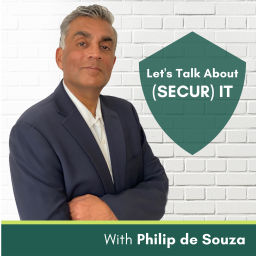
Philip de Souza is the host of Secure (IT) and a cybersecurity veteran with over 30 years of experience. He founded Aurora, leading it to a successful acquisition by Plurilock. Today, Philip is a sought-after keynote speaker and advisor, helping organizations leverage AI and innovative go-to-market strategies.
Deeply committed to philanthropy, Philip co-founded Ainiti (ainiti.org) to support girls' education globally and serves on multiple business boards including the US Chamber’s Small Business Council. When not dissecting the future of tech, he can be for his Harley near his home in LA.
When Cyber Gets Physical: From Digital Risk to Real-World Impact
I sat down with Luis Luque, Managing Director and Global Cyber Physical Security Lead at Accenture, straight from the RSA conference floor, to talk about the intersection of operational technology, physical security, and cyber risk. And honestly, it was one of those conversations that changed how I think about the space.
A few things that stuck with me:
• Most executives still believe OT and IT are separate worlds. They are not. The convergence is already happening, and the companies that pretend otherwise are the ones leaving backdoors wide open.
• Boards are paying attention, but most still cannot answer a simple question: if an OT incident happened tomorrow, who is responsible? Not who should be notified. Who owns it end to end. The silence in that room is the real vulnerability.
• Supply chain risk goes all the way down to the electron microscope level. Some companies are still running critical manufacturing on Windows NT in 2026 because replacing it would cost tens of millions.
• The basics—immutable backups, visibility, and containment—are still the things most organizations get wrong.
Luis made a point that I keep coming back to: the most successful OT security programs are not funded as security projects. They are funded as business enablement. When you can show a plant manager that the right security investment will keep the line running and make their job easier, the conversation changes completely.
If your organization touches anything physical, from a factory floor to a hospital to a data center, this is worth 44 minutes of your time.
17 Sept 2026
From the White House to the Cyber Front Lines: Why No One Can Defend Alone
What if one of cybersecurity’s biggest problems isn’t technology, but the way we’ve chosen to fight?
I sat down with Michael Daniel, former White House Cybersecurity Coordinator and CEO of the Cyber Threat Alliance, to discuss a reality every CEO, CISO, and board member needs to understand:
Your cyber risk is no longer just your risk.
We explore why the old “castle and moat” model is broken, how competitors can collaborate against common threats, what boards still misunderstand about cyber risk, the coming impact of quantum computing, and why fatalism may be one of cybersecurity’s most dangerous mindsets.
As Michael puts it: “Your risk is also my risk.”
The future of cybersecurity won’t simply be determined by who has the best technology. It will be determined by who can collaborate, adapt, and recover faster than the threat.
22 Jul 2026
The Threat They're Not Watching: Signal Intelligence with Hanna Linderstål
"Every organization I've tested — I've always found a way in."
That's not a hacker bragging.That's Hanna Linderstål — a cybersecurity strategist, who teaches digital espionage at the Swedish Defence University, and is one of Europe's most respected voices on autonomous defense.
She started coding at 11. No internet. Just a modem, a phone line, and curiosity that never stopped.
In our latest SecurIT episode, she said something that should keep every CISO up at night:"Most organizations are defensive in posture and delusional in practice."
We talked about:
The signal intelligence blind spot almost no company is watching
Why more data ≠ better security (it's just noise without context)
The OODA loop what the military knows about crisis response that your board doesn't
How a spy was caught downloading files at midnight on a Saturday — and why your systems wouldn't have caught him either
Why the next pandemic might not be biological it might be three weeks without internet
The most uncomfortable quote of the episode?"I have never found an organization where we didn't find a potential risk we could exploit. Not one."
If you're in security, leadership, or you just rely on the internet to run your business — this one's for you.
Reach and audience
Public platform figures. Ratings count people who left a rating, not total listeners.
Apple Podcasts (US)
4.9 / 5
7 ratings
Spotify
5.0 / 5
3 ratings
Podcast Authority Score: 12 / 100
A composite of feed quality, social presence, YouTube performance and engagement. Read the methodology.
Quality
12
Social presence
0
YouTube
0
Engagement
32
Host of Let's Talk About (Secur)IT?
Claim your podcast to manage its listing and keep your show details accurate.
Pod Engine is an independent podcast discovery and analytics service and is not affiliated with or endorsed by this podcast. Artwork and show content belong to their owners. Full legal notice.
Explore this show Podcast research with Pod Engine