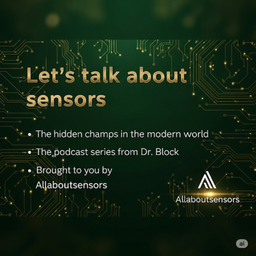
The podcast series by Dr. Thomas Block
Welcome to AllAboutSensors, the podcast dedicated to the invisible technology that powers our modern world.
Hosted by an industry expert and product manager with deep roots in solid-state chemistry and Physics, this show bridges the gap between complex sensor engineering and the consumer electronics we rely on every day. We explore the cutting-edge developments driving the next generation of smart devices, wearables, and robotics.
Die Fibonacci-Folge ist eine unendliche Reihe natürlicher Zahlen (0, 1, 1, 2, 3, 5, 8, usw.), bei der jede Zahl die Summe der beiden ihr vorangehenden Zahlen ist.
Historischer Ursprung: Benannt ist die Folge nach Leonardo Fibonacci, der damit im Jahr 1202 das Wachstum einer Kaninchenpopulation modellierte. Das Prinzip war jedoch schon in der Antike in Griechenland sowie in Indien (unter anderem zur Untersuchung von Versmaßen in der Poesie) bekannt.
Mathematische Eigenschaften: Je weiter die Folge fortschreitet, desto mehr nähert sich der Quotient zweier aufeinanderfolgender Fibonacci-Zahlen dem Goldenen Schnitt (ca. 1,6180) an. Die Glieder der Folge lassen sich durch verschiedene Methoden berechnen, darunter das Pascalsche Dreieck oder die Formel von Moivre-Binet.
Vorkommen in der Natur: Die Zahlenfolge beschreibt zahlreiche Wachstumsmuster in der Biologie. Typische Beispiele sind die spiralförmige Anordnung von Blättern, Blüten und Samen (etwa bei Sonnenblumen oder Fichtenzapfen), der Ahnenstammbaum von unbefruchteten männlichen Bienen (Drohnen) sowie die Anzahl möglicher Strukturvarianten bei bestimmten Fettsäuren.
Kunst und Kultur: Aufgrund ihrer besonderen Ästhetik und Verwandtschaft zum Goldenen Schnitt wird die Folge häufig in Kunst, Architektur, Literatur (z. B. in Dan Browns Sakrileg) und Musik (z. B. bei der Band Tool) als strukturelles Element aufgegriffen.
9 Oct 2026
Zero Bars, Infinite Reach: The Microscopic Symphony Turning Smartphones into Orbital Beacons
Terrestrial mobile networks rely on a fragile ground infrastructure vulnerable to storm damage and power outages, but modern smartphones can bypass failed local grids by connecting directly to Low Earth Orbit satellites. Because these fast-moving orbital links face severe Doppler shifts, extreme bandwidth constraints, and signal attenuation through walls and human bodies, devices restrict traffic to vital emergency payloads and require users to aim the handset outdoors. To align a narrow, power-efficient transmission beam, smartphones merge data through real-time sensor fusion: GNSS calculates exact positions and orbital trajectories, an IMU tracks 3D spatial tilt to prevent body shadowing, and a TMR magnetometer filters internal electronic noise to establish an accurate heading toward the satellite. Finally, onboard barometric pressure sensors solve the Z-axis problem by providing critical vertical elevation for rescue teams, establishing a decentralized communication model resilient against both natural disasters and deliberate ground network shutdowns.
2 Oct 2026
History of Lauersfort Castle in Moers Kapellen
Today the podcast is not about sensors. it is about Schloss Lauersfort in Moers in Germany
28 Sept 2026
Tiny sensors that detect indoor chemicals, the hidden threat at your home
The Bosch BME680 is a highly compact, 4-in-1 environmental sensor designed to measure air pressure, temperature, humidity, and gas (volatile organic compounds) to improve indoor air quality and enable smart tracking.
The Problem: Modern, highly insulated buildings trap volatile organic compounds (VOCs) emitted by everyday items and human breath; accumulating VOCs can cause headaches, reduce concentration, and lower overall productivity.
Sensor Technology: The BME680 detects these VOCs using a heated tin dioxide (SnO2) metal oxide layer. As different gases flow over the heated surface, the sensor measures the resulting changes in electrical conductivity.
High Precision: The integrated air pressure sensor boasts an accuracy of ±12 Pa, which allows it to determine altitude changes precisely down to ±1 meter. This makes it ideal for accurate indoor navigation, such as pinpointing a user's exact floor within a multi-story building.
Compact Design: Measuring just 3 x 3 x 0.95 mm³, the chip is exceptionally small and utilizes intelligent algorithms to ensure low power consumption.
Applications: Because of its energy efficiency and size, it is actively deployed in smart home electronics like the Bosch Smart Home Twinguard smoke detector. It is also highly suited for mobile IoT applications, wearables, elder care monitoring, and personalized weather stations.
17 Sept 2026
Personal Air Quality Measurement & Advanced Sensor Technologies with VOC & PM2.5 sensors
Bosch Sensortec is transitioning air quality monitoring from aggregate public data to highly localized, real-time personal tracking. By eliminating bulky mechanical fans and utilizing natural ambient air flow, Bosch has shrunk optical fine particulate (PM2.5) sensors down to 1/500th of their traditional volume—roughly the size of a match head—allowing them to fit into flat consumer devices like smartphones. Paired with the BME680 (the world's smallest 4-in-1 gas sensor for detecting volatile organic compounds), these ultra-compact sensors leverage artificial intelligence and machine learning to power smart applications, ranging from real-time forest climate mapping for early wildfire detection to predictive smart diaper alerts.
12 Sept 2026
Quantum tunneling explained
Quantum tunneling is a quantum mechanics phenomenon where particles pass through energy barriers they classically lack the energy to overcome. Because matter has wave-like properties, a particle's probability wave can extend into and leak through these forbidden regions
The 2025 Nobel-Winning Breakthrough
2025 Nobel Prize: Scientists John Clarke, Michel Devoret, and John Martinis received the award for demonstrating that macroscopic, hand-sized electrical circuits can behave like single quantum particles.
The Mechanism: Quantum tunneling occurs when a particle passes through an energy barrier it classically lacks the energy to cross, a process made possible by the wave-like nature of matter.
Macroscopic Proof: The laureates utilized superconducting circuits equipped with Josephson junctions and cooled them to near absolute zero. This environment allowed billions of paired electrons to move collectively and "tunnel" through energy barriers rather than transitioning smoothly, confirming quantum behavior on a macroscopic scale.
Real-World Applications: While tunneling naturally drives processes like solar fusion and radioactive decay, it is also the foundational mechanism for modern technologies like flash memory, quantum sensors, and superconducting qubits in quantum computers.
10 Sept 2026
What is WiFi 6, 7 and 8 why do we need barometers here?
The discussion focuses on how Wi-Fi 6E and Wi-Fi 7 access points must comply with FCC regulations by accurately reporting their vertical location to prevent signal interference.
The Regulatory Challenge: To operate in the 6 GHz spectrum without disrupting microwave links or satellite communications, the FCC requires access points to report their Height Above Terrain (HAT) with 95% confidence. Standard GPS is insufficient because it measures Height Above Ellipsoid (HAE)—a theoretical model—rather than actual ground clearance.
The Practical Hurdle: Manually measuring height or dispatching technicians ("truck rolls") for millions of devices is too slow and expensive. Meanwhile, relying on standard barometric pressure sensors introduces errors due to sensor drift and shifting weather patterns.
The Technical Solution: Access points use ultra-low drift barometric sensors (such as those from Bosch Sensortec, with drift under \pm10\text{ Pa} per year) calibrated after manufacturing.
Cloud Integration: Sensor data is sent to a cloud platform (NextNav Pinnacle), which cross-references the readings with localized, real-time weather data and a network of ground-level pressure stations to filter out weather noise and calculate precise HAT.
Key Benefits: The system provides automated, out-of-the-box FCC compliance, supports continuous monitoring if a device is moved, and eliminates the cost of manual deployment.
3 Sept 2026
Introduction to barometers with technologies, use cases and applications
Barometric pressure sensors in consumer electronics have evolved from simple weather tools into ultra-precise, low-cost components capable of measuring altitude changes within centimeters.
* Technological Shift: While piezoresistive sensors were the traditional standard, modern capacitive sensors (such as the BMP580) offer major leaps in efficiency, including an 85% reduction in current consumption and 80% lower noise to significantly extend battery life.
* Emergency Response: High-precision sensors meet regulatory requirements like the US E911 mandate—which requires 3-meter vertical accuracy for 80% of calls—enabling first responders to pinpoint exact building floors.
* Activity and Health Tracking: Sub-4-centimeter vertical resolution allows devices to detect micro-pressure shifts as small as 2 Pascals (equivalent to the mass of a mosquito), enabling single-stair detection, rep counting, and potential future applications like cuffless blood pressure monitoring via the ear canal.
* Infrastructure and Compliance: Standard-power 6 GHz Wi-Fi access points utilize height-above-terrain (HAT) readings from these sensors to comply with FCC interference regulations and prevent disruptions to satellite and microwave communications.
3 Sept 2026
Exciting world of magnetometers
Tunnel Magnetoresistance (TMR) is a revolutionary sensor technology that uses quantum mechanics to deliver up to 100 times better sensitivity and 90% lower power consumption than traditional magnetometers. This massive leap in efficiency and precision makes TMR an essential building block for next-generation electronics, powering applications like lag-free AR/VR headsets, 3D spatial audio, and advanced robotics.
3 Sept 2026
Smartphone barometers give robots human touch
This episode explores how cheap, mass-produced smartphone barometers are solving a decades-old bottleneck in robotics by giving machines a near-human sense of touch. By sealing these micro-sensors inside fluid-filled elastomer skin, engineers are combining hardware hacks with advanced AI to allow robots to handle fragile objects with unprecedented precision.
Core Topics Covered
The Smartphone Hardware Hack: Repurposing tiny barometric pressure sensors—originally designed to track weather and altitude in phones—into dense tactile arrays for robotic fingertips.
Translating Pressure to Touch: How sealing these sensors in gel or air pockets allows robots to detect shear force and slip instantaneously via fluid dynamics, mimicking the human reflex to tighten a grip on a slipping glass.
AI Super-Resolution: How deep neural networks process pressure waves to mathematically "fill in the blanks" across 6-millimeter physical dead zones between sensors, achieving sub-millimeter tactile resolution.
Real-World Application: A breakdown of how this exact architecture was integrated into Sanctuary AI’s Phoenix humanoid to achieve touch sensitivity as light as 5 millinewtons.
Scaling to Full-Body Skin: The practical and psychological implications of expanding this technology across a robot's entire chassis, creating machines capable of sensing environmental changes as subtle as a gentle breeze or a tap on the shoulder.
Target Audience
Hardware engineers, AI developers, and anyone tracking the rapid physical evolution of humanoid robotics.
Reach and audience
Public platform figures. Ratings count people who left a rating, not total listeners.
Spotify
5.0 / 5
1 ratings
Contact Let‘s talk about sensors by Dr Block
Guest appearances
Does not typically book guests
Based on episode analysis; this does not confirm that the show is currently accepting guests.
Host of Let‘s talk about sensors by Dr Block?
Claim your podcast to manage its listing and keep your show details accurate.
Pod Engine is an independent podcast discovery and analytics service and is not affiliated with or endorsed by this podcast. Artwork and show content belong to their owners. Full legal notice.
Explore this show Podcast research with Pod Engine