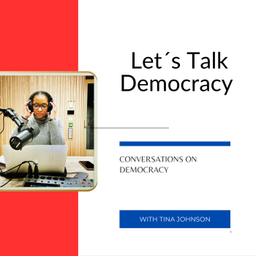
In a time when misinformation spreads like wildfire and populist movements are gaining momentum globally, it’s easy to feel disheartened. But Let’s Talk Democracy is here to remind us that democracy isn’t something we can afford to take for granted. It’s something we need to fight for, nurture, and protect. This podcast is a small but significant part of that fight—helping to cultivate hope, share knowledge, and inspire action.
At its core, Let’s Talk Democracy is a reminder that even in the darkest times, there’s always room for dialogue, reflection, and change. And that, in itself, is an act of democracy.
Let’s Talk Democracy will be in conversation with a wide variety of people whose efforts and ideas can move us toward a stronger democracy. It's important to be in dialogue with individuals who represent the diverse range of ideas that are permissible within a democracy. By engaging with these voices—whether they come from experts, activists, community leaders, or everyday citizens—we can begin to see the many facets of democracy and how we can strengthen it, together.
Where Power Lives: Activating Your Local Mutual Aid Hub
Welcome back to Let’s Talk Democracy! We are officially back from our summer hiatus with our very first workshop episode. After an intentional break spent balancing my work as a visual artist, launching my book Arctic Impressions, and finding stillness in the mountains of Northern Norway, I am thrilled to dive into an entirely new format for Season 4.
This season, we are moving past high-level political hyperbole and daily media headlines. We are shifting from a traditional talk show into an operational, hands-on masterclass. Our podcast is now your audio companion guide to building, exercising, and maintaining your hyper-local "democracy muscles."
In this episode, we are systematically unpacking Module 1: The Local Mutual Aid Hub from our newly launched Global Action Toolkit. Mutual aid is not a modern trend—it is a deeply historical, resilient framework of governance seen in the history of the Ollas Comunes in Latin America and the Emergency Response Rooms in Sudan.
To help us move from theory into practice, we revisit the words of our Season 3 guest, Vjolla Emiri (https://letstalkdemocracy.alitu.com/episode/e75aaa72-be4c-4bbf-9581-c936fc05e3dd?_gl=1*13i6010*_gcl_au*MTkyNTkxMTM0OC4xNzkwNTgxNDYy), who dropped a powerful reminder that our internal power and dignity can never be taken away—it just needs a structured space to be activated. We also look ahead at how this groundwork sets up next week's cross-partisan salon session using the polarization data of Dr. Alice Siu (https://letstalkdemocracy.alitu.com/episode/ad47cd4d-e48c-4a81-b1db-b63ba7a40ef9?_gl=1*13i6010*_gcl_au*MTkyNTkxMTM0OC4xNzkwNTgxNDYy).
Your Homework For This Week:
Download the Blueprint: Access the open-source Let’s Talk Democracy Global Action Toolkit PDF (https://static1.squarespace.com/static/61070848e188440329ff115d/t/6a2912424927e61b34ef5f37/1781076546875/Let_s+Talk+Democracy+-+Season+3+Global+Action+Toolkit+copy.pdf).
Print Your Ledger: Turn to page 6 and pull up Template 1.1: The Neighborhood Skills & Assets Audit Ledger. Print a copy for your clipboard or your fridge.
Engage Your Block: Use our conversational roleplay framework to talk to just three neighbors this week about compiling an old-school emergency contact and tool list.
Tag Your Progress: Take a photo of your printed layout pinned to an apartment lobby, park kiosk, or your bulletin board. Tag our show on social media so we can watch democracy waking up on your block!
As U.S. President Dwight D. Eisenhower famously noted: "Politics ought to be the part-time profession of every citizen who would protect the rights and privileges of free men." Let’s stop just analyzing. Let’s get to work.
Resources Mentioned in this Episode:
The Companion Guide: Download the Free Global Action Toolkit PDF
Vjolla’s Feature Archive: "Mutual Aid: Where Democracy Lives" ft. Vjolla Emiri
Alice’s Feature Archive: "Fixing Broken Conversations" ft. Dr. Alice Siu
If you believe democratic participation is an active muscle worth exercising, please subscribe to the show on your favorite app, drop a rating on our page, and share this audio guide with a neighbor!
29 Sept 2026
Let’s Talk Democracy — Season 4 Trailer: Less Talking, More Doing
We are officially back from summer hiatus, but Let’s Talk Democracy is shifting gears.
After three seasons of deep, philosophical analysis of global headlines and democratic erosion, host Tina Johnson is pulling the conversation out of the abstract ether and onto the pavement. Season 4 is no longer just a talk show—it is an audio field guide and operational workshop designed to help you strengthen your community's "democracy muscles.”
Built directly upon the frameworks of favorite past guests like Vjolla Emiri (https://letstalkdemocracy.alitu.com/episode/e75aaa72-be4c-4bbf-9581-c936fc05e3dd) and Dr. Alice Siu (https://letstalkdemocracy.alitu.com/episode/ad47cd4d-e48c-4a81-b1db-b63ba7a40ef9), this season will systematically unpack our community-driven blueprints to fight political helplessness and polarization right on your own street.
Your Homework Before Episode 1 Drops Next Week:
Download the Blueprint: Get your copy of the Let’s Talk Democracy Global Action Toolkit PDF (https://static1.squarespace.com/static/61070848e188440329ff115d/t/6a2912424927e61b34ef5f37/1781076546875/Let_s+Talk+Democracy+-+Season+3+Global+Action+Toolkit+copy.pdf).
Review Module 1: Flip to page 6 and take a look at Template 1.1: The Neighborhood Skills & Assets Audit Ledger.
Subscribe & Share: Make sure you are subscribed on your favorite podcast platform so you don't miss the Episode 1 premiere next week.
As President Dwight D. Eisenhower once said, "Politics ought to be the part-time profession of every citizen who would protect the rights and privileges of free men." Let's stop just analyzing the breakdown of democracy. Let's get to work.
10 Jun 2026
Don’t Run for President - Organize Your Block (The Season Wrap-Up)
If you’ve been scrolling through your feeds lately, you’ve probably felt it—that heavy, unmistakable sense of emotional whiplash. One minute you're watching international unrest flare up, and the next you're reading about the systemic strain fracturing democracies worldwide. It feels massive, overwhelming, and entirely out of our hands.
But in this special host-only season finale, we are turning the tables on political despair.
We are unpacking the raw mechanics of "democratic scaling"—the structural reality that real, resilient democratic change doesn't trickle down from the top; it scales up from hyper-local, street-level actions. This episode is your step-by-step masterclass on how regular people across the globe are keeping democracy alive when formal institutions falter.
Get Your Free Companion Resource
Don't spend this summer scrolling in anxiety. Our team at Pattern Change Lab has translated every single model from this episode into a plug-and-play, printable PDF toolkit for your neighborhood. It features the Skills & Assets Audit Ledger, Printable Citizens' Salon Placards, and a 2-Minute Public Comment Script for your next city council meeting.
👉 DOWNLOAD THE TOOLKIT: Go to patternchangelab.com/letstalkdemocracy/toolkit (https://www.patternchangelab.com/letstalkdemocracy/toolkit) .
Pick one model, organize your street, and change the pattern. See you back here this September for Season 4!
Brought to you by: Pattern Change Lab
#CommunityOrganizing #Mutual Aid # Local
Grassroots Democracy, Community Organizing, Mutual Aid Network, Citizens Assemblies, Participatory Budgeting, Local Government, Public Policy, Social Movements, Political Activism, Civic Engagement
Inside a recent episode
From the Archive: The Resistance For. A Free Iran Comes From Its People
Published 12 May 2026 · Transcript excerpt
[…] Their activity is increasing, their numbers increasing, and they're keeping the flame of resistance elected. So when you put all of those different aspects together, and the fact that this resistance movement actually has dedicated members, people like myself that have dedicated decades of their lives, but they're people who've dedicated dedicated like 50 years of their lives, 40 years of their lives to this movement. That kind of dedication, that's something that you know, and you know that it can't be for power because there were easier ways to gain power than to dedicate four decades of their life to a cause. […]
Pod Engine is an independent podcast discovery and analytics service and is not affiliated with or endorsed by this podcast. Artwork and show content belong to their owners. Full legal notice.
Explore this show Podcast research with Pod Engine