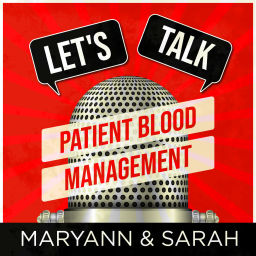
Patient Blood Management (PBM) is the standard of care everyone should discuss, but few do. Sarah is a leading implementation specialist in PBM and brings awareness to improving and managing blood health. Whether you are a trained medical professional or a healthcare consumer, this podcast will raise awareness and expand your knowledge, enabling you to make more informed healthcare decisions.
Are We Creating a Disease or Finally Recognizing Iron Deficiency?
What if a woman can be iron deficient and still not be anemic?
In Part 2 of my conversation with Professor Vernon Louw, we continue unpacking a clinical blog that questioned whether raising the lower limit of normal ferritin from 15 to 30 is simply creating a new disease in otherwise healthy people.
Vernon brings a very different perspective.
We talk about what the evidence tells us about ferritin below 30, why waiting for anemia may mean waiting too long, the symptoms women can experience before anemia develops, and why heavy menstrual bleeding deserves much more attention.
We also explore some unexpected territory—from bleeding disorders and the developing baby to the possible impact of changing nutrient levels in our food.
At the heart of the conversation is a deceptively simple question:
Should iron deficiency without anemia be recognized and treated, or are we medicalizing normal physiology?
And Vernon leaves us with a powerful message:
“Women have suffered for so many generations for so many reasons. Let's not make iron deficiency an additional one.”
Attend Dr. Louw's Masterclass on Iron Deficiency: https://academy.emguidance.com/course/iron-masterclass (https://academy.emguidance.com/course/iron-masterclass)
Visit our Website:
https://www.letstalkpbm.com/ (https://www.letstalkpbm.com/)
27 Sept 2026
When "No" Becomes a Choice: Jehovah's Witnesses & Blood Transfusions
For generations of Jehovah's Witnesses, blood transfusionwasn't really a medical decision. The answer was simply no.
Now, for many blood components, that decision has becomea personal choice. But having a choice raises a new question: How do you make an informed one?
In this episode, Sarah sits down with Ben Walker, a former Jehovah's Witness elder who once provided pastoral support to Witness patients facing life-and-death medical decisions. Together, they talk candidly about the recent change and the questions it raised for him about blood transfusion.
What are the real risks of transfusion today? When canblood be lifesaving? When might it be avoided? What alternatives are available through Patient Blood Management? And what should patients ask their medicalteam before saying yes or no?
This isn't a conversation about telling anyone what decision to make. It's about understanding your options so the decision can truly be yours.
Resources Discussed:
https://www.shotuk.org/ (https://www.shotuk.org/)
Pattakoset al., Arch Intern Med 2012 – PubMed (https://pubmed.ncbi.nlm.nih.gov/22751620/)
EurekAlertpress release on Pattakos study (https://www.eurekalert.org/news-releases/797474)
Marik& Corwin, Crit Care Med 2008 – PubMed (https://pubmed.ncbi.nlm.nih.gov/18679112/)
Reviewof JW cardiac surgery outcomes – PMC (https://pmc.ncbi.nlm.nih.gov/articles/PMC8446884/)
Visit our website:
https://www.letstalkpbm.com/ (https://www.letstalkpbm.com/)
7 Sept 2026
Are You Really "OK"? What Doctors Are Missing About Iron Deficiency.
Is iron deficiency without anemia a real diagnosis, or ismedicine turning healthy women into patients?
Prof. Vernon Louw, researcher, professor, and Executive Headof the Department of Medicine at the University of Stellenbosch, is an international authority on the global burden of iron deficiency and anemia. In Part 1 of this two-part conversation, he joins Sarah Walbolt, BSN RN, to takeapart a widely shared blog post arguing that raising the lower limit of normal ferritin from 15 to 30 in women creates a disease out of thin air.
Prof. Louw explains what ferritin actually measures, whyiron deficiency anemia is the last stage of iron deficiency rather than the first, and why the old reference range of 15 came from studies that never asked women about their periods. He walks through the evidence linking a ferritinunder 30 to fatigue, hair loss, pregnancy outcomes, fertility, and a 46% relative increase in Alzheimer's risk in a study of 70,000 adults. And he names the pattern plainly: when we tell women that heavy bleeding and exhaustion arenormal, that is medical gaslighting.
If you have ever been told your labs are normal while youstill felt awful, listen to this one.
Part 2 is coming soon.
Your Blood. Your Health.
This podcast is for education and is not medical advice.Talk to your own clinician about your labs and your care.
Visit our website: https://www.letstalkpbm.com/ (https://www.letstalkpbm.com/)
Reach and audience
Public platform figures. Ratings count people who left a rating, not total listeners.
YouTube views
18,318
Score snapshot 15 Sept 2025
Apple Podcasts (US)
4.7 / 5
12 ratings
Spotify
4.8 / 5
22 ratings
Podcast Authority Score: 54 / 100
A composite of feed quality, social presence, YouTube performance and engagement. Read the methodology.
Quality
48
Social presence
0
YouTube
76
Engagement
77
Host of Lets Talk Patient Blood Management?
Claim your podcast to manage its listing and keep your show details accurate.
Pod Engine is an independent podcast discovery and analytics service and is not affiliated with or endorsed by this podcast. Artwork and show content belong to their owners. Full legal notice.
Explore this show Podcast research with Pod Engine