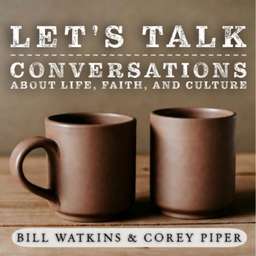
Let's Talk! with authors Bill Watkins and Corey Piper
Corey Piper
5.0from 1 ratings
- 19
- Episodes
- 1
- Ratings
- Monthly
- Cadence
- 2025
- First episode
About Let's Talk! with authors Bill Watkins and Corey Piper
Join Bill Watkins and Corey Piper—colleagues, authors, and friends of 20 years—as they reason together on timeless theological and cultural topics. Like sitting around drinking coffee with a good friend, these conversations weave together questions, fresh revelations, and practical insights. Whether unpacking Scripture or modern dilemmas, expect an honest exploration that sparks learning and growth.
- Publisher
- Corey Piper
- Category
- religion & spirituality
- Language
- en
- Explicit
- No
- First episode
- 2 Dec 2025
- Latest episode
- 1 Sept 2026
Latest episodes
19 episodes in the feed.
1 Sept 2026
God's Law vs Marx's Ten Measures | Let's Talk - Ep. 14
Marx published ten measures for advanced countries. God spoke ten commandments. Corey Piper and Bill set them side by side. They start in the original Communist Manifesto—abolition of land and inheritance, a state bank and state schools, industrial armies, the family treated as a bourgeois cash arrangement—then walk the Decalogue: no other gods, no vain speech, Sabbath limits on labor, honor father and mother, do not murder, do not commit adultery, do not steal, do not bear false witness, do not covet. Scripture, not the party, is the last word (sola Scriptura). Glory belongs to God, not the state (soli Deo Gloria). Marxism must break that loyalty so the collective can raise the child, own the field, and define truth. That is why communism is necessarily atheistic, why it has no doctrine of human rights, and why its “solutions” amplify the class divide they claim to abolish. History from Pearl Harbor to Stalin to the Gulag, and the present American mood—softness toward socialism among the young, pressure on family and speech—are the same contest in a new accent. Recommended reading from the episode: the Manifesto itself, Exodus 20, and The Black Book of Communism. Chapters: 00:00 — Cold open: why this conversation now 00:39 — Honor your father and mother: a decision that changed a life 01:53 — Vietnam, the draft, and a father’s strategic choice 07:30 — From WWII ally to Cold War enemy 13:15 — Fascism and communism: opposite banners, same total state 17:20 — Marx’s ten measures, read from the Manifesto 22:29 — Why private property must go—and why religion must go with it 27:27 — Ten Commandments vs. ten planks 37:27 — Authority, truth, work, family, life, marriage, property, speech, desire 55:11 — The Black Book of Communism 57:32 — Wake up
2 Aug 2026
O Death, Where is Your Sting? | Let's Talk - Ep. 13
“O Death, Where is Your Sting?” In a culture that either softens death into something sentimental or tries to outrun grief entirely, Corey Piper and Bill Watkins face it squarely. Through personal loss, the quiet companionship of grief, and the clear gospel of 1 Corinthians 15, they show why the sting of death is real—yet not final. Christ has already conquered it. The scars remain. Hope does too. Listen to Episode 13 of Let’s Talk.
1 Jul 2026
Who Says? The Battle for Biblical Authority in an Age of Doubt.
In this episode, Bill Watkins and Corey Piper are going to enter into a discussion about authority. Authority is very much misunderstood today and sometimes it's given a very bad name. But we all live under authority, but we also trust authorities. There are certain authorities we trust and certain ones we don't. How do we know which ones we should trust and how do we know which ones we shouldn't? Join the Conversation! 00:00 – 02:15: Opening Banter & Listener FeedbackDog stories, coffee chat, positive responses to prior episodes (esp. "Atheism on Trial"), and growing subscriptions. Ties personal life to the podcast's impact. 02:15 – 05:57: Death, Authority, and Wrestling with ScriptureDiscussion of death as revelation, To Conquer Death, and why biblical authority matters amid suffering. Contrasts evolutionary views (death as normative) with God's redemptive plan. Sets up the cultural relevance: Christians playing "fast and loose" with Scripture's authority. 05:57 – 14:45: What Is Authority? Person vs. Written AuthorityBill defines authority as ultimately personal ("Who says?"), trust, reliability, and expertise. Gleason Archer story illustrates building credibility. Cultural note: Parallels modern "expert" culture (scientists, politicians, influencers) vs. humble, teachable leaders like MacArthur and Sproul. 14:45 – 19:57: Trust, Teachability, and the Enemy's TacticsDisagreement among respected teachers (e.g., eschatology), character tests, and erosion of Scripture via subtle undermining (Moses as composite figure). References 2 Timothy 4:3-4 (itching ears, tailored teaching). 19:57 – 29:33: Biblical Criticism's Roots and FlawsGerman higher criticism (source/form/redaction), JEDP theory, and literary misunderstandings. Reformation parallel: Return to the plain sense of Scripture against traditions that nullify it (Mark 7). Modern American tie: Postmodern "reader-response" meaning-making in media and academia. 29:33 – 35:38: Gnosticism, Postmodernism, and the Danger of "What Does This Mean to You?"Spiritualizing texts vs. discovering authorial intent. Words carry meaning; Scripture is God-breathed (2 Tim 3:16-17; 2 Pet 1:20-21). 35:38 – 46:07: Inspiration – God-Breathed and LivingWarnings against adding/subtracting (Deut 4:2; Prov 30:5-6). Howard Hendricks on clear passages convicting us. Artistic/musical analogies for inspiration (including drug-free vs. drug-influenced experiences). 46:07 – 50:55: Traditions vs. Scripture; Pharisaic ErrorsGreek Orthodox/Mennonite/Amish examples. Jesus rebuking traditions that void God's Word. Reformation cry: Sola Scriptura over accumulated human traditions. 50:55 – 1:02:48: Personal Encounters with False TeachersBill's philosophy prof and "Bible as literature only"; Corey's youth group infiltrator. Subtle control tactics and 2 Timothy 4. 1:02:48 – 1:14:20: More on False Teachers, Calvin, and Primary SourcesCalvin refuting "extreme Calvinism"; divisions (1 Cor 3); reading primary sources (Institutes). Strong call to test everything Berean-style (1 Thess 5:21; 1 John 4:1). 1:14:20 – 1:29:15: Standing Firm – Courage, Gentleness, and ApplicationGalatians 1:10 (pleasing God, not man); 2 Tim 2:24-25 (patient instruction); James 1 (doers of the Word). Humility, teachability, and rejecting hubris. 1:29:15 – 1:42:06: General Revelation, Beauty, and God's AuthorityNatural order, math/music of the universe (Kepler's Harmonies), image-bearers. Ties to Reformation appreciation for God's sovereignty in creation. 1:42:06 – End: Satan's Tactics, Repentance, and SalvationDoubt ("Did God actually say?"), wolves in sheep's clothing, scoffing (2 Pet 3), sensual lures, and the call to courageous, gentle fidelity. Ends with hope in the cross and salvation.
19 Jun 2026
Faction, Freedom, and Faith: Why Disagreement Protect Liberty. | Let's Talk Ep. 11
In our current cultural moment, we see intense pressure toward enforced ideological conformity — whether through institutional speech codes, cancel culture, or political movements that treat disagreement as an existential threat. The biblical witness pushes back: genuine liberty and genuine truth-testing require room for factions. Suppressing them in the name of “unity” or “safety” usually serves the powerful and harms the pursuit of what is true. James Madison warned that the only ways to eliminate factions are to destroy liberty or to force everyone into the same opinions and passions. The Bible agrees that factions are inevitable in a fallen world — yet it also shows us that God can use even our disagreements to reveal what is genuine (1 Cor. 11:19). The Christian calling is not to pretend we have no factions, nor to weaponize the state to crush them, but to speak truth in love, test all things by Scripture, and protect the liberty of conscience.Key Topics Covered:Obstacles to genuine conversation — Worldview clashes and personal moral triggers (e.g., hidden guilt making someone defensive when faithfulness in marriage is discussed).Judging vs. condemning; hypocrisy charges — The difference between assessing behavior and hypocritical condemnation; how attacks on Christian imperfection mirror attacks on America’s founders.The sufficiency of grace (sola gratia) — God’s grace is enough not because we become instantly perfect, but because Christ’s perfection covers us while the Spirit sanctifies us over time. This counters the “Christians claim to be perfect” smear.James Madison on factions (Federalist No. 10) — Definition of faction; the two “cures” (destroy liberty or force uniformity of opinion/passions/interests); why both cures are worse than the disease.Liberty as oxygen to factions — You cannot have ordered liberty without disagreement; attempts to manufacture perfect consensus require propaganda + coercion.Constitutional republic vs. pure democracy — The founders designed structures to protect minority views from majority tyranny; this is the opposite of “democracy” as weaponized majority rule.Critique of the modern left’s project — The push to eliminate “bad” factions while empowering state-aligned ones; the illusion that the state can deliver utopia without eventually consuming individual expression.Utopian visions vs. Christian realism — Star Trek-style cashless/jobless societies and similar dreams ignore human ambition, curiosity, sin, and the need for meaningful work; they collapse under scrutiny.Holistic salvation and cultural engagement — The gospel saves from the penalty, power, and (ultimately) presence of sin; Christians are called to be salt and light in every sphere, including law and government, without imposing theocratic coercion.Moral law / natural law vs. relativism — Objective moral standards exist and are written on the heart; “my truth” factionalism destroys society because it has no transcendent anchor.Christian involvement in politics and law — Obey just laws while working to repeal unjust ones; examples of overzealous or inept laws; the church’s role in teaching values that shape culture rather than retreating to “only the gospel.” Pacifism, just war, and the use of force — Brief but clear acknowledgment that Christians have long disagreed on this; the state’s God-given role (Romans 13) to restrain evil does not require every believer to carry arms. God’s sovereignty over history — Even amid messiness and human failure, God remains in control (echoing Calvin’s emphasis); we can engage faithfully without panic or despair.
7 Jun 2026
Eyes to See | Let's Talk - Ep. 10
Discover how impactful teachers shape our lives and instill valuable lessons. Bill and Corey share personal stories about the teachers who left permanent marks on their souls—a PE coach who forced perseverance, a kindergarten teacher who showed compassion, and professors who taught them how to actually learn and see objective truth in a world that increasingly prefers feelings and slogans. Drawing on personal stories and Scripture, they explore why real education forms character and points us toward what is true, good, and beautiful.
23 May 2026
Atheism on Trial | Let's Talk - Ep. 9
In Episode 9, “Atheism on Trial,” Bill Watkins and Corey Piper turn a real-time social-media skirmish with a condescending atheist—complete with the Flying Spaghetti Monster meme that still pops up in 2026’s endless culture-war memes and classroom battles over science and worldview—into a masterclass on faith, knowledge, and evidence. Bill presses the atheist’s pure empiricism against the Big Bang’s impossible “something-from-nothing” origin, then methodically unpacks the First Cause as eternal, immutable, non-spatial, non-material, pure actuality—an infinite, uncaused spiritual Being whose attributes match the God of Scripture. Bill shows how Romans 1’s implanted knowledge of the Creator, historical proofs like the resurrection, and even miracles (which C.S. Lewis reminds us simply utilize the physics God authored) dismantle atheism’s multiverse evasions and emotive mockery. Amid today’s trending headlines about the plateauing “nones,” viral atheist-Christian clashes, and renewed debates over intelligent design, the episode reminds us that Christianity alone offers a coherent, evidential foundation—leaving Soli Deo Gloria as the only fitting response to a universe that loudly declares its Creator.
9 Apr 2026
What is a Human? | Let's Talk - Ep. 8
In our previous episode, Tierre’s Choice, we saw how her decision to continue the pregnancy carried a profound assumption: that the unborn baby is a human being—a person of equal value and worthy of protection. In this episode, What is a Human?, we’re going to examine exactly why the unborn child is a human person deserving of our protection. The abortion industry works hard to convince us that the unborn are not persons and therefore not worthy of legal or moral protection. They insist abortion should never trouble our conscience because, in their view, the unborn are neither human nor persons in any meaningful biological or legal sense. But philosophy, science, religion, and metaphysics all point in the opposite direction. That’s why we need to clearly explain why the unborn child is, in fact, a person—a human being—fully worthy of protection. In this conversation, we’ll discover that a person is a subjective center of intelligence, intention, and emotion. In other words, a person is a “who” that thinks, wills, and feels. There is so much more to say, so please listen in and join one of the most important conversations we should have!
9 Mar 2026
Tierre's Choice
The heart of the episode is Corey's raw, personal testimony of his first wife, Tierre, whose life exemplified agape in its purest, most Christ-like form. Diagnosed with rare Eisenmenger's syndrome during pregnancy—a condition involving a reversed heart shunt and severe oxygen deprivation—the medical consensus offered grim odds: roughly 50% maternal survival with abortion (and certain fetal death), versus higher risk carrying to term. Yet Tierre, rooted in her trust in God's sovereignty and the equal value of every image-bearer, chose to carry her daughter Faye to full term. Her journals reveal a maturing faith: wrestling with fear, yet declaring, "The question is not why, but who"—trusting the sovereign God who made her "for a soul and sole purpose." This was no naive recklessness but faithful stewardship: five and a half months of strict bed rest in a Seattle hospital, prolonged suffering, and ultimate sacrifice. Miraculously, Faye was born healthy (though tiny), and Tierre lived four more days to hold her newborn—embodying Philippians 2's self-emptying love and John 15's "greater love has no one than this: to lay down one's life for one's friends." Faye thrives today, married with children, bearing fruit from Tierre's choice that echoes into generations.
8 Mar 2026
Tierre's Choice | Let's Talk Ep. 7a (Same as episode 7, but with a focus on Tierre's Story)
The heart of the episode is Corey's raw, personal testimony of his first wife, Tierre, whose life exemplified agape in its purest, most Christ-like form. Diagnosed with rare Eisenmenger's syndrome during pregnancy—a condition involving a reversed heart shunt and severe oxygen deprivation—the medical consensus offered grim odds: roughly 50% maternal survival with abortion (and certain fetal death), versus higher risk carrying to term. Yet Tierre, rooted in her trust in God's sovereignty and the equal value of every image-bearer, chose to carry her daughter Faye to full term. Her journals reveal a maturing faith: wrestling with fear, yet declaring, "The question is not why, but who"—trusting the sovereign God who made her "for a soul and sole purpose." This was no naive recklessness but faithful stewardship: five and a half months of strict bed rest in a Seattle hospital, prolonged suffering, and ultimate sacrifice. Miraculously, Faye was born healthy (though tiny), and Tierre lived four more days to hold her newborn—embodying Philippians 2's self-emptying love and John 15's "greater love has no one than this: to lay down one's life for one's friends." Faye thrives today, married with children, bearing fruit from Tierre's choice that echoes into generations.
1 Mar 2026
What Love Is This? | Let's Talk - Ep. 7
This episode explores the profound nature of divine love, the importance of law and accountability, and a powerful personal story of sacrificial love through the experience of Tierre, a young woman facing a life-threatening pregnancy. It emphasizes how true love aligns with divine principles and the transformative power of love in difficult circumstances. This episode features Corey Piper sharing a powerful story of faith, sacrifice, and hope through the life and death of Tierre. It explores themes of love, obedience to God, and the ultimate victory over death through Christ.
18 Feb 2026
Love Does Not Encourage Breaking the Law
This three minute clip explores how love is often misinterpreted in political discourse, emphasizing the importance of understanding biblical texts and the role of government in enforcing justice. The full episode is here: https://creators.spotify.com/pod/profile/corey-piper3/episodes/Law-and-Love--Lets-Talk-Ep--6-e3f9jvp Christians are commanded to feed the hungry, clothe the naked, give water to the thirsty, welcome in the stranger, and visit the prisoner--these are all beautiful things that every Christian adores and seeks to obey. But nowhere in Jesus' parable in Matthew 25 does Jesus exempt people from following the law. Indeed, Jesus is standing at the borders of heaven welcoming in some and rejecting others based on a clearly articulated expectation. It seems ironic that a parable about Jesus securing the borders of heaven is frequently used to condemn Americans who want to secure our borders. In other words, there is nothing evil about enforcing borders or expecting people from other countries to be respectful and follow our laws. Jesus doesn't condemn that in this parable, he illustrates it.
18 Feb 2026
Law and Love | Let's Talk Ep. 6
This conversation delves into the complex relationship between love, law, and politics, particularly in the context of immigration and biblical teachings. The speakers explore how love is often misinterpreted in political discourse, emphasizing the importance of understanding biblical texts and the role of government in enforcing justice. They discuss the concept of agape love, its implications for societal behavior, and the necessity of a shared moral framework in maintaining a cohesive society. The dialogue also touches on the challenges posed by differing interpretations of love and law in contemporary America.*Love your neighbor as yourself is a biblical command.*Biblical texts on love must be interpreted in context.*Respect for the law is essential for immigrants.*Agape love is a divine gift that requires understanding.*Justice is a fundamental role of government.*Misinterpretation of love can lead to societal chaos.*Shared morality is crucial for a united nation.*Love should not exempt individuals from legal consequences.*Political discourse often misuses biblical teachings.*True Christianity respects individual accountability before God.Chapters00:00 Exploring Love in Political Contexts01:59 Biblical Interpretations of Love and Law03:49 The Role of Foreigners in Mosaic Law05:22 Respecting Laws as a Form of Love07:01 The New Testament Perspective on Love10:02 Agape Love: A Deeper Understanding11:36 Misuse of Biblical Passages in Political Discourse13:57 The Nature of True Love and Justice16:04 The Complexity of Love in Different Contexts17:52 The Distinction of Love in Greek Language19:28 The Misapplication of Love in Political Arguments21:10 Lawfulness and Love in Society23:27 The Role of Christians in Upholding Justice25:31 The Nature of Government and Representation26:36 Navigating Unjust Laws and Moral Responsibility28:33 The Role of Factions in American Democracy29:39 The Dangers of Ideological Extremism29:41 Constitutional Integrity and Political Rhetoric31:48 The Threat of Authoritarianism34:54 Love, Justice, and Government's Role37:57 Shared Morality and Community40:59 The Nature of True Conversion42:25 The Path Forward for America44:22 Let's Talk Outro Video Audio2.mp4
6 Feb 2026
Monotheism
Monotheism is the original religion. This is a clip from our longer episode about Worldviews, episode 5.
4 Feb 2026
Worlds Apart: Why Your View of God Shapes Everything | Let's Talk Ep. 5
In this episode of Let's Talk, hosts Corey Piper and Bill Watkins unpack the power of worldview analysis, drawing from Bill’s co-authored book Worlds Apart with Norman Geisler. They explore the seven (and arguably eight) major worldviews—centering on humanity’s ultimate question: Is there a God, many gods, or no God at all?—and demonstrate how understanding these frameworks prevents talking past one another in conversations about faith. From atheism’s materialist despair to pantheism’s dissolution of the self, polytheism’s finite gods (including a sharp look at Mormon theology), and panentheism’s evolving deity, the discussion contrasts these with robust Christian theism. The episode shows why a “thick” Christian worldview withstands relentless modern challenges, from public education’s evangelistic atheism to the irrational anger of those who rail against a good God while ignoring their own participation in evil. Tying in contemporary American flashpoints—like the 2025 assassination of Charlie Kirk and the courage that martyrdom reveals—the conversation affirms that true conversion often begins with cracks in unsatisfying worldviews, illuminated by God’s Spirit, historical evidence, and the unchanging truth of Scripture.
23 Jan 2026
Egypt and Evolution
Ancient Egyptians had a concept of evolution and deep time very similar to today's world. Genesis advances a very different concept of creation, and one that conflicts not only with our modern world but also with the ancient world. Listen to the full episode on Spotify: Ancient Egypt and Evolution: Ep. 4 (https://creators.spotify.com/pod/profile/corey-piper3/episodes/Ancient-Egypt-and-Evolution--Lets-Talk---Ep--4-e3drk9i) Let's Talk, Conversations about life, faith, and culture with authors Bill Watkins and Corey Piper.
19 Jan 2026
Ancient Egypt and Evolution | Let's Talk - Ep. 4
This is a robust, biblically grounded case against evolution that emphasizes both the authority of God’s Word and the evidence of design in creation.Bill Watkins’s believes that 1. Genesis is historical narrative, not mythThe repeated “toledoth” (“these are the generations/account of”) phrases (11 times in Genesis) indicate historical records passed down on clay tablets, compiled by Moses. This structure identifies real authors (God, Adam, etc.) and refutes claims that Genesis is mere mythology copied from Babylon or Egypt.2. The days of Genesis are solar days but days of revelation, not creationGenesis 1 has an inverted chiastic structure (day 1 ↔ day 4, day 2 ↔ day 5, etc.), with the Sabbath rest as the climax. The “evening and morning” formula likely marks the end of each day of revelation to Adam, not the duration of creative acts. This allows the sequence to match broad scientific findings (light before stars, land before sea creatures, etc.) without requiring billions of years of evolution.3. No life from non-life; no kinds evolving into other kindsGenesis clearly teaches God directly creates life; life does not emerge from non-life by chance. “After their kind” sets fixed boundaries — micro-evolution (variation within kinds) is real, but macro-evolution (one kind to another) has no evidence and contradicts Scripture.4. Chance cannot explain complexity; design is obviousThe fine-tuning of the universe and the staggering complexity of life (e.g., DNA) point unmistakably to an intelligent Designer. Even non-Christian scientists (Fred Hoyle, Chandra Wickramasinghe) concluded life arising by chance is statistically impossible (like a tornado assembling a 747 from junk).Summary of Bill's arguments. Theistic evolution is refuted scientifically, philosophically, and biblically. Bill recommends the book Theistic Evolution (2017) as a comprehensive refutation by scientists, philosophers, and biblical scholars.Corey Piper argues that 1. Genesis teaches rapid, literal creation in six daysExegetically, Moses intentionally presents creation as six literal 24-hour days followed by a Sabbath rest (Genesis 1; Exodus 20:11). This is not merely poetic or symbolic; it is a historical narrative meant to convey that God created everything quickly and miraculously. The pattern of “evening and morning” and the repeated “after their kind” emphasize immediate, complete creation of distinct kinds, not gradual development.2. Everything reproduces “after their kind” — observed fact, not evolutionGenesis 1 repeatedly states that plants and animals reproduce “after their kind” — a statement perfectly confirmed by observation (dogs produce dogs, cattle produce cattle). There is no evidence of one kind changing into another kind (no observed macro-evolution or speciation across kinds). Hybrids like ligers or mules are sterile and do not produce new kinds.3. Ancient cultures (especially Egypt) already believed in deep time and gradual emergence. Egyptian creation myths (e.g., the Book of Knowing the Evolutions of Ra) describe gods emerging from primeval matter over indefinite long periods (“hentii periods”). Moses, raised in Pharaoh’s court, deliberately contrasts this with Genesis: God is eternal (“I AM”), creates ex nihilo in six days, and speaks everything into immediate existence — directly refuting the deep-time, gradual-evolution worldview of Egypt and of evolution.4. Jesus and the New Testament affirm Genesis as historicalJesus refers to creation “from the beginning” (Mark 10:6) and upholds male and female as originally created. The genealogies in Genesis 5 and 10 give a short timeline from Adam, supporting a young-earth framework.
6 Jan 2026
What if Evolution is Wrong? | Let's Talk - Ep. 3
In this conversation, Bill Watkins and Corey Piper delve into the existence of God, the creation narrative, and the debate surrounding evolution. They discuss the limitations of Darwin's theories, the challenges of explaining the origin of life, and the implications of intelligent design versus naturalistic evolution. The dialogue also touches on philosophical arguments against atheism, the nature of truth, and the importance of humility in knowledge. They explore the age of the earth from biblical perspectives and the need for a creator in understanding existence, while also addressing the problem of evil and human responsibility. The conversation concludes with reflections on Mark Twain's views on God and the importance of ongoing discussions about creation and theology.
16 Dec 2025
Faith in the Fire
In this conversation, Corey Piper and Bill Watkins explore the complexities surrounding the existence of God, the influence of family and culture, and the personal experiences that shape belief. They discuss the nature of God, the problem of evil, and the challenges of converting from one worldview to another. The dialogue emphasizes the importance of understanding different perspectives and the emotional aspects of faith, while also addressing the philosophical underpinnings of belief systems. The conversation concludes with a discussion of resources for further exploration of these themes. Takeaways The existence of God is often a personal struggle influenced by family and culture. Experiential evidence often outweighs intellectual objections to belief in God. God's nature includes both love and hate, which are not contradictory. The problem of evil raises questions about human responsibility and divine justice. Conversion involves a significant shift in worldview, not just a minor adjustment. Understanding different worldviews is crucial for meaningful dialogue. God's love is consistent and unchanging, even in the face of human sin. Judgment is necessary for justice and understanding of good and evil. Resources like books can help explore complex theological and philosophical ideas. The emotional aspect of faith is as important as intellectual understanding. Chapters 00:00 Understanding Different Conceptions of God 07:19 The Deception of Photography and Spiritualism 09:06 The Intersection of Science and Theism 09:50 The Big Bang and Evidence for God 11:03 Experiential Evidence of God 15:14 Personal Experiences of God 18:11 The Problem of Evil and God's Nature 26:08 God's Emotions: Love and Hate 32:17 The Fall and Human Rebellion 40:50 The Nature of Free Will and Human Choice 43:30 The Concept of Judgment in a Moral Universe 46:25 Understanding Evil and God's Grace 49:18 The Importance of Truth and Justice 52:22 Conviction of Sin and the Gospel Message 55:03 Worldviews and the Conversion Experience 58:37 The Structure of Worldviews and Their Differences 01:03:41 Engaging with Different Worldviews 01:08:38 The Legacy of Christian Doctrine and Literature
2 Dec 2025
Jazz, Jesus, and Jefferson | Let's Talk Ep. 1
Corey talks with Bill about his journey from atheist jazz drummer to Jesus + why legitimate authority is breaking down in 2025. ⏰ Timestamps (chapters) 00:00 Opening Banter & Trailer 00:17 The Chuck Swindoll “Put the Notebook Away” Story 04:40 Authenticity in Preaching vs. Performance Preaching 07:08 Why Chuck Was Always the Same Man in the Pulpit 09:20 Musicians Influencing Musicians – The Conversation on Stage 11:36 Why it's Difficult for Great Artists to “Update” Their Sound 14:21 John Coltrane, Buddy Rich, and the Musician’s Musician 20:29 From Rock to Hard Rock to Jazz – Bill’s Drummer Journey 26:55 60s–70s Protests: “Isn’t This Groovy, Man?” 31:50 Authority vs. Authoritarianism – First Principles 37:43 What Makes Authority Good (and God the Best) 44:14 Authority, the Common Good, and the Five Solas ✝️ 49:14 God’s Role in All Legitimate Authority 58:20 The Authority of God Alone (Soli Deo Gloria) 01:02:39 How to Have Real Conversations in a Polarized Age 01:07:12 Bill’s Journey to Faith – From Atheist Drummer to Jesus 01:12:02 The Wild Diversity of Conversion Stories 01:16:16 Intellectual Objections, Moral Rebellion, and Real Guilt 01:22:44 Facing the Reality of Good and Evil 01:28:33 Musical Memories That Still Hit Hard 01:29:54 Rousseau vs. the Founding Fathers – The Core Clash 01:34:00 The Role of Authority in a Healthy Society 01:39:27 Why the Constitution Is Still Relevant in 2025 01:45:39 The Value-System Battle We’re Actually In 01:47:12 Closing Thoughts & Farewell Subscribe for future episodes.
Reach and audience
Public platform figures. Ratings count people who left a rating, not total listeners.
- Apple Podcasts (US)
- 5.0 / 5
- 1 ratings
Contact Let's Talk! with authors Bill Watkins and Corey Piper
- Guest appearances
- Does not typically book guests
Based on episode analysis; this does not confirm that the show is currently accepting guests.
Host of Let's Talk! with authors Bill Watkins and Corey Piper?
Claim your podcast to manage its listing and keep your show details accurate.
Pod Engine is an independent podcast discovery and analytics service and is not affiliated with or endorsed by this podcast. Artwork and show content belong to their owners. Full legal notice.
Explore this show
Podcast research with Pod Engine