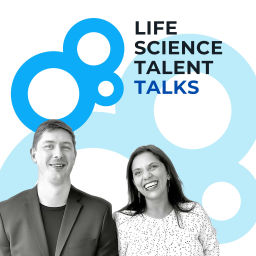
We want to build a community to inspire life science professionals and leaders through talent talks and organized events. Share knowledge across the life science community through personal stories of their journey.
𝗕𝗲𝗰𝗼𝗺𝗲 𝗽𝗮𝗿𝘁 𝗼𝗳 𝘁𝗵𝗲 𝗟𝗶𝗳𝗲 𝗦𝗰𝗶𝗲𝗻𝗰𝗲 𝗧𝗮𝗹𝗲𝗻𝘁 𝗘𝗰𝗼𝘀𝘆𝘀𝘁𝗲𝗺:
Take part in shaping this community by sharing your feedback, questions or ideas. This you can do through our community page:
https://www.linkedin.com/groups/12717528/
Follow us:
Nehar: https://www.linkedin.com/in/neharmortuza/
and
Søren: https://www.linkedin.com/in/soren-spanner-bach/
E74 #Ecosystem Builders “Inside The Kitchen: Turning University Research into Startups” with Jeppe Dørup Olesen
Jeppe Dørup Olesen (https://www.linkedin.com/in/jeppe-d%C3%B8rup-olesen-b25577/), Head of Innovation at Aarhus University, leads The Kitchen (https://www.linkedin.com/showcase/kitchen-aarhusuniversitet/posts/?feedView=all) — an incubator that has grown from a handful of cases to over 450 active startups and 350 protected technologies in five years. In this conversation, he unpacks what it takes to turn university research into companies, why early-stage risk capital remains Europe's biggest bottleneck, and how Aarhus is building an ecosystem — from an Entrepreneur in Residence program to a university-backed venture fund — to keep promising deep tech companies from moving abroad.
⏱️ TIMESTAMPS
(09:09) The Kitchen now supports 450 active startup cases and protects 350 technologies, a sharp jump from five years ago
(10:25) High-risk, early-stage capital — not talent or ideas — is named as Europe's real innovation bottleneck compared to the US
(23:53) The Entrepreneur in Residence program pairs commercial hires with research teams as potential co-founders; one resulting company raised a €10 million round
(26:41) Sunstones, a CO2-in-minerals startup spun out of the Department of Geoscience, is highlighted as a flagship success story now moving to demonstration scale
(30:29) Aarhus University's Research Foundation, Salling Foundations, Norlys, and Heartland jointly launched an evergreen VC fund that has closed ten pre-seed investments since opening
(47:18) A broader EU policy push — citing the Draghi report — is set to pull universities further into innovation and commercialization over the next decade
Guest Bio
Experienced Leader with a demonstrated history of working in international collaboration, Innovation, advocacy and public affairs. Skilled in International Relations, leadership, program development and Politics. Strong professional with leadership education from INSEAD, Harvard University and UC Berkeley.
Resources Mentioned
The Kitchen (Aarhus University incubator)
Aarhus University Research Foundation
PreSeed Ventures
BioInnovation Institute
Sunstones
Startup Aarhus
SMIL startup festival
Venture Connect investor meetups
The Draghi report
Ideas for future podcast guests or themes? 💡
We want to co-create this podcast with you. We’d therefore love to hear your suggestions for future podcast guests, ecosystem builders, or deep tech themes.
Feel free to share in a private message or leave a comment below 🙏🏼
(It's also ok to invite yourself 😉)
Call to Action
If this episode sparked your interest:
Share it with someone working in science, startups, or innovation
Follow the miniseries for more conversations with ecosystem builders
20 Aug 2026
E72 #Ecosystem Builders “From Lab to Value Chain: Mission-Driven Carbon Capture” with CORC's Lasse Rosendahl & Alexia Jacobsen
In this podcast episode on turning research into societal value, host Søren (https://www.linkedin.com/in/soren-spanner-bach/) Spanner Bach is joined by co-host Per Christensen (https://www.linkedin.com/in/per-christensen-bse/) of Black Swans Exist (https://www.linkedin.com/company/black-swans-exist/) and guests Lasse Rosendahl (https://www.linkedin.com/in/lasse-rosendahl-24b5b62/), Director of CORC (https://www.linkedin.com/company/nnfcorc/), and (https://www.linkedin.com/in/alexia-jacobsen/)Alexia Jacobsen (https://www.linkedin.com/in/alexia-jacobsen-2aa4365/), Head of Innovation at CORC - the Novo Nordisk Foundation CO2 Research Center, headquartered in Aarhus with partner institutions across Europe and the US.
The conversation centres on a deceptively simple question:
what does it actually take to translate CO2 research into real-world impact when the value chain you need doesn't yet exist?
Lasse and Alexia walk through the full journey - from TRL 1 microbe experiments exploring how to transform CO2 into methane, to a 200x scale-up pilot facility at Campus Viborg that is already testing market viability by exploring the sale of carbon credits and offtake products at pilot scale.
A key theme throughout is that the TRL ladder is not linear: scaling up consistently surfaces new fundamental questions, sending research back down before moving forward again. Iteration is the design, not the exception.
The bottleneck in commercializing carbon utilization is less about technology maturity and more about the near-complete absence of governmental verification frameworks for CCU and CCC in Europe - and the missing value chains that spin-outs need to survive.
Alexia also introduces CORC's approach to impact measurement: rather than imposing performance indicators that produce what you measure rather than what you want, the team is developing key value measures in direct dialogue with researchers. And critically, the innovation team's role is to remove the administrative and legal obstacles from the researcher's path - so that scientists can stay focused on the science while still contributing to real-world impact.
⏱️ TIMESTAMPS
01:26 What Is CORC? — Mission, Funding and International Scope
04:11 Why CO₂ Research Matters — And What TRL Actually Means
06:45 TRL in Practice — From Lab-Scale Microbes to Pilot Reactors
10:42 The Real Bottleneck — Value Chains That Don’t Exist Yet
17:13 What Can Industry Do? — Spin-Ins, De-Risking and Ecosystem Building
21:57 Researcher KPIs vs Real-World Impact — How to Navigate Both
25:20 CORC’s Four Mission Streams — Interdisciplinary Design
29:01 Keeping Researchers Mission-Aligned — Annual Meetings and Shared Direction
35:00 What Europe Can Learn from the US — Entrepreneurship and Failure Culture
38:21 Coalition on Advancing Research Assessment — Rethinking Researcher Metrics
41:46 Selling Credits at Pilot Scale — Testing the Market Before It Exists
43:15 Excel ERIC — Sharing Infrastructure Across Europe
45:29 Why Aarhus? — Location, Ecosystem and Production Pipeline
46:41 Impact by 2028 — Technologies Out, Value Chains Built, Knowledge Compounded
50:14 Target Industries and Products — What CORC Is Looking For
💡 QUOTES
"If we are not successful in bringing down atmospheric CO2 levels, it will have consequences — not for the planet, which will survive — but for the way we as humans inhabit the Earth." — Lasse
"If the value chain is not there, we set spin-outs up to fail. That's essentially what we're doing." — Alexia
Ideas for future podcast guests or themes? 💡
We want to co-create this podcast with you. We’d therefore love to hear your suggestions for future podcast guests, ecosystem builders, or deep tech themes.
Feel free to share in a private message or leave a comment below 🙏🏼
(It's also ok to invite yourself 😉)
Call to Action
If this episode sparked your interest:
Share it with someone working in science, startups, or innovation
Follow the miniseries for more conversations with ecosystem builders
13 Aug 2026
E71 #Ecosystem Builders "From Spin-Outs to Spin-Ins: How Incuba Shapes Aarhus' Innovation Ecosystem" with Jacob Doktor Mogensen
Jacob Doktor Mogensen (https://www.linkedin.com/in/jacob-doktor-mogensen-86a7045/), CEO of Incuba (https://www.linkedin.com/company/incuba-science-park-a-s/posts/?feedView=all), joins the show to unpack how Aarhus's science park model turns university research into scaled companies.
The conversation moves from Incuba's problem-first, hands-on approach to acceleration, through real cases like Coana and CrowdStrike/Humio, to the harder question of why Danish companies sell out to international capital - and what "spinning in" corporate innovation could change. Listeners get a grounded look at what actually moves a startup from idea to exit.
Episode Timestamps
(09:37) Concrete support: financing, applications, introductions
(10:49) The Investor Hub: proximity that closes deals
(27:26) Success story: Quana's journey and US sale
(41:39) Defining "spin-in" innovation
(46:14) Spin-in success story: CrowdStrike and Humio
(50:01) Turning company problems into student projects
(55:00) Aarhus' innovation ecosystem over the next 10 years
Guest Bio
Jacob Doktor Mogensen is CEO of Incuba, the Aarhus-based science park connecting university spin-outs, established companies, and investors across three hubs. Before Incuba, he spent fifteen years in Danish innovation clusters and science parks, including time in the food industry.
Resources Mentioned
Incuba (Incuba.dk) — science park hubs at Katrinebjerg, Navitas, and Skejby
Incuba on LinkedIn (https://www.linkedin.com/company/incuba-science-park-a-s/)
Coana — Aarhus University spin-out and EU Horizon-funded case study
CrowdStrike / Humio acquisition
Delfinus Venture Capital
InnoFonden, InnoBooster, Horizon Europe funding programs
Startup Aarhus
Aarhus Investor Summit (October 8)
Ideas for future podcast guests or themes? 💡
We want to co-create this podcast with you. We’d therefore love to hear your suggestions for future podcast guests, ecosystem builders, or deep tech themes.
Feel free to share in a private message or leave a comment below 🙏🏼
(It's also ok to invite yourself 😉)
Who has been a guest on Life Science Talent Talks
Names identified in recent episode analyses. Showing up to five guests.
Rahmad Akbar
Mogens Johannsen
Thomas Poulsen
Janine Erler
Lluís Riera Ponsati
Reach and audience
Public platform figures. Ratings count people who left a rating, not total listeners.
Apple Podcasts (US)
5.0 / 5
1 ratings
Spotify
4.9 / 5
15 ratings
Podcast Authority Score: 59 / 100
A composite of feed quality, social presence, YouTube performance and engagement. Read the methodology.
Quality
90
Social presence
0
YouTube
0
Engagement
71
Contact Life Science Talent Talks
Guest appearances
Books guests
Based on episode analysis; this does not confirm that the show is currently accepting guests.
Questions about Life Science Talent Talks
Who hosts Life Science Talent Talks?
Nehar Mortuza and Søren Spanner Bach host the show. Published by Life Science Talent Ecosystem.
How often do new episodes come out?
The show publishes bi-weekly, based on its RSS feed.
Does Life Science Talent Talks take guests?
Yes. Guests have been identified in episode analyses.
Host of Life Science Talent Talks?
Claim your podcast to manage its listing and keep your show details accurate.
Pod Engine is an independent podcast discovery and analytics service and is not affiliated with or endorsed by this podcast. Artwork and show content belong to their owners. Full legal notice.
Explore this show Podcast research with Pod Engine