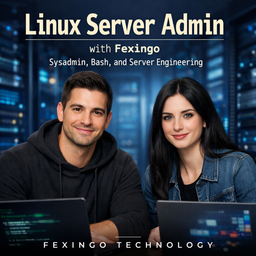
About Linux Server Admin with Fexingo: Sysadmin, Bash, and Server Engineering
Lucas and Luna sit down at a pair of thin laptops, terminal windows flickering with abstract patterns, to talk Linux server administration as it's actually practiced—bash scripting, systemd quirks, Nginx tuning, SSH hardening, and the daily grind of keeping production services online. Each episode picks a single sysadmin problem: how to diagnose a slow database query without panic, why that cron job keeps failing at 3 AM, or the right way to automate backups with rsync and rclone. Lucas brings the journalistic rigor—he'll cite real-world incidents like the 2021 AWS Kinesis outage that broke monitoring for half the internet, or the time a misplaced chmod command took down a major e-commerce site for an hour. Luna pushes back with hands-on experience: she's the one who asks whether you really need Docker for a three-service stack, or why your fail2ban config is banning your own IP. Together they cut through vendor hype—no Kubernetes if you have five servers, no Ansible if a shell loop will do—and focus on the tools and habits that keep systems boringly stable. The listener is someone who manages servers—maybe a solo IT generalist at a mid-size company, a DevOps engineer tired of conference talk, or a hobbyist running a home lab who wants professional-grade discipline. No whiteboarding abstract architectures; just concrete decisions, error messages, and the trade-offs between uptime and complexity. Can you afford to ignore SELinux? When is it smarter to reboot than to debug a memory leak? And how do you explain a 99.9% uptime SLA to a manager who thinks 'the cloud' fixes everything?
#LinuxServerAdmin #Sysadmin #Bash #ServerEngineering #SSH #Nginx #Systemd #DevOps #Infrastructure #Automation #Backup #Security #Technology #FexingoBusiness #BusinessPodcast #DailyPodcast #ServerRoom #Terminal
Keep every episode free: buymeacoffee.com/fexingo (https://buymeacoffee.com/fexingo)
Most sysadmins think Linux memory management is simple: the kernel takes what it needs and gives it back. But that intuition fails when dealing with page cache pressure, slab allocations, and reclaim stalls. This episode dissects how the Linux kernel actually balances dirty pages, anonymous memory, and buffer heads under load. We look at the specific mechanics of kswapd, direct reclaim paths, and why servers stall during high-pressure memory compaction. For anyone managing production infrastructure, understanding these internal rhythms prevents the mysterious latency spikes that happen when RAM hits one hundred percent.
#LinuxKernel #MemoryManagement #SysadminTips #ServerEngineering #PageCache #SlabAllocator #Kswapd #DirectReclaim #LatencyOptimization #ProductionInfra #BashScripting #TechOps #FexingoBusiness #BusinessPodcast #SystemPerformance #CloudInfrastructure #DevOpsDaily #LucasAndLuna
Keep every episode free: buymeacoffee.com/fexingo (https://buymeacoffee.com/fexingo)
18 Oct 2026
Linux Server Admin with Fexingo: Sysadmin Bash and Server Engineering
In this episode, Lucas and Luna explore the often-overlooked world of Linux server administration, focusing on the practical realities of managing bash scripts and ensuring robust server engineering. They discuss common pitfalls in automation, the importance of idempotent design, and how to maintain system stability without constant intervention. With a specific case study on a recent deployment failure caused by race conditions in cron jobs, they provide actionable advice for sysadmins looking to improve their workflow. This conversation is tailored for those who manage infrastructure daily and want to move beyond basic troubleshooting to proactive system management.
#LinuxServerAdmin #SysadminLife #BashScripting #ServerEngineering #DevOpsCulture #SystemAdministration #AutomationBestPractices #CronJobsExplained #IdempotencyMatters #TechPodcastDaily #FexingoBusiness #BusinessPodcast #InfrastructureManagement #LinuxTips #SysAdminTools #CloudOperations #ITCareerAdvice #TechnologyTrends
Keep every episode free: buymeacoffee.com/fexingo (https://buymeacoffee.com/fexingo)
17 Oct 2026
Why Linux Servers Crash After Months of Uptime
Most sysadmins assume that if a server has been running for six months without a reboot, it is stable. But in reality, silent resource leaks and kernel state accumulation can degrade performance until the system finally hangs or OOM kills critical processes. In this episode, we examine why long-running Linux servers fail not from acute attacks, but from chronic accumulation of untracked allocations, zombie file descriptors, and TCP socket exhaustion. We look at specific cases where uptime masked underlying decay, and how monitoring tools like systemd-journald limits and cgroup memory tracking reveal the hidden costs of perpetual operation.
#LinuxServerStability #SysadminLife #ServerUptime #ResourceLeaks #KernelState #SystemDJournal #TCPExhaustion #OOMKiller #ZombieProcesses #FileDescriptors #CGroupTracking #ServerMaintenance #TechOps #DevOpsDaily #LinuxAdmin #FexingoBusiness #BusinessPodcast #TechnologyShow
Keep every episode free: buymeacoffee.com/fexingo (https://buymeacoffee.com/fexingo)
Contact Linux Server Admin with Fexingo: Sysadmin, Bash, and Server Engineering
Guest appearances
Does not typically book guests
Based on episode analysis; this does not confirm that the show is currently accepting guests.
Host of Linux Server Admin with Fexingo: Sysadmin, Bash, and Server Engineering?
Claim your podcast to manage its listing and keep your show details accurate.
Pod Engine is an independent podcast discovery and analytics service and is not affiliated with or endorsed by this podcast. Artwork and show content belong to their owners. Full legal notice.
Explore this show Podcast research with Pod Engine