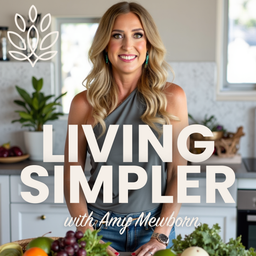
Living Simpler with Amy Mewborn
Hosted by Amy Mewborn · Amy Mewborn
5.0from 12 ratings
- 87
- Episodes
- 12
- Ratings
- Weekly
- Cadence
- 2018
- First episode
About Living Simpler with Amy Mewborn
Welcome to Living Simpler — the podcast for high-achieving women who are doing all the "right" things but still feel tired, bloated, burned out, and wondering, "What the heck happened to me?" Hosted by Amy Mewborn, former finance executive turned wellness entrepreneur, TEDx speaker, bestselling author, and certified Integrative Health Practitioner, this show is your weekly invitation to step out of survival mode and into the life and health you actually want. Each episode breaks down the confusing, overwhelming world of health, hormones, metabolism, and mindset — with real, actionable tips to help you boost energy, balance your hormones, reduce inflammation, and finally feel like yourself again. If you've ever felt like you're doing everything "right" but your body just isn't cooperating — this podcast will help you uncover what's really going on underneath the surface… and what simple shifts will actually move the needle. ✨ Life gets to feel simple. ✨ Healing gets to feel doable. ✨ And YOU get to feel like yourself again. Subscribe now and join Amy every week for honest conversations, expert guidance, and a whole lot of encouragement to take your power back — one simple step at a time.
- Publisher
- Amy Mewborn
- Category
- health & fitness · health & fitness
- Language
- en
- Explicit
- No
- First episode
- 7 Jun 2018
- Latest episode
- 21 Oct 2026
Latest episodes
87 episodes in the feed.
21 Oct 2026
The Hidden Cost of Being the Woman Who Holds It All Together
When was the last time you had nothing to do, nobody needed you, and you actually enjoyed it? If your brain jumped straight to the laundry, the unanswered emails, and the closet that needs reorganizing, this episode was made for you. Amy opens with a question most women can't answer, then walks you through what she has learned about the hidden cost of being the woman who handles everything. She shares her own story, including a stroke at 29, mold related illness, adenomyosis, severe blood pressure issues, an ICU stay, and a MOGAD diagnosis. She also shares the part that surprised her most. She had spent 20 years in the fitness and nutrition industry and helped more than 9,000 women with their nutrition and fitness, yet she still needed to lie down for two hours every afternoon just to finish her day. This conversation moves from the practical to the personal. Amy explains why the strategies that worked at 30 can stop working after 40, why slowing down can feel uncomfortable, and why knowing what to do is not always enough to do it. She introduces the SIGNALS framework, a way to look at seven areas of your health together instead of chasing one symptom at a time. Then she gives you one simple thing to try this week, and it costs nothing. Along the way you will hear about a trip to Florida for her parents' 50th wedding anniversary, a dad who couldn't walk to the beach at only 67 years old, and three months in Nashville working on basic habits with her family. It changed how she thinks about health. Health is not about the size of your jeans. It is about walking on the beach. KEY TOPICS DISCUSSED Why so many capable women feel uncomfortable when they finally get free time The hidden cost of being the person everyone counts on Amy's health story, including a stroke at 29 and her MOGAD diagnosis Why she responded to her own exhaustion by doing more, and what she asked herself instead The Florida trip for her parents' 50th anniversary and what it taught her about quality of life Three months in Nashville working on inflammation, blood sugar, food, energy, and daily routines Why identity is the missing piece in most health plans What changes in perimenopause and menopause, including sleep, temperature regulation, body composition, and stress The SIGNALS framework: sleep and circadian rhythm, inflammation, glucose and nourishment, nervous system, activity, labs, and self and identity Why the last signal, self, may matter most How daily rhythms like cortisol, light, meals, and sleep timing work together One simple practice to try for seven days NUMBERS AND DETAILS WORTH REMEMBERING Amy had a stroke at age 29 after a reaction to birth control. She spent 20 years in the fitness and nutrition industry. She has helped more than 9,000 women improve their nutrition and fitness. She once spent about $4,000 on functional testing and $1,500 a month on a health coach. Her parents celebrated 50 years of marriage in February 2026. Both are 67. She spent about three months in Nashville working on basic habits with her family. The SIGNALS framework looks at seven areas of your health. STANDOUT MOMENTS The car dashboard story. Imagine your warning lights are flashing and your engine sounds different. You respond by pressing harder on the gas pedal. Amy asks why we do the same thing with our bodies. The 3:07 a.m. moment. Your brain decides it is the perfect time to review your retirement strategy, your relationship with your mother, and something you said in 2008. The empty afternoon. Nobody needs you, so you start cleaning out a cabinet and suddenly you have created an entire afternoon of work from nothing. The big question. If you stopped being the woman who always holds everything together, would you know who you were without that role? QUOTES YOU MAY WANT TO SAVE "Simple works, complicated sells." "I want my health to support my freedom. I want it to give me more possibilities, not more rules to follow." "You can't change a pattern you haven't recognized." YOUR ONE THING FOR THIS WEEK For the next seven days, notice the moments when you automatically say yes. Before you answer, pause and ask yourself one question. Do I genuinely have the capacity for this, or am I saying yes because I'm used to being the woman who handles everything? You don't have to say no. Yes may be exactly right. The goal is to make it a choice. Pay attention to what shows up in that pause, whether it is guilt, worry about what other people think, or the urge to explain yourself. Those feelings can teach you something. WHO THIS EPISODE IS FOR This episode is for the woman who is doing all the things and still feels off. It is for the woman who has been told her labs look normal, who wakes up tired, who crashes at 2:43 in the afternoon, and who keeps telling herself she will take care of herself when things settle down. If that is you, press play. If you want to keep going after you listen, the Living Simpler App and the Living Simpler Collective were built for exactly this season of life. Start with the free resources if you want a gentle first step. DISCLAIMER This podcast is for educational purposes only and is not medical advice. Always talk with a qualified healthcare provider before making changes to your health, especially if you have a medical condition, take medication, or are pregnant. LINKS Living Simpler App: https://living-simpler.com/app/ Living Simpler Collective: https://living-simpler.com/collective/ Living Simpler Reset: https://living-simpler.com/reset/ Free Resources: https://living-simpler.com/resources Favorites: https://living-simpler.com/favorites/ Instagram: https://www.instagram.com/amymewborn Amazon: https://www.amazon.com/shop/amymewborn Labs: https://partners.superpower.com/amy-mewborn Peptides: https://elliemd.com/livingsimpler Peptide Partner Program: https://partner.elliemd.com/MemberToolsDotNet/EnrollmentV4/StartPublicEnrollment.aspx?EnrollmentCode=DEALER&referringDealerId=1019111
13 Oct 2026
Your Ring Can't Answer Your Questions: The Four Step Method for Learning What Your Body Needs with Gary Wolf
Your sleep score says you slept badly, but you felt fine when you woke up. So who do you believe, the ring on your finger or your own body? That question sits at the center of this conversation with Gary Wolf, cofounder of the Quantified Self movement and author of The Quantified Self: Learning to Observe. Gary has spent almost 20 years watching people track their sleep, mood, pain, and heart rhythms, and he has learned something that most wearable companies would rather you didn't hear. The data is not the point. The question you bring to the data is the point. Amy Mewborn sits down with Gary to talk about the overload so many women feel in 2026. You might be wearing a ring and a watch, opening an app every morning, and wondering why all those numbers haven't made you feel any clearer. Gary explains why that happens, and he gives you a simple four step learning cycle you can start using this week. Amy shares her own story, too, including a seven day ICU stay, a blood pressure crisis that caused her brain to swell, eight doctors, and the moment she walked outside afterward and felt the sun change everything. Gary tells the story of his own heart rhythm problem. He got a diagnosis, a cardiac monitor, and a prescription, and then the medical system ran out of ideas about how he should actually live with the trade offs. So he tracked it himself. What he found cut his days on medication from about 150 a year to about 20. He is clear that this is his story and not advice for anyone else, and that is exactly the point. Your body is an N of one, and the only way to learn what it needs is to pay attention to it yourself. You will also hear about proxy signals, a tiny trick that makes tracking a hard to measure symptom so much easier. And you will hear why a three point daily rating can teach you more than 500 detailed entries ever will. Amy and Gary also talk about why books, coaches, and real conversations still matter in a world full of apps, because an app can keep your record, but it can't troubleshoot your life. KEY TOPICS DISCUSSED The Overload Problem Gary has worked with people on their self tracking data for almost 20 years, and he says the biggest lesson is that too much focus on devices makes you lose track of what you actually want to learn. Amy's reminder: simple works and complicated sells. Morning sun and eating well move the needle more than most of the complicated products in her feed. Why the wellness industry hands out ideas constantly but rarely teaches you how to test whether an idea works for you. What a Discovery Really Looks Like Gary points out that noticing you feel better after morning sun is a real discovery, even though nobody wins a Nobel Prize for it. The steps he sees again and again: you notice a feeling, it becomes an idea, you pay attention to the idea, and you gain or lose confidence in it. Giving up an idea counts as a discovery, too, because learning what doesn't work frees you to try something that might. Amy's Sun Story Seven days in the ICU without going outside, and how stepping into the sunlight afterward felt like the Earth was helping her feel better. Her research into old hospital photos where patients were moved to the roof for sunlight. Her doctor's advice to take 10,000 IUs of vitamin D daily, and her thought that the best vitamin D source in the world is the sun. The Four Step Learning Cycle Question, observe, reason, explain. Question: you can't get an answer to a question you never asked, and your question will change as you learn. Gary's example: you start tracking morning sun and mood, then notice weekends are better, then realize you eat breakfast with friends on weekends. Now you have a new question. Observe: decide what in your daily life is worth paying attention to. Reason: the number one method that works is simply looking at change over time. Explain: people learn the most when they describe what they did to someone else. Gary says that is often when they realize there is another question buried inside the first one. Keep Your Tracking Simple Gary's warning: you can rate your mood from 1 to 10 several times a day once, twice, maybe 10 times. You can't do it 500 times. The general daily assessment: one rating at the end of the day, often on a three point scale. One is very bad, two is everything in between, three is very good. Why it works: after 60 or 90 days you know where you usually are, so the unusual days stand out. The unusual days are where discoveries hide. Amy rates on a 10 point scale and likes to see her weeks and months laid out, and she makes the point that a seven day still tells you something. Gary's Heart Rhythm Story He has premature ventricular contractions, which are common and usually not high risk, but they are burdensome and frightening when they hit. The medical protocol: a two week cardiac monitor, then a decision based on the percentage of irregular beats. Under about 1 to 2 percent, leave it alone. Two to 10 percent, medication. Higher, consider surgery. Gary values his beta blockers and also dislikes how they affect his exercise and how he feels. He compared his own simple notes to the clinical monitor and found they flagged the same bad days, even though the actual numbers were very different. He then saw that bad days clump together, often after stressful events like the California fires. His idea: when a bad stretch starts, take as much medication as he can tolerate right away. The result: from about 150 medication days a year to about 20. His disclaimer: he is giving zero advice to anyone else, because he has no idea how another person's heart rhythm works. Amy's Blood Pressure Story Amy did something similar with blood pressure medication that sometimes pushed her pressure far too low, leaving her with no energy. She began with a sheet of paper, tracking her blood pressure every morning and night along with sleep and what happened during the day. She went to the ICU with stroke type symptoms because her blood pressure had been so high for so long that her brain swelled. Her point: most of us only see doctors when something has gone wrong, and the more we notice our own patterns, the better support we get. She saw eight doctors, went through radiation imaging 20 different times, and left almost every appointment with three more pills. Proxy Signals Friction kills tracking. Any doubt or confusion each time you measure piles up until you quit. A proxy signal is something right next to your symptom that is easier to track. Gary's colleague counted aspirins instead of rating headaches. Gary uses a distinct little cough that shows up when his heart rhythm crosses the bothersome threshold. Amy's take: it works like habit design. Make it so simple and mindless that you can't skip it. Apps, Coaching, and Conversation An app can do one thing very well: keep a record of something you care about. An app can't troubleshoot your personal life. It takes a good question, some reasoning skills, and a social context where you explain what you found. Amy describes the Living Simpler App, where you log how you woke up, what you ate, and how you feel, then share your patterns with a coach. Gary on learning: the experience of learning something about yourself can't be done for you, even when the advice you receive turns out to be right. About the Book The Quantified Self: Learning to Observe, published by Workman Publishing, part of Hachette. Gary wrote it for people who already believe observation has value, who may already have a tracker, a coach, or a symptom diary and want to get more out of it. Amy compares it to The Big Leap by Gay Hendricks, a book she rereads every summer because she gets something new from it each time. AMY AND GARY QUOTES WORTH SAVING Gary: "You can't get an answer to a question you've never asked." Gary: "You can use your own mind as the sensor." Gary: "It's the unusual that gives you the signal that maybe you've made a discovery." Amy: "Simple works and complicated sells." Amy: "We are all an N of one." STANDOUT MOMENTS Gary's heart story is the moment to listen for. He doesn't pitch a miracle. He shows you how a person with a plain notebook mindset found a way to take far less medication, and he says clearly that no one should copy it. The other great moment comes when Amy describes writing her blood pressure on a sheet of paper in the middle of a health crisis. It reminds you that you don't need fancy tools to start paying attention. If you've been feeling buried under scores, rings, and apps, this conversation will give you permission to simplify. Pick one question. Make one tiny observation each day. Look for change over time. Then tell someone what you found. If you want a simple place to track how you wake up, eat, move, and feel, download the Living Simpler App, or join the Living Simpler Collective for coaching and community that help you make sense of your patterns. This podcast is for educational purposes only and is not medical advice. Always talk with a qualified healthcare provider before making changes to your health or medications. LINKS Living Simpler App: https://living-simpler.com/app/ Living Simpler Collective: https://living-simpler.com/collective/ Living Simpler Reset: https://living-simpler.com/reset/ Free Resources: https://living-simpler.com/resources Favorites: https://living-simpler.com/favorites/ Instagram: https://www.instagram.com/amymewborn Amazon: https://www.amazon.com/shop/amymewborn Labs: https://partners.superpower.com/amy-mewborn Peptides: https://elliemd.com/livingsimpler Peptide Partner Program: https://partner.elliemd.com/MemberToolsDotNet/EnrollmentV4/StartPublicEnrollment.aspx?EnrollmentCode=DEALER&referringDealerId=1019111 Gary Wolf: gary@quantifiedself.com Book: The Quantified Self: Learning to Observe (Workman Publishing)
6 Oct 2026
High-Achieving Women: Stop Treating Yourself Like a Project - with Stacey Hutson
Perimenopause Is Your Second Puberty: Simple Habits That Help You and Your Daughters with Stacey Hutson You've stepped over the same laundry basket for nine days. Today, for no clear reason, it feels like nails on a chalkboard. The mess has been there for years. Your patience for it packed up and left somewhere around your 40th birthday. EPISODE SUMMARY That's the moment this conversation starts with. Amy Mewborn sits down with Stacey Hutson, host of The Next Phase podcast and mom of two girls. Stacey just turned 40, and she's learning in real time that the all or nothing wellness rules that carried her through her 20s and 30s have stopped working. Stacey grew up as the little girl with a stomach ache that never went away. In her early 20s she cut gluten, went paleo, and everything changed. The bloating calmed down. Her hair grew long for the first time in her life. So she went all in, started a food blog, and photographed every meal she ate. Then 40 showed up with sleep struggles and a changing midsection, and pushing harder only made things worse. You'll hear why clearing the clutter helped Stacey's nervous system more than her whole morning routine, how she feeds a family real food without becoming the food police, and the three things she changed at home after reading about girls starting puberty earlier. Amy shares her own stories too, including the closet full of polyester she's finally clearing out at 50, the summer she spent rebuilding her parents' pantry in Nashville, and the hotel room that left her covered in hives. The big idea you'll walk away with is this. Perimenopause is a second puberty. You're on one end of the hormone ride and your daughter is on the other, and the same simple habits help you both. KEY TOPICS DISCUSSED Why Extreme Wellness Stops Working at 40 Stacey's childhood stomach aches and a 90s diet built on spaghetti, sandwiches, and pizza How cutting gluten in her early 20s calmed her bloating and helped her hair and nails finally grow The trap of going all in on any one way of eating What changed at 40: harder sleep, a changing midsection, and the same habits giving different results Why two workouts a day and a tiny list of approved foods stopped serving her Clutter and Your Nervous System Why mess that never bothered you at 35 can feel unbearable at 45 Stacey's ADHD story and what she learned cohosting the Mother Plus Podcast The donation bag that sat for three months and the returns riding around in her car Why clearing her space helped more than meditating, journaling, and tapping in the middle of chaos Amy's move from a closet full of polyester to fewer pieces in linen and organic cotton The tip from Dana K. White, author of Decluttering at the Speed of Life: you can't control his mess, so start with yours Feeding a Family Real Food Deciding who your family is so daily choices get easier The giant snack bag that goes everywhere: beef sticks, bone broth bars, apples on an ice pack, grapes, and bananas Treats at birthday parties and friends' houses, real food at home Stealth health muffins made with bone broth protein and super greens How Amy used the same idea with her parents, including cottage cheese ice cream Getting kids into the kitchen early, mess and all Early Puberty and the Three Things Stacey Changed What Stacey has been reading about girls showing signs of puberty as young as 7 or 8 Morning sunlight before screens and real darkness at night Synthetic fragrance in body sprays, candles, toys, and even slime Knowing where your food comes from How she explains the why to her almost 9 year old The Toxic Bucket The 168 chemical ingredients the average woman puts on her body every day Amy's hotel story and the hives that followed How Amy's husband went from skeptic to noticing the difference himself Raising Confident Girls Why confidence is Stacey's number one goal for her daughters The nursery wall of strong women The bedtime question she asks every single night STANDOUT MOMENTS AND QUOTES Stacey on turning 40: "I have found that pushing more, being extreme is actually hurting me." Her new rules are short. Back to basics. Simpler is better. Less is more. Stacey on why healthy choices feel easy in her house: "Once you decide that's just who you are, that's the kind of mom you are and the kind of woman you are, everything else becomes clear." Nobody argues about the drive through, because that's simply something her family doesn't do. She packs the snacks before they leave so hunger never makes the decision. Stacey on perimenopause and her daughters: "A lot of times the fixes that help us, help them." If morning light helps your hormones and your sleep at 45, it's doing the same work for a 9 year old. Amy on resilience: "What happens if we don't make them where they have to be so resilient?" Give kids the tools early, like cooking, real food, sunlight, and screens off at night, and they get to skip some of the lessons you learned the hard way. Amy on the toxic bucket: one cleaner, one lotion, or one meal out is a drop. Years of drops, day after day, fill the bucket. When it overflows, everything seems to go haywire at once. The bedtime question: every night Stacey climbs into her older daughter's bunk bed and asks, "What's on your mind?" Ten to twenty minutes later she's heard about school, friends, and the hard stuff that never comes out at the dinner table. Amy called it gold. And the line the whole conversation lands on. Stacey says the path to feeling great in your 40s and 50s is "much more simple than that, but not easy." Amy tells her clients the same thing: "Just because it's simple doesn't mean it's easy." STATISTICS AND DATA HIGHLIGHTS 168: the number of chemical ingredients the average woman puts on her body each day through personal care products, based on Environmental Working Group survey data 7 or 8: the age Stacey has read about girls beginning to show signs of puberty 10 to 20 years: how far back Amy says a lot of today's health problems started building 10 to 20 minutes: what the bedtime question adds to the nightly routine 3: the areas Stacey focuses on with her girls, which are light, fragrance, and food FIVE THINGS TO TRY THIS WEEK Step outside for morning light before anyone in the house looks at a screen Clear one surface you see every day, like the kitchen counter or your desk Take the donation bag and the returns out of your car today Add protein to a food your family already loves, like muffins or homemade ice cream Ask someone you love, "What's on your mind?" and then just listen ABOUT STACEY HUTSON Stacey Hutson is the host of The Next Phase podcast, a show for millennial moms entering perimenopause who are ready to stop making life so complicated and get back to basics with their bodies, homes, and ADHD brains. A former advertising copywriter and longtime podcaster, she explores what happens when the self improvement strategies that worked in your 20s and 30s stop working in your 40s. She lives in Golden, Colorado with her husband, two daughters, a dog, and a cat. The Next Phase podcast: https://podcasts.apple.com/us/podcast/the-next-phase/id1843182891 Stacey on Instagram: @stacehutson YOUR NEXT STEP If you want help turning morning light, protein, and a calmer evening into daily habits, the Living Simpler App keeps it simple, one day at a time. And if you'd like to do it alongside other women in this same season, come join us inside the Living Simpler Collective. The Living Simpler Podcast is for educational purposes only and is not medical advice. Always talk with a qualified healthcare provider before making changes to your health. HELPFUL RESOURCES AND LINKS Living Simpler App: https://living-simpler.com/app/ Living Simpler Collective: https://living-simpler.com/collective/ Living Simpler Reset: https://living-simpler.com/reset/ Free Resources: https://living-simpler.com/resources Favorites: https://living-simpler.com/favorites/ Instagram: https://www.instagram.com/amymewborn Amazon: https://www.amazon.com/shop/amymewborn Labs: https://partners.superpower.com/amy-mewborn Peptides: https://elliemd.com/livingsimpler Peptide Partner Program: https://partner.elliemd.com/MemberToolsDotNet/EnrollmentV4/StartPublicEnrollment.aspx?EnrollmentCode=DEALER&referringDealerId=1019111
Reach and audience
Public platform figures. Ratings count people who left a rating, not total listeners.
- Apple Podcasts (US)
- 5.0 / 5
- 12 ratings
Contact Living Simpler with Amy Mewborn
- Guest appearances
- Books guests
Based on episode analysis; this does not confirm that the show is currently accepting guests.
Questions about Living Simpler with Amy Mewborn
Who hosts Living Simpler with Amy Mewborn?
Amy Mewborn host the show. Published by Amy Mewborn.
How often do new episodes come out?
The show publishes weekly, based on its RSS feed.
Does Living Simpler with Amy Mewborn take guests?
Yes. Guests have been identified in episode analyses.
Host of Living Simpler with Amy Mewborn?
Claim your podcast to manage its listing and keep your show details accurate.
Pod Engine is an independent podcast discovery and analytics service and is not affiliated with or endorsed by this podcast. Artwork and show content belong to their owners. Full legal notice.
Explore this show
Podcast research with Pod Engine