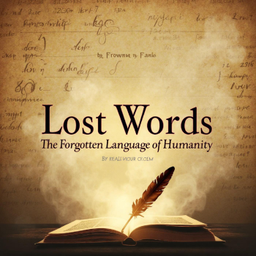
About Lost Words: The Forgotten Language of Humanity
Lost Words is a journey into the forgotten corners of language — exploring ancient, vanished, or untranslatable words that once shaped how humans thought, felt, and dreamed.
Each short episode uncovers the story behind a single word: its origin, meaning, and the world it reveals about the people who spoke it. From Old Norse to Latin, from Japanese to Sanskrit, and even words lost in modern languages, this podcast revives them with storytelling, history, and philosophy.
Through these “lost words,” listeners rediscover lost emotions, lost ways of seeing the world — and perhaps, lost parts of themselves.
Resfeber - The Restless Excitement Before a Journey
Episode 52 of Lost Words: The Forgotten Language of Humanity explores the Swedish word “Resfeber,” the restless mixture of excitement and anxiety that appears before a journey begins.
The episode explains how departure changes the feeling of ordinary life even before we leave. A packed bag, a ticket, a familiar room, or the final night at home can suddenly feel charged with possibility because part of the mind has already begun traveling.
Listeners learn that Resfeber is built from both desire and uncertainty. We worry about delays, mistakes, forgotten items, and unfamiliar places, while also wondering what unexpected beauty, freedom, or transformation may be waiting ahead.
The episode also reflects on how travel forces us to become attentive again. Familiar routines disappear, and the world becomes more vivid because we must notice directions, people, landscapes, and new surroundings instead of moving automatically.
Ultimately, Episode 52 presents Resfeber as the emotional electricity of beginnings — the small “fever” of knowing that tomorrow may unfold somewhere entirely different, and that the journey has already begun inside us before the first step is taken.
17 Oct 2026
Toska - The Ache Without a Name
Episode 51 of Lost Words: The Forgotten Language of Humanity explores the Russian word “Toska,” a difficult-to-translate feeling of longing, melancholy, restlessness, or spiritual ache without a clear cause.
The episode explains that Toska is different from sadness with an obvious reason. It can appear even when life seems normal, creating the sense that something is missing even when we cannot identify what that something is.
Listeners learn that Toska can be connected to memory, unlived possibilities, lost versions of ourselves, or a deeper search for meaning. It may feel like homesickness without knowing where home is, or longing for a life we cannot clearly imagine.
The episode also emphasizes that Toska does not always need to be “fixed.” Sometimes the feeling is not a command to make a dramatic change, but an invitation to listen more carefully to the inner life.
Ultimately, Episode 51 presents Toska as a reminder that not every emotion can be neatly explained. Some longings remain mysterious, yet they can still reveal that something within us is searching for meaning, connection, beauty, or a more truthful way of living.
10 Oct 2026
Kenopsia The Eerie Beauty of Empty Places
Episode 50 of Lost Words: The Forgotten Language of Humanity explores “Kenopsia,” a modern coined word describing the strange atmosphere of places that are normally crowded but suddenly stand empty.
The episode explains how familiar spaces change when people disappear from them. A school corridor at night, an empty airport, a silent stadium, or a deserted playground can feel unsettling because we expect those places to contain movement, voices, and activity.
Listeners learn that Kenopsia is not simply about silence. It is about missing presence. Empty places seem to hold traces of what usually happens there — footsteps, conversations, laughter, routines, and memories — making absence feel almost tangible.
The episode also reflects on how people give places meaning. Buildings may remain when everyone leaves, but something essential changes. A home without its family, a theater without its audience, or a café without conversation reveals how strongly human presence shapes atmosphere.
Ultimately, Episode 50 presents Kenopsia as a meditation on absence, memory, and impermanence. It reminds us that empty spaces can make ordinary human presence feel more valuable — and that sometimes silence reveals just how much life usually fills a place.
Contact Lost Words: The Forgotten Language of Humanity
Guest appearances
Does not typically book guests
Based on episode analysis; this does not confirm that the show is currently accepting guests.
Host of Lost Words: The Forgotten Language of Humanity?
Claim your podcast to manage its listing and keep your show details accurate.
Pod Engine is an independent podcast discovery and analytics service and is not affiliated with or endorsed by this podcast. Artwork and show content belong to their owners. Full legal notice.
Explore this show Podcast research with Pod Engine