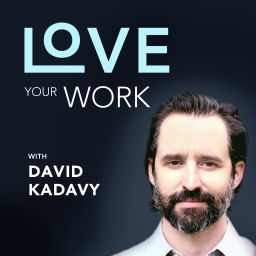
Podcast thumbnail for Love Your Work

Love Your Work

Claim This Podcast

by David Kadavy

4.8(25 reviews)
324 episodes
Updated Inactive
Accepts GuestsHas SponsorsLocation 🇺🇸

Podcast Overview

Love Your Work is the intellectual playground of David Kadavy, bestselling author of three books – including Mind Management, Not Time Management – and former design advisor to Timeful – a Google-acquired productivity app. Love Your Work is where David shows you how to be productive when creativity matters, and make big breakthroughs happen in your career as a creator. Dig into the archives for insightful conversations with Dan Ariely, David Allen, Seth Godin, James Altucher, and many more. "David is an underrated writer and thinker. In an age of instant publication, he puts time, effort and great thought into the content and work he shares with the world." —Jeff Goins, bestselling author of Real Artists Don't Starve

Language

🇺🇲

Publishing Since

12/14/2015

1 verified contact email on file for Love Your Work

Pitch yourself as a guest, propose sponsorships, or reach out directly to the host.

Recent Episodes

Episode thumbnail for [NOTE] My next book: Finish What Matters Preview Edition at kdv.co/fwmpre

January 12, 2026

[NOTE] My next book: Finish What Matters Preview Edition at kdv.co/fwmpre

<p>Hello, Love Your Work listeners, those who still have this pod in your feeds – thank you for staying subscribed!</p> <p>I do not have a new episode for you, per se, though I've certainly thought about making new episodes, the bandwidth hasn't been there, because I have been long and hard at work on my next book, Finish What Matters!</p> <p>In short, you can buy the preview edition at <a href= "https://kdv.co/fwmpre">https://kdv.co/fwmpre</a>, but also let me tell you about it.</p> <p>Yes, after all the talk I made on this show about the subject of finishing projects, after all the mini episodes I published with various ideas such as the project halfpipe, the foundation effect, and Leonardo and Raphael, I finally have something ready to show you.</p> <p>Ironically, it has taken me a very long time to finish – or at least get close to finishing – this book. I thought I had the answers going into this one, but after digging deep into why projects – creative projects specifically – don't get finished, I have learned so much.</p> <p>Basically, there are really good reasons we don't always finish what matters. The creative process is open-ended, some of us have more open-ended cognitive styles, and we just don't know if finishing is going to be worth it! So it's no wonder we succumb to shiny object syndrome and struggle with motivation, and second-guess ourselves when we receive criticism. </p> <p>I have surveyed you in the hundreds, I've interviewed you by the dozens. I have studied the great creators throughout history, I have traveled to Italy to immerse myself in the worlds of Leonardo and Raphael. Most important, I have locked myself in a cabin in the mountains, pondering these obstacles to finishing, and what to do about them.</p> <p>And now, after five years of work, I have something ready to show you. I have a publicly announced schedule of deadlines by which I will deliver to you every chapter. I have on the calendar a lecture series through which to share these concepts, and even a small-group finishing cohort to help a handful of you get a project done in Q1.</p> <p>So if you are interested, please visit <a href= "https://kdv.co/fwmpre">kdv.co/fwmpre</a> to learn more and buy the Preview Edition. This is the third and FINAL book in the Getting Art Done series, which I started ten years ago, and which has taught me so much I can't believe. I cannot wait to share it with you, and I can hardly wait to speak to you again here or on some other podcast or some other podcast-like-thing at some date in the future.</p> <p>Thank you, happy new year, and here's to you getting it done in Q1.</p>

Episode thumbnail for 308. Why I Quit Podcasting

August 10, 2023

308. Why I Quit Podcasting

<p>After nearly eight years of the <em>Love Your Work</em> podcast, I’m quitting. Here’s why, and What’s Next.</p> <h3>Podcasting is a bad business</h3> <p>This is not the immediate reason I’m quitting, but it is at the root: Podcasting is a bad business. When the indirect benefits of an activity run out, it’s hard to keep doing it if it’s not making money.</p> <p>I realized long ago podcasting is a bad business, but I kept going for other reasons. I’ll explain why in a bit.</p> <p>Though I didn’t start my podcast with dollar signs in my eyes, I did at least <em>hope</em> I would grow to earn money doing it. I’ve earned about $32,000 in the eight-year history of <em>Love Your Work</em>. More than half of that has been from Patreon supporters, many of whom support for reasons other than the podcast.</p> <p>During that time, I’ve spent:</p> <ul> <li>$1,008 on hosting</li> <li>$11,749 on assistance with editing and publishing</li> <li>$241 on equipment</li> <li>And some other expenses, for a total of about $13,000</li> </ul> <p>In raw numbers, I’ve made a “profit” on the podcast. But, as I broke down in my <a href= "https://kadavy.net/blog/posts/june-2023-income-report/">latest income report</a>, my “wage” was about $6 an hour. My podcast comprised about 5% of my income over these eight years, and took much more than that portion of my time and energy.</p> <p>Of course, I don’t think about whether the podcast was worth it in terms of an hourly rate. Creative work happens in <a href= "https://kadavy.net/blog/posts/mediocristan-vs-extremistan/">Extremistan, not Mediocristan</a>, and I’ve made <a href= "https://kadavy.net/blog/posts/third-world-better-life/">massive life choices</a> to be free to explore creatively without worrying so much what I’m earning in the short-term.</p> <h4>Ways to make money podcasting</h4> <p>But there are many different ways to make a podcast a solid business, and none of them worked for me, for various reasons.</p> <p>Here are some of these business models, as they apply to the “thought-leader” space (I’ll ignore the more entertainment/infotainment space that podcasts like Gimlet’s inhabit).</p> <ol> <li><strong>Be so massively famous, you can pick-and-choose advertisers, while demanding a lot of money.</strong> This is where Tim Ferriss and Joe Rogan are. They both started with large platforms, and applied whatever talents that helped them earn those platforms to make their podcasts huge. After more than <a href= "https://kadavy.net/blog/posts/fifteen-years/">fifteen years as a creator</a>, I have a modest platform, but orders of magnitude smaller.</li> <li><strong>Build a “content machine” that manufactures ad slots.</strong> I won’t name names, but you’ve heard these podcasts. They’re formulaic and don’t seem to discern much who they have as a guest, nor what sponsors they accept. This business model is why my inbox is still full of pitches – they think I actually <em>want</em> more guests, because more guests would mean more ad slots. It takes a very rare set of circumstances for me to be excited to interview someone.</li> <li><strong>Share information that directly helps people make money.</strong> If you have tactical and actionable information that’s useful to professionals in a specific industry, you can charge for premium podcast content. I’m not as interested in the tactical and actionable as I am in the abstract and exploratory.</li> <li><strong>Cover a niche topic.</strong> If you have a leading podcast about a very specific topic, advertisers within that niche will be willing to pay high rates to reach that audience. I didn’t want to build my podcast according to a specific topic – more on that later.</li> <li><strong>Have a “back-end” business.</strong> If you have a thriving consulting business, or training programs to sell, you can attract more clients and customers through your podcast. As I wrote in my <a href= "https://kadavy.medium.com/ive-been-a-self-employed-independent-creator-for-10-years-i-don-t-recommend-it-a2ecc92d81a9"> ten-year reflections</a>, “I want to make a living creating. I don’t want creating to be merely a marketing strategy for other things. Is that completely insane?”</li> </ol> <p>I flirted with success in a few of these business models. Early on, I hoped my podcast would be famous enough to pick and choose advertisers at high rates. For a while, it looked like I had a chance. I was approached by a <a href= "https://kadavy.net/blog/posts/podcast-network-podcast/">podcast network</a>, and I had some reputable advertisers such as LinkedIn, Skillshare, Casper, Audible, Pittney Bowes, and University of California. Various times, I thought I was on the cusp of my “big break” – such as when <em>Love Your Work</em> was <a href= "https://kadavy.net/blog/posts/apple-podcast-itunes-front-page-feature/"> featured on the Apple Podcasts home screen</a>.</p> <p>But the more I tried to go the “get famous” route, the louder the siren-song of the “content machine” route got. There were plenty of opportunities to do “interview swaps” with hosts I wasn’t interested in interviewing. There were a few advertisers that had money, but whose products felt sleazy. Joining a podcast network would have pressured me to crank out content even if I didn’t feel like it. There was (and still is) the never-ending stream of pitch emails for guests. I had too much wax in my ears to go the “content machine” route.</p> <p>Not included in my lifetime revenue-estimates for <em>Love Your Work</em> is money I made through the “back-end business” route. I was somewhat comfortable with this model, but I haven’t made a course in years, as I’ve been focused on writing books. And as bad a business as people say writing books is, it’s better than making a podcast.</p> <p>The podcast has helped me sell books in more ways than one. One way is that people who listened to the podcast bought my books. The other way is, making my podcast helped me write my books.</p> <p>This brings me to the reason I kept making my podcast, even after I realized it wasn’t a good business.</p> <h3>Make for what making makes you</h3> <p>In my sixteen years experimenting with different business models as an independent creator, I’ve settled on one thing that works: <em>Make for what making makes you.</em></p> <p>If making a podcast, writing a book, sending a weekly newsletter – you name it – merely makes you money, and doesn’t make you who you want to be, what’s the point?</p> <p>Sure, sometimes you don’t feel like creating, and you do it anyway. Yes, sometimes you pick one project over another because you think it will be more lucrative. But you can only redirect the river that is your creativity so much before it overflows and returns to its natural path.</p> <h4>I learned from my guests</h4> <p>When I started <em>Love Your Work</em>, and was struggling to make it big enough to work with an ad model, even if I wasn’t bringing in lots of ad revenue, I was still connecting with and learning from my guests. It was an incredible privilege to have in-depth conversations with people like <a href= "https://kadavy.net/blog/posts/seth-godin-podcast-2/">Seth Godin</a>, <a href= "https://kadavy.net/blog/posts/elise-bauer-interview/">Elise Bauer</a>, and <a href= "https://kadavy.net/blog/posts/david-allen-podcast-interview/">David Allen</a>. It was like having my own personal advisory board of heroes.</p> <p>Talking to them helped me learn how to go off the beaten path and find my calling. I was able to find patterns in their stories that I could apply to my own life and career. I would be a completely different person today if I hadn’t had those conversations.</p> <h4>It was time to explore</h4> <p>But there came a point when doing interviews was no longer serving me the way it once had. It was when I had gained the confidence – thanks to my previous guests – to explore further my own ideas.</p> <p>That’s when I stopped interviewing guests, so I’d have more time to explore. <em>Love Your Work</em> shifted from my personal advisory board to my personal sounding board – a sort of “open mic,” where I fleshed out ideas. I got to see how it felt to effortfully explore each idea. I got to hear how they sounded when I read them aloud. I got to feel how they resonated (or didn’t) with others.</p> <h4>It helped me write my books</h4> <p>A couple years after I started <em>Love Your Work</em>, I started writing a book called <em>Getting Art Done</em>. <em>Getting Art Done</em> turned out to be three books, two of which I’ve published. <em>Love Your Work</em> has been there to help me explore the ideas in these books. <em>The Heart to Start</em> was full of conversations from my early guests, and came from my very real struggles in gaining the confidence to take my ideas seriously enough to pursue them. <em>Mind Management, Not Time Management</em> came from my very real struggles to harness my creative energy and push my ideas forward.</p> <p>As I work on the final book in the <em>Getting Art Done</em> trilogy, <em>Finish What Matters</em>, I’m asking myself, What struggle does this book come from? Clearly, I’ve finished a lot of creative work: three books, over two-hundred consecutive <a href= "https://kadavy.net/mondays/">weekly newsletters</a>, and over three-hundred episodes of this podcast. But as I’ve dwelt on that final word in the title, <em>matters</em>, I’m asking myself if I’m really working on what matters?</p> <p><em>Love Your Work</em> and <em>Getting Art Done</em> have been an exploration in creative productivity. But at some point, writing about Resistance becomes a form of Resistance. I don’t feel I’ve reached that point yet, but I don’t want to. If I’m going to learn enough to write <em>Finish What Matters</em>, I have to really test my ideas of what matters.</p> <p>I’ve probably explored enough ideas, through <em>Love Your Work</em>, that I want to develop further in <em>Finish What Matters</em>. But for the time being, I need space to explore what matters. That’s the biggest reason I’m quitting <em>Love Your Work</em>. I had considered doing so in the past, but I kept hoping I’d know What’s Next before I quit. I’ve come to realize that I can’t know What’s Next until I have the space to explore.</p> <h3>What’s Next is finding What’s Next</h3> <p>It’s a little scary to have that void. But it’s also exciting. Furthermore, I’ve faced <a href= "https://kadavy.net/blog/posts/the-void/">The Void</a> many times before: when I started on my own, after finishing each book, and a little bit after each podcast episode or newsletter. What’s scarier now than facing the void is that I’ll stick with what’s safe, and distract myself into dying with my best creations inside me.</p> <p>I could just say I’m taking a break, or not say anything at all and stop until I felt inspired to make a new episode. I’ve talked before about how I struggle to <a href= "https://kadavy.net/blog/posts/killed-150k-passive-income/">burn my boats</a> and close doors. So, I’m calling it quits, knowing I could always drop another episode in the feed down the line if I wanted to. But I hope I find something that matters more, before that ever happens.</p> <h3>Thank you for listening!</h3> <p>Thank you for listening to <em>Love Your Work</em>. Thank you especially to my Patreon supporters, who can of course feel free to stop supporting, or keep supporting for the bonus content, and to support What’s Next. To learn What’s Next once I find it, be sure to subscribe to my newsletter at kdv.co.</p> <p>One last time, thank you. Thank you, thank you, thank you.</p> <p>Image: <a href= "https://www.wikiart.org/en/paul-klee/pierrot-lunaire-1924"><em>Pierrot Lunaire</em> by Paul Klee</a></p> <h3 id="aboutyourhostdavidkadavy">About Your Host, David Kadavy</h3> <p>David Kadavy is author of <a href= "https://www.amazon.com/dp/B08DQGLPSN?tag=kadavyinc-20"><em>Mind Management, Not Time Management</em></a>, <a href= "https://www.amazon.com/Heart-Start-Inner-Your-Shine-ebook/dp/B077XRMBR9/?tag=kadavyinc-20"> <em>The Heart to Start</em></a> and <a href= "http://geni.us/hrTCcH"><em>Design for Hackers</em></a>. Through the <em>Love Your Work</em> podcast, his <a href= "http://kadavy.net/mondays">Love Mondays newsletter</a>, and <a href="http://clarity.fm/kadavy">self-publishing coaching</a> David helps you make it as a creative.</p> <p>Follow David on:</p> <ul> <li><a href="http://twitter.com/kadavy">Twitter</a></li> <li><a href="http://instagram.com/kadavy">Instagram</a></li> <li><a href="http://facebook.com/kadavyauthor">Facebook</a></li> <li><a href="http://youtube.com/kadavy">YouTube</a></li> </ul> <h3 id="subscribetoloveyourwork">Subscribe to <em>Love Your Work</em></h3> <ul> <li><a href="https://kadavy.net/apple">Apple Podcasts</a></li> <li><a href="https://kadavy.net/overcast">Overcast</a></li> <li><a href="https://kadavy.net/spotify">Spotify</a></li> <li><a href="https://kadavy.net/stitcher">Stitcher</a></li> <li><a href="http://youtube.com/kadavy">YouTube</a></li> <li><a href="https://kadavy.net/podcast-rss">RSS</a></li> <li><a href="http://kadavy.net/rssemail">Email</a></li> </ul> <h3 id="newbonuscontentonpatreon">New bonus content on Patreon!</h3> <p>I've been adding lots of new content to Patreon. <a href= "https://www.patreon.com/bePatron?c=317272" rel="payment">Join the Patreon »</a></p> <p> </p> <p> </p> <p> </p> <p>Show notes: <a href= "https://kadavy.net/blog/posts/quit-podcasting/">https://kadavy.net/blog/posts/quit-podcasting/</a></p>

Episode thumbnail for 307. A.I. Can't Bake

July 27, 2023

307. A.I. Can't Bake

<p>You’ve probably heard that, in a blind taste test, even experts can’t tell between white and red wine. Even if this were true – and it’s not – it wouldn’t matter.</p> <p>I was in Rome last month, visiting some <a href= "https://kadavy.net/blog/posts/leonard-mind-raphael-world/">Raphael</a> paintings to research my next book, and stopped by the Sistine Chapel.</p> <p>I’ve spent a good amount of time studying what Michelangelo painted on that ceiling. There are lots of high-resolution images on Wikipedia.</p> <p>But seeing a picture is nothing like the experience of seeing the Sistine Chapel. You’ve invested thousands of dollars and spent fifteen hours on planes. You’re jet-lagged and your feet ache from walking 20,000 steps. You’re hot.</p> <p>When you enter, guards order you to keep moving, so you won’t block the door. They corral you to the center, and you can finally look up.</p> <hr /> <p>When you hear wine experts can’t tell between white and red wine, you imagine the following: Professional sommeliers are blindfolded, and directed to taste two wines. They then make an informed guess which is white, and which is red. In this imaginary scenario, they get it right half the time – as well as if they had flipped a coin.</p> <p>If it were true wine experts couldn’t tell between white and red wine, the implication would be that the experience of tasting wine is separate from other aspects of the wine. That the color, the shape of the glass, the bottle, the label, and even the price of the wine are all insignificant. That they all distract from the only thing that matters: the taste of the wine.</p> <hr /> <p>There’s some psychophysiological trigger that gets pulled when you tilt your head back. Maybe it stimulates your pituitary gland. When you have your head back and are taking in the images on the Sistine Chapel ceiling, you feel vulnerable. (You literally <em>are</em> <a href= "https://kadavy.net/blog/posts/beyond-vulnerability/">vulnerable</a>. You can’t see what’s going on around you. You’d be easy to physically attack.)</p> <p>What you see is overwhelming. As you try to focus your attention on some detail, some other portion of the imagery calls out and redirects your attention. This happens again and again.</p> <p>After a while, your neck needs a rest, and you return your gaze to eye-level. And this is almost as cool as the ceiling: You see other people with their heads back, their eyes wide, mouths agape, hands on hearts, tears in eyes. You hear languages and see faces from all over the world. You realize they all, too, have invested thousands of dollars and spent fifteen hours on planes. They, too, are jet-lagged and hot and have walked 20,000 steps.</p> <p>You can look at pictures of the Sistine Chapel ceiling on the internet. You can experience it <a href= "https://store.steampowered.com/app/1165850/IL_DIVINO_Michelangelos_Sistine_Ceiling_in_VR/"> in VR</a>. In many ways, this is <em>better</em> than going to the Sistine Chapel. You can take as much time as you want, and look as close as you want. You don’t have to spend thousands of dollars and fifteen hours on a plane, take time off work, or even crane back your neck.</p> <p>But seeing the Sistine Chapel ceiling on the internet or even VR is only better than seeing it in person, in the way that a spoonful of granulated sugar when you’re starving is better than a hypothetical burger in another iteration of the multiverse.</p> <hr /> <p>We’ve seen an explosion of AI capabilities in recent months. That has a lot of people worried about what it means to be a creator. Why do we need humans to write, for example, if ChatGPT can write?</p> <p>The reason ChatGPT’s writing is impressive is the same reason there’s still a place for things created by humans.</p> <p>Anyone old enough to have been on the internet in the heyday of America Online in the 1990s will remember this: When you were in a chat room, most the conversations were about being in a chat room: <em>How long have you been on the internet? Isn’t the internet cool? What other chat rooms do you like?</em> Part of the appeal of the question “ASL?” – <em>Age, Sex, Location?</em> – was marveling over the fact you were chatting in real-time with a stranger several states away.</p> <p>Or maybe you remember when Uber or Lyft first came to your town. For the first year or two, likely every conversation you had with a driver was about how long they had been driving, about how quickly the service had grown in your town, which is better – Uber or Lyft?, or which nearby cities got which services first.</p> <p>The first few months ChatGPT was out, it was seemingly the only thing anyone on the internet talked about. But it wasn’t because ChatGPT’s writing was amazing. ChatGPT is a bad writer’s idea of a good writer. It was because of the story: <em>Wow, my computer is writing!</em></p> <hr /> <p>Now that much of the novelty of ChatGPT has worn off, many of us are falling into the Trough of Disillusionment on the <a href= "https://en.wikipedia.org/wiki/Gartner_hype_cycle">Gartner Hype Cycle</a>. We’re realizing ChatGPT is like a talking dog: It’s impressive the dog can appear to talk, but it’s not talking – it’s just saying the words it’s been taught. ChatGPT is very useful in some situations, but not as many as we had originally hoped.</p> <p>What made us talk about the internet while on the internet, talk about Uber while in Ubers, and talk about ChatGPT while chatting with ChatGPT was the story. Once the story behind the internet or Uber wore off, we started to appreciate them for their own utility.</p> <p>Part of what’s cool about seeing the Sistine Chapel ceiling in VR is that – we’re seeing it in VR. But even if that weren’t impressive, what would still be impressive about the paintings would be more than just that they’re amazing paintings. It’s incredible to us a human could paint such a massive expanse. We think about the stories and myths of Michelangelo, up on that scaffolding, painting in isolation. Part of our appreciation of the Sistine Chapel ceiling lies outside the ceiling itself. While marveling at it, we can’t help but think of Michelangelo’s other masterpieces, such as the <em>David</em> or the <em>Pietà</em>.</p> <hr /> <p>Lloyd Richards spent fourteen years writing <em>Stone Maidens</em>, and had almost no sales for decades. Suddenly, he sold 65,000 copies in a month. He was interviewed on the <em>TODAY</em> show, and got a book deal with a major publisher.</p> <p>How did he do it? His daughter made a TikTok account. The first video showed Lloyd at his desk, and explained what a good dad he was, how hard he had worked on <em>Stone Maidens</em>, and how great it would be if he made some sales. Then the #BookTok community did the rest.</p> <p><em>Stone Maidens</em> is apparently a good book. But it’s no better today than it was all those years it didn’t sell. Most the comments on Lloyd’s TikTok account – which now has over 400,000 followers – aren’t about what a great book <em>Stone Maidens</em> is. They’re about how Lloyd seems like such a nice guy, or how excited each commenter is to have contributed to his success.</p> <hr /> <p><a href= "https://web.stanford.edu/class/linguist62n/morrot01colorofodors.pdf"> The study</a> that started the myth that wine experts can’t taste the difference between white and red wine didn’t show that. The participants in the study literally weren’t <em>allowed</em> to describe the two wines the same way – they couldn’t use the same word for one as the other. It wasn’t blindfolded – it was a white wine versus the same wine, dyed red. The study wasn’t about taste at all: Participants weren’t allowed to taste the wine – they were only allowed to smell. And wine experts? That depends on your definition of “expert”. They were undergraduate students, studying wine. They knew more than most of us, but were far from the top echelon of wine professionals. Most damning for this myth was that the <em>same study</em> casually mentions doing an informal blind test: The success rate of their participants in distinguishing the taste of white versus red wine: 70%.</p> <p>That this myth is false shouldn’t detract from the point that even if it were true, it wouldn’t matter. What the authors of this study found was not that wine enthusiasts couldn’t tell between white and red wine, but that the appearance of a wine as white or red shaped their perceptions of the smell of the wine.</p> <hr /> <p>Once you bake a cake, you can’t turn it back into flour, sugar, butter, and eggs. You can’t extract the taste of a wine from the color, the bottle, your mental image of where the grapes were grown and how the wine was made, or even the occasion for which you bought the wine. Something made by an AI can be awesome, either because it’s really good at doing what it’s supposed to, or because you appreciate it was made by an AI. Something made by a human is often awesome because of the story of the human who made it, and the story you as a human live as you interact with it.</p> <p>If you want to be relevant in the age of AI, learn how to bake your story into the product. Because AI can’t bake.</p> <p>Image: <a href= "https://www.wikiart.org/en/louis-marcoussis/figures-on-a-beach-1930"> <em>Figures on a Beach</em> by Louis Marcoussis</a></p> <h3 id="aboutyourhostdavidkadavy">About Your Host, David Kadavy</h3> <p>David Kadavy is author of <a href= "https://www.amazon.com/dp/B08DQGLPSN?tag=kadavyinc-20"><em>Mind Management, Not Time Management</em></a>, <a href= "https://www.amazon.com/Heart-Start-Inner-Your-Shine-ebook/dp/B077XRMBR9/?tag=kadavyinc-20"> <em>The Heart to Start</em></a> and <a href= "http://geni.us/hrTCcH"><em>Design for Hackers</em></a>. Through the <em>Love Your Work</em> podcast, his <a href= "http://kadavy.net/mondays">Love Mondays newsletter</a>, and <a href="http://clarity.fm/kadavy">self-publishing coaching</a> David helps you make it as a creative.</p> <p>Follow David on:</p> <ul> <li><a href="http://twitter.com/kadavy">Twitter</a></li> <li><a href="http://instagram.com/kadavy">Instagram</a></li> <li><a href="http://facebook.com/kadavyauthor">Facebook</a></li> <li><a href="http://youtube.com/kadavy">YouTube</a></li> </ul> <h3 id="subscribetoloveyourwork">Subscribe to <em>Love Your Work</em></h3> <ul> <li><a href="https://kadavy.net/apple">Apple Podcasts</a></li> <li><a href="https://kadavy.net/overcast">Overcast</a></li> <li><a href="https://kadavy.net/spotify">Spotify</a></li> <li><a href="https://kadavy.net/stitcher">Stitcher</a></li> <li><a href="http://youtube.com/kadavy">YouTube</a></li> <li><a href="https://kadavy.net/podcast-rss">RSS</a></li> <li><a href="http://kadavy.net/rssemail">Email</a></li> </ul> <h3 id="newbonuscontentonpatreon">New bonus content on Patreon!</h3> <p>I've been adding lots of new content to Patreon. <a href= "https://www.patreon.com/bePatron?c=317272" rel="payment">Join the Patreon »</a></p> <p> </p> <p> </p> <p> </p> <p>Show notes: <a href= "https://kadavy.net/blog/posts/ai-cant-bake/">https://kadavy.net/blog/posts/ai-cant-bake/</a></p>

324 total episodes available with 3 transcripts

Deep-dive analytics for Love Your Work

Frequently asked questions

Have a different question and can't find the answer you're looking for? Reach out to our support team by sending us an email and we'll get back to you as soon as we can.

What is Love Your Work?

Love Your Work is the intellectual playground of David Kadavy, bestselling author of three books – including Mind Management, Not Time Management – and former design advisor to Timeful – a Google-acquired productivity app.

Love Your Work is where David shows you how to be productive when creativity matters, and make big breakthroughs happen in your career as a creator. Dig into the archives for insightful conversations with Dan Ariely, David Allen, Seth Godin, James Altucher, and many more.

"David is an underrated writer and thinker. In an age of instant publication, he puts time, effort and great thought into the content and work he shares with the world." —Jeff Goins, bestselling author of Real Artists Don't Starve

How often does this podcast release new episodes?

This podcast updates inactive.

Where can I listen to this podcast?

This podcast is available on 2 platforms including Apple Podcasts, Spotify, and more. You can also use the RSS feed directly.

Does this podcast accept guests?

No, this podcast does not typically feature guests.

Legal Disclaimer

Pod Engine is not affiliated with, endorsed by, or officially connected with any of the podcasts displayed on this platform. We operate independently as a podcast discovery and analytics service.

All podcast artwork, thumbnails, and content displayed on this page are the property of their respective owners and are protected by applicable copyright laws. This includes, but is not limited to, podcast cover art, episode artwork, show descriptions, episode titles, transcripts, audio snippets, and any other content originating from the podcast creators or their licensors.

We display this content under fair use principles and/or implied license for the purpose of podcast discovery, information, and commentary. We make no claim of ownership over any podcast content, artwork, or related materials shown on this platform. All trademarks, service marks, and trade names are the property of their respective owners.

While we strive to ensure all content usage is properly authorized, if you are a rights holder and believe your content is being used inappropriately or without proper authorization, please contact us immediately at hey@podengine.ai for prompt review and appropriate action, which may include content removal or proper attribution.

By accessing and using this platform, you acknowledge and agree to respect all applicable copyright laws and intellectual property rights of content owners. Any unauthorized reproduction, distribution, or commercial use of the content displayed on this platform is strictly prohibited.