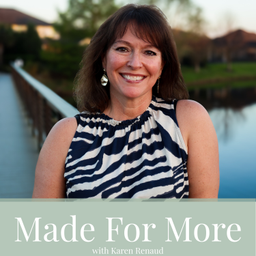
Made for More — Holistic Health and Purpose for Women in Midlife
Karen Renaud
5.0from 15 ratings
- 14
- Episodes
- 15
- Ratings
- Daily
- Cadence
- 2026
- First episode
About Made for More — Holistic Health and Purpose for Women in Midlife
Made for More — the podcast for women navigating midlife who are ready to stop surviving & start thriving. I'm Karen Renaud, M.Ed., NBC-HWC, integrative health practitioner, positive psychology coach & personal trainer. If you're in perimenopause or menopause, feeling exhausted & not quite like yourself — you are in the right place. Blending midlife wellness, positive psychology & integrative health to help you reclaim your energy, rediscover your purpose & transform your life. I cover mindset, habits, stress, fitness, confidence & whole-person transformation. You were made for more.
- Publisher
- Karen Renaud
- Category
- health & fitness
- Language
- en
- Explicit
- No
- First episode
- 22 May 2026
- Latest episode
- 24 Aug 2026
Latest episodes
14 episodes in the feed.
24 Aug 2026
What If Stress Isn't the Enemy? A New Way to Think About Stress in Midlife
Stress doesn't just affect your mood—it can influence your sleep, hormones, digestion, energy, weight, and overall health. Discover why your mindset about stress matters and learn practical strategies to build resilience without trying to eliminate every stressor from your life. What if stress isn't what's making you sick? What if your relationship with stress plays a bigger role than you've ever been taught? In this episode of Made for More: Holistic Health and Purpose for Women in Midlife, Karen explores what stress is really doing inside your body—and why understanding your stress response can change the way you think about your health. You'll learn the difference between a stressor and your stress response, why your nervous system reacts the same way to a bear on a hiking trail as it does to a full inbox, and how chronic stress can affect your sleep, hormones, digestion, energy, mood, and overall health. Karen also shares research on stress mindset, the surprising role of oxytocin during stressful times, and why some of life's most meaningful experiences are also some of its most stressful. Most importantly, you'll leave with practical tools you can use immediately—including the See It, Own It, Use It framework and the Five-Minute vs. Five-Year Question—to help you respond to stress with greater resilience. If you've ever felt overwhelmed, exhausted, or stuck in survival mode, this episode will help you understand why—and show you a healthier way forward. This week's Made for More Challenge: The next time something stresses you out, pause and ask yourself: "Is this a five-minute problem or a five-year problem?" If it's a five-minute problem, practice letting it go. If it's a five-year problem, try the See It, Own It, Use It framework and remember that your stress response is designed to help you rise to the challenge—not work against you. In This EpisodeThis Week's Made for More Challenge Connect with Karen: 🌿 Website: https://www.inspiredintegrativehealth.com (https://www.inspiredintegrativehealth.com) 🎁 Free inSPIREd Reset Guide: https://www.inspiredintegrativehealth.com/free-reset-guide (https://www.inspiredintegrativehealth.com/free-reset-guide) 📬 Weekly Wellness Newsletter: https://www.inspiredintegrativehealth.com/join-my-list (https://www.inspiredintegrativehealth.com/join-my-list) 📱 Instagram: https://www.instagram.com/inspiredintegrativehealth (https://www.instagram.com/inspiredintegrativehealth) 👥 Facebook: https://www.facebook.com/inspiredintegrativehealth (https://www.facebook.com/inspiredintegrativehealth) 💼 LinkedIn: https://www.linkedin.com/in/karenrenaudiih (https://www.linkedin.com/in/karenrenaudiih) References and Deeper Dive Resources: Stephen Cabral, DC. The Rain Barrel Effect: Why We Get Sick and How to Get Well. Kelly McGonigal, PhD. The Upside of Stress: Why Stress Is Good for You, and How to Get Good at It. Alia Crum, PhD. Crum, A. J., Salovey, P., & Achor, S. (2013). Rethinking Stress: The Role of Mindsets in Determining the Stress Response. Journal of Personality and Social Psychology, 104(4), 716–733. Crum, A. J., & Crum, T. (2015). "Stress Can Be a Good Thing If You Know How to Use It." Harvard Business Review. Mihaly Csikszentmihalyi. Flow: The Psychology of Optimal Experience. Jim Loehr & Tony Schwartz. The Power of Full Engagement. Harvard Health Publishing. Understanding the Stress Response. MEDICAL & WELLNESS DISCLAIMER The information shared in this podcast is provided for educational and informational purposes only and is not intended as medical advice. The content of this podcast is not intended to diagnose, treat, cure, or prevent any disease or medical condition, nor should it be considered a substitute for individualized medical, psychological, medical nutritional therapy, or healthcare advice. The views and opinions expressed in this podcast are my own and are intended to provide evidence-informed education and practical wellness strategies. Your health decisions are ultimately your responsibility, and you should work with your healthcare team to determine what is appropriate for your individual needs.
17 Aug 2026
Exercise Isn't Punishment—It's Training for the Life You Want
What if the question "How many calories did I burn?" is the wrong question entirely? If you've ever exercised because you felt guilty, to "earn" your food, or simply because you thought you should, you're not alone. But what if there was a better reason to move your body? In this episode of Made for More: Holistic Health and Purpose for Women in Midlife, Karen explores why exercise isn't about punishment—it's about preparing your body for the healthy, active life you want to live over the next 20, 30, or even 50 years. You'll discover why strength training becomes even more important after 40, how everyday movement contributes to your health, why joyful movement makes consistency easier, and why recovery is an essential part of getting stronger. Karen also shares how her perspective on exercise evolved—from training to perform to learning how to train for a long, healthy, active life. Along the way, injuries, mystery health challenges, and menopause completely reshaped what fitness means to her. Because exercise isn't just about burning calories. It's one piece of a much bigger health puzzle. When you connect the dots between movement, sleep, nutrition, stress, hormones, mindset, and purpose, exercise becomes less about obligation and more about building the life you want to live. If you're ready to stop exercising out of guilt and start training for your healthiest, strongest next chapter, this episode is for you. This Week's Challenge: Choose one small way to move this week.Take a 10-minute walk.Do one short strength workout.Dance in your kitchen.Try the fitness class you've been curious about.Remember...You're not just exercising for today. You're training for the life you want to live tomorrow. CONNECT WITH KAREN 🌿 Website https://www.inspiredintegrativehealth.com (https://www.inspiredintegrativehealth.com) 🎁 Free inSPIREd Reset Guide Start putting the pieces of your health puzzle together with my free guide. https://www.inspiredintegrativehealth.com/free-reset-guide (https://www.inspiredintegrativehealth.com/free-reset-guide) 📬 Join the Community Get practical wellness tips, podcast updates, and encouragement delivered straight to your inbox each week. https://www.inspiredintegrativehealth.com/join-my-list (https://www.inspiredintegrativehealth.com/join-my-list) 📸 Instagram https://www.instagram.com/inspiredintegrativehealth (https://www.instagram.com/inspiredintegrativehealth) 👥 Facebook https://www.facebook.com/inspiredintegrativehealth (https://www.facebook.com/inspiredintegrativehealth) 💼 LinkedIn https://www.linkedin.com/in/karenrenaudiih (https://www.linkedin.com/in/karenrenaudiih) 🎙️ Enjoying the podcast? If this episode encouraged you, please follow Made for More: Holistic Health and Purpose for Women in Midlife, leave a review, and share it with a friend. Every share helps another woman discover that her best chapter may still be ahead. Resources & Deeper Dive Dr. Stephen Cabral – The Rain Barrel Effect (DESTRESS Protocol) LaBlast® Fitness – Learn more about Louis Van Amstel and the LaBlast® program. MEDICAL & WELLNESS DISCLAIMER The information shared in this podcast is provided for educational and informational purposes only and is not intended as medical advice.I am not a physician, registered dietitian, or licensed mental health provider. The content of this podcast is not intended to diagnose, treat, cure, or prevent any disease or medical condition, nor should it be considered a substitute for individualized medical, psychological, nutritional, or healthcare advice.Always consult your physician or another qualified healthcare professional before beginning or changing any exercise program, nutrition plan, supplement regimen, medication, or other health-related practice, particularly if you have a medical condition, are pregnant, or have concerns about your health.Never disregard professional medical advice or delay seeking medical care because of something you heard on this podcast.The views and opinions expressed in this podcast are my own and are intended to provide evidence-informed education and practical wellness strategies. Your health decisions are ultimately your responsibility, and you should work with your healthcare team to determine what is appropriate for your individual needs.
10 Aug 2026
HEALTHY EATING AFTER 40: CUT THROUGH NUTRITION CONFUSION
EPISODE 12 — Nutrition advice has never been louder—or more confusing. Eggs are bad. Then they’re good. Carbs are the problem. No, fat is the problem. Try fasting. Don't try fasting. Count your Macros! Count your calories! Keto, Atkins, Paleo, Vegan, Vegetarian...protein goals, social media trends, and changing hormones... it’s easy to wonder what you’re actually supposed to eat! If you’re a woman over 40 who wants to feel stronger, more energized, and less stressed around food, this episode is for you. Karen Renaud offers a calmer, more sustainable approach to nutrition—one that moves away from restrictive rules and helps you pay attention to what supports your body in this season of life. In this episode, you’ll learn: Why nutrition experts agree on more than what we've been led to believe The simple foundations that matter more than the latest trend How to move from food rules and all-or-nothing thinking toward curiosity Why protein and muscle health matter more in perimenopause and menopause Why extreme diets are rarely a long-term solution How mindful eating can help you better understand hunger, energy, and satisfaction One small, realistic step you can take this week—without overhauling your life This is not another plan to follow perfectly. It’s an invitation to build a way of eating that feels practical, supportive, and sustainable. CONNECT WITH KAREN: Website: inspiredintegrativehealth.comFree inSPIREd Reset Guide: https://www.inspiredintegrativehealth.com/free-reset-guideTips, inspiration, updates: https://www.inspiredintegrativehealth.com/join-my-listEmail: karen@inspiredintegrativehealth.comInstagram: https://www.instagram.com/inspiredintegrativehealthFacebook: https://www.facebook.com/inspiredintegrativehealthLinkedIn: https://www.linkedin.com/in/karenrenaudiih MEDICAL & WELLNESS DISCLAIMER This episode is for educational purposes only and is not medical advice. Karen Renaud is not a physician or registered dietitian. Please consult a qualified healthcare professional before making changes to your nutrition, exercise, supplements, medications, or health plan. CONCEPTS REFERENCED IN THIS EPISODE Blue Zones — regions of the world with exceptionally high concentrations of people living to 100 or beyond, studied by researcher Dan Buettner. The consistent dietary patterns across Blue Zones informed the general principles discussed in this episode. Bio-individuality — the principle that each person has unique nutritional needs based on genetics, lifestyle, health history, and other individual factors. Sarcopenia — age-related muscle loss, referenced in the protein section. Mindful eating — the practice of paying full, non-judgmental attention to the experience of eating. DEEPER DIVE RESOURCES Buettner, D. (2008). The Blue Zones: Lessons for Living Longer from the People Who’ve Lived the Longest. National Geographic Society.https://www.amazon.com/Blue-Zones-Lessons-Living-Longest/dp/1426202741 Cabral, S. (2017). The Rain Barrel Effect. Stephen Cabral.https://www.amazon.com/Rain-Barrel-Effect-Stephen-Cabral/dp/0999194909 https://www.amazon.com/ROAR-Physiology-Performance-Health-Strong/dp/1623366860Tribole, E. & Resch, E. (2020). Beasley, J.M., Shikany, J.M. & Thomson, C.A. (2013). The role of dietary protein intake in the prevention of sarcopenia of aging. Nutrition in Clinical Practice, 28(6), 684–690.https://pmc.ncbi.nlm.nih.gov/articles/PMC3928027/ This is Episode 12 of the Made for More podcast. New episodes every week. Follow on Spotify and Apple Podcasts so you never miss one.
3 Aug 2026
Why Am I So Tired All the Time? What Your Body Is Trying to Tell You
Why Am I So Tired All the Time? If that question has crossed your mind lately—this episode is for you. So many women in perimenopause and midlife assume it's just aging or menopause. "Everybody's tired. I guess this is what life feels like now." But chronic fatigue isn't something you have to accept. In this episode, we'll look at exhaustion in a completely different way. What if your tiredness isn't a character flaw—or even a sleep problem? What if it's your body trying to tell you something important? • Why exhaustion is common—but not inevitable • The "energy checking account"—and why you're likely overdrawn without realizing it • Five hidden energy drains: physical, mental, emotional, relational, and purposeful • Why brain fog and low energy aren't always about sleep • The relationship that may be draining you most • A simple 7-day Energy Detective experiment—no new habits required Whether you're navigating the menopause transition, burnout, or constant fatigue, this episode will help you understand what may be happening and give you a practical starting point for feeling like yourself again. 🌿 inspiredintegrativehealth.com — Free inSPIREd Reset Guide + program information Concepts Referenced: Viktor Frankl — Austrian psychiatrist and author of Man's Search for Meaning. Referenced in the discussion of purpose. PERMA Model — Dr. Martin Seligman's framework for human flourishing. The Relationships pillar is referenced in the relational energy section. (Covered in depth in Episode 4.) SPIRE Model — Developed by Dr. Tal Ben-Shahar, Dr. Maria Sirois, and Megan McDonough at the Wholebeing Institute. The five pillars provide the framework for the five energy drains discussed in this episode. Multitasking and cognitive load — Referenced as well-established concepts in cognitive psychology. Scripture: Isaiah 40:31 Further Reading: Loehr, J. & Schwartz, T. (2003). The Power of Full Engagement. van der Kolk, B. (2014). The Body Keeps the Score. Frankl, V. (1946). Man's Search for Meaning. Seligman, M. (2011). Flourish. Happiness Studies Academy — happinessstudies.academy VIA Character Strengths (Free Assessment) — viacharacter.org (http://viacharacter.org) Health & Medical Disclaimer: The content in Made for More—including all episodes and show notes—is provided for educational and informational purposes only. It is not medical advice and is not a substitute for professional medical care. Karen is a National Board Certified Health & Wellness Coach, Integrative Health Practitioner, Certified Personal Trainer, Positive Psychology Coach, and Certified Menopause Coaching Specialist. She is not a physician, licensed therapist, psychologist, or registered dietitian and does not diagnose, treat, cure, or prescribe for any physical or mental health condition, nor does she provide medical nutrition therapy. Everything Karen shares is grounded in professional training and lived experience. Having navigated many of these same health challenges herself, she understands the value of becoming your own health detective while partnering with qualified healthcare professionals. Always consult a qualified healthcare professional before beginning or changing any exercise program, nutrition plan, supplement regimen, medication, or other health-related practice, especially if you have a medical condition, are pregnant, or have concerns about your health. If you are experiencing persistent or worsening symptoms—including fatigue, significant mood changes, or other physical or mental health concerns—seek appropriate medical care. Never disregard or delay seeking professional medical care in favor of information shared in this podcast. The views and opinions expressed in this podcast are Karen's own and are intended to provide evidence-informed education and practical wellness strategies. Your health decisions are ultimately your responsibility and should be made in partnership with your healthcare team.
27 Jul 2026
Episode 10: When Did "Busy" Become Who You Are? The Cost of Living With Your Foot on the Gas
When Did "Busy" Become Who You Are? — The Hidden Cost of Chronic Urgency for Women in Midlife When someone asks, "How are you?"—what do you say? Busy. Tired. Keeping my head above water. Hanging in there. Somewhere along the way, many of us stopped describing our schedules and started describing ourselves. In this episode, Karen Renaud asks an important question:What is living at full speed actually costing you? You'll discover: • The science behind allostatic load—what chronic stress and urgency can do to your body over time, and why it matters, especially during midlife. • Why your nervous system gets good at whatever you practice—and how to begin practicing something different. • The difference between functioning and having the capacity to truly live. • How to identify your exhaustion point and what it may be telling you. • Why recovery is a skill—not an event—and what recovery can actually look like in everyday life. • The difference between survival mode and capacity mode. • A simple 7-Day Capacity Check Challenge to help you begin creating a healthier rhythm. Question one: When did I hit my exhaustion point today? Notice the time and what was happening. Were you physically tired, mentally overloaded, emotionally depleted — or all three? Question two: How quickly did I recover from the hardest moment of my day? Did you reset within a few minutes? Did the tension follow you all afternoon? Are you still replaying it at bedtime? Question three: What helped me return to myself today? Medical & Wellness Disclaimer The information shared in this podcast is provided for educational and informational purposes only and is not intended as medical advice. I am not a physician, registered dietitian, or licensed mental health provider. The content of this podcast is not intended to diagnose, treat, cure, or prevent any disease or medical condition, nor should it be considered a substitute for individualized medical, psychological, nutritional, or healthcare advice. Always consult your physician or another qualified healthcare professional before beginning or changing any exercise program, nutrition plan, supplement regimen, medication, or other health-related practice, particularly if you have a medical condition, are pregnant, or have concerns about your health. Never disregard professional medical advice or delay seeking medical care because of something you heard on this podcast. The views and opinions expressed in this podcast are my own and are intended to provide evidence-informed education and practical wellness strategies. Your health decisions are ultimately your responsibility, and you should work with your healthcare team to determine what is appropriate for your individual needs. Resources, References, Further Exploration: McEwen, B.S. & Stellar, E. (1993). Stress and the Individual: Mechanisms Leading to Disease. Introduced the concept of allostatic load—the cumulative wear and tear on the body caused by chronic stress. https://pubmed.ncbi.nlm.nih.gov/8215752/ (https://pubmed.ncbi.nlm.nih.gov/8215752/) McEwen, B.S. (1998). Stress, Adaptation, and Disease: Allostasis and Allostatic Load. A foundational review explaining how chronic activation of the stress response affects long-term health. https://nyaspubs.onlinelibrary.wiley.com/doi/10.1111/j.1749-6632.1998.tb09546.x (https://nyaspubs.onlinelibrary.wiley.com/doi/10.1111/j.1749-6632.1998.tb09546.x) Tal Ben-Shahar – Concepts related to recovery, wellbeing, and creating "Islands of Sanity." https://www.happinessstudies.academy (https://www.happinessstudies.academy) Matthew 11:28 — "Come to me, all you who are weary and burdened, and I will give you rest." Sapolsky, R. Why Zebras Don't Get Ulcers. An accessible, evidence-based exploration of the science of stress and its effects on long-term health.
20 Jul 2026
What Are You Training For? — How to Build a Body That Says Yes to Life (Strength Training for Women over 40)
Whether you're looking to build muscle after menopause, improve your healthspan, support healthy aging, or simply create a stronger body for the life you want to live, this episode is for you. Most of us have been asking the wrong questions about our health. Did I lose weight? Did I hit my macros? What does the scale say? Did I earn dessert? Those aren't bad questions. They're just not the most important ones. What are you training for? Not for a number on the scale — but for the hiking trail, the dance floor, the spontaneous trip, the grandchildren on the floor. For the future you'll thank yourself for building today. In this episode you'll discover:— Why genetics are only one part of the story—and how your daily choices play a powerful role in shaping your future health.— The science behind sarcopenia — age-related muscle loss — and why strength training matters more in midlife than ever— How strength training supports bone density, metabolism, mood, and brain health— How getting stronger physically changes what you believe is possible in every area of life— Karen's personal story — from the Reebok National Aerobic Championships to training for future Karen— Why "I don't want my world to get smaller" is the philosophy behind everything Plus the challenge Karen wants you to answer in the comments:I'm training for ____________. 🌿 inspiredintegrativehealth.com — free inSPIREd Reset Guide + program info RESOURCES & REFERENCES Books:McGonigal, K. (2019). The Joy of Movement. Avery/Penguin Random House.amazon.com/Joy-Movement-Exercise-Happiness-Connection/dp/0525534946 Ratey, J. (2008). Spark: The Revolutionary New Science of Exercise and the Brain. Little, Brown.amazon.com/Spark-Revolutionary-Science-Exercise-Brain/dp/0316113514 Research:Sarcopenia & resistance training in menopausal women — PMC (2023)pmc.ncbi.nlm.nih.gov/articles/PMC10647115/ Resistance training & depression — Gordon et al., JAMA Psychiatry (2018)doi.org/10.1001/jamapsychiatry.2018.0572 Scripture: Philippians 4:13
13 Jul 2026
Your Next Chapter — What If Your Best Years Are Still Ahead? (Thriving in Midlife & Beyond)
Eight weeks in — and there's a question many women quietly carry but rarely say out loud: Is this it? Have I missed my chance? In this episode of Made for More, Karen Renaud explores those questions directly — and offers something better than reassurance. She offers a practical path forward for living the changes you've started making long after the excitement of a new beginning fades. This isn't about completing a program. It's about building a life. A life that reflects who you are, who you're becoming, and what is still possible for you in this chapter. In this episode, you'll discover: • The real difference between being informed and being transformed • How to build minimum baseline habits, rituals, and reminders that hold up in real life • How to "restart without drama" when life inevitably disrupts your routine • The SPIRE model reimagined as an ongoing weekly life practice rather than simply a program framework • Why growth doesn't stop at midlife — and why your prime years may still be ahead of you • A personal story about building a graduate curriculum by leaning into strengths rather than relying on willpower alone • A final challenge designed to help you carry your growth forward into whatever comes next If you've been wondering whether your best years are behind you — this episode was made to answer that question. 🌿 Visit https://www.inspiredintegrativehealth.com/ to download your free inSPIREd Reset Guide and learn more about working together. Resources & References — Episode 8 Research: Lyubomirsky, S. (2008). The How of Happiness: A Scientific Approach to Getting the Life You Want. New York: Penguin Press. (Source of the person-activity fit concept — the idea that the wellbeing strategies that work best are the ones that genuinely match a person's values, strengths, personality, and season of life.) Teaching Referenced from Karen's Training: Tal Ben-Shahar — concepts of informed vs. transformed learning and lasting change, referenced from Karen's positive psychology coursework and the Happiness Studies Academy curriculum. Maria Sirois — concepts related to change, resilience, and conscious choice, referenced from Karen's training through Wholebeing Institute and the SPIRE framework. Framework Referenced: The SPIRE framework (Spiritual, Physical, Intellectual, Relational, Emotional), developed by Tal Ben-Shahar, Maria Sirois, and Megan McDonough through Wholebeing Institute and taught as part of Karen's training and professional certification.
6 Jul 2026
Remembering Yourself: Why Confidence Comes From Action, Not Before It (Identity & Courage for Women in Midlife)
Have you ever looked in the mirror and thought: "What happened to me?" It’s not always that you don't recognize your face—sometimes, you don't recognize your life. Maybe during a stressful season, health changes, or navigating menopause symptoms, you lost touch with the woman who used to trust herself, take risks, and speak up. If you are trying to find yourself again in midlife, you are not alone.In this episode of Made for More, Karen Renaud explores how to build self-confidence, close the gap on your goals, and step into a more purposeful life. This isn't about becoming someone new. It's about remembering who you are, reconnecting with your personal strengths, and taking courageous action before you feel ready. 📌 Key Takeaways From This Episode: How to Build Self-Confidence: Why bravery is built through physical action, not just positive thinking. Albert Bandura & Self-Efficacy: How "mastery experiences" give your brain the data it needs to believe you can do hard things. The 4-Minute Mile Mental Barrier: What Roger Bannister’s historic 1954 run teaches us about challenging our limiting beliefs. The "As If" Principle: How changing your posture, breath, and movement signals your nervous system to shift your emotional state. Shifting Your Identity: Moving away from "I'm trying to change" to leading from an identity-driven framework. VIA Character Strengths: Reclaiming the core parts of your personality that got buried under years of responsibility. 🌿 Free Midlife Wellness Resource: Visit inspiredintegrativehealth.com to download your free inSPIREd Reset Guide and explore midlife coaching. 📚 Deep Dive & References From This EpisodeWant to explore the positive psychology research, history, and mind-body science discussed in today's show? Check out the resources below: William James & The "As If" Principle: In Segment 2, we discussed William James's revolutionary 1884 theory of emotion ("What Is an Emotion?", published in Mind). James argued that our physical actions and physiological responses occur before our conscious emotions. If you want to experience an emotion like confidence, you must act habitually as if that feeling is already present. For a fantastic modern extension of James's work on how behavior shapes our minds, check out psychologist Richard Wiseman’s book, As If: The Radical New Approach to Changing Your Mind. Learn more about James via his Britannica Biography (https://www.britannica.com/biography/William-James). Albert Bandura & Self-Efficacy: We looked at Bandura's foundational 1977 study, Self-efficacy: Toward a Unifying Theory of Behavioral Change. His research proves that confidence isn't a personality trait; it grows primarily through "mastery experiences"—moments where you take a risk and see that you are still standing. Review his framework via the APA Human Agency Summary (https://www.apa.org/research-practice/conduct-research/self-efficacy-human-agency). Sir Roger Bannister’s Four-Minute Mile: On May 6, 1954, Roger Bannister shattered a collective psychological barrier by running a mile in 3:59.4. While he possessed incredible mental fortitude, he was also an Oxford medical student who achieved this feat by pioneering scientific physiological pacing and interval training. Once he proved it was possible, 15 other runners matched the feat within three years, proving that the barrier was psychological, not physical. Read the story on the Guinness World Records Hall of Fame (https://www.guinnessworldrecords.com/records/hall-of-fame/first-sub-four-minute-mile). VIA Character Strengths Framework: Created by Dr. Martin Seligman and Dr. Christopher Peterson, this framework emphasizes focusing on your core character traits to build authentic self-trust. Referenced from Karen's graduate coursework in positive psychology. Identity-Based High Performance: The concepts of identity-driven change mentioned in Segment 3 are associated with the public work of Tony Robbins and Brendon Burchard, focusing on who you need to become in order to make sustainable life changes.
29 Jun 2026
How to Build Habits That Actually Stick — Stop Starting Over and Finally Stay Consistent
Are you tired of starting over? You begin the week with the best intentions — and by Wednesday the habit is gone. You're not lazy. You're not broken. You just need a system built for your real life, not your ideal one. In this episode of Made for More — the podcast for women in perimenopause and midlife who are ready to stop surviving and start thriving — Karen Renaud breaks down exactly why healthy habits fall apart for women over 40, and what to do instead. No more all-or-nothing thinking. No more waiting for motivation. No more guilt when life gets in the way. Just simple, sustainable habits that work even on your hardest days. In this episode you'll discover:— The real reason most habit attempts fail (hint: too much too fast won't last)— Why motivation is unreliable and your environment is everything— The neuroscience of habit formation — and why falling off doesn't mean starting over— The minimum baseline — the smallest version of a healthy habit you can keep on your worst day— Habit stacking — how to attach new habits to ones you already do automatically— Dr. Tal Ben-Shahar's four types of reminders that make healthy routines stick — daily, specific, ever-present, and mini— How to design your environment so the healthy choice becomes the easy choice— How Karen — a certified meditation and mindfulness instructor — still needed a system to make daily meditation stick (and exactly what that system looks like)— How to create a fall-back plan so you never have to start over again— Why identity-based habits outlast motivation-based ones every time Plus a four-step challenge to help you design a complete sustainable habit system starting today — without overhauling your life. If you're a woman over 40 or 50 navigating perimenopause, menopause, midlife transitions, low energy, or the exhausting cycle of starting over — this episode will change how you approach healthy habits for good. 🌿 Free inSPIREd Reset Guide + program info: www.inspiredintegrativehealth.com (http://www.inspiredintegrativehealth.com) RESOURCES & REFERENCES: Clear, J. (2018). Atomic Habits: An Easy & Proven Way to Build Good Habits & Break Bad Ones. Penguin Random House.https://www.amazon.com/Atomic-Habits-Proven-Build-Break/dp/0735211299 (https://www.amazon.com/Atomic-Habits-Proven-Build-Break/dp/0735211299) Ben-Shahar, T. — Happiness Studies Academy.https://www.happinessstudies.academy (https://www.happinessstudies.academy)
22 Jun 2026
Your Body Is Not Your Enemy — The Mind-Body Connection, Movement, and Mindfulness
Are you exhausted from fighting your own body? Frustrated that nothing seems to work no matter how hard you try? What if the problem isn't your body — but your relationship with it? In this episode of Made for More — the podcast for women in midlife who are ready to stop surviving and start thriving — Karen Renaud explores the science of the mind-body connection and offers a reframe that changes everything: your body has never been your enemy. It has been responding to your life all along. If you're a woman over 40 dealing with low energy, brain fog, perimenopause or menopause symptoms, or a complicated relationship with your body — this episode is for you. In this episode you'll discover:— Why Western medicine taught us to see the mind and body as separate — and how that's been costing us— How your posture, breath, and movement send constant signals to your brain — and how to use that to your advantage— The science of "hope molecules" — why just 3 minutes of movement can shift your brain chemistry and fight anxiety and depression— Why what you believe about your body and exercise changes your physical outcome (Dr. Alia Crum's groundbreaking Stanford research)— How movement is literally medicine for your brain — mood, memory, focus, and resilience (Dr. John Ratey)— A simple introduction to mindfulness and nervous system regulation for women in midlife— A guided deep breathing exercise you can use anytime to reduce stress and shift your energy Plus this week's challenge: one daily question and one daily breath practice that takes less than 60 seconds and can change how you feel in your body starting today. Stop punishing your body. Start supporting it. This episode will show you how. 📩 www.inspiredintegrativehealth.com (mailto:karen@inspiredintegrativehealth.com)🌿 Free inSPIREd Reset Guide + program info: inspiredintegrativehealth.com RESOURCES & REFERENCES: McGonigal, K. (2019). The Joy of Movement. Penguin Random House.https://www.amazon.com/Joy-Movement-Exercise-Happiness-Connection/dp/0525534946 (https://www.amazon.com/Joy-Movement-Exercise-Happiness-Connection/dp/0525534946) Ratey, J. (2008). Spark: The Revolutionary New Science of Exercise and the Brain. Little, Brown and Company.https://www.amazon.com/Spark-Revolutionary-Science-Exercise-Brain/dp/0316113514 (https://www.amazon.com/Spark-Revolutionary-Science-Exercise-Brain/dp/0316113514) Wiseman, R. (2014). The As If Principle. Free Press.https://www.amazon.com/If-Principle-Radically-Approach-Changing/dp/1451675097 (https://www.amazon.com/If-Principle-Radically-Approach-Changing/dp/1451675097) Crum, A.J. & Langer, E.J. (2007). Mind-set matters: Exercise and the placebo effect. Psychological Science, 18(2), 165–171.https://pubmed.ncbi.nlm.nih.gov/17425538/ (https://pubmed.ncbi.nlm.nih.gov/17425538/) University of Minnesota (2020). What Is the Mind-Body Connection? Takingcharge.csh.umn.edu.https://www.takingcharge.csh.umn.edu/what-is-the-mind-body-connection (https://www.takingcharge.csh.umn.edu/what-is-the-mind-body-connection)
15 Jun 2026
You Were Made For More — How to Reconnect With Purpose in Midlife | Ep. 4
Have you ever had that persistent feeling that there's more for you? More energy. More meaning. More of a sense that you're living the life you were actually made for? It may be a signal. In this episode, Karen Renaud introduces the SPIRE model of whole-being happiness — developed by Dr. Tal Ben-Shahar, Dr. Maria Sirois, and Megan McDonough at the Wholebeing Institue in Massachusetts— and explains why fixing just one area of your life never creates the lasting transformation you're looking for. She also covers the research on meaning, character strengths, and why this season of life can be your most powerful chapter yet. In this episode: The research on meaning and why it's a fundamental human need (not a luxury) Viktor Frankl and what concentration camp survivors teach us about purpose The SPIRE model — Spiritual, Physical, Intellectual, Relational, Emotional Why fixing just one thing never creates lasting change Your character strengths — and how they point toward your purpose The Best Possible Future exercise — and the research behind it How to take your next step toward the woman you were made to be Resources & links mentioned: 📖 Dr. Martin Seligman 📖 Man's Search for Meaning — Viktor Frankl 🔗 VIA Character Strengths free assessment: www.viacharacter.org (http://www.viacharacter.org) 📩 Free inSPIREd Reset Guide: https://www.inspiredintegrativehealth.com/free-reset-guide (https://www.inspiredintegrativehealth.com/free-reset-guide) 💼 I Was Made For More program: https://www.inspiredintegrativehealth.com/program (https://www.inspiredintegrativehealth.com/program) 📋 Apply for the program: https://www.inspiredintegrativehealth.com/forms/2149591591 (https://www.inspiredintegrativehealth.com/forms/2149591591) Connect with Karen: 🌐 Website: www.inspiredintegrativehealth.com (http://www.inspiredintegrativehealth.com) 📸 Instagram: https://www.instagram.com/inspiredintegrativehealth (https://www.instagram.com/inspiredintegrativehealth) 👥 Facebook: https://www.facebook.com/inspiredintegrativehealth (https://www.facebook.com/inspiredintegrativehealth) 💼 LinkedIn: https://www.linkedin.com/in/karenrenaudiih (https://www.linkedin.com/in/karenrenaudiih) 🎙️ Made for More is the podcast for women in their Prime Years who are ready to stop surviving and start thriving — body, mind, and soul.
8 Jun 2026
Why You Feel Stuck — And How to Start Moving Forward Again | Ep. 3
Feeling stuck is one of the most frustrating experiences there is. You know what you want. You know what you need to do. And you cannot make yourself do it. But here's what most people don't understand — feeling stuck is almost never about capability or discipline. It's about self trust. And self trust can be rebuilt. In this episode, Karen Renaud breaks down the neuroscience of why we get stuck, what's actually happening in your brain when you can't move forward, and a research-backed approach to building momentum again — without overhauling your entire life overnight. In this episode: Why feeling stuck is almost never about capability The self trust account — and what's been draining yours The neuroscience of stuck and why your brain resists change How small kept promises rebuild momentum The identity shift that changes everything (James Clear's Atomic Habits) The "As If Principle" — faith it till you make it Your one-promise challenge for this week Resources & links mentioned: 📖 Atomic Habits — James Clear 📖 The As If Principle — Richard Wiseman 📩 Free inSPIREd Reset Guide: https://www.inspiredintegrativehealth.com/free-reset-guide (https://www.inspiredintegrativehealth.com/free-reset-guide) 💼 I Was Made For More program: https://www.inspiredintegrativehealth.com/program (https://www.inspiredintegrativehealth.com/program) Connect with Karen: 🌐 Website: www.inspiredintegrativehealth.com (http://www.inspiredintegrativehealth.com) 📩 Free inSPIREd Reset Guide: https://www.inspiredintegrativehealth.com/free-reset-guide (https://www.inspiredintegrativehealth.com/free-reset-guide) 📸 Instagram: https://www.instagram.com/inspiredintegrativehealth (https://www.instagram.com/inspiredintegrativehealth) 👥 Facebook: https://www.facebook.com/inspiredintegrativehealth (https://www.facebook.com/inspiredintegrativehealth) 💼 LinkedIn: https://www.linkedin.com/in/karenrenaudiih (https://www.linkedin.com/in/karenrenaudiih) 🎙️ Made for More is the podcast for women in their Prime Years who are ready to stop surviving and start thriving — body, mind, and soul.
2 Jun 2026
Why You're Exhausted All the Time — What Your Body Is Actually Trying to Tell You
If you feel tired all the time — even after a full night's sleep — this episode is for you. Most women assume exhaustion is about sleep, diet, or discipline. But what's actually happening in your body is far more interesting — and far more fixable — than that. In this episode, Karen Renaud breaks down the science behind chronic exhaustion, what cortisol is actually doing to your body, and why the answer is not to push harder or do more.In this episode: Why exhaustion is almost never just a sleep problem How your stress response works — and why it's keeping you depleted The cortisol rhythm your body was designed for (and what disrupts it) The Rain Barrel Effect — and why your barrel may be overflowing Surprising research from Dr. Kelly McGonigal that will change how you think about stress The missing piece most women never address — recovery Three practical tools to start feeling better this week Resources & links mentioned: 📖 The Rain Barrel Effect — Dr. Stephen Cabral 📖 The Upside of Stress — Dr. Kelly McGonigal Connect with Karen: 🌐 www.inspiredintegrativehealth.com (http://www.inspiredintegrativehealth.com) 📩 Free inSPIREd Reset Guide: https://www.inspiredintegrativehealth.com/free-reset-guide (https://www.inspiredintegrativehealth.com/free-reset-guide) 📸 Instagram: https://www.instagram.com/inspiredintegrativehealth (https://www.instagram.com/inspiredintegrativehealth) 👥 Facebook: https://www.facebook.com/inspiredintegrativehealth (https://www.facebook.com/inspiredintegrativehealth) 💼 LinkedIn: https://www.linkedin.com/in/karenrenaudiih (https://www.linkedin.com/in/karenrenaudiih) Made for More is the podcast for women in their Prime Years who are ready to stop surviving and start thriving — body, mind, and soul.
22 May 2026
Why Midlife Women Keep Starting Over — And the Missing Piece Nobody Talks About
Do you remember when you used to show up for your life without second guessing every decision? In this first episode of Made for More, host Karen Renaud gets raw and real about the moment she chose fear over faith — and how that one decision quietly became a pattern that lasted years. If you're a woman in midlife who feels stuck, exhausted from the cycle of starting over, and wondering why nothing ever sticks — this episode was made for you Karen breaks down the real reason so many women in perimenopause and menopause feel stuck and disconnected from the woman they used to be. Spoiler — it's not a willpower problem. It's a system problem. And today she's giving you the missing piece. Topics covered:— Why high achieving women in midlife lose their courage and confidence— How the menopause transition adds to the chaos of feeling lost and stuck— The willpower vs waypower framework that explains why you keep starting over— Karen's personal journey through menopause and finding her way back— How to rebuild self trust and momentum one small promise at a time— Your weekly Made for More courage challenge Grab your free inSPIREd Reset Guide at www.inspiredintegrativehealth.com (http://www.inspiredintegrativehealth.com)
Reach and audience
Public platform figures. Ratings count people who left a rating, not total listeners.
- Apple Podcasts (US)
- 5.0 / 5
- 7 ratings
- Spotify
- 5.0 / 5
- 8 ratings
Contact Made for More — Holistic Health and Purpose for Women in Midlife
- Guest appearances
- Does not typically book guests
Based on episode analysis; this does not confirm that the show is currently accepting guests.
Host of Made for More — Holistic Health and Purpose for Women in Midlife?
Claim your podcast to manage its listing and keep your show details accurate.
Pod Engine is an independent podcast discovery and analytics service and is not affiliated with or endorsed by this podcast. Artwork and show content belong to their owners. Full legal notice.
Explore this show
Podcast research with Pod Engine