In this episode, we explore a critical but often overlooked topic:
What not to build.
Because many products don’t fail due to a lack of features—
They fail because of bad ones.
We introduce a practical lens for identifying these issues:
The Anti-Pattern Registry.
These are common design mistakes that create friction despite good intentions:
Mandatory onboarding that blocks users from getting started
Jargon-heavy interfaces that confuse instead of clarify
Dark patterns that manipulate users at the cost of trust
These patterns may improve short-term metrics.
But they damage long-term retention.
We then explore one of the most dangerous traps in product design:
The Feature Trap.
As products grow, teams tend to add more and more functionality.
The result:
Cluttered interfaces
Increased cognitive load
Slower performance and decision-making
The solution is not better organization.
It’s ruthless prioritization—and sometimes removal.
Finally, we highlight other critical failure modes that quietly frustrate users:
Poor error recovery that leaves users stuck without guidance
Weak integrations that break workflows across tools
Lack of accessibility that excludes entire groups of users
These are not edge cases.
They are core parts of the user experience.
Because great products are not just built by adding what users want.
They are refined by removing what users don’t need—and fixing what frustrates them.
This episode is part of a complete system for designing products that remain simple, focused, and trusted over time.
If you want the full framework, deeper insights, and practical strategies, you’ll find it here:
https://www.amazon.com/dp/B0GTHWKNX1 (https://www.amazon.com/dp/B0GTHWKNX1)
10 Apr 2026
23. Pattern Libraries and Proven Approaches
In this episode, we move from theory to execution.
What does frictionless design actually look like in a real product?
We introduce a practical toolkit:
The Fast Activation Pattern Library.
These are proven design patterns used by successful SaaS products to help users reach value quickly:
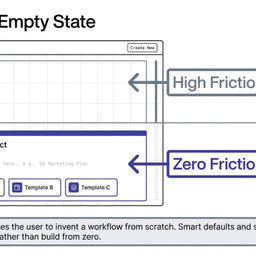
Replacing empty states with ready-to-use templates
Guiding users through their first meaningful action
Celebrating small wins with visible progress and feedback
Because activation is not an accident.
It is designed.
We then explore how to structure onboarding without creating friction:
The Frictionless Onboarding Catalog.
This includes patterns that respect user time and autonomy:
Role-based branching – tailoring the experience to the user’s context
Completion estimates – setting clear expectations upfront
Skippable flows – allowing users to move at their own pace
Because the best onboarding doesn’t force users forward.
It guides them—without slowing them down.
Finally, we highlight small but essential UX patterns that make a big difference in everyday use:
Undo actions – reducing fear and increasing confidence
Universal search – helping users find anything instantly
Lazy loading – keeping the experience fast and responsive
These are not “nice-to-have” features.
They are trust-building mechanisms.
Because great products are not defined by a single feature.
They are defined by hundreds of small, thoughtful decisions.
This episode is part of a complete system for building products that feel fast, intuitive, and effortless from the first interaction.
If you want the full framework, deeper insights, and practical strategies, you’ll find it here:
https://www.amazon.com/dp/B0GTHWKNX1 (https://www.amazon.com/dp/B0GTHWKNX1)
10 Apr 2026
22. AI, Automation, and the Future of Frictionless Design
In this episode, we explore how Artificial Intelligence is redefining what it means to build a SaaS product.
This is not just about adding AI features.
It’s about rethinking the product itself.
We introduce a new perspective:
The AI-Era SaaS Framework.
Not all AI is equal.
We break down the critical difference between:
Commoditized AI – generic chatbots and standard integrations
Behavioral AI – systems that learn from user behavior and adapt over time
The latter creates real differentiation.
Because it becomes more valuable the more it is used.
We then explore a major shift in how AI should be applied:
From assistance to automation.
Most products use AI to help users do tasks.
But the real opportunity is to eliminate the task entirely.
The best AI doesn’t guide work.
It does the work.
However, with this power comes a critical requirement:
Explainability.
Users must understand:
Why decisions are made
What actions were taken
How outcomes are determined
Because trust is essential when systems act on behalf of users.
Finally, we explore the ultimate competitive advantage in the AI era:
The Experience Moat.
As AI lowers the barrier to building features, competitors can replicate functionality faster than ever.
What cannot be easily copied is:
A deeply intuitive user experience
Seamless workflows with minimal friction
A product that feels natural, fast, and reliable
Because in a world where everything can be built—
the best experience wins.
This episode is part of a complete system for building next-generation SaaS products in the age of AI.
If you want the full framework, deeper insights, and practical strategies, you’ll find it here:
https://www.amazon.com/dp/B0GTHWKNX1 (https://www.amazon.com/dp/B0GTHWKNX1)
Contact Making of Services
Guest appearances
Does not typically book guests
Based on episode analysis; this does not confirm that the show is currently accepting guests.
Host of Making of Services?
Claim your podcast to manage its listing and keep your show details accurate.
Pod Engine is an independent podcast discovery and analytics service and is not affiliated with or endorsed by this podcast. Artwork and show content belong to their owners. Full legal notice.
Explore this show Podcast research with Pod Engine