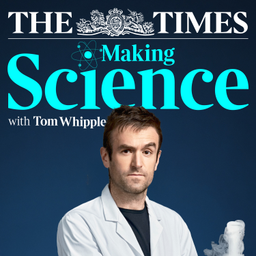
What connects 200 hand-holding monks, a lump of gold hidden in a beaker, and irradiated cocktails? Welcome to Making Science with Tom Whipple, Science Editor at The Times and Sunday Times. This is the podcast where history, innovation, and the unexpected collide, as we uncover jaw-dropping stories behind the scientific discoveries we take for granted.
Hosted on Acast. See acast.com/privacy (https://acast.com/privacy) for more information.
Are we in a “golden age” of cancer research? Cancer Research UK thinks we are. From the cancer vaccines it is supporting to the cheaper diagnostic tools that catch tumours early, the charity believes they are on the cusp of advances that change how we think about cancer. In this bonus episode Tom hears from leading research scientist, Professor Peter Sasieni to discuss the remarkable recent breakthroughs CRUK has
achieved supporting the HPV Vaccine, and the difference this is making to cervical cancer rates in Britain and around the world. And we also hear from Dr Sam Godfrey on what the new developments are - how they are discovering more about cancer and its prevention, detection and treatment.
This episode was made in partnership with Cancer Research UK.
Hosted on Acast. See acast.com/privacy (https://acast.com/privacy) for more information.
11 Aug 2025
Time-lords and the extra seconds
The start of the New Year in 2017 began in the usual way, with a countdown. But what happens when that countdown is eleven seconds rather than ten? In this final episode of the first series, Tom Whipple explores the evolution of time measurement, the complications a leap second can cause, and the ongoing debate among international 'time lords’ about what's to be done about it.
Hosted on Acast. See acast.com/privacy (https://acast.com/privacy) for more information.
4 Aug 2025
The Tree of Life
In this episode of Making Science, Tom Whipple tells the story of physician and alchemist Johannes Baptist van Helmont. In the 17th-century Van Helmont believed he had created the Philosopher's Stone, a substance that could turn base metals into gold. Whilst this might have been a pipe dream his work indirectly paved the way for a monumental scientific discovery - photosynthesis.
Hosted on Acast. See acast.com/privacy (https://acast.com/privacy) for more information.
28 Jul 2025
Glow in the dark cocktails and radioactive health drinks
The Sunshine Dinner of 1904 in New York was known for its glow-in-the-dark theme, featuring illuminated decorations, paint and of course, drinks. But what made these cocktails glow? It turned out to be none other than radium. In this episode of Making Science, Tom Whipple goes back to a time when radioactive products touted alluring health benefits. What they didn’t know then, was that the substance was unstable and would prove deadly.
Hosted on Acast. See acast.com/privacy (https://acast.com/privacy) for more information.
21 Jul 2025
The kilogram that lost its weight!
For over a century, the kilogram was defined by a single, shiny lump of metal locked in a vault near Paris. But what happens when your definition of mass starts...losing mass? In this episode, Tom Whipple, Science Editor at The Times, unpacks the surprisingly dramatic story of the kilo - from the French Revolution’s quest for order, to a quantum reimagining of what “weight” really means. Enter the kibble balance: a machine so precise it can weigh light itself. Sort of.
Hosted on Acast. See acast.com/privacy (https://acast.com/privacy) for more information.
14 Jul 2025
How do you hide a lump of gold in plain sight?
It's April in 1940. The Nazis are occupying Copenhagen. As they march through the streets, a stark realisation hits the physicist Niels Bohr. He has hours - maybe less - to make two Nobel Prize medals disappear completely. What might a substance named Aqua Regia and a humble beaker do conceal two huge lumps of gold? And bring it back again...a decade later.
Hosted on Acast. See acast.com/privacy (https://acast.com/privacy) for more information.
7 Jul 2025
How far can bull frogs jump? (And why it matters!)
Professor Tom Roberts discusses his research into frog biomechanics and the mystery of "Rosie the Ribeter," a bullfrog who defied scientific expectations with record-breaking jumps, in this interview episode.
1 Jul 2025
Are friars electric?
Host Tom Whipple explores Antoine Nolie's 1746 experiment using 200 monks to measure the speed of electric current, revealing insights into electron flow.
23 Jun 2025
Islands of Ice and Straw
Tom Whipple explores the science of latent heat and water's thermodynamic properties, revealing its crucial role in the WWII Allied plan to build an 'iceberg aircraft carrier' called Project Habakkuk.
16 Jun 2025
War, Stones and Metals!
Tom Whipple explores the profound impact of alloys, specifically how blending copper and tin transformed ancient toolmaking, modern engineering, and Stone and Bronze Age technologies in battle.
9 Jun 2025
Death rays and other would-be inventions!
Science Editor Tom Whipple investigates the mysterious "death ray" invented by Harry Grindell Matthews in 1924, which allegedly could stop engines and incapacitate enemies, exploring its potential connection to the electromagnetic spectrum.
3 Jun 2025
Introducing Making Science with Tom Whipple
Tom Whipple, Science Editor at The Times and Sunday Times, introduces his podcast, which explores the intersection of innovation, determination, and unexpected events that drive scientific discovery.
Podcast Authority Score: 20 / 100
A composite of feed quality, social presence, YouTube performance and engagement. Read the methodology.
Quality
39
Social presence
0
YouTube
0
Engagement
0
Host of Making Science with Tom Whipple?
Claim your podcast to manage its listing and keep your show details accurate.
Pod Engine is an independent podcast discovery and analytics service and is not affiliated with or endorsed by this podcast. Artwork and show content belong to their owners. Full legal notice.
Explore this show Podcast research with Pod Engine