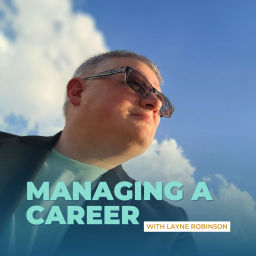
Managing A Career
Hosted by [Host Name] and Managing A Career · Layne Robinson
5.0from 4 ratings
- 219
- Episodes
- 4
- Ratings
- Daily
- Cadence
- 2023
- First episode
- 377
- YouTube views
About Managing A Career
I help you navigate the path to professional success. Whether you're a recent graduate still searching for your place or a seasoned professional with years of experience, the knowledge and insights I share can show you how to position yourself for growth and career advancement.
- Publisher
- Layne Robinson
- Category
- business · business · education
- Language
- en
- Explicit
- No
- First episode
- 18 May 2023
- Latest episode
- 6 Oct 2026
Latest episodes
219 episodes in the feed.
6 Oct 2026
Busy is what you are. Visible is what they remember. - MAC161
It's Friday afternoon, and you've just sent the weekly update. Eleven bullet points, every one of them true. Met with the vendor. Reviewed the draft. Followed up on open items. Closed out the quarter-end checklist. Eleven bullets that cost you something like fifty hours. Your manager skims them on the way to another meeting. Your manager's boss never sees them at all. By Monday morning, the most important thing you did all week exists in exactly one place: your own memory. This episode is for the person who hears "be more visible to senior leaders" and thinks, I would love to, and I don't have a single free hour to do it. If you're fully allocated, buried in delivery, and quietly suspicious that the people two levels up have no idea what you do, you're right to be suspicious, and there's a fix that doesn't ask you to work more. Busy Is Not Visible Let me start with the distinction the whole episode hangs on, because most of us blur it without noticing. Busy and visible are not the same thing, and they aren't even measured in the same place. Busy is a property of your calendar. Visible is a property of somebody else's memory. We've talked about visibility before, in Visibility (MAC-081) (https://managingacareer.com/81) and again in Your Manager Is Not Your Career Sponsor (MAC-139) (https://managingacareer.com/139). Every time, I get the same fair reply: Layne, I hear you, but I'm already at capacity. You're asking me to take on a second job. I'm not. Think about how a senior leader actually encounters you. It's in fragments: a line in your manager's monthly report, thirty seconds of a project mentioned at an all-hands, your name on slide nine of somebody else's deck. They don't see the fifty hours. They see whatever compressed version of those fifty hours happens to reach them, and that version is almost always written by someone who wasn't doing the work. That isn't carelessness. It's the shape of the job. A director with a hundred and twenty people in their organization makes decisions about budget, projects, and promotions for people they have spoken to three times. They have to decide on partial information, and the only open question is whose information it is. A group of executive coaches writing for Forbes put the hard version plainly: the belief that your work should speak for itself is outdated thinking (https://www.forbes.com/councils/forbescoachescouncil/2026/05/21/how-to-maintain-high-performance-and-stay-visible-to-leadership/). I'd go one step further. Work doesn't speak. It gets spoken about, usually by someone else, usually in a room you're not in. Busy is what you are. Visible is what they remember. Promoting Clarity, Not Yourself Before the mechanics, a word to everyone who flinched when I said visibility. Some of you find self-promotion genuinely distasteful. You'd rather do the work than talk about the work, and announcing your own wins in the team channel makes your skin crawl. I respect that. Over thirty years I've managed a lot of people like that, and they are very often the best people on the team. But let me reframe who visibility is for. It isn't for you. It's for the person making the decision. When a senior leader is deciding who gets the stretch assignment, which team gets the headcount, or whose name comes up in the talent review, they need clarity to decide well. If you leave them guessing, you aren't being humble. You're making their job harder, and you're letting the guess be made by whoever happened to talk loudest that quarter. A piece on building strategic visibility without self-promotion (https://www.globalprojectleader.co.uk/2026/02/career-compass-building-strategic-visibility-without-self-promotion/) contains a line I've more or less adopted as my own: visibility is not about promoting yourself; it's about promoting clarity. One framing is about you. The other is about the person on the other end, who has forty decisions to make this week and would love one of them to be easy. If you're one of the quiet ones, two habits will carry you a surprisingly long way. The first: give credit out loud, and own accountability in private. When the work goes well, name the people who made it go well, specifically and publicly. When it goes badly, take that conversation into a one-on-one. It sounds like the opposite of a visibility strategy, but the person who reliably makes other people look good becomes someone senior leaders trust with more people. The second habit is restraint. You don't need to speak in every meeting. You need to speak at the pivotal moment and say one precise thing. The person who delivers one sharp sentence in the quarterly review is remembered over the person who talked every five minutes. You're not promoting yourself. You're reducing their guesswork. The Forwardable Update So what does promoting clarity look like on a Tuesday when you have no time to spare? One short document, once a month. I call it the Forwardable Update: a short monthly note to your manager, written so they could forward it to their boss without changing a single word. That last part is the whole design. In MAC-139 we talked about why your manager usually isn't positioned to advocate for you the way a sponsor would. That's still true. But your manager is something else that matters enormously: the channel. Most of what a senior leader knows about you travels through your manager's upward reporting, and your manager is writing that reporting at nine o'clock at night, trying to compress eight people's work into something their boss will actually read. Picture two people on that team. One sends a list of activities. The other sends four tight lines already written for the next level up. Which one gets quoted? Structurally, the person whose update is ready to forward is the person whose work travels. So here's the test, and it's the only one that matters: could your manager forward this note, unedited, to the person above them? If they'd need to rewrite it, it won't travel, and if it doesn't travel, then above your manager it effectively didn't happen. The update has four parts. What moved. Not what you did, but what changed because you did it. "Met with finance four times" is activity. "Finance and operations are now working from the same forecast, so the March number no longer needs a footnote" is an outcome. Same four meetings, completely different sentence. The coaches I mentioned frame each item the same way: what changed, why it matters, and what comes next. If a line doesn't answer the first of those, it isn't ready. What I learned. One or two sentences. This is where your judgment becomes visible, and judgment is what senior leaders are really assessing when they think about who's ready for more. What's at risk. The thing you can see coming that they can't yet. Nothing builds trust faster than being the person who flagged it early. What I need. A decision, a resource, an introduction. Specific and small. Four parts, under two hundred words. If you've been keeping the running record from The Brag Document (MAC-141) (https://managingacareer.com/141), you already have the raw material; this is the month's version of it, shaped for an audience. Twenty minutes a month, less once it's a habit. Notice what this is not. In Reporting Status (MAC-044) (https://managingacareer.com/44) we covered the weekly status that keeps your manager informed, and that's still worth doing. But the weekly status is written for your manager. The Forwardable Update is written through them. A status report tells your manager you were busy. A Forwardable Update tells their boss what changed. Borrow the Room The update gets your work into rooms you'll never be in. Now let's get you into a few of those rooms yourself, without adding a single new project to your plate. Most of your best work happens in rooms senior leaders never enter: the working session where the problem actually got solved, the whiteboard, the spreadsheet at eleven at night. By the time that work reaches a senior audience, someone else is usually presenting it. But the rooms where senior leaders are already exist: the quarterly business review, the monthly operating review, the all-hands, the steering committee for the initiative you're three layers deep in. Nobody needs to invent a forum for you. The question is simply which recurring rooms senior leaders sit in where your work is already on the agenda, presented by someone else. Picture an analyst who builds the same recurring report every month. Her director presents it at the monthly operations review, reads the numbers aloud, and moves on. One month she asks a small question: Could I take five minutes at the next review to walk through what the numbers are actually telling us? Same report, same meeting, new narrator. Within a quarter, the VP running that review is asking for "her read" before the meeting starts. She didn't take on a project. She borrowed a room her work was already in. That's the first move: ask to present one slice of existing work. Not the whole initiative, just
29 Sept 2026
Analysis Paralysis Is Just Fear Wearing a Lab Coat - MAC160
Nobody has ever been written up for doing too much research. That's what makes it such a good place to hide. In the biggest calls a career throws at you — the job, the promotion ask, the pivot you've been circling for two years. Research looks like diligence, and it feels like diligence the whole time. But past a certain point, it stops being research and starts being a well-dressed way of not deciding. The Spreadsheet With Fourteen Columns A recruiter reaches out about a role one level up, better pay, better title. You say you'll think about it, and because you're responsible, you build a spreadsheet. Salary, commute, benefits — sensible columns, all of them. By week two there's a column for the company's review-site scores, one tracking how long the team has stayed, one for a parental leave policy you may never use, one for something the CFO said on an earnings call. By week five you're at fourteen columns, you've reread the same three reviews, and when someone asks where you landed, you say the thing we all say: "I'm still doing my homework." That spreadsheet feels like the most responsible thing you've done all month. That's the problem. Think about what got you here. Every organization you've worked in has rewarded you for looking one more time. So when fear shows up around a decision this size, it doesn't show up as fear. It puts on the most respectable costume in your closet. Fear in a hoodie, you'd spot immediately. Fear in a lab coat looks exactly like thoroughness. A career counselor who specializes in this exact problem, LaRae Jome (https://www.wldirections.com/career-counseling-blog/making-career-decisions-how-to-avoid-analysis-paralysis), makes a point worth sitting with: most people already know the steps of a good career decision — narrow your options, explore them properly, choose based on what you value. They still can't finish those steps, not from lack of knowledge but because finishing means feeling the uncertainty they've been avoiding. So they find another step. That's a different animal than the fear I described in Just Because You're Scared, Doesn't Mean You Do NOTHING (https://managingacareer.com/123). That fear freezes you. This one keeps you extremely, productively busy. The Association for Psychological Science (https://www.psychologicalscience.org/news/5-signs-youre-overthinking-a-career-decision.html) names it as one of the clearest signs of overthinking: you've researched your options to death, and you're still not moving. To be clear, I'm not telling you to stop doing homework — even Jome tells her clients to explore thoroughly. I'm telling you there's a point where the homework is actually finished, and most of us blow straight past it without noticing. Research vs. Reassurance Here's the question I want you to ask at the end of every hour you spend on a decision like this: what do I know now that I didn't know an hour ago, and would it change my answer? That's the whole test. If you can answer it, you were doing research. If you can't, you were doing something else. Amanda Nimon-Peters (https://www.psychologytoday.com/ca/blog/the-leadership-brief/202607/how-to-resist-overthinking-decisions), writing in Psychology Today, describes how your brain treats deliberation as a cost you pay to buy confidence. Normally you think until you're confident enough, then stop. But when no new information is actually arriving — you're just re-reading the same reviews, the same posting — you keep paying, and the confidence never shows up. It drops. That's the strangest part of analysis paralysis: the longer you research, the less sure you feel. So here's the distinction to carry out of this: research versus reassurance. Research changes what you know. Reassurance changes how you feel, for about an hour, then wears off and you need another dose. That's why the spreadsheet keeps growing. Research ends. Reassurance has to be refilled. There are three tells that you've crossed from one into the other. The questions repeat: a fourth set of reviews answering the question the first three already answered. The source changed. The information didn't. The criteria move. Every time one option starts to win, a new column appears — it was salary, then the commute, then the culture. When your criteria keep shifting, you're not refining the decision, you're protecting yourself from making it. And the hardest one to admit: you're researching after you already know. Somewhere in week two you knew what you wanted, and every hour since has been a search for permission, or for the one piece of evidence that would let you off the hook. You're not looking for information anymore. You're looking for an exit. The Research Receipt Noticing these tells in the moment is hard, so here's a tool. I call it the Research Receipt. At the end of every session you spend on a decision you write one line: the new fact you bought, and whether it moved your decision. You paid for that session with your time. The receipt tells you what you actually got for it. When you can fill in the line, that session was research. When you can't, it was reassurance — and you just learned that too. Three blank receipts in a row means your homework is finished, whether it feels finished or not. A blank receipt isn't a failure. It's a finding. When you get that blank receipt, there's a second question worth asking — the same one from the Control Filter episode (https://managingacareer.com/159): what is the research protecting me from? Almost always it's one of a handful of things: being told no, being wrong where others can see it, wanting something out loud and not getting it, or plain regret — the fear that a better option existed and you took the wrong one. That last one deserves a minute. Career advisors at the National Institutes of Health (https://www.training.nih.gov/oite-careers-blog/the-paradox-of-choice-in-career-decision-making/), applying Barry Schwartz's paradox-of-choice research to careers, describe the maximizer haunted by the possibility that something better existed — a pattern that curdles into chronic restlessness with jobs that are actually good. No amount of research closes that gap, because the better option doesn't exist yet. Finish Lines "Stop researching" is useless advice unless you know what done looks like, so here are the finish lines for the three decisions people stall on most. For a job change, you're done when you know four things: the actual scope of the role (not the posting), who you'd report to, because you've talked to them, the compensation in writing, and one real conversation with someone who's done the job or recently left it. Past that point, the review sites and earnings calls are noise for your decision. They're about the company. Your decision is about the job. For a promotion ask, you're done when you know what the next level requires, you have your evidence gathered — if you've kept a brag document (https://managingacareer.com/141), that's already sitting there — and you know when those calls get made. You will never feel ready enough to ask. The ask itself is the research: whatever your manager says back tells you something you couldn't have found out any other way. For a pivot, you're done when you've talked to three people who do the work and done one small, real piece of it yourself: a side project, a stretch assignment, a few hours helping the team you're circling. Reading about a field and trying it are different kinds of information, and only one tells you whether you'll like it on a Wednesday. Notice what those finish lines share. Almost every one ends in a conversation or an action, not another article. Past a certain point, the only new information left comes from doing something. The last piece of research is almost always a move. Most Career Doors Swing Both Ways Back in Fast to Decide, Slow to Act (https://managingacareer.com/125), I borrowed Jeff Bezos's idea of one-way doors and two-way doors: a one-way door is hard or impossible to reverse, a two-way door you can walk back out of. I said a one-way door deserves a slower process, and I stand by that. What I didn't talk about then is how often we mislabel the door — and which direction we get it wrong in. Fear makes every door look one-way. Take the promotion ask at two in the morning. It feels final — if they say no, everyone knows it. Now walk it forward in daylight. The worst realistic outcome is "not yet," and now you know exactly what the gap is, which you didn't before you asked. That's not a one-way door. That's a two-way door with a prize behind it. Sort a few decisions you might be sitting on. Asking for the promotion: two-way door. Interviewing for a role: two-way door, and you can walk away right up until you sign. An internal transfer: mostly two-way, because people move back, or move again a year later. Leaving for another company is heavier, but more reversible than it feels — people go back to former employers constantly. I know this personally: I'm on my second stint with my current company, having left for a better opportunity...
22 Sept 2026
Are Your Emotions Holding You Back - MAC159
It's 11:40 on a Tuesday night, and you are not asleep. You're replaying a sentence. Your skip-level said it around two-fifteen that afternoon, in a meeting with five other people in it: "Let's make sure we're being realistic about that timeline." You've run it back maybe forty times since. Tried it with the emphasis on realistic. Tried it on that. Drafted three replies you're never going to send. Somewhere around the thirtieth replay, you picked up your phone, which is how it got to be 11:40. So here's a question worth sitting with: in the nine and a half hours since that sentence was said, what has the worry actually done for you? That's the question underneath this episode. Not how to get rid of the worry, the fear, the anxiety, the flash of jealousy that shows up when somebody else gets the promotion. Not a case for toughening up, and not permission to leave your feelings at the door. What follows is a sort — a way to run any of those feelings through two questions and come out the other side knowing whether it's something to act on or something you can honestly put down. Feeling It vs. Carrying It Start with what this isn't. It isn't an argument for becoming a cold, unfeeling operator at work. In years of managing people, the ones who insisted they didn't feel anything about their jobs were usually the ones feeling the most — just quietly, and at their own expense. Emotions at work are normal, and they're useful. Stress As A Signal, Not A Symptom (MAC-146) (https://managingacareer.com/146) made the case that stress is information before it's a problem; the same holds for the rest of the list. Worry, fear, anxiety, jealousy — every one of them is pointing at something. The trouble starts when you don't follow where it points. Alice Boyes, a former clinical psychologist, wrote a piece for Harvard Business Review on what anxiety does to us at work (https://hbr.org/2019/05/what-anxiety-does-to-us-at-work), and the list is specific: it makes you misjudge what other people think of you, it makes you defensive about feedback, it makes you see the risk in a new idea before you see anything else, and it makes you avoid the situations that would actually move your work forward. Notice that none of those is the feeling itself — every one is a behavior. The anxiety doesn't cost you the stretch assignment. Avoiding the stretch assignment does. So here's the distinction worth carrying forward: there's feeling an emotion, and there's carrying one. Feeling it is the part that happens to you — the jolt in the meeting, the sting when you read the email. It's fast, it's human, and you don't get a vote. Carrying it is everything after that — the replays, the unsent drafts, the version of the conversation you keep having with yourself in the car. That part, you do get a vote on. Feeling is the immediate reaction. Carrying it takes the rest of the week. One caveat before the framework: this is about the ordinary emotional weather of a working life — the worry after a meeting, the sting of somebody else's promotion, the dread before a review. If the worry doesn't lift, if it's following you everywhere and not just to work, if it's taking your sleep for weeks rather than a night, that's not something a sorting exercise fixes, and it's not something a career podcast should try to fix. Mental Health and You (MAC-042) (https://managingacareer.com/42) covers this directly: put your own oxygen mask on first. If stress has become overwhelming, reaching out to a professional or an Employee Assistance Program is the right move, and there's nothing weak about that conversation. The Control Filter So how do you tell which feelings to act on and which to put down? There's a prayer a lot of people already know, even without ever being near a twelve-step meeting. Usually credited to the theologian Reinhold Niebuhr: God, grant me the serenity to accept the things I cannot change, the courage to change the things I can, and the wisdom to know the difference. That last line is doing all the work. Psychologists have taken it seriously enough to study — the Association for Psychological Science has written about the science behind the Serenity Prayer (https://www.psychologicalscience.org/news/the-science-behind-the-serenity-prayer.html) — and the tension it names sits underneath an enormous amount of what people struggle with at work. Knowing the difference isn't a trait you're born with. It's a sort, and a sort is something you can practice. Most people already run a version of it. They just run it on the wrong thing. They ask, "can I change what caused this?" — and they ask it about the trigger. The sentence the skip-level said. The promotion announcement. The reorg rumor. The answer is almost always no, so they conclude it's one of the things they cannot change and tell themselves to accept it — and then carry it anyway, because "accept it" is easy to say and nearly impossible to do when you haven't figured out what "it" is. Here's the sort to run instead. Call it the control filter, and it's two questions. Question one: what is this actually about? Not what set it off — what it's about. The trigger is the event; the source is the thing inside you that the event landed on. The skip-level's sentence is the trigger. The source is not knowing whether she thinks the estimate is wrong — and underneath that, a worry about being quietly filed as someone whose timelines can't be trusted. Question two: is there a move? One thing, inside your control, that you could do this week — not something that requires somebody else to change first, but something you can do. If there's a move, the feeling just became a to-do. Do the move, and the feeling has finished its job — it got your attention, pointed you somewhere, and you went. If there's no move, the feeling is weight. It can't tell you anything more, and carrying it won't change the outcome. So you name it, and you set it down on purpose. Run it on the 11:40 sentence. The trigger isn't yours. But the source — I don't know what she meant, and I'm afraid of what it might mean — has an obvious move: you ask. Something like, "You mentioned being realistic about the timeline — is there a risk you're seeing that I should be building in?" That's the whole move. The feedback episode on why that kind of question works (MAC-148) (https://managingacareer.com/148) covers this in depth — the person giving you feedback is a witness to how something landed, not a judge handing down a verdict, and the most useful thing you can do with a witness is ask what they actually saw. Once that message is sitting in your drafts for nine a.m., the worry has nothing left to do. The trigger is rarely yours. The source usually is. Try it once more on something bigger. Picture a reorg rumor — two weeks of closed-door meetings, nobody saying anything. The trigger is about as far outside your control as anything at work ever gets. But what's the source? For most people it's something like: the person drawing the new boxes doesn't know what I do. And that has a move — you can make what you do legible. If you've been keeping the Brag Document (MAC-141) (https://managingacareer.com/141), this is the week it pays for itself; if you haven't, this is the week you start one, with a short note to your manager on what you've delivered this quarter, while there's still a conversation to be part of. And then some of it really is no-move: whether the reorg happens, where your team lands, who your next manager is. Those go on the other pile, and that's fine. The filter isn't a promise that everything is secretly in your control — it's a way to stop treating the controllable parts as if they weren't. Have To vs. Get To (MAC-140) (https://managingacareer.com/140) talked about locus of control — whether your default is to believe your outcomes are driven by you or by the world around you. The more useful way to hold that now: you choose it one feeling at a time. Every time you run the filter on the source instead of the trigger, you're moving the locus back inside — not by pretending the reorg is yours, but by finding the part of the problem that is. Setting It Down Is Not Pushing It Down About that second pile: "set it down" does not mean "push it down." The two phrases sound almost identical and do opposite things. Pushing it down is suppression — gritting your teeth through the rest of the meeting, telling yourself you're fine, scrolling your phone until the feeling goes quiet. It looks and feels like control for about an hour, and it's the move most professionals were trained to make, because the workplace rewards the person who looks unbothered. The problem is that it doesn't work. Pushing a feeling down turns out to be counterproductive in most cases (https://www.psychologytoday.com/us/blog/mindfulness-insights/202312/pitfalls-of-suppressing-emotions-and-pros-of-processing-them) — the feeling doesn't leave, it relocates. It shows up in your sleep, in your body, in how short you are with somebody who had nothing to do with it, and in the quality of your work the next day. You don't get out of feeling it — you just move the bill....
Reach and audience
Public platform figures. Ratings count people who left a rating, not total listeners.
- YouTube views
- 377
- Score snapshot 15 Sept 2025
- Apple Podcasts (US)
- 5.0 / 5
- 2 ratings
- Spotify
- 5.0 / 5
- 2 ratings
Podcast Authority Score: 58 / 100
A composite of feed quality, social presence, YouTube performance and engagement. Read the methodology.
- Quality
- 63
- Social presence
- 0
- YouTube
- 64
- Engagement
- 68
Host of Managing A Career?
Claim your podcast to manage its listing and keep your show details accurate.
Pod Engine is an independent podcast discovery and analytics service and is not affiliated with or endorsed by this podcast. Artwork and show content belong to their owners. Full legal notice.
Explore this show
Podcast research with Pod Engine