- 18
- Episodes
- 2
- Ratings
- Daily
- Cadence
- 2026
- First episode
About Markets Without Spin
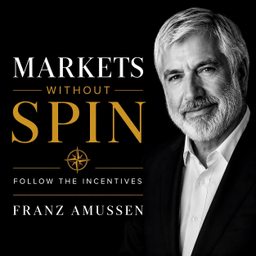
Markets Without Spin explores the incentives that drive markets, governments, corporations, and investor behavior. Hosted by Franz Amussen, the show examines why things happen—not simply what happened. Through historical examples, market analysis, and long-form conversations, each episode follows the incentives, follows the money, and follows the behavior beneath the headlines.
- Publisher
- Franz Amussen
- Category
- business · news
- Language
- en
- Explicit
- No
- First episode
- 18 Jun 2026
- Latest episode
- 6 Oct 2026
Latest episodes
18 episodes in the feed.
6 Oct 2026
Kirk Konert — The Track Record
Kirk Konert is the chairman of York Space Systems and one of the key figures at AE Industrial Partners. But a résumé isn't a track record. In this episode of Markets Without Spin, we look at what Kirk Konert has actually done. Rather than relying on private-equity marketing materials, we follow the transactions through SEC filings, company filings, merger documents, transaction records and public pension-fund disclosures. Those records can tell us something private-equity firms don't always emphasize: how much money went in, how much came out, what was actually sold, and what remains. We start with some of the clearer successes. Gryphon Technologies was acquired by AEI in 2018, with Kirk Konert identified as the AEI principal involved. Three years later, ManTech acquired Gryphon for $350 million. A real exit—but we don't know what AEI originally paid, so we cannot calculate the actual return. American Pacific (AMPAC) provides another clean exit. AEI acquired the company in 2020, and NewMarket purchased it four years later for $700 million in cash. But the transaction also illustrates an important private-equity technique: money can come out of an investment before the final sale through dividends or recapitalizations. Belcan shows another recurring AEI strategy: acquire a specialized aerospace and defense company, add capabilities and acquisitions, build a larger platform, and eventually sell it. Cognizant purchased Belcan for approximately $1.29 billion in 2024. Again, however, the original purchase price isn't publicly available, so we cannot calculate Kirk's actual return. Then we get to Redwire. The original Redwire platform missed its projected 2025 revenue by a wide margin. But AEI subsequently made a preferred-stock investment in Redwire at a distressed valuation. AEI invested approximately $46.5 million and later sold the resulting shares for approximately $209.6 million. That's a transaction where we can actually follow the money. BigBear.ai gives us the other side of the ledger. AEI eventually liquidated approximately 80 million shares at prices substantially below the $10 SPAC reference price. And that's an important reminder: a "realized investment" simply means an investment has left the portfolio. It does not necessarily mean it was profitable. Edge Autonomy raises another issue. The transaction was announced at approximately $925 million, but only $150 million was cash. The other $775 million was Redwire stock valued at $15.07 per share. If that stock is subsequently sold for substantially less, the economic result is different from the headline transaction value. And then there's Firefly—perhaps the most useful comparison to York. AEI acquired control of Firefly in 2022 and continued investing heavily. Disclosed direct investments eventually totaled approximately $280 million, in addition to the acquisition of Noosphere's controlling stake. Firefly went public at $45, and in 2026 AEI affiliates sold eight million shares at $48, generating approximately $384 million in gross proceeds while retaining a very large remaining position. That's where the distinction becomes important: What is an investment worth? versus How much money has actually come back to the investor? Finally, we return to York Space Systems. AEI invested in York in 2022. Kirk became chairman. Public filings show essentially no direct beneficial ownership of York stock by Kirk beyond restricted stock units, although he may have economic interests through AEI's carried interest or management structure that aren't publicly disclosed. So what does the record tell us? There are genuine successes: Gryphon, American Pacific, Belcan and the later Redwire preferred investment. There are investments that are much harder to defend, including BigBear.ai and the original Redwire platform. And there are investments—particularly Firefly and York—where the public record does not yet give us enough information to calculate the complete return. That's the point of Markets Without Spin. We don't have to decide whether Kirk Konert is a hero or a villain. We don't have to decide whether AEI is brilliant or incompetent. We follow the money. When the public record gives us the numbers, we use them. When it doesn't, we say we don't know. And that's important because when you buy a public stock, you know exactly what happens to your investment when the price falls. A private-equity manager's economics can be structured very differently. Follow the incentives. Markets Without Spin is commentary based on the host's research and is not investment advice or a recommendation to buy or sell any security.
29 Sept 2026
Before AEI — Who Built York Space Systems?
Episode 16: Before AEI — Who Built York? How did York Space Systems go from a small satellite startup to a billion-dollar defense company? In this episode of Markets Without Spin, we go back to the beginning of York Space Systems—before AE Industrial Partners, before BlackRock, before the acquisitions, and before York became a major government contractor. York was founded in 2012 by engineer Dirk Wallinger with a very different idea about how satellites should be built. Rather than treating every spacecraft as a custom engineering project, York set out to manufacture standardized satellites more like products. The company's original thesis was that traditional spacecraft economics were dominated by non-recurring engineering, and that standardization could dramatically reduce costs. We follow the company's earliest financing and discover that the story is considerably more ordinary—and more interesting—than some of the theories surrounding York might suggest. The first documented SEC financing we found was only $250,000, raised from nine investors in 2015. Two of those investors were not accredited investors. We also examine the unexplained second financing round that York later said had occurred, but for which we could not reconstruct the details from the available SEC records. Then comes the turning point. In 2017, York brought in Chuck Beames, a former senior Pentagon space and intelligence executive. Three years later, York won a $94 million Space Development Agency contract for 10 satellites. In 2022, it won another $382 million contract for 42 satellites. Those two contracts—worth a combined $476 million—came before AE Industrial Partners invested in the company. That chronology changes the story. AEI did not create York or open the door to the Space Development Agency. York had already become a serious defense contractor before AEI acquired a 51% stake in 2022. At the time of the transaction, York reportedly had a backlog exceeding $1 billion and was described as profitable. But after AEI took control, York began acquiring other space companies and building a vertically integrated space and defense business. At the same time, the company took on significant acquisition debt and moved from reported profitability to substantial pre-tax losses. That brings us back to the question at the heart of Markets Without Spin: What happened to York after AEI arrived—and who benefits if the strategy succeeds? We examine the debt, preferred securities, management interests, ownership, fees, acquisitions and incentives that make the answer considerably more complicated than simply saying, "AEI owns 51%." In this episode: Who founded York Space Systems and what was his original vision? Why did York believe standardized satellites could dramatically reduce costs? Who provided York's first documented outside financing? What do we actually know—and not know—about York's early financing? Was there evidence of secret government or intelligence-community financing? Why did York hire former Pentagon executive Chuck Beames? How did York win $476 million in Space Development Agency contracts before AEI invested? What did AE Industrial Partners actually buy? How did York change after AEI took control? Why did York move from reported profitability to substantial losses? What role do debt, preferred securities and management incentives play? And ultimately, who benefits if the York strategy works? The evidence does not support the idea that someone secretly created York as a government-financed vehicle. The more interesting question is what AEI saw in the company—and what it intended to build after taking control. Next episode: We turn the investigation around and follow the money on the other side of the transaction: AE Industrial Partners—who they are, where they came from, what they put into York, what they get paid, and how their economics change depending on whether York succeeds or fails. Because if you really want to understand a company: Follow the incentives. Markets Without Spin is commentary based on the host's research and is not investment advice or a recommendation to buy or sell any security.
22 Sept 2026
Episode 15: Follow the York Space Systems Money
In this episode of Markets Without Spin, I continue following the money behind York Space Systems. What began with an unexpected visit to the Small Satellite Conference led me to York, its acquisition of Orbion, and ultimately to the people and institutions behind the company. We look at AE Industrial Partners, York chairman Kirk Konert, founder Dirk Wallinger, and BlackRock—and ask an important question: who actually owns York, who controls it, and where does the money behind the company come from? This is part of a continuing series examining York Space Systems, its acquisitions, its investors, and the incentives that may ultimately determine what happens to the company. And we're not finished. Next time on Markets Without Spin: Who Owns the Owners?
15 Sept 2026
Episode 14: The York Rabbit Hole Begins
In the last episode, Franz Amussen explained how a morning walk through Salt Lake City unexpectedly led him to the Small Satellite Conference—and ultimately to York Space Systems. Now the rabbit hole begins. After discovering that Orbion had been acquired by York, Franz starts digging into York itself. The company had gone public only months earlier at $34 a share, yet its stock had fallen dramatically. At the same time, York was pursuing an ambitious strategy: assembling an integrated space and defense company through acquisitions. York had acquired Orbion for propulsion, ATLAS Space Operations for ground infrastructure and mission operations, Solestial for space solar technology, and ALL.SPACE for advanced satellite communications. Is York assembling a collection of best-in-class technologies—or simply buying companies and locking itself into them? Franz examines York's business model, its government dependence, its falling revenue guidance, its backlog and contract pipeline, and the question at the center of the investigation: What exactly is York trying to build? That question leads to an even more important one: Who is betting on York—and what are their incentives? Next time: Follow the Money. This podcast is for informational and educational purposes only and is not investment advice or a recommendation to buy or sell any security.
8 Sept 2026
Episode 13 The Conference I Wasn't Looking For
What started as a morning walk through downtown Salt Lake City turned into the beginning of a much bigger investigation. Franz Amussen accidentally stumbled across the Small Satellite Conference and began talking with companies exhibiting there. One conversation at the Orbion booth led to a surprising discovery: Orbion had been acquired by York Space Systems. That raised a series of questions. Who is York? Who owns it? Why is it acquiring aerospace companies? Who is financing the strategy? What does BlackRock have to do with it? And are York's substantial losses actually destroying capital—or investing in capabilities that could eventually be worth much more? In this episode, Franz explains how an ordinary morning walk became the starting point for a deep dive into York Space Systems—and why he decided to follow the story wherever it led. This is the beginning of the York Space Systems rabbit hole. Markets Without Spin is about understanding how markets and companies actually work—not telling you what to buy. This podcast is for informational and educational purposes only and is not investment advice or a recommendation to buy or sell any security.
1 Sept 2026
Episode 12: When Profits Aren't Profits: The Accounting Game Behind GAAP Earnings
What does it really mean when a company says it "earned" $500 million? GAAP gives investors a common language for measuring corporate performance. But GAAP earnings aren't the same thing as cash—and the accounting choices, estimates and assumptions behind those earnings can have a profound effect on what investors see. In this episode of Markets Without Spin, we examine how accounting can make a company's economics look better or worse than they really are. We look at: Accrual accounting and the difference between earnings and cash Depreciation and useful-life assumptions FIFO vs. LIFO inventory accounting Revenue recognition Fair-value and mark-to-market accounting Management incentives and executive compensation Enron and the danger of turning future profits into today's earnings Arthur Andersen and the collapse of Enron Planet Labs and the opposite problem: when today's investment looks like today's expense Goodwill and acquisitions Why the cash flow statement may tell you more than the headline earnings number The central lesson is simple: Don't distrust GAAP. Understand it. Don't just ask, "What did the company earn?" Ask: How did it earn it? Where's the cash? What assumptions went into the number? What is management incentivized to do? And what is the company actually building with the money? Because companies don't spend earnings. They spend cash. Markets Without Spin explores the forces, incentives and financial mechanics that shape markets—and what investors should know before accepting the conventional story.
25 Aug 2026
Episode 11: When Great Stories Become Bad Investments
History's greatest investment bubbles reveal timeless lessons about valuation, cash flow, incentives, and speculation. This episode examines the South Sea Bubble, Railway Mania, and why revolutionary technology doesn't always make for a great investment.
18 Aug 2026
Episode 10: Show Me the Incentives
Episode 10 – Show Me the Incentives In this episode of Markets Without Spin, Franz Amussen traces the structural transformation of the American economy — not through ideology, but through incentives. Beginning with President Nixon's closure of the gold window in 1971, Franz explains how monetary expansion, inflation, regulatory accumulation, globalization, and financialization reshaped American production, ownership, and middle-class stability over decades. This episode explores: Why inflation is not neutral How Paul Volcker restored monetary credibility Why many factories never reopened after the early 1980s The incentive gap between U.S. and emerging markets The long-term hollowing of industrial communities Regulatory friction and its cumulative effects Financialization and capital concentration Why structural change rarely feels dramatic while it's happening This is not a political episode. It is an examination of cause and effect. If you want to understand how the American economy transformed — and why — start with incentives.
11 Aug 2026
Episode 9: The Myth of Safety
The Myth of Safety In this episode, we examine what "safe" really means in modern finance. We often assume that money in the bank is secure. That brokerage accounts are protected. That money market funds are cash equivalents. History tells a more complicated story. This episode explores: The 2013 Cyprus bail-in and frozen deposit accounts Capital controls and withdrawal limits inside the European Union The 2008 "breaking the buck" moment at the Reserve Primary Fund How the commercial paper market nearly froze payroll across America The structural build-up to the 2008 financial crisis The incentives behind mortgage securitization and leverage expansion Moral hazard and the stabilization of major institutions through TARP A personal experience during the collapse of Silicon Valley Bank Why some uninsured depositors were rescued — and others were not Brokerage firm failures and the risk of losing access even when assets are legally segregated What it actually means to be an unsecured creditor of a bank How FDIC insurance works — and what it doesn't guarantee The role of the Treasury and Federal Reserve as ultimate backstops Why nominal protection is not the same as protection of purchasing power Practical steps toward antifragility in a layered financial system This episode sets the foundation for Episode 10, where we examine the gold window, inflation, and the structural shift in the monetary system. If you found value in this discussion, please subscribe and share.
4 Aug 2026
Episode 8: Inside the Pipes: Dark Pools, Payment for Order Flow & Who Really Sets Price
In Episode 8 of Markets Without Spin, Franz Amussen pulls back the curtain on the invisible plumbing of modern markets. When you click "buy" or "sell," where does your order actually go? It may never reach the public exchange. This episode breaks down: Payment for Order Flow (PFOF) Internalization Dark pools High-frequency trading and latency arbitrage Conditional liquidity The 2010 Flash Crash March 2020's liquidity shock Why stop-loss orders can behave unpredictably in stressed markets How leverage interacts with volatility Franz revisits lessons from: The 2010 Flash Crash The March 2020 COVID liquidity event A personal story involving short volatility exposure and margin liquidation Referencing Flash Boys by Michael Lewis, this episode explains how modern market structure fragments price discovery — and why liquidity can disappear when it's needed most. Key Takeaways Commission-free trading isn't free — it's monetized differently. A significant portion of retail flow never hits public exchanges. High-frequency traders provide liquidity — but only conditionally. In volatility spikes, liquidity providers step back. Liquidity risk can be more dangerous than fundamental risk. Structure determines survival during market stress.
28 Jul 2026
Episode 7: The Anatomy of a Market Illusion: Why Smart People Believe Bad Stories
Following Episode 6's breakdown of Bonneville Pacific, Episode 7 examines why investors fall for compelling narratives — and how market illusions form, grow, and collapse. Topics Covered Why smart people believe bad stories The three elements of every market illusion The false narrative of stock buybacks Bonneville Pacific and familiarity risk Utah's penny-stock boom The unverifiable modular nuclear pitch Why government endorsement ≠ due diligence Personal angel investing psychology Practical rules to avoid narrative traps
21 Jul 2026
Episode 6: Corporate Boards, Corporate Governance & Shareholder Risk — The Illusion of Oversight
Episode 6: Corporate Boards, Corporate Governance & Shareholder Risk — The Illusion of Oversight Do corporate boards really protect shareholders—or do they simply create the appearance of accountability? In this episode of Markets Without Spin, Franz Amussen examines one of the most persistent assumptions in investing: that corporate boards provide effective oversight of management. Drawing on firsthand experience with the collapse of Bonneville Pacific, along with lessons from Enron and other corporate failures, Franz explains why many boards struggle to challenge management, identify risks, or prevent costly mistakes. Rather than focusing on corporate governance as presented in annual reports, this episode explores the incentives, information gaps, and structural weaknesses that often prevent boards from serving as truly independent watchdogs. In this episode you'll learn: Why corporate boards often fail to protect shareholders How information asymmetry limits board oversight What the Bonneville Pacific collapse revealed about prestigious boards Why Enron remains a landmark example of governance failure How executive compensation can influence board independence Why directors often face few consequences after major failures What effective corporate governance would require The indicators investors should watch instead of relying on board prestige Whether you're an investor, board member, financial professional, or business owner, this episode offers a practical framework for evaluating companies beyond polished governance reports and impressive résumés. Next Episode: Why corporate forecasts so often miss reality—and how investors can recognize when forecasts are driven more by incentives than by objective analysis. If you enjoy Markets Without Spin, please subscribe, leave a review, and share the podcast with someone who wants to better understand the incentives and structures that shape today's markets. Follow Franz Amussen on LinkedIn for additional commentary and future episodes.
14 Jul 2026
Episode 5: Passive Investing, Money Printing & Stock Buybacks — The Liquidity Mirage
Episode 5: Passive Investing, Money Printing & Stock Buybacks — The Liquidity Mirage Why did the stock market rise so dramatically for more than a decade? Was it simply stronger companies—or did powerful structural forces reshape markets? In this episode of Markets Without Spin, Franz Amussen examines how passive investing, unprecedented monetary expansion, and corporate stock buybacks combined to create one of the strongest and longest-running bull markets in history. He explains why these forces reinforced one another, why market liquidity may not be as deep as it appears, and what could happen as demographics, higher interest rates, and slowing money creation begin to change the investment landscape. In this episode you'll learn: How passive investing changed the behavior of financial markets Why 401(k) plans, target-date funds, and index funds created a powerful "Passive Bid" How money creation and monetary policy influenced asset prices Why corporate stock buybacks amplified rising stock prices The relationship between buybacks, executive incentives, and market valuations Why ETF liquidity can weaken during periods of market stress How retiring Baby Boomers may affect long-term investment flows Why future market cycles may differ significantly from the last fifteen years Whether you're an investor, financial professional, or simply interested in how modern markets function, this episode provides a framework for understanding the structural forces that have driven markets—and why those forces may be changing. Next Episode: We continue examining the incentives and structural changes reshaping today's financial markets. If you enjoy Markets Without Spin, please subscribe, leave a review, and share the podcast with someone who wants to better understand today's markets. Follow Franz Amussen on LinkedIn for additional commentary and future episodes.
7 Jul 2026
Episode 4: Passive Investing, Market Flows & the Hidden Machinery of the Stock Market
Episode 4: Passive Investing, Market Flows & the Hidden Machinery of the Stock Market Why do stock prices often move even when there seems to be no news? In this episode of Markets Without Spin, Franz Amussen explores the hidden forces that increasingly drive today's financial markets. While most investors focus on earnings, economic reports, and headlines, a growing share of market activity is driven by passive investing, index funds, ETFs, corporate buybacks, and other systematic flows. Learn how automatic retirement contributions, target-date funds, index rebalancing, and market structure influence prices regardless of valuation—and why demographic changes may alter those flows in the years ahead. In this episode you'll learn: How markets have shifted from valuation-driven to flow-driven Why passive investing has become one of the largest forces in U.S. equities How 401(k) plans and target-date funds create the "Passive Bid" Why retiring Baby Boomers may change long-term market flows How corporate stock buybacks affect liquidity and share prices What index funds and ETFs do during index additions and rebalancing Why market liquidity can disappear during periods of stress How inflation, earnings pressure, and demographics interact with market structure Whether you're an investor, financial advisor, or simply curious about how modern markets really function, this episode provides a practical framework for understanding the mechanics operating beneath daily price movements. Next Episode: We examine why traditional valuation measures may matter less than many investors believe—and what could cause that to change. If you enjoy Markets Without Spin, please subscribe, leave a review, and share the podcast with someone who wants to better understand today's financial markets. Follow Franz Amussen on LinkedIn for additional commentary and future episodes.
30 Jun 2026
Episode 3: The Incentive Mirage — Executive Compensation, Buybacks & Insider Selling
Episode 3: The Incentive Mirage — Executive Compensation, Buybacks & Insider Selling Are corporate executives truly aligned with shareholders—or do today's compensation systems reward something entirely different? In this episode of Markets Without Spin, Franz Amussen examines how executive compensation, stock buybacks, insider selling, and equity awards create incentives that often favor short-term value extraction over long-term ownership. Using publicly available information from proxy statements, Form 4 filings, and SEC disclosures, Franz explains how modern compensation structures work and why many investors misunderstand the relationship between executive pay and shareholder interests. In this episode you'll learn: Why executive "alignment" with shareholders is often more appearance than reality How restricted stock units (RSUs), performance shares, and stock options are awarded The relationship between stock buybacks, executive compensation, and share dilution What proxy statements reveal about executive incentives How Form 4 filings help investors track insider buying and selling Why Rule 10b5-1 trading plans make many insider sales legal How passive index investing can absorb large amounts of insider selling Why understanding incentives can provide a different perspective on corporate decision-making Whether you're an investor, financial professional, or simply interested in how public companies operate, this episode offers a framework for understanding the incentives that influence executive behavior. Next Episode: Episode 4 explores the hidden plumbing of the financial markets, including indexing, ETFs, liquidity, market makers, and why market flows can matter more than fundamentals. If you enjoy Markets Without Spin, please subscribe, leave a review, and share the podcast with someone who wants to better understand the forces driving today's markets. Follow Franz Amussen on LinkedIn for additional commentary and future episodes.
22 Jun 2026
Episode 2 – The Buyback Machine: How Modern Incentives Drive Corporate Behavior
Episode Title: Episode 2 — The Buyback Machine: How Modern Incentives Drive Corporate Behavior Summary: In this episode, Franz Amussen breaks down the real reason stock buybacks dominate corporate America: executive incentives. From EPS targets and TSR windows to dilution cycles and mega-grants, this episode reveals the internal machinery shaping corporate decision-making today. Key Topics: How executive compensation drives buyback behavior EPS manipulation through denominator shrinkage TSR windows and 3-year vesting cycles Case studies: IBM, Apple, Salesforce Airline buybacks before COVID Why buybacks accelerate wealth concentration Investor choice vs. management choice Mentioned Companies: IBM • Apple • Amazon • Microsoft • Salesforce • Delta Air Lines • American Airlines • United Airlines • Southwest Airlines Next Episode: Episode 3 — The Passive Avalanche
22 Jun 2026
Episode 1 – Credit Ratings, Incentives, and How "Safe Companies" Become Dangerous
Episode 1 — How "Safe Companies" Become Dangerous: Montana Power, Boeing, and the Incentives Behind Corporate Failure Welcome to the first full episode of Markets Without Spin, the show where Franz Amussen breaks down the real forces that drive corporate decision-making. Today we explore why companies with strong reputations — and even strong credit ratings — can collapse from the inside out when incentives shift. This episode tells two powerful stories: 1. Montana Power Once a stable, conservative utility held by retirees across the Northwest, Montana Power collapsed after new leadership pursued a risky telecom pivot during the dot-com boom. A century of stewardship was wiped out when incentives changed. 2. Boeing For decades, Boeing was the global symbol of American engineering excellence. But a shift toward financial-first executive leadership, massive buybacks, and EPS-driven incentives hollowed out the culture that made Boeing great — with tragic results. Topics covered: Why credit ratings don't measure today's management How buybacks distort EPS and executive compensation How boards unknowingly reward short-term extraction The dilution → buyback → compensation loop Why companies that look healthiest are often most vulnerable If you care about investing, corporate governance, capital allocation, or the incentives behind modern markets… this episode will reshape how you see "quality" companies. Chapters: 00:00 — Intro 02:00 — What credit ratings really measure 05:00 — The Montana Power collapse 09:00 — Boeing: When engineering stopped leading 14:00 — How buybacks manipulate incentives 17:00 — How incentives hollow out companies 19:00 — Closing + Episode 2 teaser Next episode: We examine the opportunity costs behind buybacks — and what corporate America isn't building. 👍 If this episode helped you see markets more clearly, please like, subscribe, and share. Your support helps bring transparency to corporate incentives.
18 Jun 2026
Pilot Episode – Introduction to Markets Without Spin
Welcome to Markets Without Spin. In this pilot episode, Franz Amussen introduces the central idea behind the show: incentives drive behavior. Markets, governments, corporations, and investors all respond to incentives—and understanding those incentives is often more important than following the headlines. This podcast explores why things happen, not simply what happened. Follow the incentives. Follow the money. Follow the behavior.
Reach and audience
Public platform figures. Ratings count people who left a rating, not total listeners.
- Apple Podcasts (US)
- 5.0 / 5
- 2 ratings
Contact Markets Without Spin
- Guest appearances
- Books guests
Based on episode analysis; this does not confirm that the show is currently accepting guests.
Host of Markets Without Spin?
Claim your podcast to manage its listing and keep your show details accurate.
Pod Engine is an independent podcast discovery and analytics service and is not affiliated with or endorsed by this podcast. Artwork and show content belong to their owners. Full legal notice.
Explore this show
Podcast research with Pod Engine