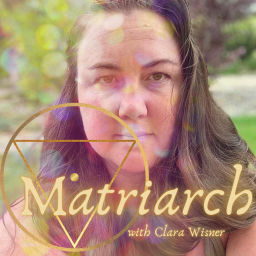
Matriarch by Clara Wisner
Hosted by Clara Wisner · Clara Belize Wisner
- 105
- Episodes
- Monthly
- Cadence
- 2021
- First episode
About Matriarch by Clara Wisner
ReMothering is a podcast dedicated to nourishing women at all points on the mother-continuum. clarabelize.substack.com (https://clarabelize.substack.com?utm_medium=podcast)
- Publisher
- Clara Belize Wisner
- Category
- education · society & culture
- Language
- en
- Explicit
- No
- First episode
- 26 Oct 2021
- Latest episode
- 9 Jul 2026
Latest episodes
105 episodes in the feed.
9 Jul 2026
Befriending A Broken Heart
I recently experienced the reopening of a wound in my heart. Nothing overly dramatic happened. No major further betrayals or abandonment. But, around and around the spiral we go, and I guess it was time for me to come around again to my broken heart. It’s been quite unexpectedly intense, this revisiting. From a bird's-eye view, I can see that this return is not random. It is arriving now, after I've cultivated a new baseline of physical resourcing, as though my system finally has the capacity to meet it. Our Wounding Shapes Us Our wounding shapes us. It molds us. It creates patterns, personalities, identities, responses, blind spots, and, for the most part, all of these are in place to protect us. They are all protection mechanisms. If someone you loved hurt you badly, you may develop a belief that love isn’t safe. You may want love, but parts of your protection mechanisms cause you to be noncommittal or subtly or not-so-subtly push a person away or keep them at arm’s length. This would make sense. And if you were interacting with people who might hurt you, this would also be a wise adaptation. But what about that tender and delicate need for love, intimacy, and connection? What about the nutrient of relationship that us human social animals require? At some point in our journey and growth we start to feel our rigidly held protection mechanisms are no longer supportive, but effectively cut us off from something we need. That need most of the time being some sort of connection or expression or desire. Protection Mechanisms vs Instincts I want to be clear, protecting ourselves is not pathological in any way. We need healthy boundaries. We need to be able to say No and hold it. We need to be be able to trust ourselves with ourselves. This is maybe the most important aspect of healing I can think of. Lost or buried instincts can be another place where our “protection mechanisms” paradoxically disconnect us from ourselves and our needs. If, for some reason, your instincts were overpowered by a yearning or a need for connection as a child or as an adult, you might have learned to devalue your instincts. You might have learned to ignore your instincts in the interest of your need for connection. This is a very real phenomenon in the women I work with and in my own journey. What I am calling ‘protection mechanisms’ are not instincts. Protection mechanisms are built on top of our experiences; instincts come from a deeper, more primal location. Both of these things are geared toward protection, but one comes from an innate, natural, life-giving place and the other comes from wounding. When I say I recently experienced a wound being revisited it’s because I am being asked to take down some of my protection mechanisms. When a protective mechanism comes down we have to revisit the wound that created it. And, simultaneously, we must get reacquainted with our instinctual nature as it pertains to the area of wounding. We cannot take down a protection mechanism and leave ourselves completely defenseless and open. This type of unguarded opening is not actually in service to any woman’s physiology or thriving. And, ultimately, this type of opening will result in a snapping shut and maybe even potentially more protective mechanisms being put in place in the long run. This is where I diverge from common spiritual teachings. We are not supposed to be and stay open constantly. Being open all the time is just another version pedestalizing yang/masculine energy. We need closure, too. We need the contraction. We need to restore our instincts, which tell us which thing to move toward. We need the substance and the substrate, which requires an inward rebuilding, not constant outward energy. We have protection mechanisms and adaptations for a reason. Restoring instinct must be part of the conversation if we’re going to talk about ‘taking down our walls’ and ‘revealing ourselves’ more deeply or we run the risk of further depletion, burnout, and real negative consequences to our bodies and psyches. Befriending My Broken Heart Part of my recent process of shedding my stiff protection mechanisms while also reestablishing my innate instincts when it comes to trusting the people I love to care for me is a process I have begun to see as ‘befriending my broken heart.’ My heart has been broken many times in my relatively short lifetime, as I’m sure yours has. I have tender, vulnerable, aching, and weary aspects of myself, as I’m sure you do. These parts are valuable and beautiful. They are the parts that allow us to access our compassion, true generosity, playfulness, passion, warmth and so much more. These are the aspects our protection mechanisms are built up around. And so, if we are going to take down our walls, we must befriend these qualities in ourselves. We must be able to hold them sweetly while we choose to emerge from behind the fortresses of our personal protection mechanisms. We must concurrently have the capacity to use and be connected to our primal, restorative instincts during this process. I have found, for myself, the most important thing I have is my relationship to the world I carry around inside myself. We can go through heart break after heart break, challenge after challenge, harrowing decision after harrowing decision, make mistakes upon mistakes, and as long as we know that we are on our own side, we can be ok. We can even not be ok and we’re ok, as long as we have a sense of connection to self. This is befriending our broken hearts. To know that our hearts are precious. To know that our innate worthiness is intact. As Sarah Blondin (https://sarahblondin.substack.com/) said in her book Heart Minded (https://www.abebooks.com/9781649630490/Heart-Minded-Blondin-Sarah-1649630492/plp), “I am love. It is never lacking or able to be stolen from me. I am good enough. I trust life. Life is kind. There is no pain too great not to be fed by my love and kindness. I am strong. My worth is not to be gained. I am already all of the worth I will ever be.” As I feel I say a lot— living itself is painful. There has never been any guarantee that life will not hurt. In fact, pain is the result of coming into more conscious awareness. It can hurt to see the things we did not see before. So, sometimes we’d rather fall asleep, avoid, numb out, than face the painful truth of our broken hearts. This is ok. It is human. However, as Rumi said, “The moment you accept what troubles you’ve been given, the door opens.” I believe so much of our prolonged suffering comes from not being on our own side through those painful moments. It comes from not being willing to simply look into our own experience and befriend our own broken hearts. It seems, this year, I’ve been turning to Rainer Maria Rilke in times of great pain and I given this line today, “In the difficult are the friendly forces, the hands that work on us.” My broken heart deserves my attention. When I truly have the capacity to stand still with it, it does not result in my collapse, or rumination, or self pity, but, instead, a deeper, more intimate, knowing of myself. Fearlessness Comes From Tenderness The unfiltered experience of befriending your broken heart is one of fearlessness. This is why, when we have the true foundational baseline of physical resource, restored instincts are actually the product of tenderness with ourselves. The more we are with ourselves at this organic, stripped down level, the more fearless we become. Because we know, if we can be with ourselves in our pain, we will never leave ourselves, and this let’s us know, we are safe. I have been making a practice of feeling my broken heart in all situations. It doesn’t take extra time out of my day. It doesn’t leave me drained on the floor. In fact, it leaves me feeling closer to myself. While I’m making breakfast for my kids—I’ll sway with my broken heart for a few moments as I flip the eggs. Sitting in the sunshine—let me open the ache and express gratitude for the ability to feel. Driving in the car—I listen to a sad song and let the soft tears fall. It does cause me to slow down a bit. To feel what is happening in my internal world for moment. To be oriented to me. I can do this because I have built the physical resource and structure in my real life that can hold me and sustain the shifting taking place. You cannot be with yourself on this level without the physical resourcing to sustain it. There is nothing to fear when we befriend our broken hearts. This is a public episode. If you'd like to discuss this with other subscribers or get access to bonus episodes, visit clarabelize.substack.com/subscribe (https://clarabelize.substack.com/subscribe?utm_medium=podcast&utm_campaign=CTA_2)
2 Jul 2026
Sober Spirituality
I have a poet’s Soul. I want to go deep. I have always profoundly felt life. I have always wanted to make beautiful things because it feeds my being and for no other reason. At 17 years old I got a tattoo that says, “you make your own reality” in latin. 21 years ago I was already aware I was a creative force in my own life’s unfolding. I was a spiritual seeker from a very young age. I grew up in a household where I was allowed to be spiritually-curious. Both my parents went to church when they were kids (my mom Methodist and my dad Lutheran) but don’t seem to have any religious ties, trauma or negative feelings towards the church or strong indoctrination (beyond the Chrisitian cosmology all Westerners are indoctrinated with.) When I was young I think my parents tried to become part of a Unitarian church community. Ultimately my early experience with religion and spirituality was through Rumi poems, Buddhist philosophy books, and going to church on Christmas with my grandparents. I remember the relief I felt reading ecstatic spiritual poetry even though I didn’t understand it. I remember the joy in being able to sing hymns in a group. I wanted more of those things, I just didn’t have any idea where to get them. I felt the ‘true god’ in my household was Academia. My mother is a professor and has phD in computer science. My father is a agricultural economist with a plethora of higher education under his belt. Mind and science were of the highest value. Critical thinking was the goal, always. Both my parents have a palpable love of learning and definitely passed that love to me. A Sense of Brokenness I can track back to adolescence the feeling I needed to fix myself. I knew that I was broken and if only I could find the right glue to put the broken plate of myself back together, I would be ok. If only I worked hard, succeeded in school and then career, looked good, was effortlessly cool, not too sensitive, always strong, reliable and stable, and impressive I could, maybe, someday in the far future, earn the right to relax. It makes total sense to me, looking back, that my spiritually-seeking-and-inclined-self would see spirituality as a very attractive solution to this sense of brokenness I carried underneath the surface. Some people who feel broken get smaller, more timid, like a dog with its tail between its legs. They opt out of life. They curl into a ball and wait for it all to be over. Then, other people who feel broken decide maybe they can earn their right to take up space. These people will just work and work and work, push and push and push, force and force and force. In a way, they can seem bigger, larger than life even, but the truth is there is very little room for their humanity or needs. There became a desperation to my seeking as I achieved the things I set out to. The things I achieved didn’t actually make me feel less broken. How many people have this story? Maybe everyone on this Earth to some degree? Maybe what I am attempting to describe is partially ‘the human condition’? The ‘original ouch,’ I’ve heard it called, of separation from the Oneness or the dark, quiet, watery weightlessness of our mother’s womb. Maybe this severing is the brokenness we feel? Wherever this sense of being cut off or cut up comes from, it seems most of us expect the solutions to be outside of ourselves. We seek the perceived soothing balm of material things, accolades, relationships, self denial, substances, addictions, and even spiritual practice, only to find our feelings of brokenness still there, under the surface, driving us. The Wellness Industry The personal development/wellness/new-age-spirituality industry is just that— an industry. It is a money making machine. It’s the high quality supplements, organic/’clean’ food brands, endless educational courses on everything from gardening to kundalini yoga to thyroid health, retreats, incredible apothecaries, life coaching, business coaching, parenting coaching, spiritual coaching, find-your-purpose coaching, awakening womb care, gold and semi-precious stone jewelry in shapes of goddesses, niche body work, somatic therapy, spiritual communities, slow fashion, minimalist organic skin care, plant dyed silk undies… you know what I mean. It’s all amazing stuff. I am a sucker for it all myself, I want fixing just as much as the next person. I love nice, quality things that feel aligned with my values. Generating money or being part of an industry does not necessarily imply there is any foul play. However, the rampant spiritual materialism present in this industry is something we must be willing to look at within ourselves with a sharp and humble eye. It comes from this sense of brokenness we all experience to some degree. Spiritual Materialism Spiritual materialism is a concept coined by Tibetan Buddhist teacher Chögyam Trungpa to describe the tendency to use spiritual practices, teachings, and experiences to reinforce the ego rather than dissolve it. It involves treating spirituality as a material possession or status symbol, such as accumulating credentials, boasting about enlightenment, or seeking temporary emotional states to avoid suffering. In my own definition of spiritual materialism; it is when we try to use our spiritual beliefs, practices, or ideals to ‘get’ something our personality (as opposed to our Soul) wants. We don’t want to feel broken so we seek something we think will “fix” it. We don’t like feeling sad or down, so we try to fill our days with practices or read self help books. We don’t like feeling angry so we try to meditate or “regulate” the rage away. We feel tired so we seek out another supplement or protocol that might make us feel energized ALL THE TIME. We’re bored or unsatisfied by our life so we seek out plant medicine journeys, more travel and novelty, or spiritual teachers who seem to have the answers or practices we need. We are willing to try harder. We are willing to push ourselves more. We are broken and we need fixing! Being Who You Are I recently heard this Marion Woodman quote and it felt like a bell clanging through my whole body: “It’s easier to try to be better than you are than to be who you are.” - Marion Woodman How many times have I tried to push beyond what I actually had the capacity for? How many times have I over-promised, over-gave, or been in fantasy about what I can show up for with my full presence? Question: Why would I do that? What would make that kind of pushing of myself make sense? Answer: A desperation to find ‘the answer’ to my restlessness and sense of inadequacy. What would it look like to be where I am? To be who I am? With the capacity I actually have? With the bandwidth I actually have? Spiritual materialism rewards premature certainty, good branding, and shallow interpretation over depth, nuance and reverence for the process one must experience to become the person Life is asking us to become. Spiritual materialism is the spirituality that comes from desperation, not wholeness. What We Want is Not Where We Are Seeking It In this moment in time so many of us are seeing the insidious s**t storm that lives under the slick plastic surface of our collective narratives. We are feeling and becoming aware of the deadening of our human hearts that is required to live in the status quo. We want more alignment. We want more coherence. We want a world that values more than just ROI, productivity, and output. I truly believe we all have poets’ Souls. We want a world that values our unique and creative Soul essence and fosters it. We want the radiance that comes from integrity between mind, body, and Soul. We want to re-member our wholeness. If this is what you are seeking it will not come from more money, more certifications, more plant medicine journeys, or from a spiritual teacher. It won’t come from eating only clean food or taking the ‘right’ supplement. It won’t come from finding your ideal partner. It won’t come from having the perfect non toxic furniture. It won’t come from your community or only ever surrounding yourself with people who share your particular values. It won’t come from the next ceremony or book you read. Some of the above things may be a part of your unique journey. You may need to create more financial stability. You may need to have more mystical experiences or take some supplements that work for you. But, the combination of things that make up your path will be yours and yours alone. There is no silver bullet and, ultimately, the answer won’t come from outside yourself. There is the story about a man who spends his life searching for a precious jewel. He goes on adventures, has painful experiences, journeys far and wide, only to find, in the end, the jewel was in his pocket the whole time. The experience of wholeness will not come from a desperate searching and grasping. Though, paradoxically, desperate searching and grasping may be part of the journey back into ourselves. It will not be one thing that shifts it all for you; it will be an undertaking. There will be no flash of lightening from sky and an all-your-problems-are-solved moment. It will be a slow and steady paradoxical process that will require your participation and your full presence, as well as your realization that there is nothing wrong with you. This is your one and only, precious life we are talking about. And it is yours and yours alone. Sober Spirituality It’s human nature to want the quick fix and to believe if you have what you think you want you’ll be happier. It’s normal to believe the change you’re seeking is in something tangible and not something you have access to right now. Spirituality was never meant to be about what kind of food you eat or clothes you wear. It isn’t about what retreats you can afford or influencers you know. It’s about being willing to let God lead your life. It’s about really being with yourself long enough to touch your own heart and your own Soul and follow the niggle that’s always been there, even and especially when, it doesn’t make sense. It’s about trusting in your inherent worthiness and the perfection of the creation that is you. Your spiritual journey doesn’t even start until you stop trying to use spirituality to fix your ‘problems’. Spirituality is not a self help book. It’s not a linear journey to the top of some mountain where you sit—enlightened. The frustration IS the journey. The depression IS the journey. The pain, suffering, upset, IS the journey. A spiritual [life] journey is asking you to become and becoming is hard. As Carl Jung said, “There is no coming to consciousness without pain.” Maybe a more direct way of saying this would be— there is no living without pain. Any part of you that believes being “spiritual” means you’ll get what your ego wants will need to be surrendered if you wish to even begin living a life led by God. It is a dance; sometimes you will get what you want and plenty of times what you want actually isn’t what would help you become. It’s the faith, trust, and tethering to something benevolent and bigger than yourself during the times when you don’t get what you want that will call a larger and more whole version of yourself forward. The key to a sober spirituality is to be a student of every moment, every happening in your life. You’re not only ‘aligned’ if you ‘manifest’ the new car you want. You are literally manifesting all the time. You aren’t more spiritually advanced if you teach feminine energetics on the internet. There is no spiritual judgement being dished out based on the size of your bank account. You are loved by God unconditionally. You come from and are the Light. Just like everyone else. There is no hierarchical system you are climbing when it comes to spirituality. That’s the secret if there is one— there is no secret. God’s love is always there and always available to you if you only chose to accept it. If there is nothing you need to ‘do”—no ladder to climb, no hoops to jump through, no goals to reach—to be able to receive the love you’ve always craved, if all you have to do is open to it, what changes about your spirituality? This is sobering. It shows us all the ways we are still striving so hard to be worthy. All the ways we believe we must change, improve, grow, morph to be deserving of our own lives. I read recently that the root of the word enchanted means to be sung through. If I am as I should be. If I was never broken. What I want is to be enchanted by life. I want to be sung through by God. I want to be present, wholly myself and holy in my self. This is my prayer. This is my desire. This is my spiritual practice: to be sung through. This is a public episode. If you'd like to discuss this with other subscribers or get access to bonus episodes, visit clarabelize.substack.com/subscribe (https://clarabelize.substack.com/subscribe?utm_medium=podcast&utm_campaign=CTA_2)
10 May 2026
The Mother Continuum
**this is an adaption of piece I wrote in May 2024 on Mothers’ Day. It’s updated and tweaked to include new ideas, thoughts, perspectives I’ve had since then. Hope you enjoy this version on Mothers’ Day 2026 Today, on Mothers’ Day, (and honestly all my days) I have been thinking about our relationship to Mother. As I wrote the cards I sent to my mother and my mother-in-law I was struck by the continuum of mothers who allowed me to become a mother. If either of those two women had not become mothers I could not be the mother I am today. And if their mothers before them had not become mothers… and on back. This is the red thread. The mother line. The line of the blood. Fun fact: only women and their children live on Earth. Parent Blaming There is a trend in the collective of parent-blaming. There is a trend of looking at the way we were parented and holding it to a current standard and calling it ‘toxic’ or ‘traumatic.’ This is not to say some of us weren’t hurt by our mothers. It’s not to say they did it all right. It’s definitely not to say we should lower our standards for motherhood. It’s not to say it was ok. You may fully deserve to be victimized by the way you were mothered. You may legitimately and fully be a victim of your mother’s pain. You can experience this as true. You are allowed to. And I hope you really do feel it because the only way to not pass it on is to feel and integrate your experience. When one person in unwilling to feel their pain, they will put it on the people around them. This is an energetic law. Sometimes the most vulnerable people are the easiest targets for passing down pain. An awful truth of humanity is the unprocessed pain we are all walking around with and subject to. But, when we are fully grown adult women, it’s time to stop asking “Why did my mother do this to me!?” And start acknowledging, “Wow. My mother was in a lot of pain.” It’s not even necessarily about forgiveness (although, remember, forgiveness isn’t for the other person, it’s for you), it’s about realizing that people, even our own mothers, are multifaceted beings. They could have a part of them that deeply loved us, but another part that was deeply wounded and instead of feeling, integrating, and dealing with that wounding themselves, they passed it on. This is how pain works. It moves through families until someone is willing to feeling it. It may be we were just innocent bystanders of their wounding. So many women were/are just surviving. The saying goes, “You cannot teach a starving man about God.” And you cannot expect a woman stretched to her physical, mental, and emotional limits to process or integrate generations of trauma and pain. Acknowledging this doesn’t make it ok that we were hurt. It just takes out the blame and the shame. Mother Wounding Holding a grudge towards our mothers, I believe, results in holding a grudge against The Mother. The Mother can hold it. However, holding this grudge will result in our mommy wounds being played out with other people in our lives. If you find yourself constantly looking for approval and validation from, or you’re constantly in conflict with, women you perceive as more powerful than you, you may have some mother wounds. If you feel like you cannot open, reveal yourself, or connect with people who deserve your trust and vulnerability, that could be rooted in mother wounding. If you feel like you can’t nourish yourself, don’t take time rest and fill your own cup, feel very uncomfortable simply being, feel a lack of innate worthiness, that could be related to your relationship with the Feminine principle or The Mother. When I read Elayne Kalila recent article, What Happens When the World is Motherless (https://substack.com/home/post/p-194666030), I was struck in the gut by a few of her descriptions of what it feels like in the body to be motherless. Here are the quotes about that especially pinged for me. “You have never once in your adult life laid your head in someone’s lap and been stroked until you fell asleep. When you are sick you manage it. You order the soup. You cancel the meetings. You text your mother an update if you have one. Nobody comes. When you cry, you cry alone, usually in the bath, usually at night, and you clean yourself up before you come out. Your own mother is aging and you do not know how to be near her grief, or your own, so you phone once a week and keep it light. We do not know how to grieve, or how to descend, or how to rest, or how to belong. We are ashamed of what makes us alive.” The reason our mothers were/are in pain is because of a lack of what I’ll call the mother nutrient or feminine nourishment. The same reason we feel pain and hurt in this place because we were/are missing that too. See how the solution is not pointing fingers? It’s not making them see their mistakes. It’s not holding on to all the ways we were hurt as if holding on to to our hurt will save our life. The solution is to feel our pain. To let it move through us. To be with it. To orient to the Great Mother as mother. To let ourselves be seen by those that can be trusted with our vulnerability. To reveal ourselves to ourselves first. To reach into our hearts and remember we belong here. To allow ourselves the simple joys of living, mothering, and nature. What I do want to invite is an appreciation for all that was overcome for us to exist as we are, the mothering we received and the mothering our mothers received, from the women in their lives, from their aunts, and from the Earth. Everyone has dealt with some pain. Everyone alive has prevailed over something awful in their life time. For those of us who are also mothers ourselves I want to point to the joy of our own motherhood that we would not be able to experience without the life of our mothers and grandmothers before us. Respecting Our Mothers You exist because they exist/ed. This is the level of respect and honoring for all mothers that this day invites us in to. Humanity is messy. It is complex and nuanced. I have the experience that the harder I am on the world, the more I judge and find wrong in it, the harder I am on myself. The more I judge my own choices. And the more I judge myself. There is so much joy available in motherhood if we move away from this harshness. There is so much depth available when we’re willing to go into the darkness and look at what’s there. There is so much beauty in feeling these soft warm small bodies on ours. The little voices figuring out how to communicate and be heard. Can we let that open us a little wider today? And if you don’t have children, can you let your little one feel your joy at being the one that gets to hold her now? Can we all lean on female friend or friends to hold us in our grief? To share in our joy? Can we let ourselves our be mothered? Can we mother those around us? Can we let the tasks list, the exhaustion, the ideas of should, the ways we are doing it all wrong, go today and drop in with our children/inner children and feel the pure joy that lives there? Our creations! The creation of mothers back and back until the beginning of time! It is awe-worthy. It is worth celebrating. Thank you to the Mothers. Thank you to The Mother. Thank you to my mother. Thank you to my husband’s mother. Thank you to all the mothers that hold me and mother me while I mother (because we NEED that so much). Thank you to my grandmothers and my great grandmothers and on back. May we all find our joy in mothering today. And if not, may we start to get clear on the changes we need to make in our lives so that our joy can shine through. Because a mother’s joy will heal all wounds. Happy Mother’s Day to all. I would love to her from you in the comments or by replying: What is your relationship to mother? What brings you joy in motherhood? This is a public episode. If you'd like to discuss this with other subscribers or get access to bonus episodes, visit clarabelize.substack.com/subscribe (https://clarabelize.substack.com/subscribe?utm_medium=podcast&utm_campaign=CTA_2)
Contact Matriarch by Clara Wisner
- Guest appearances
- Does not typically book guests
Based on episode analysis; this does not confirm that the show is currently accepting guests.
Questions about Matriarch by Clara Wisner
Who hosts Matriarch by Clara Wisner?
Clara Wisner host the show. Published by Clara Belize Wisner.
How often do new episodes come out?
The show publishes monthly, based on its RSS feed.
Does Matriarch by Clara Wisner take guests?
The show does not typically feature guests, based on episode analyses.
Host of Matriarch by Clara Wisner?
Claim your podcast to manage its listing and keep your show details accurate.
Pod Engine is an independent podcast discovery and analytics service and is not affiliated with or endorsed by this podcast. Artwork and show content belong to their owners. Full legal notice.
Explore this show
Podcast research with Pod Engine