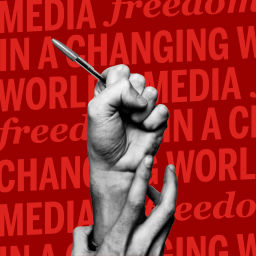
Welcome to Media Freedom in a Changing World, a podcast produced by the Center for International Media Law and Policy Studies in The Media School at Indiana University, Bloomington. The podcast features experts who will discuss issues related to the intersection of media freedom and the digital age.
Special thanks to producer Tanka Dhakal.
Media Freedom in a Changing World: Erin Coyle and Eric P. Robinson
Erin Coyle is an associate professor of media law and the First Amendment at the Walter Cronkite School of Journalism and Mass Communication at Arizona State University. She teaches media law and is an affiliate faculty member of the Sandra Day O'Connor College of Law at ASU. She has published a book on privacy and press freedom, and she has published legal and historical scholarship in peer-reviewed journals. Eric P. Robinson is the Reid H. Montgomery Chair in Freedom of Information at the University of South Carolina. Professor Robinson teaches media and internet law as an associate professor at the USC School of Journalism and Mass Communications and is an Academic Affiliate of the University of South Carolina Joseph F. Rice School of Law. He also writes a monthly media law column for the South Carolina Press Association. In this episode, professors Coyle and Robinson discuss recent research they have done on how artificial intelligence can be used to improve government agency compliance with the Freedom of Information Act, as well as concerns about AI use in the public records context.
27 Apr 2026
Media Freedom in a Changing World: Lyrissa Lidsky
Lyrissa Lidsky is the Raymond & Miriam Ehrlich Chair in U.S. Constitutional Law at the University of Florida’s Levin College of Law. Her research focuses on the intersection of the First Amendment and tort law, with an emphasis on free speech and new technologies. Lidsky is co-reporter for the "Third Restatement of Defamation and Privacy" and is the new author of "Sack on Defamation." She has co-authored casebooks on media law, First Amendment law, and torts, and has published dozens of law review articles and other scholarly works.
Her most recent article, published in the "Journal of Free Speech Law," grapples with defamation issues engendered by the newest developments in artificial intelligence. In this episode, she discusses the various collisions between AI and tort law, including AI outputs that could be classified as speech and also discusses how perceptions of the rational audience in First Amendment law are being challenged by new technologies.
13 Apr 2026
Media Freedom in a Changing World: Katherine Jacobsen
Katherine Jacobsen is the U.S., Canada and Caribbean Program Coordinator at the Committee to Protect Journalists, where she focuses on documenting press freedom violations and supporting journalists at risk. She has authored two special reports, one on the second Trump administration's impact on media freedom, and the other on the state of local press freedom in the United States. Prior to working at CPJ, Katherine was a foreign correspondent in Russia with the Associated Press and in Ukraine as a freelancer. In this episode, Jacobsen discusses the CPJ’s work and key issues the organization is focusing on, including cascading media problems with the Trump administration and, on the more local front, arrests of journalists for their coverage of immigration issues.
19 Dec 2025
Media Freedom in a Changing World: David Greene
David Greene is the senior staff attorney and civil liberties director for the Electronic Frontier Foundation, based in San Francisco. He serves on the steering committee of the Free Expression Network, the governing committee of the ABA Forum on Communications Law, and on advisory boards for several arts and free speech organizations across the country. He has written and lectured extensively on many areas of First Amendment law.
In this episode, Greene discusses possible privacy threats from various uses of smartphones and the “Internet of Things” and how to assess and address those threats. He also discusses information access and privacy concerns raised by attempts to ban social media use by minors, as well as the implications of the Supreme Court’s recent upholding of a Texas law requiring adult websites to use age verification technology to block access to the sites by minors.
1 Dec 2025
Media Freedom in a Changing World: Frank LoMonte
Frank LoMonte is senior legal counsel to the newsroom at CNN, advising the network’s 3,000 worldwide journalists on a wide range of legal issues implicating the right to gather and distribute news. He joined CNN in 2022 from the faculty at the University of Florida, where he taught media law and ran the Joseph L. Brechner Center for Freedom of Information, a think-tank focusing on the public’s right of access to information. For nearly 10 years, he served as national director of the Student Press Law Center, a Washington, D.C.-based nonprofit supporting journalism students and educators nationwide. At the SPLC, he launched the “New Voices” project to enact state laws safeguarding college and high school media against undue government censorship, which are now on the books in 18 states. In this episode, LoMonte discusses a wide range of press freedom issues, including issues related to recent controversies involving the Indiana Daily Student newspaper at Indiana University-Bloomington.
19 Nov 2025
Media Freedom in a Changing World: Claudia Kozman
Claudia Kozman is an associate journalism professor in residence at Northwestern University in Doha, Qatar. She conducts comparative research on news content through a media systems approach and the theoretical frameworks of framing, sourcing, and journalistic role performance. Specifically, she examines the media coverage of conflict and the public’s media uses during political turmoil. Her research on conflict takes a war and peace journalism framing approach to better understand how the media cover wars and protests. She earned her Ph.D. at Indiana University in Bloomington. In this episode, Dr. Kozman discusses peace journalism as an alternative to how journalists typically cover conflicts. She discusses how a focus on solutions-based journalism and shifting conflict coverage from political and elite perspectives to citizen perspectives could improve the way wars and other conflicts are covered in the news media.
3 Nov 2025
Media Freedom in a Changing World: Michelle Gomez
Michelle Gomez is a rising scholar and media producer. A native of Guatemala City, her work as a media law and ethics researcher has attempted to bridge legal analysis with advertising and political communication. Her work focuses on privacy, data collection for deceptive and misleading consumer practices, media literacy, and human rights. Her work centers on Guatemala, Central America, and the broader Latin America region. She is a two-time graduate of Marquette University in Milwaukee, Wisconsin, and hopes to pursue a law degree and a Ph.D. to connect her interests with the law. In this episode, she discusses her recent research on privacy, data collection, and AI, including the pros and cons of government use of AI in Guatemala.
14 May 2025
Media Freedom in a Changing World: Anastasia Micich and Emma Troha
Anastasia Micich and Emma Troha are master’s students at the University of Minnesota Hubbard School of Journalism and Mass Communication. Ms. Micich’s research focuses on the intersection of advertising and digital technology, specifically through a consumer protection lens. Her interests lie in privacy and deception in advertising and its intersection with legal regulations. Ms. Troha is interested in information law, specifically regarding issues of Section 230, the First Amendment and associated policy issues, and political communication law. She has looked at influencer regulations, political advertising, and compelled and subsidized government speech in her work.
In this episode, Ms. Micich and Ms. Troha discuss their recent paper, presented in March at the Southeast Colloquium at the University of North Carolina in Chapel Hill, that questions the government’s attempts to ban the social media app TikTok from the United States. Their paper argues that the proposed ban of the Chinese-based app, which was upheld by the Supreme Court but paused by the Trump administration, is inconsistent with punishments meted out to U.S.-based social media platforms for similar or worse violations of user privacy. The paper raises concerns about the unprecedented use of a prior restraint against a media platform.
22 Apr 2025
Media Freedom in a Changing World: Carl Bernstein
Carl Bernstein is a Pulitzer Prize-winning journalist best known for breaking the Watergate story for the Washington Post, leading to the resignation of President Richard Nixon and setting the standard for modern investigative reporting. He is the author of five best-selling books, an on-air political analyst for CNN, and a contributing editor of Vanity Fair magazine. Bernstein is the 2024-25 IU Poynter Chair and Visiting Roy W. Howard journalist in residence.
In this episode, Bernstein discusses whether we need a federal shield law, what sources should expect from reporters in a more hazardous era for sharing information, and what drives trust, or the lack of trust, in the news media.
11 Apr 2025
Media Freedom in a Changing World: Samantha Barbas
Samantha Barbas is the Aliber Family Chair in Law at the University of Iowa College of Law. Professor Barbas is the award-winning author of seven books and focuses on journalism, privacy, defamation and the First Amendment. Her most recent book, "Actual Malice: Civil Rights and Freedom of the Press in New York Times v. Sullivan," was included in The New Yorker’s list of the best books of 2023. Her previous book, "Newsworthy: The Supreme Court Battle Over Privacy and Press Freedom," won a silver medal in the U.S. History category of the Independent Publisher Book Awards. She received the Public Scholar Award from the National Endowment for the Humanities in 2020. She is a Distinguished Lecturer for the Organization of American Historians and gave the 2023 Constitution Day Lecture for the Library of Congress. She previously taught at the University of Buffalo School of Law in New York and earned her law degree at Stanford University and her Ph.D. in history at the University of California Berkeley.
In this episode, Professor Barbas talks about why New York Times v. Sullivan still garners a great deal of attention 60 years after it was decided. She also discusses recent arguments, including some by current Supreme Court members, that the decision should be reconsidered.
18 Mar 2025
Media Freedom in a Changing World: Ari Waldman
Ari Waldman is a professor of law at the University of California-Irvine and the author of two books, "Privacy As Trust: Information Privacy for an Information Age" and "Industry Unbound: The Inside Story of Privacy, Data, and Corporate Power," both published by Cambridge University Press. He was honored as one of Prospect magazine’s Top Fifty Thinkers in 2020. He serves on the board of the Electronic Privacy Information Center (EPIC), and he was elected chair of the Privacy Law Scholars Conference (PLSC), the premier academic conference in the field of law and technology, in 2020. He holds a Ph.D. in sociology from Columbia University and law and bachelor’s degrees from Harvard.
In this episode, Waldman questions why we allow technology experts to have extensive control over how new technology, such as AI, is regulated. He also discusses how authoritarians use the language of harassment and technology tools to silence dissent.
13 Dec 2024
Media Freedom in a Changing World: Aimee Rinehart
Aimee Rinehart, Senior Product Manager AI Strategy at The Associated Press, explores the development and implications of AI in journalism, from empowering newsrooms to mitigating concerns and shaping the future of media freedom.
29 Oct 2024
Media Freedom in a Changing World: Filippo Menczer
Filippo Menczer is a distinguished professor of informatics and computer science at the Luddy School of Informatics, Computer Science, and Engineering at Indiana University, Bloomington, and is the director of the Observatory on Social Media. He has courtesy appointments in cognitive science and physics. He holds a Laurea in Physics from the Sapienza University of Rome and a Ph.D. in Computer Science and Cognitive Science from the University of California, San Diego. Dr. Menczer is an ACM Fellow, a Fellow of the Center for Computer-Mediated Communication, a Senior Research Fellow of The Kinsey Institute, and a board member of the IU Network Science Institute.
In this episode, he talks about the threats of disinformation and “fake news” to the 2024 election and beyond, and what social media platforms could and should do to curb the amount of disinformation the public is exposed to online.
3 Oct 2024
Media Freedom in a Changing World: : Tanjev Schultz
Tanjev Schultz is a professor of journalism at Johannes Gutenberg University in Mainz, Germany, a book author, and a former journalist. His recent work has focused on trust in the media in the United States and Europe. In this episode, he discusses how widespread the mistrust problem is for the media, its causes, and how it affects support for protecting the press from excessive regulation.
Special thanks to producer Mia Venturini.
21 May 2024
Media Freedom in a Changing World: Kris Cundiff
Kris Cundiff is a Local Legal Initiative staff attorney based in Indiana for the Reporters Committee for Freedom of the Press. He previously worked for the Indiana Public Access Counselor’s office and in various capacities at several Indiana radio stations. He discusses his new role with the RCFP and issues affecting media law in Indiana and nationwide.
Special thanks to host Brookelyn Lambright and producer Karl Templeton.
21 May 2024
Media Freedom in a Changing World: Christopher Terry
Christopher Terry, an Associate Professor of Media Law and the Cowles Fellow of Journalism, Law and Policy in the Hubbard School of Journalism and Mass Communication at the University of Minnesota, discusses the U.S. Supreme Court’s upcoming decisions in the NetChoice cases. The decisions are likely to have a profound effect on the government’s ability to regulate social media platforms.
26 Mar 2024
Media Freedom in a Changing World: W. Wat Hopkins
W. Wat Hopkins, professor emeritus of communication at Virginia Tech, discusses his new book "Hate Speech Is Not Free: The Case Against First Amendment Protection," which argues against the prevailing idea that hate speech is and should be protected by case law and theory.
Hopkins has written four books and several articles on First Amendment topics. He is the former editor of Communication Law and Policy, the research journal of the Law Division of the Association for Education in Journalism and Mass Communication. He served as the head of the Law Division and was the president of the Virginia Coalition for Open Government. He was a founding member of Virginia’s first Freedom of Information Advisory Council, an advisory and educational group established by the Virginia General Assembly. He received his bachelor’s degree from Western Carolina University and his master’s and Ph.D. degrees from UNC-CH.
Special thanks to host Brookelyn Lambright and producer Karl Templeton.
23 Jan 2024
Media Freedom in a Changing World: Tamta Muradashvili
Tamta Muradashvili is a director at the Mtavari Channel, one of the last independent media outlets in the Republic of Georgia. She also is a lecturer at the Georgian Institute of Public Affairs in Tbilisi, where she teaches media law and ethics at the Caucasus School of Journalism and Media Management. Through the Fulbright Faculty Development Program, she has been a visiting scholar in The Media School at Indiana University since August 2023 primarily studying American media law. During this episode, Muradashvili explores a concept known as media capture, which is a form of control by the government that threatens media expression.
Special thanks to host Anthony Fargo, associate professor at The Media School at IU and director of the Center for International Media Law and Policy Studies, and producer Karl Templeton.
1 Dec 2023
Media Freedom in a Changing World: Erin Carroll
Erin Carroll is a professor of law and legal practice at Georgetown Law. Her teaching and research interests lie at the intersection of legal analysis and communication, rhetoric, the free press, and technology. A journalist before becoming a lawyer, Carroll assesses how law can help reinvigorate and reimagine the press such that journalists and journalism can better serve democracy. Carroll also serves as the chair of the Association of American Law Schools’ Section on Communication, Media, and Information Law.
Special thanks to host Anthony Fargo, associate professor at The Media School at IU and director of the Center for International Media Law and Policy Studies, and producer Karl Templeton.
Reach and audience
Public platform figures. Ratings count people who left a rating, not total listeners.
Apple Podcasts (US)
5.0 / 5
1 ratings
Spotify
5.0 / 5
1 ratings
Podcast Authority Score: 5 / 100
A composite of feed quality, social presence, YouTube performance and engagement. Read the methodology.
Quality
9
Social presence
0
YouTube
0
Engagement
0
Host of Media Freedom in a Changing World?
Claim your podcast to manage its listing and keep your show details accurate.
Pod Engine is an independent podcast discovery and analytics service and is not affiliated with or endorsed by this podcast. Artwork and show content belong to their owners. Full legal notice.
Explore this show Podcast research with Pod Engine