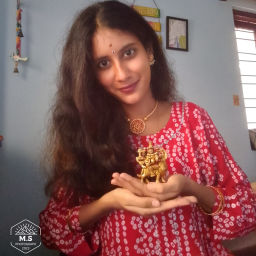
The Voice Behind “The Tales of Divinity” 🎙️
I am Meena — a seeker, storyteller, and student of India’s ancient traditions. Through The Tales of Divinity, I explore the stories, scriptures, rituals, symbols, and forgotten narratives that have travelled through generations — and bring them into conversations that feel relevant to the world we live in today.🌺🌺🌺🌺
From the mysteries of Śākta and Tantric traditions, Śrī Vidyā, Purāṇas and Vedic knowledge to the stories behind temples, deities, rituals, festivals, and lesser-known traditions, each episode uncovers a different layer of our sacred heritage. This is a space for curious minds who want to go beyond what they have simply heard — to listen, learn, question, and discover the stories hidden behind the traditions we inherited.🔱🔱🔱
The Tales of Divinity — where ancient stories meet the curious mind.🔻🌺🪷
Credits- Topic suggestion by my HUSBAND Sandilya ji❤️
A ram. A bull. A human pair. A crab. A lion. A maiden.
Six Rāśis. Six completely different forms.
In Vedic Jyotiṣa, the twelve Rāśis are not represented only through animals. Some appear as human beings, some as objects, some as aquatic or composite forms.
But these forms are not random illustrations.
In Part 1 of Tales of Divinity, we begin with Meṣa and move through Vṛṣabha, Mithuna, Karkaṭa, Siṃha and Kanyā — exploring what these forms reveal about the nature of each Rāśi and why Jyotiṣa preserves such a fascinating symbolic language.
From the first movement of Meṣa to the human form of Kanyā, we begin to see the Rāśi Chakra differently.
This is only the first half.
Part 2 continues from Tulā to Mīna.
Listen to Part 1 and enter the hidden language of the Rāśis.
#vedicjyotisha #jyotish #rashis #sanatanadharma #talesofdivinity
23 Sept 2026
Bali: The Offering the World Forgot How to Understand"🔻
The word Bali is often immediately associated with animal sacrifice, but in Śākta and Tantric traditions, Bali has a much broader ritual meaning. It can involve food grains, fruits, vegetables and other prescribed offerings, while certain Tantric traditions also prescribe paśu-bali. The distinction between Dakṣiṇācāra and Vāmācāra, and the ritual purpose behind different forms of Bali, is far more nuanced than the way it is usually presented.
In this episode, we go deeper into what Bali actually means, how different forms of Bali are understood, what Dakṣiṇācāra and Vāmācāra have to do with it, and how traditional texts and ritual frameworks approach paśu-bali. If you have ever wondered why Bali is performed, what happens within the ritual, and why it should not simply be reduced to “animal sacrifice,” listen to the full episode of Tales of Divinity.
29 Aug 2026
THE PLANETS WE SEE MAY BE ONLY ONE LAYER OF THE LOKAS”
In the Purāṇic worldview, the universe is not presented as one flat physical space containing a collection of planets. It is presented as a vast, structured creation containing different Lokas and planetary systems. Śrīmad Bhāgavatam describes fourteen planetary systems within the cosmic manifestation. The upper seven are Bhūḥ, Bhuvaḥ, Svaḥ, Mahaḥ, Janaḥ, Tapaḥ and Satya. The seven lower systems are Atala, Vitala, Sutala, Talātala, Mahātala, Rasātala and Pātāla. This is not merely a poetic list. The text places these realms within the cosmic body of the Virāṭ Puruṣa, the universal form of the Divine.
https://vedabase.io/en/library/sb/2/5/40-41/?utm_source=chatgpt.com
Reach and audience
Public platform figures. Ratings count people who left a rating, not total listeners.
Spotify
4.7 / 5
23 ratings
Host of Meena Sripada?
Claim your podcast to manage its listing and keep your show details accurate.
Pod Engine is an independent podcast discovery and analytics service and is not affiliated with or endorsed by this podcast. Artwork and show content belong to their owners. Full legal notice.
Explore this show Podcast research with Pod Engine