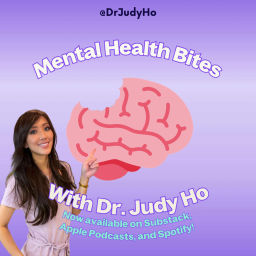
Mental Health Bites with Dr. Judy Ho
Hosted by Dr Judy Ho and Dr. Judy Ho · Get Your Dose of Mental Wellness News and Tips in Just 10 Minutes
4.5from 8 ratings
- 74
- Episodes
- 8
- Ratings
- Weekly
- Cadence
- 2024
- First episode
- 351K
- YouTube views
About Mental Health Bites with Dr. Judy Ho
Welcome to Mental Health Bites with Dr. Judy! In just 10 minutes, we dive into a hot topic, answer your burning questions, and leave you with a practical tip to improve your mental wellness. 🌟 drjudyho.substack.com (https://drjudyho.substack.com?utm_medium=podcast)
- Publisher
- Get Your Dose of Mental Wellness News and Tips in Just 10 Minutes
- Category
- health & fitness · society & culture
- Language
- en
- Explicit
- No
- First episode
- 10 Jul 2024
- Latest episode
- 13 Apr 2026
Latest episodes
74 episodes in the feed.
13 Apr 2026
A New Chapter: Join Me On Savvy Psychologist Podcast!
Hey Mental Health Bites listeners — I’m here with some big news! I’m so excited to let you know I’m back on the mic with a brand new podcast: Savvy Psychologist! I’ll still be sending out my substack newsletters weekly, but this is another way you can receive tips and resources from me via audio and video podcast! Everything you loved about Mental Health Bites podcast is still here, plus so much more. We’re diving into everyday mental health tips, cultural moments everyone is talking about, and true crime through a forensic psychology lens! Head over to Apple Podcasts, Spotify, or wherever you’re listening right now and search Savvy Psychologist — hit subscribe and I’ll see you every Tuesday! This is a public episode. If you'd like to discuss this with other subscribers or get access to bonus episodes, visit drjudyho.substack.com/subscribe (https://drjudyho.substack.com/subscribe?utm_medium=podcast&utm_campaign=CTA_2)
1 Dec 2025
A Calmer December Starts Here: My Annual Wellness Advent Calendar
The first week of December is the time for holiday lights, long lists, and (frequently) more pressure than presence. You’ve got disrupted sleep, extra sugar, unpredictable travel, and emotional triggers everywhere. From a brain perspective, all of that equals uncertainty, and uncertainty is fuel for your threat system—the amygdala lights up, cortisol rises, and executive functions in the prefrontal cortex dip. That’s why you forget simple tasks, feel snappy, or lose motivation halfway through the day. But I have an idea: What if, instead of pushing through December on fumes, you used this month to restore your energy? Today, I’ll introduce you to something I’ve developed - a tradition of sorts over the past several years: The Wellness Advent Calendar. It’s made up of thirty-one small, science-backed actions to calm your nervous system, boost your focus, and reconnect you to yourself before the year ends. They take minutes, but they can change the way your brain handles stress. As always, for a deeper dive, you can listen to the latest episode of Mental Health Bites here or on Apple Podcasts (https://podcasts.apple.com/us/podcast/mental-health-bites-with-dr-judy-ho/id1756371710). You can also find more short clips and helpful tips at my YouTube channel (https://www.youtube.com/judyhophd). The Science of Tiny Wins Instead of waiting for the New Year to come around to set giant resolutions, I encourage you to start building your micro-resilience now. And The Wellness Advent Calendar will help you do just that. Your brain loves small, predictable rewards. Each micro-habit gives a dopamine pulse. Even though it’s tiny, it’s enough to say “safe, controllable, achievable.” Neuroscientists call this reinforcement learning. When repeated daily, these small loops reshape your baseline stress response. The Wellness Advent Calendar rests on three evidence-based pillars: * Minimum Viable Effort. Start ridiculously small. Don’t worry. Momentum matters more than magnitude. The smaller the step, the faster the start, and the stronger the habit. * State → Trait Shift. Each quick regulation practice moves your nervous system from threat to safety. Repeat that enough, and “calm” stops being a rare state and becomes part of who you are. * Habit Chaining. Tie each daily action to something you already do. It can be your coffee ritual, brushing your teeth, or unlocking your phone. By connecting these tiny wins to something you already do there won’t be any extra willpower required. Here’s a sneak peak of what’s in store. If you’d like the full explainer of each wellness advent activity, plus access to my December 3 Day Jumpstart program, become one of my elite subscribers here (https://drjudyho.substack.com/subscribe?utm_source=menu&simple=true&next=https%3A%2F%2Fdrjudyho.substack.com%2F). The Holiday 3-Day Jumpstart is a gentle reset to help you enter December with nervous system calm and emotional clarity. Paid subscribers receive: * A short guided video each day * A 2-minute micro-practice you can use immediately * A written breakdown of the science behind each tool * A reflection prompt to integrate the lesson * A downloadable mini-worksheet for each day * A bonus grounding audio you can replay all season * 5 Fast Body-Based Resets * 7 Hidden Cognitive Drains and How to Cope * A December “Energy Map” If you want a calmer, more intentional December — or if you want to end the year feeling connected, grounded, and proud of how you showed up — I’d love for you to join us inside the paid community. Upgrade here to get both the 3-Day Jumpstart & Advent Calendar (https://drjudyho.substack.com/subscribe?utm_source=menu&simple=true&next=https%3A%2F%2Fdrjudyho.substack.com%2F) How to Establish Healthy Habits in 1-2-3 To end this year on a high note, try to anchor this month with a simple 1-2-3 system to incorporate some of these habits into your life. * One Breath, One Action (OB-OA). Inhale through your nose for four counts, exhale for six to eight. Immediately follow with one quick action from the day’s tile; it might be a 90-second body scan or a two-minute brain dump. Taking a breath helps because it drops your arousal just enough to make action frictionless. * The 2-1-1 Rule. Two minutes. One minute. One minute. In the morning, take two minutes, choose your tile from the calendar and visualize exactly when and where you’ll do it. In the middle of the day, take sixty seconds and do a quick state check. Rate your stress on a scale of one to five. Then run a quick down-shift: a long exhale, unclench, and orient. In the evening, write out one sentence: What worked today? This primes reward circuits and improves follow-through tomorrow. * Anchor the Habit. As mentioned, attach your daily practice to an existing routine. This will help turn intention into automation. After I pour coffee → 90-second breath. After I park the car → 3-item brain dump. After I brush teeth → 2-minute stretch. When you weave these three tools together—One Breath, One Action, the 2-1-1 Rule, and Habit Anchoring—you’re giving your brain exactly what it needs: predictability, simplicity, and consistency. With just a few minutes a day, you’ll feel steadier, clearer, and more grounded as you move through the busiest month of the year. If you found this helpful, consider turning it into a shared journey. Send it to someone who might need this routine before the holiday. When you build these tiny wins together, you’re creating accountability and connection that can make these new habits even easier to sustain. Order The New Rules of Attachment here: https://bit.ly/3MvuvvF (https://bit.ly/3MvuvvF) Check out my TEDxReno talk (https://youtu.be/ibM6ANA5c4Q?si=pPtFC27pJr5JToeb) Visit my website (https://drjudyho.com/) Take my attachment styles quiz (https://judyho.typeform.com/to/Kwkmgi5z?typeform-source=drjudyho.com) Follow me on LinkedIn (https://www.linkedin.com/in/drjudyho/) Follow me on Instagram (https://www.instagram.com/drjudyho/) Follow me on Facebook (https://www.facebook.com/doctorjudyho) Follow me on TikTok (https://www.tiktok.com/@drjudyho?lang=en) About me: Dr. Judy Ho, Ph. D., ABPP, ABPdN is a triple board certified and licensed Clinical and Forensic Neuropsychologist, a tenured Associate Professor at Pepperdine University, television and podcast host, and author of Stop Self-Sabotage. An avid researcher and a two-time recipient of the National Institute of Mental Health Services Research Award, Dr. Judy maintains a private practice where she specializes in comprehensive neuropsychological evaluations and expert witness work. She is often called on by the media as an expert psychologist and is also a sought after public speaker for universities, businesses, and organizations. Dr. Judy received her bachelor’s degrees in Psychology and Business Administration from UC Berkeley, and her masters and doctorate from SDSU/UCSD Joint Doctoral Program in Clinical Psychology. She completed a National Institute of Mental Health sponsored fellowship at UCLA’s Semel Institute. This is a public episode. If you'd like to discuss this with other subscribers or get access to bonus episodes, visit drjudyho.substack.com/subscribe (https://drjudyho.substack.com/subscribe?utm_medium=podcast&utm_campaign=CTA_2)
26 Nov 2025
If the Holidays Bring Out Your Old Wounds...Read This
The holidays are supposed to be a time of joy, connection, and reflection. But for many of us, the moment we walk through that familiar front door, something shifts. Your shoulders tense. Your heart rate quickens. You hear a certain tone in your parent’s voice, and suddenly you’re a fourteen-year-old again, trying not to roll your eyes or cry at the dinner table. You tell yourself you’ll stay calm, but within ten minutes your mom starts to criticize how you raise your kids and then you snap and feel guilty and sad for days. It may not be this exact scenario, but many people go through their own version of something like this. It can be a strange experience. You spent years building confidence, independence, and emotional regulation, yet all it takes is one holiday meal to send your nervous system into a tailspin. So, why does this happen? And why can the people who love us most also make us feel the most triggered? In this piece we’ll unpack this, and I’ll share a step-by-step reset you can use this Thanksgiving to stay calm, kind, and grounded no matter what happens. For a deeper dive, you can listen to the latest episode of Mental Health Bites here or on Apple Podcasts (https://podcasts.apple.com/us/podcast/mental-health-bites-with-dr-judy-ho/id1756371710). You can also find more short clips and helpful tips at my YouTube channel (https://www.youtube.com/judyhophd). The Neuroscience of Family Triggers Your brain is a memory keeper. But it doesn’t necessarily remember events as you might think. Instead, it remembers states. This happens to all of us. Even if you’re 40, successful, and self-aware, your amygdala can pull up emotional “snapshots” of how it used to feel to be around your family in an instant—moments when you felt criticized, dismissed, unseen, or pressured to perform. This is because when you’re around people who shaped your earliest emotional experiences, your amygdala (the part of your brain responsible for threat detection) lights up like a fire alarm. The hippocampus, which stores context and narrative memory, works alongside the amygdala.So when your mom makes that same comment she’s been making for decades, your brain doesn’t process it as “just a comment.” Your brain links it to a cascade of similar moments. And with every eye roll, sigh, and unmet need, your body reacts as if you’re back there again. At the same time, the rational part of your brain that manages impulse control and perspective, gets temporarily hijacked. When that happens, your adult self fades and your inner child grabs the wheel. This is why even a small family comment can feel like a deep wound. The Attachment Angle: The Why Behind These Reactivations Attachment theory (https://drjudyho.substack.com/p/how-attachment-styles-and-love-languages?utm_source=publication-search) helps explain the “why” behind those reactivations. If you grew up with inconsistent caregiving, such as love mixed with criticism or attention paired with pressure, your body learned to anticipate rejection even in closeness. So when you visit home for the holidays, your body sees family but also the potential for disapproval, comparison, or shame. When the family reconvenes, it’s like stepping back into a play that’s been rehearsed for decades. And everyone instinctively remembers their lines. One person becomes the peacemaker, smoothing every conflict. Another becomes the achiever, trying to earn approval through success. These dynamics can be stressful, but the hopeful truth is that awareness gives you power. While you can’t erase the past conditioning, thanks to neuroplasticity (https://drjudyho.substack.com/p/neuroplasticity-101?utm_source=publication-search), you can rewire your nervous system’s response in the present and form new, healthier patterns. The “Table Reset” Technique: A Practical Takeaway This is a neuroscience-based, four-step grounding method I teach to patients for use in high-stress family interactions. It helps you re-engage your prefrontal cortex, regulate your nervous system, and step back into your adult self calmly, confidently, and compassionately. * Step 1: Name What’s Happening (Silently). When you notice your body reacting, say to yourself, “This is a trigger. My chest feels heavy. My body remembers this feeling.” This is called affect labeling; it’s a technique that reduces amygdala activation. When you name your emotion or physical state it brings online the rational, calming parts of your brain. * Step 2: Engage Your Vagus Nerve. This will signal your nervous system to exit “fight or flight” (https://drjudyho.substack.com/p/why-your-exercise-routine-is-stressing?utm_source=publication-search) and return to “rest and digest.” To do this breathe in for four seconds then exhale for six. When you make your exhale slightly longer than your inhale, that tells your vagus nerve, “We’re safe.” If you can, hum quietly or even touch your throat as you exhale; this vibration further activates parasympathetic calm. * Step 3: Re-anchor in the Present. Look around. Name one thing you can see, one thing you can touch, and one thing you can hear. These micro sensory check-ins reorient the hippocampus to now, not then. It’s your way of saying to the body:“I’m not that child anymore. I’m sitting at a table, not in danger.” * Step 4: Respond, Don’t React. Once you feel a bit more grounded, choose your next step intentionally. If you want to speak up, use calm, clear language that sets a boundary and preserves connection. You might say something like, “Mom, I know you care, but I’d love to just enjoy dinner tonight without advice.” Or “I appreciate that you want to help, but I’ve got this handled.” If it’s not the right moment to engage, internal boundaries count too. Tell yourself: “This comment doesn’t define me. I can let that pass and still protect my peace.” Every time you take any of these steps, you’re building a new neural pathway that teaches your brain that safety and self-respect can coexist. If You Want Additional Support This December… If the holidays tend to feel emotionally heavy, overstimulating, or complicated, I want to make sure you have tools that actually help you in real time, not just in theory. That’s why next month I’m releasing two exclusive subscriber resources: The Holiday 3-Day Jumpstart (December 1–3) A gentle reset to help you enter December with nervous system calm and emotional clarity.Paid subscribers receive: * A short guided video each day * A 2-minute micro-practice you can use immediately * A written breakdown of the science behind each tool * A reflection prompt to integrate the lesson * A downloadable mini-worksheet for each day * A bonus grounding audio you can replay all season It’s designed for busy, overwhelmed schedules — high-impact, minimal effort. The Mental Wellness Advent Calendar 31 days of simple, evidence-based practices (1–5 minutes each) to help you: * Set boundaries without guilt * Reduce stress and emotional reactivity * Stay grounded during gatherings * Find small, meaningful moments of joy * Keep your nervous system steady through the holidays Paid subscribers get: * The full printable calendar * The digital daily version * Audio guidance for selected practices * A December “Energy Map” to track what drains and replenishes you * Extra reflection prompts + Sunday resets If you want a calmer, more intentional December — or if you want to end the year feeling connected, grounded, and proud of how you showed up — I’d love for you to join us inside the paid community. Upgrade here to get both the 3-Day Jumpstart & Advent Calendar (https://drjudyho.substack.com/subscribe?utm_source=menu&simple=true&next=https%3A%2F%2Fdrjudyho.substack.com%2F) Remember This for the Holidays You can’t control who brings the drama or which family patterns resurface, but you can choose how you meet them. Calm is not passive. It’s power. And when you regulate your nervous system, you’re healing yourself and changing the emotional legacy for everyone at that table. If you found this helpful, please share it with someone who might need it before the holiday. Order The New Rules of Attachment here: https://bit.ly/3MvuvvF (https://bit.ly/3MvuvvF) Check out my TEDxReno talk (https://youtu.be/ibM6ANA5c4Q?si=pPtFC27pJr5JToeb) Visit my website (https://drjudyho.com/) Take my attachment styles quiz (https://judyho.typeform.com/to/Kwkmgi5z?typeform-source=drjudyho.com) Follow me on LinkedIn (https://www.linkedin.com/in/drjudyho/) Follow me on Instagram (https://www.instagram.com/drjudyho/) Follow me on Facebook (https://www.facebook.com/doctorjudyho) Follow me on TikTok (https://www.tiktok.com/@drjudyho?lang=en) About me: Dr. Judy Ho, Ph. D., ABPP, ABPdN is a triple board certified and licensed Clinical and Forensic Neuropsychologist, a tenured Associate Professor at Pepperdine University, television and podcast host, and author of Stop Self-Sabotage. An avid researcher and a two-time recipient of the National Institute of Mental Health Services Research Award, Dr. Judy maintains a private practice where she specializes in comprehensive neuropsychological evaluations and expert witness work. She is often called on by the media as an expert psychologist and is also a sought after public speaker for universities, businesses, and organizations. Dr. Judy received her bachelor’s degrees in Psychology and Business Administration from UC Berkeley, and her masters and doctorate from SDSU/UCSD Joint Doctoral Program in Clinical Psychology. She completed a National Institute of Mental Health sponsored fellowship at UCLA’s Semel Institute. This is a public episode. If you'd like to discuss this with other subscribers or get access to bonus episodes, visit drjudyho.substack.com/subscribe (https://drjudyho.substack.com/subscribe?utm_medium=podcast&utm_campaign=CTA_2)
Reach and audience
Public platform figures. Ratings count people who left a rating, not total listeners.
- YouTube views
- 351,223
- Score snapshot 15 Sept 2025
- Apple Podcasts (US)
- 4.5 / 5
- 8 ratings
Podcast Authority Score: 72 / 100
A composite of feed quality, social presence, YouTube performance and engagement. Read the methodology.
- Quality
- 95
- Social presence
- 0
- YouTube
- 93
- Engagement
- 31
Contact Mental Health Bites with Dr. Judy Ho
- Guest appearances
- Books guests
Based on episode analysis; this does not confirm that the show is currently accepting guests.
Questions about Mental Health Bites with Dr. Judy Ho
Who hosts Mental Health Bites with Dr. Judy Ho?
Dr Judy Ho and Dr. Judy Ho host the show. Published by Get Your Dose of Mental Wellness News and Tips in Just 10 Minutes.
How often do new episodes come out?
The show publishes weekly, based on its RSS feed.
Does Mental Health Bites with Dr. Judy Ho take guests?
Yes. Guests have been identified in episode analyses.
Host of Mental Health Bites with Dr. Judy Ho?
Claim your podcast to manage its listing and keep your show details accurate.
Pod Engine is an independent podcast discovery and analytics service and is not affiliated with or endorsed by this podcast. Artwork and show content belong to their owners. Full legal notice.
Explore this show
Podcast research with Pod Engine