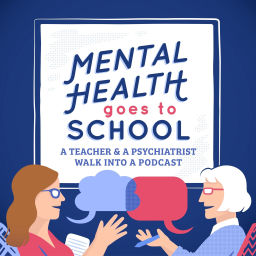
Mental Health Goes to School
Mental Health Goes To School
4.6from 11 ratings
- 33
- Episodes
- 11
- Ratings
- Monthly
- Cadence
- 2023
- First episode
About Mental Health Goes to School
A teacher and a psychiatrist talk to experts and with each other to bridge the gap between schools and mental health. We want to learn more about how professionals and families can work together to address the surging crisis in youth mental health.
- Publisher
- Mental Health Goes To School
- Category
- education · health & fitness · kids & family
- Language
- en
- Explicit
- No
- First episode
- 29 Jun 2023
- Latest episode
- 24 Sept 2026
Latest episodes
33 episodes in the feed.
24 Sept 2026
E34: The Anxious Generation – Moving from Theory to Reality 📱
In this episode, Candida Fink MD and Jo-Ann Berry take a friendly but critical look at Jonathan Haidt’s bestseller, The Anxious Generation. The hosts break down Haidt’s four key recommendations for raising healthier kids and challenge some common buzzwords (like “brain rewiring”) with up-to-date research. They mix in plenty of real-world wisdom from the front lines of education and psychiatry, tackling what families and schools are actually up against when it comes to technology, screen time, and the mental health of young people. Episode Chapters & Timestamps 00:00 Intro: Coffee Chaos & Catching Up The episode starts with Jo-Ann Berry and Candida Fink MD swapping coffee disaster stories and welcoming listeners to another conversation at the intersection of school and mental health. 01:47 The Anxious Generation: Haidt’s Four Rules Jo-Ann Berry introduces Jonathan Haidt’s four major recommendations: no smartphones before high school, no social media before 16, phone-free schools, and more unsupervised play. 03:50 Facing Reality: The Pressure on Families Candida Fink MD highlights the real-life struggle for families to follow these guidelines given the strong pull of community standards and FOMO. 07:47 ⭐ HIGHLIGHT: The (Lack of) Science on “Rewiring” Kids’ Brains Candida Fink MD explains there’s little evidence smartphones are literally rewiring young brains, pushing for honest, non-scary science communication. 11:30 How Tech Hooks Us: Dopamine, Design, and Predatory Apps The conversation turns to how tech and gaming companies use brain science to keep everyone—especially kids and teens—coming back for more. 15:44 Gender Differences & Power for Marginalized Groups The hosts discuss how boys and girls are socialized into different tech habits, while also acknowledging that online spaces can be crucial support networks for LGBTQ+ kids and other marginalized youth. 21:27 Redefining Success: There’s More to Life Than a Paycheck Jo-Ann Berry and Candida Fink MD critique the tendency to judge success by career and financial outcomes alone—reminding us that connection, emotional health, and care work matter too. 30:43 Free Play & the Lost Art of Appropriate Risk Why “boredom” and unstructured time (even with a little risk) are keys to kid’s growth—and how families used to (and still can) nurture these crucial experiences. 34:17 One Good Thing & Closing Shout Outs Jo-Ann Berry celebrates feeling better, and Candida Fink MD throws some love to the recent Bad Bunny halftime show for its infectious energy. Key Takeaways The Four Pillars: Basic agreement on no smartphones pre-high school, no social media before 16, phone-free schools, and encouraging more free play and independence. Science vs. Hype: No strong evidence (yet) that smartphones and social media are literally “rewiring” brains—so let’s be careful with scary language. Compassion & Community First: The most successful changes will come from “ground up” agreements among parents, not just top-down rules. Know Your Tech: Social media and gaming platforms are designed to hold attention; understanding this is the first step toward making smarter choices. Benefits for Marginalized Youth: Online spaces aren’t all bad—there’s real power and connection for many kids who don’t see themselves represented elsewhere. Redefining Success: Remember, there are lots of ways to measure a “successful” life—mental health, relationships, and community are just as important as financial gain. Practical Tips for Families Build Community Agreements: Connect with other families to set mutual expectations around devices and apps—individual change is hard in a vacuum. Teach Critical Consumption: Regularly talk with your kids about how, and why, tech platforms try to keep them engaged. Encourage Analog Fun: Make space for (and celebrate!) boredom, spontaneous play, and outdoor adventures—sometimes the best learning happens away from screens. Watch for Signs: Keep an eye out for when gaming or online time stops being fun and starts interfering with sleep, relationships, or schoolwork. Resources Mentioned Book: (https://www.theatlantic.com/books/archive/2024/03/anxious-generation-book-excerpt-haidt/677818/)The Anxious Generation by Jonathan Haidt (https://www.theatlantic.com/books/archive/2024/03/anxious-generation-book-excerpt-haidt/677818/) Book: (https://www.brookings.edu/people/richard-reeves/)Of Boys and Men by Richard Reeves (https://www.brookings.edu/people/richard-reeves/) Article: (https://www.newyorker.com/culture/the-weekend-essay/is-technology-really-ruining-teens-lives)Is Technology Really Ruining Teens’ Lives? (https://www.newyorker.com/culture/the-weekend-essay/is-technology-really-ruining-teens-lives) by Molly Fischer (The New Yorker) Support: (https://www.nami.org/)NAMI (National Alliance on Mental Illness) (https://www.nami.org/) for families navigating youth mental health Further Reading: (https://publications.aap.org/pediatrics/article/148/5/e2021054003/183355)AAP Technical Report on Digital Ecosystems, Children, and Adolescents (https://publications.aap.org/pediatrics/article/148/5/e2021054003/183355) Show Notes: [References to selected scientific studies] to be listed in the episode’s web notes Looking for more practical suggestions, resources, or future topics? Find us at (https://mentalhealthgoestoschool.com/)mentalhealthgoestoschool.com (https://mentalhealthgoestoschool.com/), and don’t forget to subscribe and leave us a quick review! If you enjoy our content, please like and follow - and review if you can!
18 Jun 2026
E32: ADHD Prompts
Episode Summary In this episode, Dr. Candida Fink and special educator Jo-Ann Berry dive into the nuances of supporting students with ADHD in the classroom. Moving beyond repetitive "pay attention" reminders, they explore the "curious approach" to prompting—asking students if they are stuck or simply thinking. The conversation covers practical classroom strategies for high schoolers, the importance of student autonomy, and how simple adjustments like doodling or movement breaks can transform a student's ability to engage with challenging or tedious tasks. Key Points & Highlights The Power of Curiosity: Replacing standard redirections with curious questions (e.g., "Are you thinking or are you stuck?") helps students re-engage without feeling singled out or shamed. The "Neuro-Spicy" Classroom: Strategies like doodling, fidgets, and varied seating (wobbly stools, yoga balls, or spin chairs) are essential tools that help ADHD brains "reset" their attentional systems. Autonomy in High School: Giving older students the choice to opt-out or delay a task often leads to better engagement, as it shifts the dynamic from compliance to personal responsibility. Functional Writing Skills: For 11th and 12th graders, the focus shifts from academic perfection to functional communication, such as emailing a doctor or writing a job application. The Flaw in IEP Goals: Jo-Ann critiques the common IEP phrasing "the student needs to..." and argues that goals should reflect what the educator wants to see, rather than placing the "need" solely on the student. Takeaways & Practical Tips For Teachers: Use neutral "check-ins" like "Are you with me?" rather than demanding eye contact. If a student is looking away, they may still be listening. For Students: Identify which sensory "muscle" helps you focus—whether it's a specific fidget, standing up for a minute, or taking a strategic "mental break" by looking out the window. Movement as a Tool: Understand that movement helps "wire" the brain to focus. Even a brief walk to the restroom can serve as a necessary cognitive reset. Writing Prompts: Use low-stakes, non-daily writing prompts to build the "writing muscle" without the pressure of a major grade. Resources Mentioned Ross Greene’s Collaborative & Proactive Solutions (CPS) Model: (https://livesinthebalance.org/)Referenced for its "What's up?" approach to problem-solving. Classroom Tools: Wobbly stools, yoga balls, spin chairs, and fidget bins. Digital Tools: iPads/Tablets for doodling during lessons or, even better, paper and pencil. Connect With Us We want to hear from you! What strategies have worked in your classroom or for your child? Website: (https://mentalhealthgoestoschool.com/)MentalHealthGoesToSchool.com (http://mentalhealthgoestoschool.com). Social Media: Watch on YouTube (https://www.youtube.com/@MentalHealthGoestoSchool) and be sure to follow us on Instagram (https://www.instagram.com/mentalhealthgoestoschool/)for more tips and "good things" from our travels and teaching. Timeline [00:00] Intro: Welcome to Episode 32. [02:15] The frustration of repetitive ADHD prompts in the classroom. [05:40] Strategies for high school: Doodling, fidgets, and movement breaks. [09:20] The "Are you stuck or are you thinking?" technique. [12:10] The importance of student autonomy and choice. [16:45] Reimagining IEP goals: Moving away from "Student needs to..." [20:30] Functional writing skills for upperclassmen. [24:50] "One Good Thing": Recapping our trip to Iceland and the beauty of the glaciers. If you enjoy our content, please like and follow - and review if you can!
28 May 2026
E31: Cell Phones and AI in the Classroom
Episode Summary In Episode 31, Dr. Candida Fink and Jo-Ann Berry tackle the complex and evolving role of technology in the classroom. They discuss the growing movement toward "phone-free" schools, examining the tension between the potential benefits of reduced distractions and the practical challenges of enforcement. The conversation also shifts to the transformative power of Generative AI, with Jo sharing firsthand accounts of how tools like Gemini are becoming essential "thought partners" for students with learning differences. Together, they explore how educators can move away from a culture of restriction toward one of intentional, supportive technology use. Key Points & Highlights The Phone-Free School Debate: Schools are increasingly implementing bans to reclaim student focus, but the practical reality of managing "thousands of phones" remains a major hurdle for administrators. AI as a Cognitive Tool: Generative AI is shifting from a feared "cheating tool" to a powerful executive functioning aid, helping students brainstorm, organize thoughts, and break down complex tasks. The "Thought Partner" Concept: Jo describes AI not as a replacement for work, but as a collaborator that helps students move past the "blank page" paralysis often associated with ADHD and learning disabilities. Safety vs. Distraction: While parents often want students to have phones for safety reasons, the constant pull of social media and notifications creates a significant "switching cost" that hinders deep learning. Modeling Digital Habits: The hosts emphasize that adults must model healthy technology use rather than just imposing bans, acknowledging that phone addiction is a systemic challenge for all ages. Takeaways & Practical Tips For Educators: Instead of banning AI, teach students how to use it for "low-stakes" brainstorming or outlining to build confidence in their writing process. For Parents: Understand that the push for phone-free environments is about creating a "sacred space" for learning, even if it feels inconvenient for immediate communication. For Students: Experiment with using AI tools to summarize long texts or generate "to-do" lists for projects to help manage executive functioning demands. Incremental Implementation: Schools can try "phone-free" zones or specific times (like lunch or transition periods) rather than an all-or-nothing approach to build community buy-in. Resources Mentioned Gemini (Google AI): Discussed as a tool for students to use as a brainstorming partner. Yondr Pouches: Mentioned as a common physical solution for locking away phones during the school day. The Anxious Generation by Jonathan Haidt: Referenced (implicitly) in the context of the national movement toward phone-free schools and the impact of technology on youth mental health. Connect With Us We would love to hear how your school is handling the phone and AI revolution! Website: MentalHealthGoesToSchool.com (http://MentalHealthGoesToSchool.com) Social Media: Follow us for updates on "good things" from our travels and classroom insights. Timeline [00:00] Intro: Welcome to Episode 31. [02:45] The "Great Phone Ban": Current trends in school policies across the country. [06:30] The distraction factor: How "switching costs" impact a student's ability to focus. [10:15] Parents and safety: The conflict between home communication and school focus. [14:50] AI in the classroom: Moving from fear of cheating to embracing support. [19:20] Case study: How Jo uses AI as a "thought partner" for students with ADHD. [24:10] The future of education: Why we need to teach students "how to learn" with these tools. [27:35] "One Good Thing": Celebrating our trip to Iceland—the food, the people, and the geothermal pools. If you enjoy our content, please like and follow - and review if you can!
Reach and audience
Public platform figures. Ratings count people who left a rating, not total listeners.
- Apple Podcasts (US)
- 4.6 / 5
- 10 ratings
- Spotify
- 5.0 / 5
- 1 ratings
Podcast Authority Score: 17 / 100
A composite of feed quality, social presence, YouTube performance and engagement. Read the methodology.
- Quality
- 5
- Social presence
- 0
- YouTube
- 0
- Engagement
- 71
Host of Mental Health Goes to School?
Claim your podcast to manage its listing and keep your show details accurate.
Pod Engine is an independent podcast discovery and analytics service and is not affiliated with or endorsed by this podcast. Artwork and show content belong to their owners. Full legal notice.
Explore this show
Podcast research with Pod Engine