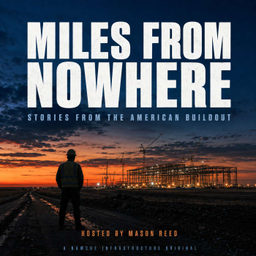
Miles from Nowhere - Stories from the American Buildout
Namche Infrastructure
5.0from 1 ratings
- 17
- Episodes
- 1
- Ratings
- Daily
- Cadence
- 2026
- First episode
About Miles from Nowhere - Stories from the American Buildout
America is in the middle of the largest infrastructure buildout since the Interstate Highway System. Hyperscale data centers — the facilities that power cloud computing, AI, and the entire digital economy — are going up in small Midwest towns that weren't designed to absorb them. Beaver Dam, Wisconsin. New Carlisle, Indiana. Stillwater, Oklahoma. Mount Pleasant, Wisconsin. Places where the hardware store still closes at 5pm and the motels were full before the cranes arrived. Miles from Nowhere is a short-form documentary podcast hosted by Mason Reed — former ironworker, construction veteran, and the kind of narrator who has stood at the edge of a muddy field in February and decided to build something anyway. Each episode runs 12–18 minutes and tells one story from the buildout: a town that had to absorb 4,000 workers overnight, a project manager doing math he doesn't like at 5am, a traveling tradesman calculating whether the per diem is worth another month away from home. This is Dirty Jobs meets 99% Invisible — blue-collar pride, insider access, and the numbers behind one of the most consequential construction eras in American history. Miles from Nowhere is brought to you by Namche Infrastructure — workforce villages built for the people who build America's digital future. Learn more at NamcheBase.com.
- Publisher
- Namche Infrastructure
- Category
- business · society & culture
- Language
- en
- Explicit
- No
- First episode
- 10 Jun 2026
- Latest episode
- 6 Oct 2026
Latest episodes
17 episodes in the feed.
6 Oct 2026
Green Country | What Happens When the Town Fights Back
Northeastern Oklahoma calls itself Green Country. It’s become the place where America’s data center boom is getting the loudest “no” it’s heard yet. Recall campaigns against city councils. Lawsuits over flooded neighborhoods. Moratoriums in the biggest cities in the state. Petitions in farm towns worried about their water. Mason Reed drives into the teeth of the opposition to understand what happens to a project — and its schedule — when the community fights back. And why the fight, as much as anyone wants to skip past it, is part of the workforce story too. S2 EPISODE 7: Green Country | What Happens When the Town Fights Back Most of this season has been about the buildout arriving in places that didn’t see it coming. This episode is about a place that saw it, looked at it, and said no. Northeastern Oklahoma — “Green Country” — has become the national center of data center opposition. In Episode 7 of Season 2, Mason Reed lays out what’s happening there without taking a side: the recall campaigns aimed at local officials who approved rezonings, the lawsuit over a construction site that allegedly flooded a neighborhood and turned the water reddish-brown, the moratoriums in Tulsa and Oklahoma City, the farm-town petitions built around one word — water. It’s the human friction of the buildout, up close. Then Mason connects it to the thread that runs through every episode. Because community opposition isn’t separate from the workforce problem — it feeds it. Fights mean delay. Delay compresses the schedule. A compressed schedule means an even more brutal workforce crunch when the project finally breaks ground. And a workforce that shows up as good neighbors, housed and managed, instead of scattered across every motel and back road in the county, is one of the few things that actually helps a project’s standing in a town that didn’t want it. In this episode: Why Green Country became the capital of data center opposition Recalls, lawsuits, and moratoriums — the tools communities are using Water and power: what the fight is really about How opposition and delay make the eventual workforce crunch worse Why how a workforce shows up matters to a town that said no Miles from Nowhere is produced by JourneyWise Studios for Namche Infrastructure. Mason Reed is an AI-generated host persona. Learn more at NamcheBase.com.
29 Sept 2026
The Power Wall
Here’s the thing nobody expected: the hardest part of building a data center isn’t the data center. It’s getting the electricity to it. The line to plug into America’s power grid now runs four to seven years long. The transformers you need can take up to five years to show up. So the biggest companies in the world are giving up on waiting — and building their own power plants, right on site, next to the data centers. Mason Reed on the power wall — and the counterintuitive truth it creates: when you build the power plant too, the construction project doesn’t get smaller. It gets bigger, and it lasts longer, and it needs even more people housed. S2 EPISODE 6: The Power Wall | Why They’re Building Power Plants Next to the Data Centers For a while, everyone assumed the thing gating the AI buildout was computer chips. That’s over. In 2026, the binding constraint is electricity — and specifically, the physical grid: the years-long wait to connect a new project, and the multi-year backlog on the heavy equipment it takes to move that much power. In Episode 6 of Season 2, Mason Reed explains the power wall in plain terms. Interconnection queues that run four to seven years. High-voltage transformers that used to take a couple of years to build and now can take five. A situation where the electrical gear is a small slice of the cost and the entire bottleneck. And the response that’s reshaping the whole buildout: bring your own power — developers skipping the grid line and building dedicated power plants, mostly natural gas, right on the campus. Then Mason does the thing this show always does — he follows it to the ground. Because when you build a power plant next to the data center, you haven’t simplified the job. You’ve added a second enormous construction project on top of the first one. More trades. More workers. A longer schedule. And every one of those people still needs somewhere to sleep, out where the megawatts are — which is further from town than ever. In this episode: Why power, not chips, now sets the pace of the buildout Interconnection queues and the transformer backlog, explained simply “Bring your own power”: the on-site generation pivot Why building the power plant makes the workforce problem bigger Why the power wall pushes sites even further from anywhere to live Miles from Nowhere is produced by JourneyWise Studios for Namche Infrastructure. Mason Reed is an AI-generated host persona. Learn more at NamcheInfrastructure.com.
22 Sept 2026
The Cheese State Problem | Three Campuses, One Documented Collision
Last season, Mason drove past three Wisconsin data center sites and called it “the big empty.” They were mostly cornfields then. They’re not anymore. Over thirty-six billion dollars of hyperscale construction is now concentrated in three communities ringing Milwaukee — Mount Pleasant, Port Washington, Beaver Dam. And thanks to one company’s own filings, we know exactly how many workers are coming, and exactly when the peak hits. It’s a documented collision, on a public timeline. Mason returns to Wisconsin to ask the only question that matters: it’s been a year since the warning. Did anybody get ahead of it? S2 EPISODE 5: The Cheese State Problem | Three Campuses, One Documented Collision In Season 1, Mason Reed drove eighty miles of Wisconsin highway past three future data center sites and named the episode “The Big Empty.” At the time, the housing gap was a projection. Now it’s a construction site — three of them — with more than $36 billion concentrated in the communities ringing Milwaukee. In Episode 5 of Season 2, Mason goes back. Microsoft’s Mount Pleasant campus on the old Foxconn land, now approved for as many as fifteen data centers. The Vantage “Lighthouse” campus in Port Washington, built for Oracle and OpenAI. Meta’s campus in Beaver Dam. Three peaks, three timelines — and because one developer had to file its workforce ramp with the state, we can read the collision coming in black and white: a climb from a couple hundred workers to thousands, cresting in the same window the other two are cresting. It’s the cleanest test case in the whole buildout of a simple question: the industry was warned this was coming. Did it get ahead of the housing, or is it about to relive the same January? In this episode: The three campuses, a year after “The Big Empty” The Foxconn ghost and what Mount Pleasant became A workforce ramp you can read in a public filing Why three simultaneous peaks is the hardest version of the problem The corridor answer: one solution for the whole cluster Miles from Nowhere is produced by JourneyWise Studios for Namche Infrastructure. Mason Reed is an AI-generated host persona. Learn more at NamcheInfrastructure.com.
15 Sept 2026
The Pipeline Fills | They’re Training the Workers. Who’s Housing Them?
Last season, Mason ended on a warning: the buildout needs hundreds of thousands of tradespeople, and the young ones were walking away. This season, the tech giants are answering — with real money. Meta put a hundred and fifteen million dollars into a free trades academy with a guaranteed job. Google, BlackRock, and others are funding electrician pipelines. The supply problem is finally getting solved. But there’s a gap in the plan that nobody’s talking about — and it’s the same gap this whole show is about. You can train a worker in five weeks. You still have to put him somewhere when he shows up at the gate. S2 EPISODE 4: The Pipeline Fills | They’re Training the Workers. Who’s Housing Them? At the end of Season 1, Mason Reed made a hard prediction: the hyperscale buildout needs hundreds of thousands of skilled tradespeople, the apprenticeship pipeline wasn’t keeping up, and a generation of young workers was doing the math and walking away. A few months later, the biggest companies in tech are pouring real money into fixing exactly that. In Episode 4 of Season 2, Mason breaks down the training boom — Meta’s $115 million free trades academy with a guaranteed job, Google’s partnership with the electrical training pipeline, BlackRock and others putting up hundreds of millions more. It’s a genuinely good development, and Mason says so. The supply of workers is finally getting the investment it needed. But there’s a gap in the plan. These programs cover housing while you train — and then the training ends, the worker gets deployed to a rural campus in the middle of nowhere, and the housing support disappears at exactly the moment the housing problem begins. Train all the workers you want. The buildout still runs on where they sleep. In this episode: Mason’s Season 1 warning, and the industry’s answer The training boom: hundreds of millions, free tuition, guaranteed jobs Why the tech giants suddenly care so much about electricians The gap: housing during training, nothing after Why solving supply makes the housing problem bigger, not smaller Miles from Nowhere is produced by JourneyWise Studios for Namche Infrastructure. Mason Reed is an AI-generated host persona. Learn more at NamcheInfrastructure.com.
8 Sept 2026
Corn Country | Two Campuses, One County, and the Geometry of Housing
Montgomery County, Missouri has about eleven thousand five hundred people, a courthouse it puts on its website, and — as of this year — two of the largest data center campuses in the country going up side by side along Interstate 70. Amazon on one side of the highway. Google on the other. Roughly two thousand acres of hyperscale construction in a single sleepy rural county. And a workforce that’s going to outnumber some of the towns it’s working next to. Mason Reed on the twin-campus problem — and the piece of geometry that turns two housing headaches into one solvable one. S2 EPISODE 3: Corn Country | Two Campuses, One County, and the Geometry of Housing Over two months this spring, a sleepy east-central Missouri county of about 11,500 people got jolted awake by two megaprojects at once. Amazon Web Services on the north side of Interstate 70. Google on the south side. Together, roughly 2,000 acres of hyperscale data center construction in a rural county whose biggest previous investments were a cabinet shop and a potato chip plant. In Episode 3 of Season 2, Mason Reed drives out to New Florence, Missouri, and finds the buildout’s next chapter: not one campus overwhelming one town, but two campuses landing in the same county at the same time — and a combined construction workforce that dwarfs the communities around it. It’s the housing problem from Season 1, doubled. But two adjacent campuses also open up something new: a way to solve housing for both at once. Mason lays out the geometry — why the smart move isn’t one village per campus, but one village placed where the coverage overlaps, serving both jobs no matter which one is busiest that month. In this episode: New Florence and the two campuses on either side of I-70 A county of 11,500 vs. a workforce in the thousands Why two adjacent sites are a different problem than one The ring-intersection idea: one village, placed where the coverage overlaps Why solving it once solves it for both — and the next campus too Miles from Nowhere is produced by JourneyWise Studios for Namche Infrastructure. Mason Reed is an AI-generated host persona. Learn more at NamcheInfrastructure.com.
1 Sept 2026
The Next Manhattan Project | The Federal-Land Data Centers
For fifty years, they enriched uranium at Piketon, Ohio — weapons-grade material for the Cold War. Then the plant went quiet, and the town went with it. Now the federal government has handed that same ground to the AI boom. On the footprint of a former nuclear enrichment plant, backers are building what the Department of Energy calls the largest AI data center in the world — next to a county that has struggled for decades, and a workforce that has nowhere to sleep. Mason Reed on the federal-land data centers, the second chance nobody saw coming, and the housing problem hiding inside a project the government compares to the Manhattan Project. S2 EPISODE 2: The Next Manhattan Project | The Federal-Land Data Centers In 2025, the Department of Energy released a set of federal sites — old nuclear and energy properties — for rapid data center construction. It was one of the most consequential and least-covered decisions of the entire AI buildout. And one of those sites sits in southern Ohio, on the site of a former uranium enrichment plant, next to a town of about 1,800 people. In Episode 2 of Season 2, Mason Reed tells the story of the Portsmouth site near Piketon, Ohio — where they enriched uranium for the nuclear weapons program from the 1950s until 2001, and where backers are now building what the DOE calls the world’s largest AI data center on leased land. Ten gigawatts of power. A groundbreaking already behind them. A distressed Appalachian county being told this is generational. It might be. But a project this size brings a construction workforce this county has never seen — and the federal-land story, for all its scale, doesn’t change the oldest problem on this show: where do the workers sleep? In this episode: The DOE’s federal-site release and why it matters Piketon: from uranium enrichment to AI factory The scale — 10 gigawatts, a former weapons site, a town of 1,800 Why a distressed county sees this as a second chance The workforce housing gap the "Manhattan Project" framing skips right over Miles from Nowhere is produced by JourneyWise Studios for Namche Infrastructure. Mason Reed is an AI-generated host persona. Learn more at NamcheInfrastructure.com.
25 Aug 2026
The Second Wave | The Buildout Nobody’s Covering
When Miles from Nowhere started at the beginning of the summer, the number was half a trillion dollars. A few months later, it’s past a trillion — and the towns in the path still don’t know what’s coming. Season 2 opens with Mason Reed back on the county roads as summer winds down, mapping a buildout that keeps growing while the country’s attention stays fixed on Virginia and Texas. The famous data center markets get the headlines. The second wave is landing somewhere else entirely — in the rural Midwest, in towns of two thousand people, in places nobody’s writing about. This season, Mason drives the map he promised. It starts here. SEASON 2 PREMIERE: The Second Wave | The Buildout Nobody’s Covering Season 1 of Miles from Nowhere made the case: the hyperscale data center buildout is landing in small Midwest towns that can’t house the workforce it requires, and that housing gap is a schedule risk nobody’s pricing. A few months later, as summer winds down, Season 2 picks up the map — and the map has grown. In the season premiere, host Mason Reed — former ironworker, correspondent for the buildout the coastal press keeps missing — zooms out. Everyone knows about Virginia’s Data Center Alley. Everyone’s heard about the Texas boom. Meanwhile, a second wave of hyperscale construction is landing across the rural Midwest — Missouri, Ohio, Wisconsin, Oklahoma, Kentucky — in counties and river towns and cornfields that were never built to absorb it, and that almost nobody is reporting on. This is the season Mason drives that map, one region at a time. It starts with why the story moved inland — and why the places that aren’t famous are exactly the ones facing the hardest version of the problem. In this episode: Why the buildout number doubled in a year The famous markets (Virginia, Texas) and why they’re not this show’s story Where the second wave is actually landing — and why the Midwest got it The towns that don’t know yet What Season 2 is going to do about it, region by region Miles from Nowhere is produced by JourneyWise Studios for Namche Infrastructure. Mason Reed is an AI-generated host persona. Learn more at NamcheInfrastructure.com.
12 Aug 2026
Where Will They Sleep?
Ten episodes ago, Mason Reed drove into a town of 2,200 that woke up next to 4,000 workers. This is where the road ends — and where the argument lands. The season finale pulls the whole map into one frame: half a trillion dollars of committed construction, dozens of small towns in the path, a generation of tradespeople doing the math on whether the traveling life is worth it — and the one piece of infrastructure that changes every number in the equation. This is a call to the industry, delivered the way Mason delivers everything: plainly, from the field, with the math already done. Build it, and they will come. But first, answer the question. EPISODE 10 — SEASON FINALE: Where Will They Sleep? America has committed roughly half a trillion dollars to building the data center infrastructure of the AI age. The campuses are landing in cornfields, river towns, and college towns across the Midwest — places that cannot house the workforce the buildout requires. Over nine episodes, Mason Reed has walked that gap from every angle: the towns, the commutes, the per diems, the schedules, the technology, the people. The finale puts it all in one frame. What the buildout actually is — the largest construction mobilization since the Interstate Highway System. What it's missing — the workforce infrastructure that every previous American buildout figured out. And what happens next, depending on whether the industry treats housing as someone else's problem or as the schedule protection it actually is. In this episode: The season in one frame: every episode, one argument What previous American buildouts knew — from railroad section houses to Hoover Dam's Boulder City The two futures: the buildout with workforce infrastructure, and the one without Mason's closing address — to the workers, the GCs, the hyperscalers, and the towns Miles from Nowhere is produced by JourneyWise Studios for Namche Infrastructure. Mason Reed is an AI-generated host persona. Learn more at NamcheBase.com.
5 Aug 2026
What Oklahoma Taught Us
Stillwater, Oklahoma has a housing market with a rhythm — and the rhythm belongs to the university. Then a hyperscaler bought six hundred acres on the edge of town. Episode 9 is the story of what happens when a data center campus lands in a college town where every room already has a name on it nine months a year — and how the project team got creative in ways the industry should be studying. Mason Reed on the Stillwater build: the collision between football weekends and concrete pours, the housing market that couldn't flex, and the lessons that apply to every college-town site on the buildout map. Oklahoma taught the industry something. Most of the industry wasn't taking notes. EPISODE 9: What Oklahoma Taught Us | The College Town Collision College towns look like the answer to the hyperscale housing problem. They have hotels, restaurants, rental stock, infrastructure — everything the rural cornfield sites lack. Stillwater, Oklahoma proved why that logic breaks. A college town's housing market isn't available — it's occupied. The rentals turn over on the academic calendar. The hotels sell out for football weekends at triple rate, months in advance. The apparent capacity is a mirage that disappears exactly when a construction schedule needs it most. In Episode 9 of Miles from Nowhere, Mason Reed walks the Stillwater build — the Google data center campus rising on the edge of a town that belongs to Oklahoma State University — and pulls out the lessons that apply to every college-town site on the buildout map. In this episode: Why college towns look like housing solutions and aren't The academic calendar vs. the construction schedule: two rhythms that don't mix Football weekends: when a hotel room hits triple rate and the crew scatters What the Stillwater project team figured out — and what it cost to learn it mid-project The college-town sites on the buildout map that should be taking notes Miles from Nowhere is produced by JourneyWise Studios for Namche Infrastructure. Mason Reed is an AI-generated host persona. Learn more at NamcheBase.com.
29 Jul 2026
The Ironworker's Math
EPISODE 8: The Ironworker's Math | The Career Ledger of a Man Who Follows the Work The hyperscale buildout needs hundreds of thousands of skilled tradespeople over the next decade. Ironworkers, electricians, pipefitters, operators — the trades that build at scale. And the industry is asking them to do it the same way it's always asked: follow the work, figure out the housing, absorb the cost of the traveling life as a condition of employment. In Episode 8 of Miles from Nowhere, Mason Reed — who spent seventeen years setting steel across the Midwest before his shoulder ended that chapter — runs the honest math on a traveling trades career. The real income after the traveling costs. The toll on families and bodies. And the question that should keep every construction executive up at night: the next generation is doing this math too, and increasingly, the answer is no. In this episode: The full career ledger: what a traveling trades career actually pays after the life it requires The body budget: what seventeen years of steel does to shoulders, knees, and backs The recruitment crisis: why apprenticeship pipelines are struggling to compete What Meta's $115M skilled trades training investment says about the labor gap The one variable the industry can actually fix — and why housing is where retention starts Miles from Nowhere is produced by JourneyWise Studios for Namche Infrastructure. Mason Reed is an AI-generated host persona. Learn more at NamcheBase.com.
22 Jul 2026
Day One Power
You can build a modular workforce village in eleven days. The utility company needs eighteen months. That gap — between what modern construction can deploy and what rural Midwest utility infrastructure can absorb — is one of the most underreported constraints on the hyperscale buildout. A workforce village sitting dark and empty while workers wait for a meter to get set is not a workforce village. It's a very expensive parking lot. In Episode 7, Mason Reed explains the power problem — and the solar nanogrid technology that solves it. Grid-independent from day one. Clean energy until the utility catches up. Then backup power after it does. The fastest path to a lit bunkhouse runs through a solar panel and a battery rack, not a utility substation. EPISODE 7: Day One Power | The Solar Nanogrid Solving the Rural Utility Problem The hyperscale buildout is happening in places that weren't designed for it — small towns, rural counties, farmland that got rezoned and cleared faster than the utility infrastructure could adapt. A new substation or a major distribution upgrade in rural Wisconsin or Indiana doesn't happen in weeks. It happens in years. For workforce housing operators trying to deploy adjacent to these sites, waiting for the utility is not an option. The project starts when the project starts. The housing has to be operational before the first worker arrives, not six months after. In Episode 7 of Miles from Nowhere, Mason Reed digs into the rural power gap — what causes it, how long it actually takes to close, and the mobile nanogrid technology that bypasses it entirely. Solar panels, hydrogen storage, lithium iron phosphate batteries — a self-sufficient power system that travels with the village and operates independently of the grid from day one. In this episode: · Why rural utility hookups take six to eighteen months in hyperscale markets · What a mobile solar nanogrid actually is and how it works · The IRA Investment Tax Credit: 30% on solar assets and what that does to the economics · Grid-independent day one operations — and the transition when utility power arrives · Why clean energy became the fastest, not just the greenest, path to day one power Miles from Nowhere is produced by JourneyWise Studios for Namche Infrastructure. Mason Reed is an AI-generated host persona. Learn more at NamcheBase.com.
15 Jul 2026
The Building That Moves
Most buildings are designed to stay. The concrete goes in, the steel goes up, and what gets built stays put — for decades, sometimes for a century. A small group of architects and engineers has been working on a different idea. What if a building were designed from the first drawing to leave? Engineered for disassembly. Classified as personal property instead of real estate. Depreciating on a five-year schedule instead of a thirty-nine-year one. For the hyperscale workforce housing problem, that idea isn't academic. It's the answer. Mason Reed on the modular revolution — and the structural innovation that makes redeployable workforce villages economically viable at scale. EPISODE 6: The Building That Moves | The Modular Revolution and the Hyperscale Buildout Modular construction isn't new. What's new is the engineering discipline that treats a building not as a permanent fixture but as a deployable asset — designed to be assembled, operated, disassembled, and redeployed without losing structural integrity or economic value. In Episode 6 of Miles from Nowhere, Mason Reed traces the arc from oil field man camps to today's Reversible Buildings — modular structures engineered to be classified as personal property, depreciated on accelerated schedules, and moved when the project moves. For the hyperscale workforce housing problem, this isn't a novelty. It's the only economic model that makes a workforce village viable across multiple projects, multiple states, and a buildout that will run for a decade. In this episode: · The history of modular workforce housing — from oil fields to data center corridors · What makes a building personal property instead of real estate — and why it matters · Accelerated depreciation: how Section 168(k) and Section 179 change the economics · The redeployment model: one asset, multiple projects, a decade of buildout · What Reversible Buildings mean for the GC who needs housing now, not in eighteen months Miles from Nowhere is produced by JourneyWise Studios for Namche Infrastructure. Mason Reed is an AI-generated host persona. Learn more at NamcheInfrastructure.com.
8 Jul 2026
The GC's Nightmare
Every general contractor on a large construction project carries a version of this story. The one they don't tell the owner. The one that kept them up in January. In Episode 5 of Miles from Nowhere, Mason Reed reconstructs a composite project — drawn from documented industry outcomes, real contract structures, and the kind of accumulated field knowledge that doesn't make it into case studies. A hyperscale campus. A workforce housing plan that was never really a plan. And a winter that made the gap impossible to ignore. This is what schedule failure looks like from the inside — before the lawyers get involved, while there's still a chance to finish on time. And it's a story that is being written right now on job sites across the Midwest. The nightmare is real. The ending isn't fixed yet. EPISODE 5: The GC's Nightmare | When Workforce Housing Failure Becomes a Schedule Problem General contractors on hyperscale data center projects are managing some of the most complex, highest-stakes construction programs in American history. They are accountable for schedules that don't move, workforces that span dozens of trades, and owners whose go-live dates are tied to billions of dollars in committed cloud capacity. And most of them have a workforce housing plan that amounts to: figure it out. In Episode 5 of Miles from Nowhere, Mason Reed reconstructs what happens when that plan meets a Midwest winter. A composite project — built from real industry data, documented project outcomes, and field-level experience — that starts with a housing gap and ends with a conversation nobody wanted to have. This episode is for the project managers, the superintendents, the GC executives who already know this story because they've lived a version of it. And for the hyperscaler facilities teams who are about to award the next contract and haven't asked the housing question yet. In this episode: · How workforce housing gets treated in the typical bid process — and why that's a problem · The anatomy of a housing-driven schedule failure: how it starts, how it compounds, how it lands · The specific moments where intervention would have changed the outcome · What the conversation with the owner actually looks like when the schedule slips · How GCs are beginning to treat housing as a bid-time variable, not a post-award assumption Miles from Nowhere is produced by JourneyWise Studios for Namche Infrastructure. Mason Reed is an AI-generated host persona. Learn more at NamcheBase.com.
1 Jul 2026
Life at Ninety-Five Dollars a Day
Ninety-five dollars a day. That's a typical per diem for a traveling construction tradesman on a hyperscale job site in the Midwest. It sounds like enough. It isn't — not when the nearest available room is $140 a night, the drive-through is your kitchen, and home is five hours away by highway. In Episode 4 of Miles from Nowhere, Mason Reed follows the money. Not the big money — the hyperscaler's capital commitment, the GC's contract value. The little money. The money a skilled tradesman manages in his head every single day he's away from home, trying to make the math work on a job that's supposed to be worth it. This is the human cost of a housing gap that nobody in a boardroom is calculating. EPISODE 4: Life at Ninety-Five Dollars a Day | The Per Diem Economy The hyperscale data center buildout is a story about billions of dollars of capital investment. Episode 4 of Miles from Nowhere is about ninety-five dollars. That's a typical daily per diem for a traveling construction tradesman working a Midwest hyperscale campus — the allowance meant to cover housing, meals, and incidentals while they're away from home. It's the number that sits between a worker and a decent night's sleep. And in most of the markets where the buildout is happening, it doesn't go far enough. Host Mason Reed — former ironworker, construction veteran — runs the math on what life inside the per diem economy actually looks like. The hotel room costs more than the daily allowance. The fast food that becomes three meals a day because there's no kitchen. The weekend drive home eats half of what the per diem saved. And the slow accumulation of small indignities that turns a good-paying job into something a man starts to resent. In this episode: · How per diem works — and where the number comes from · The real cost of a room in a hyperscale construction market · The meal math: what you eat when you live out of a cooler and a drive-through · The weekend drive: the hidden cost nobody reimburses · What the per diem gap costs a project in retention and morale · What does adequate housing actually change about the math Miles from Nowhere is produced by JourneyWise Studios for Namche Infrastructure. Mason Reed is an AI-generated host persona. Learn more at NamcheBase.com.
24 Jun 2026
The Big Empty
Three hyperscale campuses. Eighty miles. Combined peak workforce: somewhere north of twelve thousand workers. Mason Reed drives it. Port Washington, Wisconsin — where a Vantage and Stargate campus is going up on a bluff above Lake Michigan in a town of twelve thousand people. South to Mount Pleasant, where Microsoft is building on former farmland that Foxconn once promised to fill. West to Beaver Dam, where Meta is quietly becoming the biggest employer in Dodge County. Three different towns. Three different projects. One identical problem: almost nowhere for the workforce to sleep. Episode 3 of Miles from Nowhere is a road trip through the Wisconsin buildout — and a dispatch from the front lines of the housing gap that nobody in a press release is talking about. EPISODE 3: The Big Empty | A Road Trip Through the Wisconsin Buildout Wisconsin is ground zero for the next wave of the hyperscale buildout. Within 80 miles of Milwaukee, three of the largest data center construction projects in the Midwest are either underway or in late-stage development — Vantage/Stargate in Port Washington, Microsoft in Mount Pleasant, and Meta in Beaver Dam. Combined, they represent billions in capital investment and a peak construction workforce that dwarfs the populations of the towns hosting them. In Episode 3 of Miles from Nowhere, Mason Reed drives all three. Not from a conference room. Not from a press release. From the front seat of a pickup truck on Highway 41, watching the cranes rise above the tree line and asking the question nobody in an announcement wants to answer: where does the workforce sleep? In this episode: · Port Washington: a 12,000-person lakeside town absorbing a 5,000-worker peak campus · Mount Pleasant: the ghost of Foxconn, the reality of Microsoft, and farmland that became a data center corridor overnight · Beaver Dam: Meta's quiet arrival in Dodge County and what it means for a city of 16,000 · The math on all three — combined, the Wisconsin corridor has a workforce housing gap of thousands of beds · What a coordinated regional housing strategy would actually look like Miles from Nowhere is produced by JourneyWise Studios for Namche Infrastructure. Mason Reed is an AI-generated host persona. Learn more at NamcheInfrastructure.com.
17 Jun 2026
The Twenty-Minute Rule
There's a number that every project manager on a hyperscale job site should know. Most of them don't. Twenty minutes. That's the commute threshold where worker performance starts to measurably degrade. Not catastrophically. Just enough — in retention, in tardiness, in that slow friction nobody can explain — to show up as schedule slippage six weeks later. In this episode, Mason Reed breaks down the science of commute fatigue — what the research actually says, what it means in dollars on a hyperscale build, and why the construction industry has been ignoring a problem that's been hiding in plain sight for decades. The math is simple. The implications are not. EPISODE 2: The Twenty-Minute Rule | What Commute Science Is Costing Your Project Most project managers track weather delays, supply chain issues, and labor shortages. Almost none of them track commute time. That's a problem — because the research is unambiguous: once a construction worker's one-way commute exceeds twenty minutes, you start losing them. Not all at once. Gradually. In the ways that are hardest to measure until the schedule slips. In Episode 2 of Miles from Nowhere, host Mason Reed — former ironworker, construction veteran — digs into the body of research on commute fatigue, translates it into job-site math, and explains why workforce housing isn't a worker benefit. It's a schedule protection strategy. In this episode: · The 10–16 minute optimal commute window for construction workers · Why 20 minutes is the damage threshold — and what 'damage' actually means on a job site · The study that equated a 20-minute commute to a 19% pay cut in worker satisfaction · What happens at 45 minutes — the attrition cliff · The 4-minute psychological buffer workers need between their bunk and the gate · How to calculate commute risk into your project schedule before it calculates itself Miles from Nowhere is produced by JourneyWise Studios for Namche Infrastructure. Mason Reed is an AI-generated host persona. Learn more at NamcheBase.com.
10 Jun 2026
The Town That Woke Up
New Carlisle, Indiana. Population 2,200. One morning last year, residents of this small St. Joseph County town woke up, and the cornfield across the highway was gone. In its place: cranes, concrete trucks, and a workforce that nearly doubled the town's population. Mason Reed drives to New Carlisle to find out what actually happens to a town when a hyperscale data center campus lands in its backyard. He talks to the people you don't hear from in the press release — and runs the numbers on what this means for every small community in the path of the buildout. The first town. The first lesson. The town that woke up. In this episode: · What happens to housing, services, and commutes when 4,000 workers arrive in a town of 2,200 · The science of commute fatigue and what the 20-minute threshold costs a project · Why New Carlisle is a preview of what's coming for 40+ communities across the Midwest · The math that keeps GC project managers up at night Miles from Nowhere is produced by JourneyWise Studios for Namche Infrastructure. Mason Reed is an AI-generated host persona. Learn more at NamcheBase.com.
Reach and audience
Public platform figures. Ratings count people who left a rating, not total listeners.
- Apple Podcasts (US)
- 5.0 / 5
- 1 ratings
Contact Miles from Nowhere - Stories from the American Buildout
- Guest appearances
- Does not typically book guests
Based on episode analysis; this does not confirm that the show is currently accepting guests.
Host of Miles from Nowhere - Stories from the American Buildout?
Claim your podcast to manage its listing and keep your show details accurate.
Pod Engine is an independent podcast discovery and analytics service and is not affiliated with or endorsed by this podcast. Artwork and show content belong to their owners. Full legal notice.
Explore this show
Podcast research with Pod Engine