- 14
- Episodes
- Daily
- Cadence
- 2026
- First episode
About Mind Meets Machine: Global
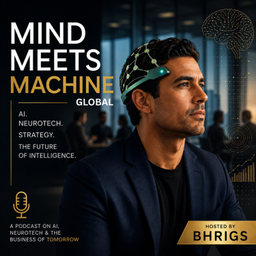
Mind Meets Machine explores the evolving relationship between neurotech, artificial intelligence, human cognition, mental health and leadership. From AI systems and strategy to neurotechnology, brain-computer interfaces, and human augmentation, this podcast examines how intelligent machines are reshaping decision-making, leadership, and the future of work. Through thoughtful conversations and deep dives, we ask: How do we build intelligence that amplifies human potential, not replaces it? For builders, leaders, and thinkers shaping the Intelligence Era.
- Publisher
- Bhrigs
- Category
- business
- Language
- en
- Explicit
- No
- First episode
- 18 Jun 2026
- Latest episode
- 14 Oct 2026
Latest episodes
14 episodes in the feed.
14 Oct 2026
Sound Meets Signal: Jean Rintoul on Ultrasound Neuromodulation, Open-Source Hardware, and Bridging the Translation Gap
My latest guest on Mind Meets Machine: Global is @Jean Rintoul, founder of Minds Eye Labs, who has built hardware across multiple biosensor products and is now working on non-invasive ways to sense and stimulate the brain using ultrasound. A few insights that stood out: 🔹 Translation needs its own funding model. Academic grants reward novel findings, and VC funding looks for products. The unglamorous engineering in between, making a prototype reliable and repeatable, often falls through the gap. Jean argues for staged funding as evidence gets stronger, and for rewarding replication, negative results, and the engineers behind the shiny clinical result. 🔹 Open, affordable tools change who gets to participate. Jean built and crowdfunded Spectra, an open-source Electrical Impedance Tomography kit that uses the same reconstruction approach as a CT scan. It makes no medical claims. It puts a research technique, usually locked inside papers and expensive equipment, into people's hands. Users have explored everything from fruit ripeness to tooth cavities to lung imaging. 🔹 Lead through uncertainty by removing it step by step. Uncertainty is core to science, but many failed experiments come from uncharacterized hardware or unexpected timing. Solidify everything else iteratively, so all that's left is the big question you set out to answer.
13 Oct 2026
Signals with Purpose: Reza Khanbabaie on Seizure Prediction, Pharma-Backed Innovation and Patient-Centred Neurotech
I sat down with Reza Khanbabaie a former founder and CEO with over 20 peer-reviewed papers and four patents, who has spent 25 years turning brain signals into technology for patients. Today he is at Mentis Care AI, building AI to detect and predict seizures for people living with epilepsy. A few insights that stood out: 🔹 Who backs you shapes what you build. Mentis Care AI is pharma-backed rather than venture-backed. A backer that knows the patient population helps you avoid costly mid-course changes in design and strategy, and gives the work a clearer long-term direction. 🔹 Clinical usefulness beats scientific novelty. A scientifically interesting signal isn't always a clinically useful one. With wearables, the question isn't how to replicate a clinical EEG with fewer sensors, but what information the task actually needs. 🔹 Leadership doesn't mean having all the answers. It's much more about creating an environment where other people can do their best work, helping the team ask better questions, removing obstacles, and creating the conditions for good ideas to emerge.
14 Sept 2026
Turning a life alterning facial paralysis into a remarkable career in neuroengineering: my conversation with Nilou Hashemi
This week on Mind Meets Machine: Global, I sat down with Nilou Hashimi, whose path into neuroengineering started with an 11-hour emergency brain surgery. We covered a lot of ground: → How a decade of medical uncertainty, from a facial paralysis to a life-altering surgery, shaped Nilou's decision to pursue rehabilitation engineering and neuroscience → A parallel reflection on navigating health uncertainty and what it does to your sense of time and control → The unglamorous realities of running pediatric neuroscience studies: recruitment, attention spans, and getting clean signal from young, disabled participants → Where AI is already changing the pace of EEG and signal processing research, and where the field is still catching up → Whether we're close to predicting anxiety or panic states before they escalate, and why individual variability makes this harder than it sounds → The emerging (and still niche) world of space neuroscience, and what microgravity might teach us about the nervous system
9 Sept 2026
From XR to EEG: Atif Mahmud on Turning Brainwaves into Actionable Signals
This week: the gap between reading a brain signal and understanding what it means. I spoke with Atif Mahmood, a computational neuroscience researcher building real time EEG neurofeedback tools for children's emotional regulation, about the hard problems in translating brain data into usable insight. We cover: → Why brain activity readings can be misleading without context → How gaming architecture solved real time neurofeedback delivery → Mindful, an EEG tool helping children self regulate → The rigor gap between engineering and science → A closing thought experiment on privacy versus collective safety A sharp look at what it takes to build trustworthy neurotech.
14 Aug 2026
Biotech At The Crossroads: Trade, War & the Future of Medical Innovation
While GLP-1 drugs and established medtech pulled in billions and shrugged off tariffs, early-stage biotech funding hit a five-year low and neurotech startups were left fighting for scraps. → Political leverage is now a balance sheet asset. Novo Nordisk and Eli Lilly negotiated directly with the White House and walked away with three years of tariff relief. That's not luck. That's strategic positioning translating straight into capital insulation. → The companies best placed to benefit from reshoring incentives are the least likely to need them. Large pharma has the balance sheet to onshore and negotiate. The startups actually driving the next wave of innovation, especially in BCI and neurotech, have none of those levers. → Uncertainty is more expensive than bad news. The moment the MFN deal structure became visible, capital that had been sitting on the sidelines moved fast. Leaders who resolved ambiguity early outperformed the ones who waited for clarity to arrive on its own. → BCI is now a patient capital game. No revenue, no reimbursement, no seat at the negotiating table. The investors still in this space are underwriting a 7 to 10 year horizon, not a quarter. If you're leading, regulating, or investing anywhere near biotech or neurotech, the through-line is the same: the market is rewarding decisive adaptation, not wait-and-see. REFERENCES: [1] FDA API sourcing data, via DelveInsight (Sep 2025).[2] Grassi Advisors (Jun 2025).[3] DCAT Value Chain Insights (Apr 2025).[4] DCAT Value Chain Insights (Jul 2025).[5] Pharmaceutical Technology (Apr 2026) — source for BIO CEO John Crowley quote and pharma reshoring commitments.[6] Pharmaceutical Technology (Apr 2026) — 16 MFN companies incl. Pfizer, Eli Lilly, MSD.[7] White House Presidential Proclamation, Adjusting Imports of Pharmaceuticals (Apr 2026).[8] White House Proclamation [7]; Pharmaceutical Technology [5] — generics/biosimilars exemption.[9] ING analyst Diederik Stadig, via Pharmaceutical Technology [5].[10] Morrison Foerster, BIOSECURE Act Update (Dec 2025).[11] Baker McKenzie, The BIOSECURE Act Becomes Law (Jan 2026).[12] Latham & Watkins, BIOSECURE Act Becomes Law.[13] DelveInsight [1] — 4-in-10 generics/Chinese APIs; reshoring announcements.[14] BIO member survey (Mar 2025), via DCAT VCI [4] and HubXchange (Apr 2025).[15] DelveInsight [1] — 25% Canada/Mexico device tariffs.[16] Janus Henderson Investors, Why Healthcare Stocks Could Excel in 2026 (Dec 2025).[17] EY, Pulse of the MedTech Report 2025 (Sep/Oct 2025).[18] Granted AI, FY2026 Science Budget Scorecard (Feb 2026); FABBS, FY26 Budget Request (Jun 2025) for proposed-cut context.[19] MDC Associates, NIH Budget Cuts and Realignment (2025).[20] Andersen Lab, BCIs in 2025: Trials, Progress, and Challenges (Jul 2025).[21] Fortune Business Insights, Brain Computer Interface Market.[22] Prime Therapeutics, GLP-1 Pipeline Update (Nov 2025).[23] IQVIA, Outlook for Obesity in 2026 (Jan 2026).[24] EY, Pulse of the MedTech Report 2025 [17].[25] BioPharma Dive / HSBC Innovation Banking (Jul 2025).[26] Ropes & Gray LLP, From Volatility to Vitality (Mar 2026).[27] Janus Henderson Investors [16].[28] William Blair, The Quarterly Rx: Q2 2025 Recap (Jul 2025).[29] Pharmaceutical Technology, Biotech Recovery in Q3 2025 (Oct 2025).[30] PitchBook Q2 2025 MedTech VC Trends, via HTD Health (Jan 2026).[31] IQVIA [23].[32] Labiotech.eu, Six Key Obesity Deals of 2025 (Dec 2025).[33] IQVIA [23].[34] J.P. Morgan, Weight Loss Drug Supply and Demand in 2026 (Feb 2026).[35] Paradromics, Healthtech and the FDA (Nov 2025).
6 Aug 2026
10 NeuroTech Use Cases That Could Put You Ahead of Your Own Mind
What if a headset could tell you an anxiety attack was coming, moments before you felt it? That's not ten years out. In this episode of Mind Meets Machine: Global, I go through 10 potential and real use cases for non-invasive brain-computer interfaces: anxiety, addiction, trauma therapy, ADHD, insomnia, loneliness, even early psychosis detection. And then I paint a highly detailed scenario and ask the question I couldn't stop thinking about: if this same technology could flag when someone nearby is entering a violent mental state, would you want to know? Would you agree to share your own neural data in exchange for that alert? REFERENCES: Davidson, R. J. (1995). Cerebral asymmetry, emotion, and affective style. In Brain Asymmetry. MIT Press. Thibodeau, R., Jorgensen, R. S., & Kim, S. (2006). Can EEG asymmetry patterns predict future development of anxiety and depression? Biological Psychology. https://doi.org/10.1016/j.biopsycho.2005.09.003 (https://doi.org/10.1016/j.biopsycho.2005.09.003) Scientific Reports. (2025). The power spectrum and functional connectivity characteristics of resting-state EEG in patients with generalized anxiety disorder. Frontiers in Psychiatry. (2025). Neurofeedback in substance and non-substance-related addictions: A mini review of current evidence and future directions. Peniston, E. G., & Kulkosky, P. J. (1989, 1990). Alpha-theta brainwave training for alcoholism. Snyder, S. M., et al. (2013). FDA-cleared NEBA System for ADHD assessment. Neurology. https://doi.org/10.1212/WNL.0000000000003265 (https://doi.org/10.1212/WNL.0000000000003265) Neurosity. (2026). EEG Biomarkers for ADHD: What Are We Looking For? Sleep Medicine. (2025). Estimation of the global prevalence and burden of insomnia: A systematic literature review-based analysis. World Health Organization. (2023). WHO Commission on Social Connection. Morrish, N., et al. (2025). How loneliness relates to health, wellbeing, quality of life, and healthcare resource utilisation and costs across multiple age groups in the UK. PLOS ONE. https://doi.org/10.1371/journal.pone.0327671 (https://doi.org/10.1371/journal.pone.0327671) Schall, U., et al. (2015). Mismatch negativity as biomarker predicting psychosis in clinically at-risk individuals. Bodatsch, M., et al. (2013). Mismatch negativity as a translatable brain marker toward early intervention for psychosis. Roth, M., et al. (2018). Resting-state brain fluctuation and functional connectivity dissociate moral injury from PTSD. bioRxiv. Holroyd, C. B., & Coles, M. G. H. (2002). The neural basis of human error processing: Reinforcement learning, dopamine, and the error-related negativity. Psychological Review. Fortune. (2026). A decade after the Godfather of AI said radiologists were obsolete, their salaries are up to $571K and demand is growing fast. Mousa, D. (2025). AI Isn't Replacing Radiologists. Works in Progress / Understanding AI. CNN Business. (2026). Worried about AI replacing your job? This job has become the ultimate case study for why it won't. Towards New Human Rights in the Age of Neuroscience and Neurotechnology — Ienca, M., & Andorno, R. (2017). (Springer (https://link.springer.com/article/10.1186/s40504-017-0050-1?utm_source=chatgpt.com)) Neurorights Foundation. UNESCO. (2021). Recommendation on the Ethics of Artificial Intelligence. (unesdoc.unesco.org (https://unesdoc.unesco.org/in/rest/annotationSVC/DownloadWatermarkedAttachment/attach_import_7d682b54-d706-4df1-a1e9-e3c57cd8316e?_=384185eng.pdf&utm_source=chatgpt.com))
20 Jul 2026
Don't Get Left Behind – Again: Preparing for the Age of BCIs
We all said the same thing about AI: "I'll pay attention when it matters." By the time it mattered, we were already playing catch-up. I don't want us to make that mistake twice. The next technological wave is already here. Not in science fiction, but in operating rooms, research labs, and clinical trials around the world. While most of us are debating AI, another revolution is quietly taking shape: BCIs In this episode, I explore why I believe neural implants could reshape society just as profoundly as AI. And why the biggest risk isn't the technology itself. It's being caught unprepared... again. We'll discuss: ➡️ Why the AI story was widely misunderstood, and what we can learn from it. ➡️ Why media hype and fear often distract us from the conversations that really matter. ➡️ The future of jobs, cognitive enhancement, and human-AI collaboration. ➡️ Who will own your neural data, and why that question deserves attention today, not a decade from now. ➡️ The ethical, legal, and societal questions we should be asking before this technology becomes mainstream. ➡️ Practical steps every professional, policymaker, parent, and lifelong learner can take to stay ahead of what's coming. This isn't a conversation about whether brain implants are "good" or "bad." It's about making sure we don't wake up one morning asking, *"How did this happen so fast?"* The same question so many people asked after ChatGPT changed the world. Because the future isn't built the day it becomes mainstream. It's built years before anyone is paying attention. Do you think we're paying enough attention to the next wave of innovation? References ChatGPT growth (1M users in 5 days; 100M in 2 months): Wikipedia; History.com; TIME (UBS). OpenAI founded (2015); GPT-1 released (2018): Engadget. ChatGPT reached 800M weekly users (Nov. 2025): History.com. AI-related job losses (2024): ITIF. AI job creation outpacing displacement: ITIF. Labor market stability since ChatGPT: Brookings (Yale Budget Lab). Technology-driven employment growth: Goldman Sachs. PC created 15.8M net new U.S. jobs: McKinsey. WEF jobs forecast (170M created; 92M displaced): World Economic Forum. Early-career AI displacement: Econofact (Stanford working paper). Enterprise AI hallucinations: Drainpipe.io. AI hallucinations in legal filings: AIMultiple. Hallucination rates & AI literature synthesis: AI & Society (Springer). Human-in-the-loop adoption: IBM AI Adoption Index (Drainpipe.io). First Neuralink human implant: Wikipedia; IEEE Spectrum. Noland Arbaugh outcomes: Wikipedia. Second Neuralink patient ("Alex"): Wikipedia. DJ Seo / Mario Kart quote: All Health Tech. Neuralink trial participants & usage statistics: Wikipedia. Neuralink typing speeds: Applying AI (Reuters). Blindsight FDA Breakthrough designation: Wikipedia; eWeek. N1 speech restoration approval: eWeek. Neuralink funding ($650M; $1B+ total): Reuters via Applying AI. First Canadian Neuralink surgeries: Wikipedia. UK clinical trials: eWeek. Neuralink product lines (Telepathy, Blindsight, Deep): eWeek. Neuralink founded (2016): Wikipedia. Initial FDA rejection (2022): Wikipedia. Synchron COMMAND study results: Business Wire; MedTech Dive. First FDA IDE permanent BCI trial: Clinical Trials Arena. Synchron Alexa & Apple Vision Pro demonstration: Fierce Biotech; MedTech Dive. Synchron investors & funding: Clinical Trials Arena. SWITCH study (JAMA Neurology): Business Wire. Estimated BCI beneficiaries: Business Wire. Neurorights Foundation findings: Bloomberg Law; Arnold & Porter. Colorado neural data law: Gadget Review; CBS News. California & Montana neural privacy laws: KFF Health News; CBS News. U.S. MIND Act: Davis Wright Tremaine; Inside Privacy. Colorado Sen. Cathy Kipp quote: CBS News. Chile neurorights amendment: CBS News; Cardozo AELJ. UNESCO statement on AI & neurotechnology: CBS News. Federal neural data regulation: PMC. Sam Altman on high-bandwidth BCIs: eWeek.
16 Jul 2026
Wired for Power: The Neuralink Governance Problem
The most consequential technologies are rarely undone by bad science. They're undone by bad governance. Case in point: a regulator who oversaw Neuralink's brain implant now works at Neuralink. The FDA's own device chief the man whose office reviewed the company's file walked straight into a job there in December 2025. Legal? Yes. But it's a clean window into what happens when hubris, unchecked narrative power, and zero structural accountability collide in an industry literally putting computers inside human brains. We run this through an organizational leadership lens: power intoxication, narrative control, coalition failure, and land on 3 concrete fixes the BCI industry needs before its first real crisis, not after. The patients are real. The technology works. The governance? Not even close. ---- REFERENCE NOTESAll facts drawn from verifiable published sources. Frameworks derived from published academic/practitioner literature, not proprietary materials. Act One — Clinical Facts 21 patients enrolled (early 2026): The Debrief, Feb 16, 2026. 12 patients, 2,000+ cumulative days, 15,000+ hours (Sept 2025): U.S. News & World Report, Sept 9, 2025. First patient Noland Arbaugh, Jan 2024: Dallas Express, Mar 6, 2026. Device specs — coin-sized, 1,000+ electrodes, 64 threads, R1 robot, Bluetooth: Dallas Express, Mar 2026. Synchron backed by Gates/Bezos, endovascular approach: Synchron disclosures; PMC, 2024. Blackrock Neurotech — 30+ patients, longest-serving patient 9+ years: Spherical Insights, 2025. Global BCI market — $3.21B (2025) → $12.87B by 2034: Fintool, Jan 2026. Act One — Governance Timeline8. 1,500+ animals used 2018–2022, USDA investigation: Wikipedia; Reuters; Dallas Express, Mar 2026.9. DOT investigation into biohazard shipment: IEEE Spectrum, Apr 2023.10. FDA rejection (2022) — battery, electrode migration, removal risk: IEEE Spectrum, Apr 2023; Fortune/TechCrunch/MedTech Dive, Mar 2023.11. FDA approval for human trials (May 2023); first implant (Jan 2024): Wikipedia; ClinicalTrials.gov NCT06429735.12. David McMullen hire — FDA device office director, announced Dec 9, 2025: Bloomberg; Becker's; MD+DI; STAT News, Dec 2025.13. Conflicting messaging harming industry approval/reimbursement: STAT News, Jan 5, 2026.14. Broad claims raising regulatory scrutiny: IEEE Spectrum, Apr 2023 (Victor Krauthamer, GWU).15. Musk's "high-volume production" claims (Dec 31, 2025): The Debrief, Feb 2026.16. Neuralink valuation ~$9.65B after Series E (June 2025): MD+DI; Fintool. Act Two — Frameworks17–18. Power intoxication, hubris, dice-roll experiment, structural safeguards: Van Kleef & Cluistra, Power For All, Ch. 2 (PublicAffairs, 2022).19. Self-serving optics, stakeholder sequencing, narrative control: synthesized from Pfeffer, Power (2010); Cialdini, Influence (2021).20. Coalition-building/shared mission: Kotter, Leading Change (1996); Van Kleef & Cluistra, Ch. 2, 8.21. Effective leaders reluctant to hold power: Van Kleef & Cluistra, Ch. 2. Act Three — Policy Landscape22. No binding U.S. federal neural data law: Cabrera et al., Bioethics 40 (2026).23. Colorado HB 24-1058 (Apr 2024, effective Aug 2024): Goodwin Law; Arnold & Porter, 2025.24. California SB 1223 (Sept 2024, effective Jan 2025): ArentFox Schiff; Stanford Law Blog.25. Montana SB 163 (May 2025, effective Oct 2025): Arnold & Porter; FPF, 2025.26. Neural data bills passed bipartisan: KFF Health News; CBS News, Jul 2025.27. Chile constitutional mental integrity amendment (2021): KFF Health News, Jul 2025.28. China national BCI roadmap (Jul 2025), milestones 2027/2030: China Briefing, Oct 2025.29. China BCI insurance reimbursement category (Mar 2025): Neeuro, Oct 2025.30. China BCI market — RMB 3.2B (2024) → RMB 5.58B (2027): Neeuro, Oct 2025.31. SEMATECH semiconductor consortium (1987): historical record; structural analogy only.
6 Jul 2026
(Part 2) The Neural Implant & BCI Industry Landscape
In this episode we analyze the Industry Landscape of BCI Implants. The section closes with a strategic framework for how to think about market sizing, investment, and what it actually takes to build a durable business in one of the most capital-intensive and regulatory-complex sectors in all of technology. Key Topics: The Industry Overview The Technology Landscape The Major Players - Top Three Operational Realities Competitive Dynamics & How to Win Building an Ecosystem The Global Picture ------------------------------------------------------------- Additional Notes and References: Neuralink N1 chip — 1,024 electrodes; first human implant January 2024 → NPR, Fierce Biotech, Axis Intelligence Synchron Stentrode — backed by Gates & Bezos ($75M Series C); COMMAND study positive 12-month results → CNBC, BusinessWire, Clinical Trials Arena Precision Neuroscience — $102M Series C (Dec 2024); thin-film subdural array → Globe Newswire, Wikipedia, Nature Biomedical Engineering BrainGate — NIH/DARPA funded, Brown University → BrainGate.org, Brown University News Meta/Ctrl-Labs — $500M–$1B acquisition (2019); EMG wristband → Engadget, Neurofounders EPFL / Prof. Courtine — brain-spine interface restoring walking (published in Nature) → EPFL, CHUV China 14th Five-Year Plan, seven-ministry BCI policy (2025) → Chinese government website, MIT Technology Review, CSET Georgetown, Ofek Technology Any claims that could not be verified with real public sources (certain revenue figures, MindMaze funding details, Russia's Kurchatov Institute BCI output) are flagged. -------------------------------------------------------------Acronyms: ADHD - Attention Deficit Hyperactivity DisorderAI - Artificial IntelligenceALS - Amyotrophic Lateral SclerosisAR - Augmented RealityASIC - Application-Specific Integrated CircuitBCI - Brain-Computer InterfaceBMBF - Bundesministerium für Bildung und ForschungBRAIN - Brain Research Through Advancing Innovative NeurotechnologiesCE - Conformité EuropéenneCIHR - Canadian Institutes of Health ResearchCMS - Centers for Medicare & Medicaid ServicesCOVID - Coronavirus DiseaseDARPA - Defense Advanced Research Projects AgencyDBS - Deep Brain StimulationEEG - ElectroencephalographyEHR - Electronic Health RecordEMG - ElectromyographyEPFL - École Polytechnique Fédérale de LausanneEU - European UnionFDA - Food and Drug AdministrationGDPR - General Data Protection RegulationIDE - Investigational Device ExemptionIP - Intellectual PropertyISO - International Organization for StandardizationITMO - Institute of Technology, Mechanics and OpticsMDR - Medical Device RegulationMS - Multiple SclerosisNIH - National Institutes of HealthNMPA - National Medical Products AdministrationNSERC - Natural Sciences and Engineering Research Council of CanadaNSF - National Science FoundationOCD - Obsessive-Compulsive DisorderPMA - Pre-Market ApprovalPTSD - Post-Traumatic Stress DisorderSBIR - Small Business Innovation ResearchSCS - Spinal Cord StimulationSDK - Software Development KitSTTR - Small Business Technology TransferTAM - Total Addressable MarketUBC - University of British ColumbiaUK - United KingdomUS - United StatesVC - Venture CapitalVR - Virtual RealityXR - Extended Reality
1 Jul 2026
(Part 1) The Neural Implant & BCI Industry Landscape
In this episode we analyze the Industry Landscape of healthcare Neural Implants and go over: The Industry Overview The Technology Landscape The Major Players - Top Three Operational Realities Competitive Dynamics & How to Win Building an Ecosystem The Global Picture ------------------------------------------------------------- Additional Notes and References: For current up-to-date figures and TAM, look up https://www.insightaceanalytic.com/report/neurotech-devices-market/3472 DBS history (late 1980s) → Sourced from The Lancet Neurology, ScienceDirect, and Frontiers in Neurology FDA approvals (essential tremor 1997, Parkinson's 2002) → Sourced from Liv Hospital timeline and PubMed Medtronic Percept PC / BrainSense adaptive DBS → Official Medtronic press release (FDA approval Feb 24 2025) + APDA + Frontiers in Neurology Nevro high-frequency SCS outperforming conventional devices → SENZA-RCT 24-month data (PMC), Medscape, Nevro PR Newswire EU MDR came into effect 2021, raised compliance burden → TÜV SÜD, Hogan Lovells, PubMed InteraXon / Muse headband (Toronto) → Wikipedia, LinkedIn company page BrainCo classroom EEG deployments in China → Rappler, Big Think, EdSurge, Neurofounders Knowledge base (well-documentedpublic record):Cochlear, Abbott, Boston Scientific revenuesegments; BrainGate history; FDA Breakthrough Device program; NIH BRAINInitiative; DARPA programs; EU MDR; Meta/Ctrl-Labs acquisition; Canadianfunding programs -------------------------------------------------------------Acronyms: ADHD - Attention Deficit Hyperactivity DisorderAI - Artificial IntelligenceALS - Amyotrophic Lateral SclerosisAR - Augmented RealityASIC - Application-Specific Integrated CircuitBCI - Brain-Computer InterfaceBMBF - Bundesministerium für Bildung und ForschungBRAIN - Brain Research Through Advancing Innovative NeurotechnologiesCE - Conformité EuropéenneCIHR - Canadian Institutes of Health ResearchCMS - Centers for Medicare & Medicaid ServicesCOVID - Coronavirus DiseaseDARPA - Defense Advanced Research Projects AgencyDBS - Deep Brain StimulationEEG - ElectroencephalographyEHR - Electronic Health RecordEMG - ElectromyographyEPFL - École Polytechnique Fédérale de LausanneEU - European UnionFDA - Food and Drug AdministrationGDPR - General Data Protection RegulationIDE - Investigational Device ExemptionIP - Intellectual PropertyISO - International Organization for StandardizationITMO - Institute of Technology, Mechanics and OpticsMDR - Medical Device RegulationMS - Multiple SclerosisNIH - National Institutes of HealthNMPA - National Medical Products AdministrationNSERC - Natural Sciences and Engineering Research Council of CanadaNSF - National Science FoundationOCD - Obsessive-Compulsive DisorderPMA - Pre-Market ApprovalPTSD - Post-Traumatic Stress DisorderSBIR - Small Business Innovation ResearchSCS - Spinal Cord StimulationSDK - Software Development KitSTTR - Small Business Technology TransferTAM - Total Addressable MarketUBC - University of British ColumbiaUK - United KingdomUS - United StatesVC - Venture CapitalVR - Virtual RealityXR - Extended Reality
28 Jun 2026
From the Operating Room to the Algorithm: The Future of Treating Depression and Anxiety
The Neurotechnology of Mental Health. Anxiety and depression usually get framed as emotional experiences. This episode argues they're also disorders of brain circuitry, and that reframing opens the door to treating them with medical technology, not just therapy and medication.We walk through the full spectrum. Invasive options like Deep Brain Stimulation and Vagus Nerve Stimulation, reserved for severe, treatment-resistant cases. Non-invasive technologies already in clinical use today. And where AI changes the equation entirely. We also get into what this could look like in practice, from wearable neuromodulation devices to environments that respond automatically to detected stress. For executives and leaders thinking about where healthtech, AI, and human wellbeing intersect, this episode closes with two questions worth sitting with: what it means to give people tools that regulate their own emotional states, and whether that builds self-awareness or dependence. REFERENCES: SUMMARY OF SAFETY AND EFFECTIVENESS DATA https://www.accessdata.fda.gov/cdrh_docs/pdf23/P230024B.pdf (https://www.accessdata.fda.gov/cdrh_docs/pdf23/P230024B.pdf) | Depression in adults: treatment and management | Guidance https://www.nice.org.uk/guidance/ng222/chapter/Recommendations (https://www.nice.org.uk/guidance/ng222/chapter/Recommendations) | Generalised anxiety disorder and panic disorder in adults: https://www.nice.org.uk/guidance/cg113/chapter/Recommendation (https://www.nice.org.uk/guidance/cg113/chapter/Recommendation) CDRH Humanitarian Device Exemptions https://www.fda.gov/medical-devices/hde-approvals/listing-cdrh-humanitarian-device-exemptions (https://www.fda.gov/medical-devices/hde-approvals/listing-cdrh-humanitarian-device-exemptions?utm_source=chatgpt.com) Getting a Humanitarian Use Device to Market https://www.fda.gov/medical-devices/humanitarian-device-exemption/getting-humanitarian-use-device-market (https://www.fda.gov/medical-devices/humanitarian-device-exemption/getting-humanitarian-use-device-market?utm_source=chatgpt.com) FDA permits marketing of transcranial magnetic stimulation for treatment of obsessive compulsive disorder https://www.fda.gov/news-events/press-announcements/fda-permits-marketing-transcranial-magnetic-stimulation-treatment-obsessive-compulsive-disorder (https://www.fda.gov/news-events/press-announcements/fda-permits-marketing-transcranial-magnetic-stimulation-treatment-obsessive-compulsive-disorder?utm_source=chatgpt.com) https://www.accessdata.fda.gov/cdrh_docs/pdf23/P230024A.pdf (https://www.accessdata.fda.gov/cdrh_docs/pdf23/P230024A.pdf) Effect of transcutaneous vagus nerve stimulation with electrical stimulation on generalized anxiety disorder: Study protocol for an assessor-participant blinded, randomized sham-controlled trial - PubMed https://pubmed.ncbi.nlm.nih.gov/40041000/ (https://pubmed.ncbi.nlm.nih.gov/40041000/?utm_source=chatgpt.com) Ethics and governance of artificial intelligence for health https://www.who.int/publications/i/item/9789240029200 (https://www.who.int/publications/i/item/9789240029200?utm_source=chatgpt.com) Cingulotomy for Intractable Obsessive-compulsive Disorder https://jamanetwork.com/journals/jamapsychiatry/fullarticle/497081 (https://jamanetwork.com/journals/jamapsychiatry/fullarticle/497081?utm_source=chatgpt.com) Potential optimization of focused ultrasound capsulotomy for obsessive compulsive disorder https://academic.oup.com/brain/advance-article-abstract/doi/10.1093/brain/awab232/6305828 (https://academic.oup.com/brain/advance-article-abstract/doi/10.1093/brain/awab232/6305828?utm_source=chatgpt.com) Transcranial focused ultrasound of the amygdala modulates fear network activation and connectivity https://pubmed.ncbi.nlm.nih.gov/38447773/ (https://pubmed.ncbi.nlm.nih.gov/38447773/?utm_source=chatgpt.com) Vagus Nerve Stimulation (VNS) for Treatment Resistant Depression (TRD) https://www.cms.gov/medicare/coverage/evidence/vagus-nerve-stimulation (https://www.cms.gov/medicare/coverage/evidence/vagus-nerve-stimulation?utm_source=chatgpt.com) Transcutaneous vagus nerve stimulation reduces spontaneous but not induced negative thought intrusions in high worriers https://www.sciencedirect.com/science/article/abs/pii/S0301051118302321 (https://www.sciencedirect.com/science/article/abs/pii/S0301051118302321?utm_source=chatgpt.com) Improvement in mood symptoms after post-bariatric surgery among people with obesity https://pubmed.ncbi.nlm.nih.gov/33891377/ (https://pubmed.ncbi.nlm.nih.gov/33891377/?utm_source=chatgpt.com) Psychiatric and Cognitive Functioning After Metabolic and Bariatric Surgery https://pubmed.ncbi.nlm.nih.gov/40545266/ (https://pubmed.ncbi.nlm.nih.gov/40545266/?utm_source=chatgpt.com) Closed-loop neuromodulation in an individual with treatment-resistant depression https://pubmed.ncbi.nlm.nih.gov/34608328/ (https://pubmed.ncbi.nlm.nih.gov/34608328/?utm_source=chatgpt.com) NHS Identity Guidelines https://www.england.nhs.uk/nhsidentity/identity-guidelines/tone-of-voice/ (https://www.england.nhs.uk/nhsidentity/identity-guidelines/tone-of-voice/?utm_source=chatgpt.com) Content design: planning, writing and managing content https://www.gov.uk/guidance/content-design/writing-for-gov-uk (https://www.gov.uk/guidance/content-design/writing-for-gov-uk?utm_source=chatgpt.com)
22 Jun 2026
Centralized or Distributed? The Real AI Org Design Decision
Centralized or Distributed? The Real AI Org Design Decision Every growing organization eventually faces the same question: should AI capability live in one central team, or spread across the business units that need it? In this episode, we walk through how that decision actually plays out as companies scale, and why the "right" answer shifts the moment headcount and complexity grow. We cover the case for a concentrated central team, the operational efficiency and cost trade-offs leadership actually cares about, and the often-overlooked MLOps question: should that function be team-agnostic, or aligned to specific domains? We also name a dynamic most org charts don't account for: what happens when a business unit gets tired of waiting on a central team and starts solving its own AI problems independently. That's a structural decision with real political consequences inside the company. From there we turn to healthcare to make a different point: domain experts can't just be looped in for review at the end. If clinicians and frontline staff aren't actively involved in building the model, not just validating it after the fact, the result is a tool that doesn't fit how people actually work. Operationalizing it just creates burnout instead of value. This conversation is for CEOs, VPs, and directors actively wrestling with how to structure AI and data capability inside their own organizations, closing with a set of questions designed to apply directly to your own org's reality. [1] Multiple industry sources report AI-powered recruitment tools can reduce time-to-hire by 30% or more. See: DemandSage, “AI Recruitment Statistics 2026,” demandsage.com; McKinsey-cited data reported in JobsPikr, “AI Recruitment in 2025,” jobspikr.com; SHRM, “The Evolving Role of AI in Recruitment and Retention,” shrm.org. Note: figures vary by implementation; the 30% figure represents a commonly cited benchmark, not a guaranteed outcome. [2] Centers for Disease Control and Prevention (CDC), “Health Workers Face a Mental Health Crisis,” Vital Signs, October 2023. Available at: cdc.gov/vitalsigns/health-worker-mental-health. Reports 46% of health workers felt burned out often or very often in 2022, vs. 32% in 2018. [3] Mayo Clinic Well-Being Index, 2023–2024 State of Well-Being Report. Reported in HealthLeaders Media, “Where Burnout Rates Are Trending Among Healthcare Professions,” January 2025. Available at: healthleadersmedia.com. Reports 50% of healthcare workers reported burnout in 2023, with nurses at 52% and physicians at 51%. [4] Wang, Z. et al. (2021). “A Machine Learning Model for Accurate Prediction of Sepsis in ICU Patients.” Frontiers in Medicine, PMC8553999. Reports AUC of 0.91, sensitivity of 87%, specificity of 89% in external validation. See also: Awad, A. et al. (2025). “Artificial Intelligence-Based Predictive Modeling for Early Sepsis Detection: A Systematic Review.” Critical Care Explorations, PMC12685403. Across 52 studies, AUC range of 0.79–0.96. [5] Verhage, T.L. et al. (2024). “To warrant clinical adoption AI models require a multi-faceted implementation evaluation.” npj Digital Medicine. doi:10.1038/s41746-024-01064-1. Notes fewer than 2% of AI models progress beyond prototyping, and that high statistical accuracy in sepsis ICU tools does not translate to clinical adoption. [6] Mohr, D.C. et al. (2025). “Adoption of Artificial Intelligence in Healthcare: Survey of Health System Priorities, Successes, and Challenges.” Journal of the American Medical Informatics Association, PMC12202002. Survey of 43 US health systems; clinician alert fatigue and AI tool immaturity identified as leading barriers to adoption, including for sepsis prediction tools.
19 Jun 2026
The Middle-Management AI Crisis: Who Gets to Lead, Who Gets Left Behind
Middle managers have quietly become one of the most anxious groups in today's workplace, and this episode tackles why head-on. The host opens with a direct question: is AI actually eliminating middle management, or is it exposing a structural problem organizations have ignored for decades? The episode traces the role's history, from pre-1990s information pipelines, through the IT revolution (which didn't shrink headcount but did raise expectations), to today's AI moment. It names exactly what AI threatens: the synthesis-and-coordination work that defined the job, reports, summaries, status updates. But it argues this exposes what was always irreplaceable: emotional intelligence and conflict resolution, now the core competency for execution. Using a "weakest link" framing, the host shows how this plays out differently by industry: manufacturing managers freed from traffic-cop duties to become business bridges; consulting leads protected by client relationships but at risk of becoming pure administrators; SaaS managers becoming "AI orchestrators" who decide what to trust rather than doing synthesis themselves; and healthcare/neurotech managers carrying moral accountability AI can't touch. The back half turns prescriptive: organizations need to redistribute high-value work, formalize neglected secondary relationships, build in time for improvement, and (critically) redefine what managers are measured on, since rewarding throughput just optimizes away the judgment work that matters. It closes with practical advice for managers (build contextual judgment, become a bridge not a bottleneck, develop your team, get fluent with AI as a collaborator) and three reflective listener questions about where their own value really sits. References: Leavitt, H. J., & Whisler, T. L. (1958). "Management in the 1980s." Harvard Business Review, 36(6), 41–48. Dopson, S., & Stewart, R. (1993). "Information Technology, Organisational Restructuring and the Future of Middle Management." New Technology, Work and Employment, 8(1), 10–20. Netflix Inc.'s Organizational Structure & Its Strategic Implications — Rancord Society. https://www.rancord.org/netflix-organizational-structure-design-organizational-chart-characteristics (https://www.rancord.org/netflix-organizational-structure-design-organizational-chart-characteristics) Spotify Organizational Structure — FourWeekMBA. https://fourweekmba.com/spotify-organizational-structure/ (https://fourweekmba.com/spotify-organizational-structure/) "Project Oxygen: The 8 Essential Qualities of Effective Managers" — CliffsNotes. https://www.cliffsnotes.com/study-notes/20870159 (https://www.cliffsnotes.com/study-notes/20870159) "Effective Engineering Managers: The 10 traits that make great managers from Google's Project Oxygen" — Addy Osmani. https://addyo.substack.com/p/effective-engineering-managers (https://addyo.substack.com/p/effective-engineering-managers) Goldratt, E. M. — Theory of Constraints (overview). "No Chain Stronger Than Its Weakest Link: Constraints Theory" — IncrementOne. https://www.incrementone.com/perspectives/no-chain-can-ever-be-stronger-than-its-weakest-link-the-theory-of-constraints (https://www.incrementone.com/perspectives/no-chain-can-ever-be-stronger-than-its-weakest-link-the-theory-of-constraints) "Why Middle Management will Fall First in the AI Revolution" (Pega survey, 78% of executives) — Chris Hood. https://chrishood.com/why-middle-management-will-fall-first-in-the-ai-revolution/ (https://chrishood.com/why-middle-management-will-fall-first-in-the-ai-revolution/) "Middle managers are getting laid off—but their role is 'more important than ever'" (Gartner, Oct. 2024 report) — CNBC. https://www.cnbc.com/2025/12/29/middle-managers-are-getting-laid-offbut-their-role-is-more-important-than-ever-says-leadership-expert.html (https://www.cnbc.com/2025/12/29/middle-managers-are-getting-laid-offbut-their-role-is-more-important-than-ever-says-leadership-expert.html)
18 Jun 2026
Your Brain is Changing With or Without You: The Convergence of Neurotech, Brain-Computer Interfaces, AI, Psychedelics, and Mental Health
What happens when psychedelics, neurotechnology, AI, brain-computer interfaces, and even ancient healing practices like Reiki begin converging into a single ecosystem? In this thought-provoking episode, we explore how neuroscience and artificial intelligence are reshaping our understanding of the human brain and what that means for mental health, healing, performance, and the future of human potential. From Neuralink and brain-computer interfaces to psilocybin therapy, optogenetics, neurofeedback, and emerging cognitive enhancement technologies, we examine the breakthroughs that are moving from research labs into real-world applications. We also discuss the opportunities and challenges facing practitioners, healthcare innovators, investors, regulators, and everyday people as these technologies evolve. Can AI help personalize mental health treatment? Could neurotechnology validate practices like Reiki? Who should own neural data? And are we prepared for a future where enhancing cognition becomes as common as treating disease? Whether you're interested in neuroscience, mental health, emerging technology, consciousness, or the future of healthcare, this episode offers a comprehensive look at one of the most important convergences of our time. Key References & Further Reading: Boyden ES et al. (2005). Millisecond-timescale,genetically targeted optical control of neural activity. Nature Neuroscience8(9):1263-1268. MIT Synthetic Neurobiology Group — OptogeneticsProjects: synthneuro.org/projects Willett FR et al. (2021). High-performancebrain-to-text communication via handwriting. Nature 593:249–254. Carhart-Harris R et al. (2021). Trial of psilocybinversus escitalopram for depression. NEJM 384:1402-1411. Hampson RE et al. (2018). Facilitation of memoryencoding in humans via a closed-loop cortical neuroprosthetic. JNE 15(3). Grand View Research (2024). Neurotechnology MarketSize, Share & Trends Analysis Report. Sahel JA et al. (2021). Partial recovery of visualfunction in a blind patient after optogenetic therapy. Nature Medicine27:1223-1229. Iaccarino HF et al. (2016). Gamma frequency entrainmentattenuates amyloid load and modifies microglia. Nature 540:230–235. "Beyond the Breakthrough Therapy designations forpsilocybin (COMPASS Pathways and USONA Institute, 2018 to 2019) and MDMA-assisted therapy for PTSD" (MAPS, 2017)
Contact Mind Meets Machine: Global
- Guest appearances
- Books guests
Based on episode analysis; this does not confirm that the show is currently accepting guests.
Host of Mind Meets Machine: Global?
Claim your podcast to manage its listing and keep your show details accurate.
Pod Engine is an independent podcast discovery and analytics service and is not affiliated with or endorsed by this podcast. Artwork and show content belong to their owners. Full legal notice.
Explore this show
Podcast research with Pod Engine