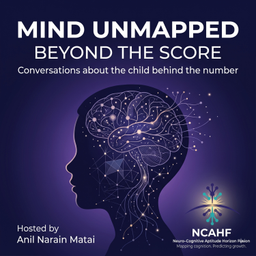
MIND UNMAPPED | Beyond the Score — Conversations About the Human Behind the Number
Anil Narain Matai
- 9
- Episodes
- Weekly
- Cadence
- 2026
- First episode
About MIND UNMAPPED | Beyond the Score — Conversations About the Human Behind the Number
MIND UNMAPPED | Beyond the Score explores the human being behind the numbers, labels and achievements. Through raw, thought-provoking conversations with educators, psychologists, leaders, researchers and changemakers, we question what truly shapes intelligence, potential, identity and success. Because every score tells a story—but never the whole story. We go beyond the score to discover the mind, the heart and the human.
- Publisher
- Anil Narain Matai
- Category
- education
- Language
- en
- Explicit
- No
- First episode
- 11 Sept 2026
- Latest episode
- 6 Nov 2026
Latest episodes
9 episodes in the feed.
6 Nov 2026
MIND UNMAPPED | BEYOND THE SCORE SEASON 1 | EPISODE 9 WHAT IF THE DIFFICULT CHILD IS THE ONE THINKING DIFFERENTLY? | Understanding the Scientific Mind with Hayat Fatima
MIND UNMAPPED | BEYOND THE SCORESEASON 1 | EPISODE 9WHAT IF THE DIFFICULT CHILD IS THE ONE THINKING DIFFERENTLY? | Understanding the Scientific Mind with Hayat Fatima What if the child who asks too many questions is not disruptive, but deeply curious? What if a student who struggles with marks possesses an extraordinary ability to understand, experiment, and create? And why do children sometimes stop asking WHY because they fear being judged? In this episode of MIND UNMAPPED | BEYOND THE SCORE, host Anil Narain Matai speaks with Ms. Hayat Fatima, an educator by passion, speaker by voice, and Science Teacher at Bal Bhavan Public School, New Delhi, with over a decade of teaching experience. Together, they explore why education must go beyond examination scores, completed syllabuses, and report cards to nurture curiosity, independent thinking, and scientific temper. Drawing from her experience teaching Physics, Chemistry, and Biology, Hayat shares why observation, experimentation, questioning, and discovery are essential to meaningful learning. 🔹 The difficult child or the curious mind? Why questioning behaviour before judging it can reveal a child's genuine curiosity. 🔹 Why do children stop asking WHY? How peer pressure and fear of embarrassment can silence young minds. 🔹 The power of encouragement: How one positive response from a teacher can build confidence and make curiosity feel welcome. 🔹 Scientific thinking beyond marks: Why observation, evidence, experimentation, and the courage to say "I don't know yet" matter. 🔹 Marks versus meaningful learning: How a child's creativity and practical abilities may reveal potential that examination scores cannot capture. 🔹 The syllabus versus curiosity: Why completing the syllabus should not come at the cost of genuine understanding. 🔹 AI and the disappearing WHY: When technology provides instant answers, how do we ensure children continue thinking and finding their own solutions? 🔹 Looking beyond the report card: Why parents and educators must recognise different forms of intelligence and potential. A child may demonstrate understanding through questions, experiments, practical applications, and original ideas rather than perfect examination answers. A classroom should never become a place where children learn to fear questions. It should become a place where asking WHY is celebrated. The purpose of education is not simply to produce children who know the answers. It is to nurture individuals with the courage to question, explore, discover, and think independently. This conversation invites parents, teachers, and school leaders to rethink how we recognise intelligence and nurture human potential. MIND UNMAPPED is a thought-leadership podcast exploring education, identity, human potential, and the person behind the number. Hosted by Anil Narain Matai, it brings educators and change-makers into conversations that challenge conventional thinking and reimagine the future of learning. 🎙️ Listen, reflect, and join the conversation. Are we nurturing curious minds, or teaching children to become comfortable with ready-made answers? Share your thoughts. #MindUnmapped #BeyondTheScore #HayatFatima #ScienceEducation #InquiryBasedLearning #CriticalThinking #ChildDevelopment #FutureOfEducation #StudentPotential #CuriosityInLearning #EducationMatters #AnilNarainMatai
30 Oct 2026
Mind Unmapped | Beyond the Score, Anil Narain Matai | Mr. Ravi Khera | Season 1 Episode 8
MIND UNMAPPED | BEYOND THE SCORE SEASON 1 | EPISODE 8 What happens when a machine can write code, generate ideas, solve problems, and deliver answers in seconds? What should schools teach children when technology can increasingly do what we once considered uniquely human skills? In Season 1, Episode 8 of MIND UNMAPPED | BEYOND THE SCORE, host Anil Narain Matai speaks with Mr. Ravi Khera, Computer Science Teaching Faculty at Shiv Nadar School, who brings over 13 years of experience in K–12 computer science education, digital literacy, and technology-enabled learning. Together, they explore a crucial question: Are we teaching children merely to use technology, or helping them think independently with it? AI offers extraordinary opportunities for learning, but how do we ensure it supports rather than replaces a child's ability to think, question, and solve problems? 🔹 AI: Learning partner or thinking substitute? Where should we draw the line between assistance and intellectual dependence? 🔹 Critical thinking in the age of AI: Why questioning, research, logical reasoning, and validating answers matter more than simply finding solutions. 🔹 The power of asking WHY: How understanding a problem, identifying who it affects, and exploring possible solutions can lead to meaningful learning. 🔹 From consumers to creators: Why children must learn to use technology thoughtfully rather than become dependent on it. 🔹 Can AI replace human capabilities? The enduring importance of curiosity, empathy, creativity, and recognising bias. 🔹 Learning through mistakes: What programming teaches us about experimentation, debugging, persistence, and discovering multiple ways to solve a problem. 🔹 Every child learns differently: Why education must accommodate different approaches, from visual explanations to collaboration and experimentation. 🔹 The role of parents and educators: How encouraging children to question, experiment, and learn from mistakes develops independent thinking. Technology can provide answers, but can children recognise whether those answers make sense? Can they challenge assumptions, verify information, identify the real problem, and consider the consequences? The goal of education should not be to compete with machines at what machines do best. It should be to develop the human capabilities that make technology meaningful. As AI transforms education, the ability to ask better questions may become one of the most important skills a child can develop. This episode invites parents, teachers, school leaders, and education innovators to rethink digital literacy and what it means to prepare children for the future. MIND UNMAPPED is a thought-leadership podcast exploring education, identity, human potential, and the person behind the number. Hosted by Anil Narain Matai, it brings educators and change-makers together to challenge conventional thinking and reimagine the future of learning. 🎙️ Listen, reflect, and join the conversation. Are schools preparing children to think independently in the age of AI, or are we becoming too dependent on technology for answers? Share your thoughts. #MindUnmapped #BeyondTheScore #RaviKhera #ArtificialIntelligence #AIinEducation #DigitalLiteracy #CriticalThinking #FutureOfEducation #ComputerScienceEducation #CreativeThinking #HumanPotential #AnilNarainMatai
23 Oct 2026
Mind Unmapped | Beyond the Score, Anil Narain Matai | Ms. Geeta Baijal | Season 1 Episode 7
MIND UNMAPPED | BEYOND THE SCOREWHO TOLD YOU WHO YOUR CHILD IS? | Looking Beyond Behaviour with Geeta Baijal What if the child we call difficult is actually struggling? What if a distracted student is carrying an invisible burden? And what if a class topper is silently terrified of disappointing their parents? In this thought-provoking episode of MIND UNMAPPED | BEYOND THE SCORE, host Anil Narain Matai speaks with Geeta Baijal, EdTech Implementation and School Transformation Consultant, K–12 education expert, and former Principal with over 24 years of experience in education and school leadership. Drawing from her years inside schools, Geeta explores a fundamental question: Are we responding to children's behaviour without understanding the experiences behind it? A child who bullies may be experiencing distress. A quiet, well-behaved student may be struggling with loneliness. A high achiever may be carrying immense pressure. These stories rarely appear on report cards, yet they may be among the most important stories educators need to understand. 🔹 The behaviour beneath the behaviour: Why visible actions may conceal emotional struggles, unmet needs, or difficult experiences. 🔹 The danger of labels: How calling a child difficult, disruptive, or disengaged can prevent us from seeing the individual behind the behaviour. 🔹 When success hides suffering: Why good grades, obedience, and academic excellence do not automatically indicate emotional well-being. 🔹 The signals we overlook: Changes in attendance, handwriting, participation, social interaction, or classroom behaviour may deserve attention rather than instant judgement. 🔹 Beyond occasional wellbeing activities: Why children's emotional well-being must be supported through everyday relationships, classroom culture, and meaningful conversations. 🔹 Creating space for children to speak: Geeta shares her perspective on using circle time beyond the early years to help students express themselves beyond academics. 🔹 Supporting teachers: Why educators need practical guidance, training, and support to recognise children's emotional experiences without adding unnecessary pressure to their responsibilities. 🔹 Can AI help schools notice what they miss? Exploring how technology may help identify patterns while keeping human judgement, empathy, and appropriate intervention at the centre. Every child carries a story shaped by relationships, family circumstances, friendships, fears, aspirations, and pressures that adults may never fully see. As schools navigate academic expectations and growing responsibilities for student well-being, perhaps the real question is not simply how to improve performance, but how to create environments where children feel understood, supported, and heard. Technology may help us notice the signals. But compassion must help us understand them. This conversation invites parents, teachers, principals, counsellors, school leaders, and EdTech innovators to reconsider how we interpret children's behaviour and nurture their potential. Before we correct a child, we must try to understand them. Before we interpret a score, we must recognise the person. And before deciding who a child is, we must ask ourselves: Have we really listened? MIND UNMAPPED is a thought-leadership podcast exploring education, identity, human potential, and the human being behind the number. Through conversations with educators, school leaders, and change-makers, we challenge conventional assumptions and explore how education can better serve the whole child. 🎙️ Watch, listen, reflect, and join the conversation. What might adults misunderstand about a child's behaviour? Share your thoughts in the comments. Like, share, and subscribe to help bring these important conversations to more parents, teachers, and school leaders #MindUnmapped #BeyondTheScore #StudentWellbeing #ChildPsychology #EducationLeadership #MentalHealthInSchools #SchoolTransformation #EmotionalIntelligence #HumanPotential
16 Oct 2026
Mind Unmapped | Beyond the Score — Unlocking Child-Centric Education | Anil Narain Matai | Mr.Devyanshu Banerjee
Welcome to another inspiring episode of Mind Unmapped | Beyond the Score, hosted by Anil Narain Matai. In this profound and engaging conversation, we sit down with Mr. Divyanshu Banerjee, a passionate Postgraduate Social Science and Political Science Educator at GD Goenka Public School, Aurangabad (Bihar), with over 7 years of teaching experience. Education today is heavily fixated on marks, attendance, and performance metrics. But what happens when we look beyond the report card to discover the person behind the grades? Join us as Divyanshu shares his invaluable classroom experiences, discussing why teaching is much bigger than delivering content—it is about shaping human behavior, building emotional resilience, and nurturing independent thinkers. Key Highlights from the Episode: Beyond Memorization: Why social science is not just about dates and constitutions, but about understanding human behavior, societal structures, and why revolutions happen. Teaching How to Think, Not What to Think: Helping students transition from "this is what I think" to understanding the rationale behind their beliefs. Navigating Social Media & Certainty: How educators can guide Gen Z to look past 30-second headlines and develop true intellectual responsibility and evidence-based reasoning. Psychological Safety in Classrooms: Why finding one's voice starts with a safe environment where students feel comfortable enough to be wrong, make mistakes, and grow. The True Meaning of Leadership: Moving beyond confidence and communication to embrace accountability, empathy, and the courage to take onus when things go wrong. AI and the Future of Education: Why human teachers can never be replaced, and how students can use AI intelligently as a tool for critical thinking and debating ideas rather than seeking instant answers. Unlocking Hidden Potentials: What assemblies, cultural activities, storytelling, and podcasting reveal about a child that traditional examinations never capture. The Power of Moral Education: Why cultivating discipline, punctuality, social responsibility, and mutual respect is essential for taking our country forward. 🔔 Subscribe to Mind Unmapped for more thought-provoking conversations that look beyond conventional schooling and explore the true essence of child-centric learning, consciousness, and human potential! #MindUnmapped #ChildCentricEducation #SocialScience #PoliticalScience #CriticalThinking #EducationBeyondGrades #GenZ #AIinEducation #TeacherStories #HolisticEducation #AnilNarainMatai #DivyanshuBanerjee
9 Oct 2026
ARE WE TEACHING CHILDREN — OR TEACHING THEM WHO THEY ARE? | MIND UNMAPPED EPISODE 5
𝗔𝗥𝗘 𝗪𝗘 𝗧𝗘𝗔𝗖𝗛𝗜𝗡𝗚 𝗖𝗛𝗜𝗟𝗗𝗥𝗘𝗡 — 𝗢𝗥 𝗧𝗘𝗔𝗖𝗛𝗜𝗡𝗚 𝗧𝗛𝗘𝗠 𝗪𝗛𝗢 𝗧𝗛𝗘𝗬 𝗔𝗥𝗘? Welcome to 𝗠𝗜𝗡𝗗 𝗨𝗡𝗠𝗔𝗣𝗣𝗘𝗗 | 𝗕𝗲𝘆𝗼𝗻𝗱 𝘁𝗵𝗲 𝗦𝗰𝗼𝗿𝗲 — 𝗖𝗼𝗻𝘃𝗲𝗿𝘀𝗮𝘁𝗶𝗼𝗻𝘀 𝗔𝗯𝗼𝘂𝘁 𝘁𝗵𝗲 𝗛𝘂𝗺𝗮𝗻 𝗕𝗲𝗵𝗶𝗻𝗱 𝘁𝗵𝗲 𝗡𝘂𝗺𝗯𝗲𝗿. In 𝗦𝗲𝗮𝘀𝗼𝗻 𝟭, 𝗘𝗽𝗶𝘀𝗼𝗱𝗲 𝟱, 𝗵𝗼𝘀𝘁 𝗔𝗻𝗶𝗹 𝗡𝗮𝗿𝗮𝗶𝗻 𝗠𝗮𝘁𝗮𝗶 𝘀𝗽𝗲𝗮𝗸𝘀 𝘄𝗶𝘁𝗵 𝗧𝗲𝗷𝗮𝗹 𝗦𝗵𝗶𝘃𝗮𝗽𝘂𝗿𝗶, Principal at GD Goenka and an education leader with 16+ years of experience in school leadership, student development, teacher mentoring and school culture. At the heart of this conversation is a simple belief: 𝗘𝘃𝗲𝗿𝘆 𝗰𝗵𝗶𝗹𝗱 𝗶𝘀 𝗱𝗶𝗳𝗳𝗲𝗿𝗲𝗻𝘁. 𝗔𝗻𝗱 𝗲𝘃𝗲𝗿𝘆 𝗰𝗵𝗶𝗹𝗱 𝗻𝗲𝗲𝗱𝘀 𝘁𝗼 𝗯𝗲 𝘀𝗲𝗲𝗻. What happens when educators look beyond marks, grades and report cards and begin to understand the 𝗰𝗵𝗶𝗹𝗱 𝗯𝗲𝗵𝗶𝗻𝗱 𝘁𝗵𝗲 𝘀𝗰𝗼𝗿𝗲? Tejal shares her perspective on creating learning environments where children are given opportunities to 𝗱𝗶𝘀𝗰𝗼𝘃𝗲𝗿 𝘁𝗵𝗲𝗺𝘀𝗲𝗹𝘃𝗲𝘀, 𝗽𝗮𝗿𝘁𝗶𝗰𝗶𝗽𝗮𝘁𝗲, 𝗲𝘅𝗽𝗲𝗿𝗶𝗺𝗲𝗻𝘁, 𝗯𝘂𝗶𝗹𝗱 𝗰𝗼𝗻𝗳𝗶𝗱𝗲𝗻𝗰𝗲 𝗮𝗻𝗱 𝗳𝗶𝗻𝗱 𝘁𝗵𝗲𝗶𝗿 𝘃𝗼𝗶𝗰𝗲. 𝗜𝗡 𝗧𝗛𝗜𝗦 𝗘𝗣𝗜𝗦𝗢𝗗𝗘 • Why marks are only one part of a child's development • Why every classroom contains different personalities and ways of learning • Why teachers need to understand children before deciding how to teach them • How quiet children can be encouraged to find their voice • Why children should not constantly be compared with one another • How different learning experiences can help children flourish • Why schools need to create space for exploration and discovery • The relationship between academic excellence and student well-being • Why students must remain at the centre of school decisions • Why parents, teachers and school leaders must work together One of the most powerful ideas in the conversation is “𝘁𝗵𝗲 𝗳𝗹𝗼𝘄𝗲𝗿𝗶𝗻𝗴 𝗼𝗳 𝘁𝗵𝗲 𝗰𝗵𝗶𝗹𝗱.” Educators can plant the seeds, create the environment and nurture the child — but every child may flourish at a different time. 𝗗𝗲𝘃𝗲𝗹𝗼𝗽𝗺𝗲𝗻𝘁 𝗱𝗼𝗲𝘀 𝗻𝗼𝘁 𝗮𝗹𝘄𝗮𝘆𝘀 𝗵𝗮𝗽𝗽𝗲𝗻 𝗼𝗻 𝗼𝘂𝗿 𝘁𝗶𝗺𝗲𝘁𝗮𝗯𝗹𝗲. The conversation also explores the changing role of the teacher. A teacher is not simply someone who completes a syllabus or prepares students for examinations. A teacher can become a 𝗺𝗲𝗻𝘁𝗼𝗿 𝗳𝗼𝗿 𝗹𝗶𝗳𝗲 — someone who notices, listens, encourages and helps a child recognise their own possibilities. For parents, it raises an important question: 𝗔𝗿𝗲 𝘄𝗲 𝗹𝗼𝗼𝗸𝗶𝗻𝗴 𝗮𝘁 𝗼𝘂𝗿 𝗰𝗵𝗶𝗹𝗱'𝘀 𝗴𝗿𝗼𝘄𝘁𝗵 — 𝗼𝗿 𝗰𝗼𝗻𝘀𝘁𝗮𝗻𝘁𝗹𝘆 𝗺𝗲𝗮𝘀𝘂𝗿𝗶𝗻𝗴 𝘁𝗵𝗲𝗺 𝗮𝗴𝗮𝗶𝗻𝘀𝘁 𝘀𝗼𝗺𝗲𝗼𝗻𝗲 𝗲𝗹𝘀𝗲'𝘀? And perhaps the most important question of this episode: 𝗪𝗵𝗮𝘁 𝗶𝗳 𝘁𝗵𝗲 𝗿𝗲𝗮𝗹 𝘀𝘂𝗰𝗰𝗲𝘀𝘀 𝗼𝗳 𝗮 𝘁𝗲𝗮𝗰𝗵𝗲𝗿 𝗶𝘀 𝗻𝗼𝘁 𝘀𝗶𝗺𝗽𝗹𝘆 𝘄𝗵𝗮𝘁 𝗮 𝗰𝗵𝗶𝗹𝗱 𝗹𝗲𝗮𝗿𝗻𝘀, 𝗯𝘂𝘁 𝘄𝗵𝗼 𝘁𝗵𝗲 𝗰𝗵𝗶𝗹𝗱 𝗯𝗲𝗴𝗶𝗻𝘀 𝘁𝗼 𝗯𝗲𝗹𝗶𝗲𝘃𝗲 𝘁𝗵𝗲𝘆 𝗰𝗮𝗻 𝗯𝗲𝗰𝗼𝗺𝗲? Because a report card can show performance. But it cannot always show 𝗰𝘂𝗿𝗶𝗼𝘀𝗶𝘁𝘆, 𝗰𝗼𝗻𝗳𝗶𝗱𝗲𝗻𝗰𝗲, 𝗰𝗿𝗲𝗮𝘁𝗶𝘃𝗶𝘁𝘆, 𝗰𝗼𝘂𝗿𝗮𝗴𝗲, 𝗲𝗺𝗽𝗮𝘁𝗵𝘆, 𝗿𝗲𝘀𝗶𝗹𝗶𝗲𝗻𝗰𝗲 𝗼𝗿 𝗽𝗼𝘁𝗲𝗻𝘁𝗶𝗮𝗹. That is why we need to look 𝗯𝗲𝘆𝗼𝗻𝗱 𝘁𝗵𝗲 𝘀𝗰𝗼𝗿𝗲. 🎙️ 𝗠𝗜𝗡𝗗 𝗨𝗡𝗠𝗔𝗣𝗣𝗘𝗗 | 𝗕𝗲𝘆𝗼𝗻𝗱 𝘁𝗵𝗲 𝗦𝗰𝗼𝗿𝗲 𝗖𝗼𝗻𝘃𝗲𝗿𝘀𝗮𝘁𝗶𝗼𝗻𝘀 𝗔𝗯𝗼𝘂𝘁 𝘁𝗵𝗲 𝗛𝘂𝗺𝗮𝗻 𝗕𝗲𝗵𝗶𝗻𝗱 𝘁𝗵𝗲 𝗡𝘂𝗺𝗯𝗲𝗿 𝗛𝗼𝘀𝘁: 𝗔𝗻𝗶𝗹 𝗡𝗮𝗿𝗮𝗶𝗻 𝗠𝗮𝘁𝗮𝗶 | 𝗚𝘂𝗲𝘀𝘁: 𝗧𝗲𝗷𝗮𝗹 𝗦𝗵𝗶𝘃𝗮𝗽𝘂𝗿𝗶 𝗦𝗲𝗮𝘀𝗼𝗻 𝟭 | 𝗘𝗽𝗶𝘀𝗼𝗱𝗲 𝟱 About Tejal Shivapuri: School principal and education leader with 16+ years of experience across India, focused on student empowerment, teacher mentoring, school culture, curiosity, critical thinking, emotional intelligence and student well-being. #MindUnmapped #BeyondTheScore #TejalShivapuri #Education #SchoolLeadership #TeacherDevelopment #ChildDevelopment #HumanPotential #HolisticEducation #StudentWellbeing #FutureOfEducation #Parenting
2 Oct 2026
Mind Unmapped | Beyond the Score — Unlocking Child-Centric Education | Anil Narain Matai | Ms.Rachna Arora
MIND UNMAPPED — Beyond the Score | Season 1 | Episode 4 WHAT IF THE RIGHT ANSWER ISN’T THE POINT? What if the most important moment in a classroom isn't when a student gets the right answer—but when they ask “Why?” In Episode 4 of MIND UNMAPPED — Beyond the Score, we meet Rachna Arora, Senior Physics Educator, Author and STEAM Advocate, for a fascinating conversation about what it really means to educate a child to become a thinker. Rachna believes that teaching Physics is not simply about equations, formulas and examinations. Her deeper purpose is to help students question, connect and create. Her classroom begins not necessarily with a textbook, but with something real. What would happen if electricity disappeared from the world tomorrow? Why does a moving car appear to change the direction of falling rain? What happens when we look at a problem from another frame of reference? These questions become more than Physics problems. They become invitations to think. Rachna deliberately creates space for students to challenge her, challenge each other, make mistakes and rethink their assumptions. Sometimes she even gives them an incorrect statement and waits to see whether someone will catch it. Because she doesn't want students sitting in a classroom waiting for the teacher to tell them what is right. She wants them in the game. One of the most powerful ideas in this conversation is the difference between asking: “Is this correct?” and asking: “Is this reasonable?” The first seeks approval. The second requires thinking. We also explore the pressure surrounding marks, examinations and comparison, and how the fear of being wrong can gradually make children afraid to ask questions. Marks matter, Rachna acknowledges—but they should not become the only measure of a child. The conversation takes another fascinating turn when we discuss the words “I don't know.” For Rachna, admitting that she doesn't know something isn't a failure. It can actually be the beginning of inquiry. When a student asks a question she cannot immediately answer, she doesn't pretend to know. She says, “Let's find out.” In doing so, the teacher becomes a learner alongside the student—and responsibility for learning moves into the hands of the child as well. We then explore how science, storytelling and purpose can come together to make learning more human. Rachna speaks about bringing the people behind scientific discoveries back into the classroom—Faraday, Maxwell, Oersted, Tesla, Edison and others—so students can see that scientific knowledge didn't simply appear inside a textbook. It grew through observation, questions, experiments, disagreement, failure and persistence. And perhaps that is how learning itself grows. The episode also explores STEAM education and the importance of breaking down the artificial walls between Science, Technology, Engineering, Arts and Mathematics. The real world doesn't arrive neatly divided into subjects. Real problems require multiple ways of thinking—and, importantly, empathy. Perhaps the most beautiful lesson comes from Physics itself: perspective matters. In relative motion, we ask: “Who is watching?” Rachna connects this scientific idea to life. Changing our perspective doesn't necessarily change the problem—but it can help us understand it differently. That may be one of the most important skills education can give a young mind. Not merely the ability to find an answer. But the ability to look again. This is MIND UNMAPPED — Beyond the Score. Because behind every mark is a mind. And behind every mind is a world of questions waiting to be explored. Guest: Rachna Arora Season 1 | Episode 4 #MindUnmapped #BeyondTheScore #NCAHF #RachnaArora #PhysicsEducation #STEAM #Education #Curiosity #CriticalThinking #StudentPotential #ExperientialLearning #ScienceEducation #Teachers #Learning #EducationBeyondMarks
25 Sept 2026
Mind Unmapped | Beyond the Score — Unlocking Child-Centric Education | Anil Narain Matai | Mohana Chikkanagu
MIND UNMAPPED — Beyond the Score | Season 1 | Episode 3 BEYOND MARKS: Why Curiosity Matters More Than a Report Card | Mohana Chikkanagu What happens when a child who once asked endless questions slowly stops asking them? Is curiosity really disappearing—or are we creating an education system where marks, examinations and correct answers become more important than the questions themselves? In Episode 3 of MIND UNMAPPED — Beyond the Score, we speak with Mohana Chikkanagu, Chemistry Mentor and Science Educator with more than a decade of experience across CBSE and ICSE education. Mohana brings a powerful perspective from inside the classroom: children are naturally curious, but the way we teach and assess them can either protect that curiosity or slowly silence it. The conversation explores what happens when learning becomes heavily examination-oriented, particularly as students move towards higher grades. We look beyond academic performance to ask what education should really nurture—curiosity, critical thinking, creativity, experimentation, questioning and the confidence to explore an idea without being afraid of getting the answer wrong. For a science educator, this becomes even more important. Science is not simply about remembering formulas, definitions and answers. It is about observing, questioning, experimenting, collecting evidence, analysing what happened and being willing to change your understanding when the evidence tells you something different. Mohana shares his thoughts on project-based learning, activity-based teaching, STEM integration, experiential learning and constructivist approaches, and why students need opportunities to participate actively in the learning process rather than simply receive information. We also explore an important distinction: Is a good-looking school project necessarily evidence of scientific thinking? Or should we be asking different questions? Did the child identify the problem? Did they ask the question? Did they experiment? Did something fail? Did they try again? Can they explain what they discovered? These questions take us to the heart of MIND UNMAPPED. Because a report card can tell us something about a learner—but it cannot tell us everything about the learner. It may record marks. It may reflect performance in an examination. But what about curiosity? The ability to ask questions? The courage to experiment? The capacity to think differently? The ability to learn from failure? Mohana also reflects on his experience working closely with students, including the realities of supporting young people beyond academics and understanding the individual behind the classroom performance. This episode invites educators, parents and students to reconsider a simple question: Are we preparing children to find the right answers—or helping them become better thinkers? At MIND UNMAPPED — Beyond the Score, we believe every learner is more than a number, a grade, a label or a test result. Because sometimes the most important measure of learning isn't the answer a child gives. It's the question they have the courage to ask next. Guest: Mohana Chikkanagu Season 1 | Episode 3 Subscribe to MIND UNMAPPED — Beyond the Score for conversations exploring cognition, aptitude, education, potential, behaviour and the human being behind the score. #MindUnmapped #BeyondTheScore #NCAHF #MohanaChikkanagu #Education #ScienceEducation #STEM #Curiosity #ExperientialLearning #CriticalThinking #StudentPotential #ChildCentredLearning #Teachers #Educators
18 Sept 2026
Mind Unmapped | Beyond the Score — Unlocking Child-Centric Education | Anil Narain Matai| Ms. Anubhuti Mehta |
What if our education system is producing students who can score — but not necessarily children who can think, create and thrive? In Episode 2 of MIND UNMAPPED | Beyond the Score — Conversations About the Human Behind the Number, Anil Narain Matai speaks with Anubhuti Mehta, K12 School Development Specialist, educational administrator, advisor and education leader with 35 years of experience across India's school education ecosystem. This is a candid conversation about school education, child development, education reform, curriculum, school leadership, teachers, technology, AI and the future of learning. Anubhuti challenges us to ask a deeper question: Are our schools truly designed around the needs of the child? The conversation explores why education must move beyond marks, examinations, rankings and report cards to develop the whole child — cognitive abilities, co-curricular skills, linguistic capabilities, social and emotional skills, empathy, life skills and the ability to apply knowledge in real life. Anubhuti explains why simply providing knowledge is not enough. Education must help children move from knowledge to understanding, from understanding to skill, and from skill to application. She also speaks about the natural curiosity of young children and why the early and elementary years are critical for developing a strong foundation. Instead of restricting children to predetermined academic pathways, schools need to create environments where children can explore, question, experiment, innovate and become independent learners. The conversation also takes a hard look at the education system itself: • Are schools focusing too heavily on academic results? • Is commercialisation changing the purpose of education? • Are teachers being sufficiently empowered and developed? • Does our curriculum truly prepare children for the world they will enter? • Can technology and **AI in education** enhance teaching without replacing the human connection? • Are we creating innovators and problem-solvers, or simply examination-ready students? • What can India learn from other education systems? • Why must children develop empathy, citizenship and social responsibility alongside academic knowledge? Anubhuti also shares insights from her extensive experience working across different educational environments, including rural and developing school ecosystems, and explains why resources alone do not determine a child's potential. Sometimes what matters most is the drive, curiosity and willingness to learn within the child. Perhaps the most powerful idea comes towards the end of the conversation. When we look at a child, we must look beyond the report card. We must see the cognitive abilities, co-curricular interests, language skills, social and emotional development, life skills and, most importantly, the human being who is growing within the system. Because education is not simply about creating employable individuals. It is about creating human beings capable of creating a better society. Welcome to MIND UNMAPPED — Beyond the Score. Every child is more than a number. About Anubhuti Mehta Anubhuti Mehta is a K12 School Development Specialist and educational administrator with 35 years of experience in school education. Her work spans school development, educational policy, administration, curriculum, school leadership and philanthropic education initiatives. About MIND UNMAPPED MIND UNMAPPED | Beyond the Score — Conversations About the Human Behind the Number explores the human potential hidden behind scores, grades, labels and conventional measures of success. Hosted by Anil Narain Matai, the series brings educators, psychologists, leaders, researchers and thinkers into conversations about the person behind the number. Subscribe to MIND UNMAPPED and join us as we look beyond the score.
11 Sept 2026
Mind Unmapped | Beyond the Score — Unlocking Child-Centric Education | Anil Narain Matai| Dr. Mukta Sharma on Parenting, Education & Unlocking Child Potential
What happens when we stop seeing a child as a student — and start seeing the child as a human being? Welcome to MIND UNMAPPED | Beyond the Score, a new conversation series from NCAHF that looks beyond marks, grades, labels and conventional measures to explore the human being behind the number. In Season 1, Episode 1, host Anil Narain Matai sits down with Dr. Mukta Sharma, an academic consultant, trainer, parenting coach, author, K–12 curriculum designer and former school principal with extensive experience across education, school administration, curriculum design, teacher development, leadership training and parenting. This conversation challenges one of the most deeply embedded assumptions in education: that a child's progress can be understood primarily through academic performance. Dr. Mukta Sharma shares a powerful perspective — we need to see the child first as a person and then as a student. Together, Anil and Dr. Sharma explore what happens when children are labelled as “good at maths,” “weak,” “shy,” “brilliant” or “average,” and how these spoken and unspoken labels can gradually become part of a child's identity. The conversation moves into the relationship between parents, teachers and children, including why the same child can behave very differently at home and at school, how communication gaps between parents and teachers can affect children, and why creating a safe environment for children to express their emotions is so important. Dr. Sharma also discusses the enormous influence teachers can have in recognising strengths that may never appear in academic scores. Sometimes a child's leadership, helpfulness, creativity, emotional awareness or ability to support peers can remain invisible if we only look at marks. One of the most important ideas in this episode is that potential is not something that can necessarily be measured in a single moment. It is something we discover over time through continuous observation, experience and opportunity. The conversation also examines: • Why comparison between children can be damaging • How parental expectations can create performance pressure • Why children need space to experiment, make mistakes and learn • The importance of a growth mindset in everyday interactions • Why education must prepare children for life, not simply for jobs • How AI, automation and changing careers are reshaping education • Why adaptability, curiosity, resilience and continuous learning matter • The importance of the 4 Cs — creativity, critical thinking, collaboration and communication • Why schools need to recognise the individual personality of every child • How parents and teachers can work together rather than view the child through competing perspectives • Why we should compare a child with their own previous growth rather than with another child And perhaps the most important question of all: Instead of asking a child, “What do you want to be when you grow up?”, should we be asking something that helps them discover who they are, what matters to them and how they would like to contribute to society? This is not simply a conversation about education. It is a conversation about child development, parenting, learning, human potential, identity and the responsibility of adults to create the conditions in which children can discover themselves. Because every child is different. And perhaps the real question is not: “What score did the child get?” But: “What are we discovering about the child behind the score?” 🎙️MIND UNMAPPED | Beyond the Score Conversations About the Human Behind the Number Host: Anil Narain Matai Guest: Dr. Mukta Sharma Season 1 | Episode 1 #MindUnmapped #BeyondTheScore #DrMuktaSharma #Education #Parenting #ChildDevelopment #ChildPotential #HumanPotential #SchoolEducation #EducationReform #ParentingTips #GrowthMindset #StudentPotential #FutureOfEducation #K12Education #TeacherDevelopment #Learning #ChildPsychology #NCAHF
Contact MIND UNMAPPED | Beyond the Score — Conversations About the Human Behind the Number
- Guest appearances
- Books guests
Based on episode analysis; this does not confirm that the show is currently accepting guests.
Host of MIND UNMAPPED | Beyond the Score — Conversations About the Human Behind the Number?
Claim your podcast to manage its listing and keep your show details accurate.
Pod Engine is an independent podcast discovery and analytics service and is not affiliated with or endorsed by this podcast. Artwork and show content belong to their owners. Full legal notice.
Explore this show
Podcast research with Pod Engine