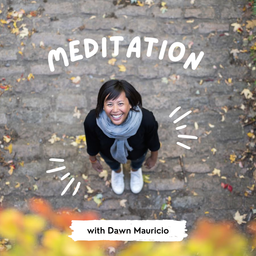
Insight helps us see. Practice helps us change.
I’m a Buddhist meditation teacher and Somatic Experiencing Practitioner sharing weekly guided meditations to support clarity, choice, and embodied change. While mindfulness may help us see more clearly, it’s consistent practice that builds the capacity to respond—especially in moments of overwhelm, grief, and uncertainty.
Follow for meditations from 5 to 30 minutes, including mindfulness of the body, open awareness, and practices for meeting life as it is.
Learn more at dawnmauricio.com.
dawnmauricio.substack.com (https://dawnmauricio.substack.com?utm_medium=podcast)
In this short practice, you’re invited to check in with what your body, heart, and mind actually need in order to settle, which could be a change from “just doing what you usually do.” This is not meant to be a practice of guilty indulgence but a training in discerning what would create less suffering. Even though, in practice, choosing less suffering is centered on you in the short term, this can be ripe training for seeing, discerning, and choosing less suffering for yourself and others, now and in the future.
This meditation was guided in the Everyday Dhamma Community (https://dawnmauricio.com/membership) monthly meetup.
-----
Practice Reflection
The Buddhist teaching of Right Action (sammā-kammanta) is a teaching that invites us into understanding cause and effect clearly enough to choose what can reduce suffering. In meditation, this looks like noticing what actually helps you settle versus what you think should help. In daily life, it’s the same—the conversation you’d rather avoid but that actually resolves something, the rest you take instead of pushing through exhaustion, the boundary you set that has been long overdue.
Learning to discern what supports you teaches you to recognize what supports others, too. You can’t offer what you don’t know how to receive. By training yourself to notice what creates ease and less suffering in your own system, you slowly develop the sensitivity to see it in others.
-----
🗓️ explore ways to deepen your practice and study here (https://dawnmauricio.com/events)🫶🏽 deepen our connection and become a member here (https://dawnmauricio.com/membership)🌱 join somatic experiencing™ for qt/bipoc waitlist here (https://dawnmauricio.com/waitlist)💌 receive a monthly letter in your inbox here (https://dawnmauricio.myflodesk.com/newsletter)
This is a public episode. If you would like to discuss this with other subscribers or get access to bonus episodes, visit dawnmauricio.substack.com (https://dawnmauricio.substack.com?utm_medium=podcast&utm_campaign=CTA_1)
7 Oct 2026
Getting curious
In this meditation, you’re invited to notice what’s here through the felt sense—the somatic doorway. How does whatever you feel feel in the body? Where does it land? How does it shift? Rather than naming the experience and moving on, you’re getting curious about its texture, its movement, and how it shifts and evolves.
This meditation was guided in the Everyday Dhamma Community (https://dawnmauricio.com/membership) monthly meetup.
-----
Practice Reflection
We can easily move through an experience quickly and call it mindfulness—feeling something arise and immediately naming it: anxiety, joy, frustration. I certainly did this for years when I started meditating, thinking I was doing a “good job” at being mindful and “being with” my experience. In hindsight, quickly naming something and moving on was more akin to whack-a- mole than anything else.
As my practice has taught me to slow down over the years, I’ve realize that the naming lets us off the hook. We think we understand what’s happening but naming is just the mind’s shorthand. I wasn’t giving myself time to truly be with and understand whatever I was experiencing. The practice of getting curious about the felt sense marks the difference between truly understanding your experience vs. conceptually knowing it.
From there, deep insights can arise. When you stay with that tingling in your chest instead of just calling it nervousness, you learn in a deep way that it’s not solid; it moves and shifts, showing you anicca or impermanence. With time and repetition, you can also begin to see how, when the storylines and characters fall away, the specificity of the nuance and complexity you’re experiencing is a doorway into the universal, connecting you with all sentient beings.
-----
🗓️ explore ways to deepen your practice and study here (https://dawnmauricio.com/events)🫶🏽 deepen our connection and become a member here (https://dawnmauricio.com/membership)🌱 join somatic experiencing™ for qt/bipoc waitlist here (https://dawnmauricio.com/waitlist)💌 receive a monthly letter in your inbox here (https://dawnmauricio.myflodesk.com/newsletter)
This is a public episode. If you would like to discuss this with other subscribers or get access to bonus episodes, visit dawnmauricio.substack.com (https://dawnmauricio.substack.com?utm_medium=podcast&utm_campaign=CTA_1)
30 Sept 2026
Meeting Yourself As You Are
We are complex beings made up of different parts—a wise and intuitive part, a fragile and wounded part, an impatient one. And depending on changing conditions like whether we've slept or eaten well, or feel activated, any one of these could be driving the show. And they all belong.
In this meditation, you’re invited to notice which part feels most prominent in this moment and to meet it with tenderness.
This meditation was guided in the Everyday Dhamma Community (https://dawnmauricio.com/membership) monthly meetup.
Practice Reflection
When I started meditating over 20 years ago, I unintentionally brought the part of myself that was a perfectionist and my own worst critic to my practice, so much so that my practice became another place to measure my self worth.
It took me more than a decade and a lot of loving-kindness (mettā) and tenderness practice (and therapy) to shift that tendency that once felt oh! so! permanent! I didn’t end up converting the harsh critic to a loving part, though. The harsh critic ended up getting folded into the unconditional love of mettā where she didn’t need to love me back to belong.
All this to say, your fragile and wounded part isn't broken and your impatient part isn't bad. They show up from time to time because of causes and conditions, and they all belong.
In daily life, practicing with this can look like both offering yourself patience for your own resistance and contradictions, and seeing others in their actions through the same lens.
🗓️ explore ways to deepen your practice and study here (https://dawnmauricio.com/events)
🫶🏽 deepen our connection and become a member here (https://dawnmauricio.com/membership)
💌 receive a monthly letter in your inbox here (https://dawnmauricio.myflodesk.com/newsletter)
This is a public episode. If you would like to discuss this with other subscribers or get access to bonus episodes, visit dawnmauricio.substack.com (https://dawnmauricio.substack.com?utm_medium=podcast&utm_campaign=CTA_1)
Reach and audience
Public platform figures. Ratings count people who left a rating, not total listeners.
Apple Podcasts (US)
5.0 / 5
20 ratings
Contact Mindfulness Meditation with Dawn Mauricio
Guest appearances
Does not typically book guests
Based on episode analysis; this does not confirm that the show is currently accepting guests.
Host of Mindfulness Meditation with Dawn Mauricio?
Claim your podcast to manage its listing and keep your show details accurate.
Pod Engine is an independent podcast discovery and analytics service and is not affiliated with or endorsed by this podcast. Artwork and show content belong to their owners. Full legal notice.
Explore this show Podcast research with Pod Engine