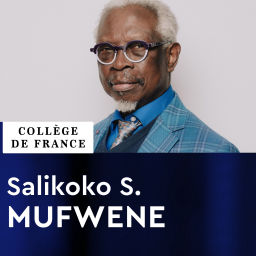
Mondes francophones (2023-2024) - Salikoko S. Mufwene
Claim This Podcastby Collège de France
Podcast Overview
<p>Présentation de la chaire</p><p></p><p>La chaire annuelle Mondes francophones a été créée en partenariat avec l'Agence Universitaire de la Francophonie.</p><p></p><p>Dynamiques langagières dans l'univers francophone</p><p></p><p>L'histoire humaine est marquée par une succession de migrations, de colonisations, et de contacts de langues suivis parfois de l'extinction de certaines d'entre elles et de l'émergence de nouveaux parlers. Les créoles illustrent ce dernier phénomène et nous invitent à réexaminer d'une perspective uniformitaire l'étude traditionnelle de la spéciation langagière.</p>
Language
🇫🇷
Publishing Since
3/28/2024
1 verified contact email on file for Mondes francophones (2023-2024) - Salikoko S. Mufwene
Pitch yourself as a guest, propose sponsorships, or reach out directly to the host.
Recent Episodes

June 7, 2024
Colloque - L'émergence des parlers et des cultures créoles : syncrétismes et hybridations : Clôture
<p>Salikoko S. Mufwene</p><p>Mondes francophones (2023-2024)</p><p>Collège de France</p><p>Année 2023-2024</p><p></p><p>Colloque - L'émergence des parlers et des cultures créoles : syncrétismes et hybridations : Clôture</p><p></p><p>Intervenant(s)</p><p></p><p>Salikoko S. Mufwene</p><p>Université de Chicago, professeur invité du Collège de France</p>

June 7, 2024
Colloque - Michel DeGraff : "Hybridity" and Scientific Racism in Suzanne Comhaire-Sylvain's Le créole haïtien… — The First PhD Dissertation by a Haitian Linguist and on Haitian Creole
<p>Salikoko S. Mufwene</p><p>Mondes francophones (2023-2024)</p><p>Collège de France</p><p>Année 2023-2024</p><p></p><p>Colloque - Michel DeGraff : "Hybridity" and Scientific Racism in Suzanne Comhaire-Sylvain's Le créole haïtien… — The First PhD Dissertation by a Haitian Linguist and on Haitian Creole</p><p></p><p>Intervenant(s)</p><p></p><p>Michel DeGraff</p><p>Professor, Massachusetts Institute of Technology</p><p></p><p>Résumé</p><p></p><p>Published in 1936, Le créole haïtien: Morphologie et syntaxe is the first research monograph on Haitian Creole (Kreyòl) by a professional Haitian linguist. As far as I know, it's also the first publication that explicitly stated a specific version of "Hybridity" in the formation of Kreyòl. This sort of Hybridity has come to be known as the (now disconfirmed) "Relexification Hypothesis" whereby Kreyòl is: </p><p></p><p>… a form of French fashioned in the mold of African syntax, or, since we generally classify languages based on the history of their grammar, Haitian Creole (Kreyòl) is an African (Ewe) language with a French vocabulary.</p><p></p><p>This talk is an exercise in intellectual history and critical race theory to try and understand the historically and geo-politically rooted biases in the deep contradictions between Sylvain's theoretical claims, on the one hand, and, on the other hand, her detailed comparative data triangulating Kreyòl, French and Ewe toward a thorough documentation of systematic parallels, at the levels of morphology, lexicon and syntax, among all three languages. We will analyze certain discursive links between language, linguistics, identity, decolonization and liberation through the prism of the formidable intellectual biography of Comhaire-Sylvain – Haiti's first linguist and anthropologist and the first Haitian woman to obtain a PhD, back in 1936. Comhaire-Sylvain's contributions can help us forge a better future ahead – for Creole studies, Creole speakers and more.</p><p></p><p>Michel DeGraff</p><p></p><p>Michel DeGraff is Professor of Linguistics at MIT, co-founder and co-director of the MIT-Haiti Initiative, founding member of Akademi Kreyòl Ayisyen and fellow of the Linguistic Society of America. Michel entered linguistics through the "backdoor" so to speak, in 1985, as a Summer Intern at AT&T Bell Laboratories' Linguistics and Artificial Intelligence department in Murray Hill, New Jersey. Michel obtained his PhD in 1992 with a dissertation on the syntax of Haitian Creole. Today, Michel's research contributes to an egalitarian approach to Creole, Indigenous and other non-colonial languages and their speakers, as in his native Haiti. In addition to linguistics and education, his writings engage intellectual history and critical race theory, especially the links between power-knowledge hierarchies and the hegemonic (mis)representations of non-colonial languages and their speakers in the Global South and beyond. His work is anchored in a broader agenda for human rights and social justice, with Haiti as one spectacular case of a post-colony where the national language spoken by all (Haitian Creole) is systematically disenfranchised, even in certain scholarly traditions, while the (former) colonial language (in this case, French), spoken by few in Haiti, is enlisted for socio-economic, political and geo-political domination.</p>

June 7, 2024
Colloque - Ananya Jahanara Kabir : Creolisation across the Connected Oceans: An Archipelagic Key
<p>Salikoko S. Mufwene</p><p>Mondes francophones (2023-2024)</p><p>Collège de France</p><p>Année 2023-2024</p><p></p><p>Colloque - Ananya Jahanara Kabir : Creolisation across the Connected Oceans: An Archipelagic Key</p><p></p><p>Intervenant(s)</p><p></p><p>Ananya Jahanara Kabir</p><p>Professor of English Literature, King's College London</p><p></p><p>Résumé</p><p></p><p>Maman ma trouvé klé-la/ klé-la pou ouvé pot-la/ pot-la si lakarayib. Dans la chanson « Kavalyé o Dan' » de Kassav', qui réutilise les appels rassemblant les individus pour danser le quadrille, la clé pour comprendre la Caraïbe est le quadrille lui-même dans sa forme créolisée. Le quadrille créolisé est aussi une clé qui connecte l'océan Indien avec l'Atlantique où des versions de cette danse ont prospéré et y sont encore chéries en tant que patrimoine. Le quadrille créole transocéanique illustre comment le processus de créolisation s'est déroulé dans des endroits vastement différents en réponse à l'expansionnisme européen et aux différentes impulsions locales. Les résultats de la créolisation à travers les océans connectés manifestent ainsi à la fois des variations et une constance, des polysémies et une reconnaissabilité structurelle. À travers une approche archipélagique, je propose une réévaluation des caractéristiques de ces produits culturels créolisés, qui nous aide à comprendre leurs valeurs pour nos études de l'histoire, de la théorie et du patrimoine durable. </p><p></p><p>Ananya Jahanara Kabir</p><p></p><p>Ananya Jahanara Kabir FBA is Professor of English Literature at King's College London and Fellow of the British Academy. Her research spans creolisation across the Atlantic and Indian Ocean worlds, critical philology, and the relationship between literary texts, embodied cultural expression, and memory work. The author of Paradise, Death and Doomsday in Anglo-Saxon Literature (2002), Territory of Desire: Representing the Valley of Kashmir (2009) and Partition's Post-Amnesias: 1947, 1971, and Modern South Asia (2013), she has been awarded India's Infosys Prize in the Humanities and Germany's Humboldt Research Prize. She is writing the book, Alegropolitics: Creolising Connection on the AfroModern Dance Floor, arising from her ERC Advanced Grant-funded project 'Modern Moves' (2013-2018). In 2024, she is Faculty Fellow at the Global Cultures Institute, King's College London, where she is developing her project, 'Fort Creole: Transcolonial Enclaves and Archipelagic Memory across the Atlantic and Indian Ocean Worlds'.</p>
26 total episodes available
Deep-dive analytics for Mondes francophones (2023-2024) - Salikoko S. Mufwene
Frequently asked questions
Have a different question and can't find the answer you're looking for? Reach out to our support team by sending us an email and we'll get back to you as soon as we can.
- What is Mondes francophones (2023-2024) - Salikoko S. Mufwene?
<p>Présentation de la chaire</p><p></p><p>La chaire annuelle Mondes francophones a été créée en partenariat avec l'Agence Universitaire de la Francophonie.</p><p></p><p>Dynamiques langagières dans l'univers francophone</p><p></p><p>L'histoire humaine est marquée par une succession de migrations, de colonisations, et de contacts de langues suivis parfois de l'extinction de certaines d'entre elles et de l'émergence de nouveaux parlers. Les créoles illustrent ce dernier phénomène et nous invitent à réexaminer d'une perspective uniformitaire l'étude traditionnelle de la spéciation langagière.</p> - How often does this podcast release new episodes?
This podcast updates weekly.
- Where can I listen to this podcast?
This podcast is available on 7 platforms including Apple Podcasts, Spotify, and more. You can also use the RSS feed directly.
- Does this podcast accept guests?
Yes, this podcast regularly features guests.
Legal Disclaimer
Pod Engine is not affiliated with, endorsed by, or officially connected with any of the podcasts displayed on this platform. We operate independently as a podcast discovery and analytics service.
All podcast artwork, thumbnails, and content displayed on this page are the property of their respective owners and are protected by applicable copyright laws. This includes, but is not limited to, podcast cover art, episode artwork, show descriptions, episode titles, transcripts, audio snippets, and any other content originating from the podcast creators or their licensors.
We display this content under fair use principles and/or implied license for the purpose of podcast discovery, information, and commentary. We make no claim of ownership over any podcast content, artwork, or related materials shown on this platform. All trademarks, service marks, and trade names are the property of their respective owners.
While we strive to ensure all content usage is properly authorized, if you are a rights holder and believe your content is being used inappropriately or without proper authorization, please contact us immediately at hey@podengine.ai for prompt review and appropriate action, which may include content removal or proper attribution.
By accessing and using this platform, you acknowledge and agree to respect all applicable copyright laws and intellectual property rights of content owners. Any unauthorized reproduction, distribution, or commercial use of the content displayed on this platform is strictly prohibited.
