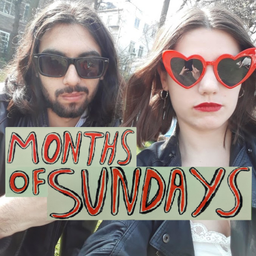
The show bringing you political commentary on entertainment media from the perpetual Sunday of suburban ennui. Hosted by Livvy Sutherland and Ruben Traynor.
Shows every other Sunday.
Chasing Bleak Highs: Postmodernism to Nihilism in Heathers (1989) and Point Break (1991)
'This'll be the kind of thing to infect a generation! It'll be a Woodstock for the 80s!' / 'If you want the ultimate, you've got to be willing to pay the ultimate price. It's not tragic to die doing what you love.'
What have a classic high school satire and a camp action film got in common? Sex and death, of course! We explore late 80s /early 90s ennui as the breeding ground of films that both examine and encapsulate postmodernist depthlessness, chasing the only high left at the end of history: the end of life. In Heathers, would-be school-shooters seek stimulation in callous suburbia, while Point Break positions the endless chasing of the next wave as a hedonistic alternative to the dull bureaucracy of a hollowed-out state. But thrill-seeking is a pastime with an expiration date...
16 May 2021
Freudian Dreams to Postmodernist Nightmares: the Nightmare On Elm Street franchise (1984-94)
'It's only a dream!'
A Nightmare on Elm Street, and its iconic villain Freddy Kruger, has been a cultural staple since Wes Craven's original film in 1984. Since then, there have been six more films in the decade-long series, all the way up to the postmodern malaise of 1994. From the Freudian modernism of the 80s films, through the carbon-copy unoriginality in the middle of the series, up to the postmodern reflexivity of the last two films, the films trace a familiar pattern, and one which charts wider cultural shifts around this time. We ask how the first two films defy gender expectations and subvert already familiar slasher tropes. We delve into how these films represent dreams, and how far they can be understood as relating to Freud's Interpretation of Dreams. Is Freddy a phantom of the death drive, or a paradoxical creature of wish fulfilment? Finally, we analyse the nineties films' self-awareness, and what this means for our own dreams, desires and, indeed, nightmares.
2 May 2021
Emotional Affect and the Hyperreal: Nathan For You and 'Hidden' Camera Comedy
'You're filming something. That's kind of the purpose, right?'
From the dizzy heights of Borat (2006) and Jackass (2002), to the pandemic-inflected How to With John Wilson (2020), Bad Trip (2020) and slightly disappointing Borat 2 (2020), the twenty-first-century can't get enough of comedy that blends reality and the scripted. Perhaps the most successful of these productions is Nathan For You (2013-17), the show where Nathan Fielder uses his 'knowledge to help struggling small business owners make it in this competitive world', blending cringe-comedy and reality TV to create a light-hearted but prickly satire on American business and media culture. But with its final episode, 'Finding Frances' (2017), Nathan For You pulls us into a newly touching realm, where the line between construction and reality is thinner than ever. How does our fixation with the authentic reflect on our culture of constant performance, where social media makes us all into hidden-camera comedians? Is a 'New Sincerity' possible, in film as in literature, as the culmination of artifice? And if something moves us, perhaps even moves us to change our world, does its authenticity matter?
4 Apr 2021
Zombified Desire: on consuming and being consumed in Dawn of the Dead (1978 and 2004)
'They're after the place. They don't know why, they just remember. Remember that they want to be in here. They're us, that's all, when there's no more room in hell.'
What happens when our desires become zombies of themselves? In George Romero's Dawn of the Dead, the libidinal urge to consume and accrue play out in a radically altered landscape, in which capitalist modes of meaning-making have lost their value. We discuss how Romero subverts the traditional fantasy of the zombie film, of the apocalypse as a libertarian playground for a few individual survivors, by transforming consumers into the consumed. We imagine how the survivor of a zombie apocalypse, under siege in a mall, reflects the middle-class experience of lockdown listlessness, where individuals entrapped but surrounded by material comforts access the outside world exclusively through an increasingly surreal media. And finally, we consider how a more considered remake than Zach Snyder's 2004 film might have used a virtual landscape, rather than a physical one, as the playground of the posthumous desires of the twenty-first century...
21 Mar 2021
'Reality is not what it used to be': Lovecraftian Landscapes in In The Mouth of Madness (1994) and The Color Out of Space (2019)
'God's not supposed to be a hack horror writer'
We compare John Carpenter's metafictional Lovecraft homage In the Mouth of Madness with Richard Stanley's more recent The Color Out of Space. Why does Carpenter's film succeed where Stanley's fails in creating a truly Lovecraftian sense of horror, despite the latter's textual faithfulness? What makes Lovecraft the quintessential author of the 'weird'? And what are the political ramifications of a retreat into fiction, especially in our digital age?
28 Feb 2021
'I've taken off my person suit': Hannibal Lecter and A Very American Displacement
'I find the trout to be a very Nietzschean fish'
As brilliant as it is bizarre, Bryan Fuller's 'Hannibal' (2013-15) is a psychiatrist's dream, chock-a-block with displacements: psychological, sexual, social, tonal, structural and bodily. How does Hannibal use cannibalisation to evoke the anxiety of de-individualisation in the similitude of corporate America? How has it borrowed from its precursors, Manhunter (1986) and Silence of the Lambs (1991), to flirt with censorship and create subplots into which the queer subtext of the main plot is camply displaced? And what happens when a police procedural takes off its person suit, and becomes something else entirely?
31 Jan 2021
'The Immaterial Has Become... Immaterial': Pirates of the Caribbean and Hope in Hopeless Causes
'The world used to be a bigger place.' / 'World's still the same. There's just less in it.'
This episode, we plot our coordinates and set our course for the rosy mists of childhood, taking on the original 'Pirates of the Caribbean' trilogy. Captain Jack Sparrow is constantly dancing before the inevitability of fate, outliving the ephemeral freedoms of the doomed pirate era, as the centre of empire clamps down on the opportunistic flourishings of the periphery. We might find an appealing analogue in this late flourishing of commercial cinema, soon to be extinguished by remakes and marvel movies. Join us to discuss piracy as a vanishing mediator of modern capitalism, the culture war 'at world's end', and how things might be less 'business' than 'personal' after all...
4 Jan 2021
Performed 'Selves' in the Era of Digital Capitalism: Holy Motors (2012) and Possessor (2020)
'I miss the cameras. They used to be heavier than us. Then they became smaller than our heads. Now you can't see them at all.'
We discuss one of our favourites of 2020: Brandon Cronenberg's sci-fi horror film Possessor, in comparison with Leos Carax's rightly-lauded Holy Motors . As they unfold, both films reveal themselves to be concerned with the blurring of selfhood and performance. We ask how these films relate to our corporatized world of global mass surveillance and how much agency we have within this scheme, when our bodies seem to be fated by unseen corporate entities. And ultimately, we must ask: who is this performance for?
6 Dec 2020
The Family Film at the End of History: Gremlins, The Addams Family and Scoob!
Whatever happened to films like Gremlins 2? If the 1990s was a high-point of Western cultural hedonism, apathy and affluence, then it was also the perfect breeding-ground for camp fun for all the family, before such commercial film-making tipped over into the homogenised hits of the 2000s Marvel movie. In fact, in an era in which the Left had been so thoroughly quashed as to no longer be threatening in Hollywood, the very silliness of these rude romps permits them both sparkling moments of innovation, and anti-capitalist satire.
20 Sept 2020
The Destruction of Time: Tenet (2020), Anachronism and Netflix
In this episode, we do a deep dive into Netflix shows like Sex Education, Sabrina, Umbrella Academy and Stranger Things and their disturbing tendency towards uncritical nostalgia. Where does this nostalgia come from? Why is it so prevalent, especially on a platform like Netflix which has a tendency towards algorithmically designed TV? And why does modern TV not want to historicise itself? We then move on to discuss how this trend may be exemplified in modern depictions of the Cold War, specifically the uneasy allure of time's ultimate destruction in Tenet (2020) and The House With a Clock in its Walls (2018).
6 Sept 2020
Sex Work, Kitsch and [dis] Empowerment: Gigi (1944 and 1958) and Showgirls (1995)
We compare Minnelli's classic MGM musical Gigi and Verhoeven's derided melodrama Showgirls. Despite their seemingly disparate traditions, a decadent fin-de-siecle set-piece and a satire of the 90s zeitgeist share a dirty dressing room in their taste for the hammy, the spectacular and the uneasily exploitative. But when does absurdity veer into skilful pastiche? What does Colette's novella Gigi tell us about the film's [mis]reading? And can these films' portrayal of commodified sexuality give us any insight into the performance of sex in the internet’s phantasmagorical arena?
23 Aug 2020
'The present is harder to find': Cosmopolis by Don DeLillo (2003) and David Cronenberg (2012)
This episode, we delve into Don DeLillo's spiky satire of information capitalism and David Cronenberg's much-misunderstood adaptation. Has the future become a dully knowable property, endlessly foreseen on the passive screens of our spectacular society? Or can tomorrow still turn round to kick us in the teeth? Taking in twenty years of New York, from 9/11, to Occupy Wall Street, to popularism and pandemics, this episode asks the question: what does it mean to be ‘contemporary’?
26 Jul 2020
The Political Compass of Buffy the Vampire Slayer (1997-2003)
We dissect the politics of cult classic, Buffy, and its spin-off, Angel. Is Buffy individualist or collectivist? Libertarian or authoritarian? And what does its spectacularly camp aesthetic suggest about its ideological alignment? In a double-length bumper episode, we hope to bring you some of the magic of one of the most formally radical TV shows of all time, with a nod and wink to some potential political radicalism along the way.
12 Jul 2020
Gender, Revenge and Sexual Assault: Ms. 45 (1981) and Elle (2016)
In this episode, we discuss two women protagonists, both of whom undergo sexual assault and take revenge - creating two very different films. Are these exploitation movies? Is the stylised more truthful than the realist? And can women's stories, told by male directors, ever move beyond misogynistic ventriloquism?
This episode contains sustained discussion of depictions of sexual assault.
21 Jun 2020
The Class Dynamics of Joseph Losey: The Servant (1963) and Mr. Klein (1976)
We discuss the films of Hollywood exile and Pinter collaborator Joseph Losey (focusing on The Servant, Accident, and Mr. Klein).
19 May 2020
Free Will? Devs (2020) and Determinism
This week, we discuss the potential for political agency in a seemingly over-determined world, in the context of new SF TV show Devs. Materially circumscribed and confined to our houses during lockdown, is there a way of escaping the tracks laid out for us?
3 May 2020
Home Invasion: Ready or Not (2019) and Knives Out (2019)
We discuss the political co-ordinates of the home invasion movie in the context of the quarantined home and look at how two recent films have subverted the conventions of the genre from a left-wing political perspective
26 Apr 2020
Safe (1995), Children of Men (2006) and Viral Paranoia
This was our first episode, so it's not as well produced/a bit ramble-y: enjoy!
We discuss the eerie relevancy of Todd Haynes's Safe, and what it tells us about the current global state through the work of Mark Fisher, among others. We also look to Alfonso Cuaron's Children of Men.
Reach and audience
Public platform figures. Ratings count people who left a rating, not total listeners.
Spotify
5.0 / 5
1 ratings
Contact Months Of Sundays
Guest appearances
Does not typically book guests
Based on episode analysis; this does not confirm that the show is currently accepting guests.
Host of Months Of Sundays?
Claim your podcast to manage its listing and keep your show details accurate.
Pod Engine is an independent podcast discovery and analytics service and is not affiliated with or endorsed by this podcast. Artwork and show content belong to their owners. Full legal notice.
Explore this show Podcast research with Pod Engine