Discussions around tools and discoveries in the novel domain of multi-messenger and time domain astrophysics. We'll highlight recent publications, discuss tools to faciliate observations and generally talk about the cool science behind the most violent explosions in the universe.
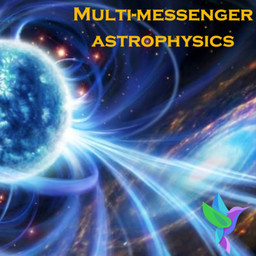
Multi-messenger astrophysics
Claim This Podcastby Astro-COLIBRI
5.0(2 reviews)
109 episodes
Updated Daily
Accepts GuestsHas SponsorsLocation 🇫🇷
49
Podcast Authority
BetaFairBased on show quality, social media presence, reviews, charts, and more

Quality55
Social0
YouTube74
Engagement32
Podcast Overview
Discussions around tools and discoveries in the novel domain of multi-messenger and time domain astrophysics. We'll highlight recent publications, discuss tools to faciliate observations and generally talk about the cool science behind the most violent explosions in the universe.
Language
🇺🇲
Publishing Since
10/6/2024
Unlock The Full Podcast Authority Score Report
See how your podcast performs across key metrics
49
Podcast Authority
BetaFairBased on show quality, social media presence, reviews, charts, and more
Quality55
Social0
YouTube74
Engagement32
7
Excellent Areas
1
Good Performance
11
Growth Opportunities
excellent
Publishing Consistency
Every 6 days
Performing excellently!
good
Show Experience
56 episodes over 0.9 years
Recommendations available
Unlock the full report to see detailed tips
poor
Episode Thumbnails
Recommendations available
Unlock the full report to see detailed tips
+16 More Metrics
Unlock comprehensive insights including:
- • YouTube presence analysis
- • Social media reach metrics
- • RSS compliance scoring
- • Podcast 2.0 features
- • Technical standards
What's Included in Your Full Report
Detailed Analytics
- Complete breakdown of all 19 authority metrics
- Personalized recommendations for each metric
- Industry benchmarks and comparisons
- Technical RSS feed analysis and compliance scoring
Growth Strategies
- Step-by-step action plans for improvement
- Quick wins to boost your score immediately
- Pro tips from successful podcasters
Get your free podcast insights report
See how your show performs across every key metric
Instant delivery
No spam
Attract Better Guests
High authority scores make your podcast more attractive to industry leaders and influencers who want to appear on credible shows.
Secure Sponsorships
Sponsors look for podcasts with proven authority and engagement. Your score demonstrates your podcast's value to potential partners.
Grow Your Audience
Understanding your strengths and weaknesses helps you make data-driven decisions to expand your listener base effectively.
Reach the team behind Multi-messenger astrophysics
Verified contact details for this show aren't on file yet — sign up to get notified when they land.
Recent Episodes
July 13, 2026
The Dynamic Radio Sky: Unveiling Transients with the SKAO
<p>Welcome to a deep dive into the fast-paced, explosive universe of time-domain astronomy! In this episode, we explore how the upcoming Square Kilometre Array Observatory (SKAO) will revolutionize our understanding of astrophysical transients. Operating across a massive discovery space—from coherent radio bursts lasting just microseconds to the decades-long afterglows of cosmic collisions—radio transients serve as natural laboratories for fundamental physics. We discuss the diverse menagerie of extreme events SKAO will uncover and how new automated technologies will capture the universe in action.</p><p><br></p><p>Key Topics Discussed:</p><ul><li>Fast Radio Bursts (FRBs) & Long-Period Transients (LPTs): We explore the extremes of coherent radio emission. Discover how SKAO will track millisecond-duration extragalactic FRBs across broad frequency ranges and unveil the nature of a newly discovered class of sources—Long-Period Transients (LPTs)—which emit periodic radio bursts lasting minutes to hours and may be powered by highly-magnetized white dwarf binaries or magnetars. </li><li>The Multi-Messenger Era: We unpack the synergies between SKAO and next-generation multi-messenger observatories. Learn how SKAO will hunt for the radio afterglows of binary neutron star mergers detected by 3G gravitational wave detectors, and how it will survey the localization fields of high-energy neutrinos detected by IceCube and KM3NeT to find their elusive point sources.</li><li>Gamma-Ray Synergies with CTAO: A look at how SKAO will collaborate with the upcoming Cherenkov Telescope Array Observatory (CTAO). By combining radio and very-high-energy gamma-ray data, astronomers will probe particle acceleration and shocks in extreme environments, including supernovae, X-ray binaries, novae, and tidal disruption events (TDEs).</li><li>Rapid-Response Triggering & Commensal Surveys: How do you catch a flash you didn't know was coming? We delve into the cutting-edge operational modes of the SKAO, including "rapid-response" systems that will automatically repoint the telescope in seconds based on automated alerts (like VOEvents). We also cover "commensal" transient pipelines, which hitch a ride on other dedicated observations to continuously search for unexpected transients in the image plane without requiring extra telescope time. </li></ul><p><br></p><p>References (Chapters in Advancing Astrophysics with the SKA – II):</p><ul><li>Anderson, G. E., et al. Rapid Response Triggering for Radio Transients with the SKA Observatory.</li><li>Andersson, A., et al. Commensal image plane transient search methods with the SKAO.</li><li>Caleb, M., Qiu, H., et al. Long-Period Transients as a new frontier in time-domain astronomy.</li><li>Castignani, G., Rowell, G., et al. SKAO and Gamma-Ray Synergies.</li><li>Colombo, A., et al. Gamma-ray Bursts and Kilonovae from Gravitational Wave Events.</li><li>Curtin, A. P., et al. The Astrophysics of Fast Radio Bursts.</li><li>Miller-Jones, J. C. A., et al. Unveiling Radio Transients with SKAO Telescopes.</li><li>Rösch, F., et al. A Census of Variable and Transient Radio Sources Within High-Energy Neutrino Fields.</li></ul><p><br></p><p>Acknowledements: Podcast prepared with Google/NotebookLM. Illustration credits: SKAO</p>
July 8, 2026
X-Raying the Earth: Neutrino Tomography at the South Pole
<p>Welcome back to the podcast! Today, we are exploring a groundbreaking new way scientists are looking deep inside our planet. For a century, our understanding of the Earth's interior has relied almost entirely on seismic waves and gravity. But what if we could use cosmic "ghost particles" to scan the Earth instead? </p><p><br></p><p>In this episode, we dive into a fascinating new study from the IceCube Neutrino Observatory located deep in the glacial ice at the South Pole. Using 10.7 years of data, scientists have successfully mapped the Earth's radial density profile using high-energy muon neutrinos. We discuss how these neutrinos, which usually pass right through matter undetected, become partially blocked by the Earth at extremely high energies (above ~10 TeV). By measuring how these particles are absorbed as they travel through different layers of the planet at different angles, researchers can essentially take a tomographic scan of the Earth's interior using the weak nuclear force. </p><p><br></p><p>Tune in to hear how this cutting-edge method has been used to independently calculate the Earth's mass and polar moment of inertia, yielding results that are completely consistent with traditional seismology and the Preliminary Reference Earth Model (PREM). We also discuss what this means for the future of planetary science and how next-generation neutrino telescopes will bring even sharper resolution to the hidden layers beneath our feet.</p><p><br></p><p>Reference mentioned in this episode: Abbasi, R., et al. (IceCube Collaboration). "High-Energy Neutrino Tomography of the Earth’s Interior with IceCube." arXiv:2607.02644v1 (July 2026).</p><p><br></p><p>Acknowledements: Podcast prepared with Google/NotebookLM. Illustration credits: IceCube Collaboration</p>
July 6, 2026
SVOM's First Year: From Gamma-Ray Bursts to Blazars
<p>In this episode, we dive into the exciting early results from the SVOM (Space-based multi-band astronomical Variable Objects Monitor) mission, which launched in June 2024. Originally designed to hunt for Gamma-Ray Bursts (GRBs), SVOM has proven to be a highly versatile powerhouse for all kinds of high-energy transient phenomena. We discuss its first batch of discoveries, from ancient stellar explosions at the edge of the universe to the serendipitous detections of black holes, flaring stars, and active galaxies!</p><p><br></p><p>Key Topics Discussed:</p><ul><li>The Hunt for GRBs: We look at how SVOM successfully detected 86 GRBs in its first 9.3 months. We explore how its ECLAIRs and Gamma-Ray Monitor (GRM) instruments work together to capture everything from classical long GRBs to soft X-ray flashes and short GRBs tied to neutron star mergers. </li><li>Probing the Distant Universe: A special spotlight on GRB250314A, a massive star explosion detected at a redshift of roughly 7.3. This incredible detection allows astronomers to peer back into the universe's epoch of reionization.</li><li>The Observatory Science Program: We explore SVOM's secondary objective, which focuses on tracking non-GRB events. This program has already yielded hundreds of detections, primarily consisting of low-mass and high-mass X-ray binaries.</li><li>Serendipitous Discoveries: Hear about SVOM's fascinating unexpected catches, like an X-ray outburst from the blazar 1ES 1959+650, burst oscillations from the neutron star binary 4U 0614+091, and even hard X-ray stellar flares from the binary star system HD 22468.</li><li>Multi-Wavelength Synergy: We discuss how SVOM's onboard suite of instruments—which include wide-field coded-mask imagers and narrow-field X-ray and visible telescopes—work together. We also touch on how SVOM collaborates with other observatories like Swift and Einstein Probe to provide a rapid, comprehensive view of the high-energy sky.</li></ul><p><br></p><p>References / Mentioned Articles:</p><ul><li>Daigne, F., et al. (2026). First Gamma-Ray Burst Observations with SVOM. Research in Astronomy and Astrophysics. </li><li>Coleiro, A., et al. (2026). Early results from the SVOM Observatory Science program. Research in Astronomy and Astrophysics.</li></ul><p>Acknowledements: Podcast prepared with Google/NotebookLM. Illustration credits: CNES</p>
109 total episodes available
Similar Podcasts
Discover related shows you might enjoy
The Astrophysics Podcast
Paul Duffell

EVSN: Escape Velocity Space News
Dr. Pamela Gay, Erik Madaus, Ally Pelphrey

Astronomy Daily - The Podcast
bitesz.com

The Supermassive Podcast
The Royal Astronomical Society

Universe Today Podcast
Fraser Cain

SpaceTime with Stuart Gary
Stuart Gary

Space Nuts
Professor Fred Watson and Andrew Dunkley

Physics World Weekly Podcast
Physics World

Sleep Space from Astrum
Astrum

Ask a Spaceman!
Paul M. Sutter

Planetary Radio: Space Exploration, Astronomy and Science
The Planetary Society

Daniel and Jorge Explain the Universe
iHeartPodcasts

Quanta Science Podcast
Quanta Magazine

This Week in Space (Audio)
TWiT

Are We There Yet?
Central Florida Public Media
Deep-dive analytics for Multi-messenger astrophysics
Frequently asked questions
Have a different question and can't find the answer you're looking for? Reach out to our support team by sending us an email and we'll get back to you as soon as we can.
- What is Multi-messenger astrophysics?
- How often does this podcast release new episodes?
This podcast updates daily.
- Where can I listen to this podcast?
This podcast is available on 4 platforms including Apple Podcasts, Spotify, and more. You can also use the RSS feed directly.
- Does this podcast accept guests?
Information about guest appearances is not available.
Legal Disclaimer
Pod Engine is not affiliated with, endorsed by, or officially connected with any of the podcasts displayed on this platform. We operate independently as a podcast discovery and analytics service.
All podcast artwork, thumbnails, and content displayed on this page are the property of their respective owners and are protected by applicable copyright laws. This includes, but is not limited to, podcast cover art, episode artwork, show descriptions, episode titles, transcripts, audio snippets, and any other content originating from the podcast creators or their licensors.
We display this content under fair use principles and/or implied license for the purpose of podcast discovery, information, and commentary. We make no claim of ownership over any podcast content, artwork, or related materials shown on this platform. All trademarks, service marks, and trade names are the property of their respective owners.
While we strive to ensure all content usage is properly authorized, if you are a rights holder and believe your content is being used inappropriately or without proper authorization, please contact us immediately at hey@podengine.ai for prompt review and appropriate action, which may include content removal or proper attribution.
By accessing and using this platform, you acknowledge and agree to respect all applicable copyright laws and intellectual property rights of content owners. Any unauthorized reproduction, distribution, or commercial use of the content displayed on this platform is strictly prohibited.