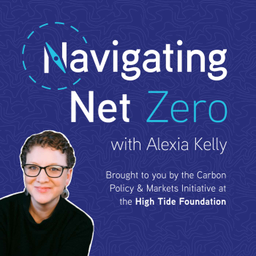
Navigating Net Zero is a podcast featuring conversations with practitioners and experts who are working through the complex realities of corporate decarbonization and sustainability.
We demystify and highlight the challenges, opportunities, and real-world experiences faced by the people leading their institutions' net-zero journeys.
Hosted by internationally-renowned climate change expert Alexia Kelly and brought to you by the Carbon Policy & Markets at the High Tide Foundation, Navigating Net Zero hopes to inspire action from this generation of climate leaders and the next.
IN FOCUS: Amy Merrill on the ICVCM and the Evolution of Carbon Markets Governance
In this episode of the Navigating Net Zero: In Focus mini-series on Developments in Climate Standards & Guidance, Alexia Kelly is joined by Amy Merrill, CEO of the Integrity Council for the Voluntary Carbon Market (ICVCM). Amy outlines how the independent governance body is creating an auditable, regulatory-style floor for credit quality through its Core Carbon Principles (CCPs). They unpack the mechanics of ICVCM's "double-tick" framework – evaluating both program governance and project-level quantification methodologies – to explain how 13 CCP-eligible programs representing 96% of the market are now providing comparable, high-integrity carbon credits to institutional buyers and corporate procurement teams.
Highlights from the Discussion:
The Mechanics of the "Double-Tick" Assessment: Amy breaks down how ICVCM evaluates carbon registries on governance, transparency, and grievance handling (Tick 1) alongside methodology-specific assessments of additionality, conservative baselines, and reversal risk (Tick 2).
Pre-Market Conditioning and Governance Reform: How publishing strict threshold requirements has driven carbon crediting programs to proactively upgrade their internal governance and risk management frameworks before undergoing formal review.
Continuous Improvement and the Rule Architecture: An inside look at how stakeholder-led Continuous Improvement Work Programs (CIWPs) and the new Rule Architecture allow the ICVCM to clarify, interpret, and deepen quality standards over time without stranding market investments.
18 Aug 2026
IN FOCUS: Chris Davis on TCAT, Assurable Guidance, and Closing the Corporate Climate Reporting Gaps
In this episode of the Navigating Net Zero: In Focus – Developments in Climate Standards & Guidance, host Alexia Kelly is joined by Chris Davis, Senior Fellow at the High Tide Foundation and lead for the Task Force for Corporate Action Transparency (TCAT). Chris unpacks the fundamental challenges facing corporate sustainability leaders as legacy carbon accounting standards fail to keep pace with modern market instruments. They discuss TCAT’s practitioner-led framework – including the Mitigation Action Accounting & Reporting Guidance (MAARG) and Targeted Action Reporting Guidance (TARG) – which provides the scaffolding companies need to report mitigation actions credibly, satisfy financial auditors and assurability requirements, and navigate complex global disclosure regulations amidst anti-ESG scrutiny.
Highlights from the Discussion:
Bridging the Third-Party Assurability Gap: Chris explains how TCAT fills a critical void by creating auditable, rule-based methodologies that allow accounting firms to assure active mitigation investments with the same rigor applied to financial audits.
The Architecture of the MAARG Logic Structure: A breakdown of TCAT’s multi-statement "sorting hat" framework, which applies strict logical tests to categorize corporate climate interventions inside or outside direct value chain footprints.
Standardizing Regulatory Disclosures via TARG: How TARG translates granular mitigation data into audit-ready reporting templates, easing administrative friction for multinationals navigating complex global disclosure mandates.
Differentiating Caused Mitigation from Footprint Volatility: Why net inventory changes fall short, and how TCAT isolates direct corporate investments so companies receive credit for intentional decarbonization rather than macro-economic shifts.
11 Aug 2026
IN FOCUS: Kim Carnahan on the AIM Platform Standard & Guidance
In this episode of the Navigating Net Zero: In Focus mini-series on Developments in Climate Standards & Guidance, host Alexia Kelly is joined by longtime climate policy expert Kim Carnahan.
Kim shares the story behind launching the Sustainable Aviation Buyers Alliance (SABA), which led to the Center for Green Market Activation (GMA) and informed the development of the new AIM Platform Standard and Guidance.
Together, Alexia and Kim explore:
Why Scope 3 accounting remains such a challenge
How buyer alliances and book-and-claim systems work
The launch of the new AIM Platform Standard
Why accounting rules are shaping the speed of climate action
The balance between environmental integrity and scaling investment
A thoughtful conversation about the future of corporate decarbonization and the market infrastructure needed to reach net zero.
Reach and audience
Public platform figures. Ratings count people who left a rating, not total listeners.
Apple Podcasts (US)
5.0 / 5
8 ratings
Contact Navigating Net Zero with Alexia Kelly
Guest appearances
Books guests
Based on episode analysis; this does not confirm that the show is currently accepting guests.
Pod Engine is an independent podcast discovery and analytics service and is not affiliated with or endorsed by this podcast. Artwork and show content belong to their owners. Full legal notice.
Explore this show Podcast research with Pod Engine