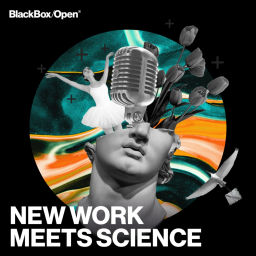
Podcast thumbnail for New Work Meets Science

New Work Meets Science

Claim This Podcast

by BlackBox/Open

5.0(37 reviews)
50 episodes
Updated Bi-weekly
Accepts GuestsHas SponsorsLocation 🇩🇪

Podcast Overview

Unsere Arbeitswelt wandelt sich schneller als je zuvor . New Work stellt neue Anforderungen an Führung, Gesundheit und Teamarbeit. Arbeitspsychologische Forschung kann helfen, diese Entwicklungen optimal zu gestalten – doch wir müssen ihre Erkenntnisse auch nutzen. Dazu möchte unser Podcast einen Beitrag leisten! Host Dr. Theresa Fehn taucht einmal monatlich mit ihren Gästen in die facettenreiche Welt der Psychologie hinter Organisationsentwicklung und Führung ein. Gemeinsam mit profilierten Forscherinnen und Forschern baut sie eine Brücke zwischen Theorie und Praxis. www.blackboxopen.com

Language

🇩🇪

Publishing Since

12/20/2022

1 verified contact email on file for New Work Meets Science

Pitch yourself as a guest, propose sponsorships, or reach out directly to the host.

Recent Episodes

Episode thumbnail for Wer führt besser: Mensch oder Maschine, Niels van Quaquebeke?

July 8, 2026

Wer führt besser: Mensch oder Maschine, Niels van Quaquebeke?

<p>Führt KI besser als ein Mensch?</p><p><br></p><p>In einer Fabrik in der Türkei beginnt der Arbeitstag mit einem Blick auf ein Tablet anstelle von Anweisungen einer Führungskraft. Ein algorithmisches System verteilt Aufgaben, macht Leistung sichtbar, zeigt Engpässe auf und gibt Orientierung im laufenden Betrieb.</p><p>Was zunächst nach Kontrolle, Kälte und technischer Dystopie klingt, entfaltet in der Praxis eine überraschend andere Wirkung: Mitarbeitende erleben die neue Form der Steuerung als fairer, transparenter und nachvollziehbarer. Entscheidungen werden weniger vom Bauchgefühl einzelner Vorgesetzter abhängig. Unterstützung wird sichtbarer. Und dort, wo man vielleicht Entfremdung erwartet hätte, entsteht plötzlich ein neues Gefühl von Teamgeist.</p><p>Kann eine KI etwa besser führen als ein Mensch? Bedeutet das, dass solche Szenarien mehr Utopie als Dystopie sind? Was genau passiert, wenn KI nicht mehr nur assistiert, sondern Führungsaufgaben übernimmt?</p><p><br></p><p>In dieser Folge von <strong>New Work Meets Science</strong> spricht Dr. Theresa Fehn mit <strong>Prof. Niels van Quaquebeke</strong>, Professor für Leadership und Organizational Behavior an der Kühne Logistics University, über die Zukunft von Führung im Zeitalter künstlicher Intelligenz.</p><p>Es geht um algorithmisches Management, psychologische Grundbedürfnisse wie Kompetenz, Autonomie und Verbundenheit, um Bullshit-Jobs, Identität in der Arbeit und die Frage, was menschliche Führung zukünftig noch ausmacht.</p><p>Denn vielleicht liegt die Verschiebung nicht darin, dass KI Führung ersetzt. Vielleicht zwingt sie uns vielmehr dazu, neu zu fragen, was gute Führung im Kern bedeutet: Management oder Menschlichkeit? Kontrolle oder Orientierung? Effizienz oder Verbindung?</p><p>Eine Folge über die Karriereleiter der KI: Vom Tool, über den Ratgeber bis hin zur Führungskraft.</p><p>Viel Spaß beim Hören!</p><p><br></p><p><a href="https://www.blackboxopen.com/">⁠BlackBox/Open im Web⁠⁠⁠⁠⁠⁠⁠⁠⁠⁠⁠⁠⁠⁠⁠⁠</a></p><p><a href="https://www.linkedin.com/company/blackboxopen">⁠⁠⁠⁠BlackBox/Open bei LinkedIn⁠⁠⁠⁠⁠⁠⁠⁠⁠⁠⁠⁠⁠⁠⁠⁠</a></p><p><a href="www.instagram.com/blackboxopen">⁠⁠⁠⁠BlackBox/Open bei Instagram⁠⁠⁠⁠⁠⁠</a></p><p><br></p><p><br></p><p>Links &amp; Quellen:</p><p><strong>Open Paper von Van Quaquebeke &amp; Gerpott:</strong></p><p>Van Quaquebeke, N., &amp; Gerpott, F. H. (2023). The now, new, and next of digital leadership: How artificial intelligence (AI) will take over and change leadership as we know it. Journal of Leadership &amp; Organizational Studies. <a href="https://doi.org/10.1177/15480518231181731">https://doi.org/10.1177/15480518231181731</a></p><p><strong>Literaturempfehlung:</strong></p><p>O’Neil, C. (2017). Weapons of math destruction: How big data increases inequality and threatens democracy. Crown.</p><p>Link zur Verlagsseite:</p><p><a href="https://www.penguinrandomhouse.com/books/241363/weapons-of-math-destruction-by-cathy-oneil/">https://www.penguinrandomhouse.com/books/241363/weapons-of-math-destruction-by-cathy-oneil/</a></p><p><strong>Studie Gerichtsurteile:</strong></p><p>Završnik, A. (2024). Code is law: How COMPAS affects the way the judiciary handles the risk of recidivism. Artificial Intelligence and Law. <a href="https://doi.org/10.1007/s10506-024-09389-8">https://doi.org/10.1007/s10506-024-09389-8</a></p>

Episode thumbnail for How should we talk about success at work, Janey Zheng? Live from the leadership conference @NEOMA Business School

June 24, 2026

How should we talk about success at work, Janey Zheng? Live from the leadership conference @NEOMA Business School

<p>english version below</p><p><br></p><p><strong>Zwei Personen berichten vom gleichen erfolgreichen Projekt. Nur eine wird befördert. Warum?</strong></p><p><br></p><p>Die eine sagt: „Das Projekt lief richtig gut. Wir haben alle Ziele erreicht, der Kunde war zufrieden und das Ergebnis wurde pünktlich geliefert.“</p><p><br></p><p>Die andere sagt: „Das Projekt lief richtig gut. Wir haben alle Ziele erreicht und ich habe dabei einiges gelernt. Zum Beispiel gab es einen Moment, in dem der Kunde kurzfristig neue Anforderungen eingebracht hat. Früher hätte ich wahrscheinlich versucht, das erst einmal allein zu lösen. Diesmal habe ich direkt Feedback eingeholt, die offenen Fragen mit dem Team besprochen und gemeinsam entschieden, wie wir vorgehen. Das hat viel Zeit gespart. Beim nächsten Mal würde ich das sogar noch früher tun.“</p><p>Beide sprechen über Erfolg. Aber sie senden unterschiedliche Signale. Die erste Person zeigt vergangene Leistung, die zweite zusätzlich auch zukünftiges Potenzial.</p><p><br></p><p>In dieser Folge spricht Dr. Theresa Fehn mit Dr. Janey Zheng, Associate Professor in Leadership and Organizational Behavior an der Durham University Business School, über die Frage, wie wir Erfolg im Arbeitskontext kommunizieren.</p><p>Viele Menschen gehen davon aus: Wer gute Leistung bringt, sie sichtbar macht und die eigenen Erfolge klar präsentiert, wird früher oder später als „Führungsmaterial“ erkannt. Doch Janey Zhengs Forschung zeigt: Ganz so einfach ist es nicht. Entscheidend ist nicht nur, <strong>dass</strong> wir über unsere Leistung sprechen, sondern vor allem <strong>wie</strong> wir unseren Erfolg rahmen.</p><p><br></p><p>Erfolg erzählt, was war. Lernen zeigt, was noch möglich ist. Warum genau dieser Unterschied für Karriere und Führungspotenzial entscheidend sein kann, zeigt diese Podcastfolge.</p><p><br></p><p>english version</p><p><strong>Two people report on the same successful project. Only one of them gets promoted. Why?</strong></p><p><br></p><p>The first says: “The project went really well. We achieved all our goals, the client was satisfied, and the result was delivered on time.”</p><p>The second says: “The project went really well. We achieved all our goals and I learned quite a lot along the way. For example, there was a moment when the client brought in new requirements at short notice. In the past, I probably would have tried to solve it on my own first. This time, I asked for feedback right away, discussed the open questions with the team, and we decided together how to move forward. That saved us a lot of time. Next time, I would involve the team even earlier.”</p><p>Both talk about success, but they send different signals. The first person demonstrates past performance. The second also signals future potential.</p><p><br></p><p>In this episode, Dr. Theresa Fehn speaks with Dr. Janey Zheng, Associate Professor in Leadership and Organizational Behavior at Durham University Business School, about how we communicate success at work.</p><p>Many people assume that strong performance, visibility, and clearly presenting one’s achievements will sooner or later make someone be recognized as “leadership material.” But Janey Zheng’s research shows that it is not quite that simple. What matters is not only <strong>that</strong> we talk about our performance, but above all <strong>how</strong> we frame our success.</p><p><br></p><p>Success tells the story of what has been achieved. Learning shows what might still be possible. This podcast episode explores why exactly this difference can be crucial for careers and leadership potential.</p><p><br></p><p><a href="https://www.blackboxopen.com/">⁠⁠⁠⁠⁠BlackBox/Open im Web⁠⁠⁠⁠⁠⁠⁠⁠⁠⁠⁠⁠⁠⁠⁠⁠⁠⁠⁠⁠</a></p><p><a href="https://www.linkedin.com/company/blackboxopen">⁠⁠⁠⁠⁠⁠⁠⁠BlackBox/Open bei LinkedIn⁠⁠⁠⁠⁠⁠⁠⁠⁠⁠⁠⁠⁠⁠⁠⁠⁠⁠⁠⁠</a></p><p><a href="www.instagram.com/blackboxopen">⁠⁠⁠⁠⁠⁠⁠⁠BlackBox/Open bei Instagram⁠⁠⁠⁠⁠⁠⁠⁠</a></p>

Episode thumbnail for Is leadership becoming just another backlog item, Diana Rus? Live from the leadership conference @NEOMA Business School

June 22, 2026

Is leadership becoming just another backlog item, Diana Rus? Live from the leadership conference @NEOMA Business School

<p>english version below</p><p><br></p><p><strong>“Hast du kurz eine Minute?”</strong></p><p>Eigentlich wollten Sie gerade eine Präsentation fertigstellen, einen Kunden anrufen oder eine wichtige Entscheidungsvorlage für die Geschäftsführung vorbereiten. Gleichzeitig steht jemand in der Tür, der Orientierung braucht, Feedback sucht oder ein kurzes Sparring möchte.</p><p>Das ist die Realität moderner Führung: zwischen eigener To-do-Liste und Verantwortung für andere. Zwischen Task-Modus und Leadership-Modus. Zwischen dem Anspruch, gute Führung zu leisten, und der Frage, wann dafür eigentlich Zeit sein soll.</p><p>Denn während klassische Führungsideale von Inspiration, Vision, Entwicklung und Orientierung sprechen, sieht der Alltag oft anders aus: Führungskräfte wechseln ständig zwischen Rollen – mal sind sie Entscheiderin, mal Kollege, mal Expertin, mal Sparringspartner.</p><p>Dieser Wechsel kostet Aufmerksamkeit, Energie und kann schnell zu Überlastung, Rollenkonflikten oder dem Gefühl führen, keiner Rolle wirklich gerecht zu werden.</p><p>Dr. Diana Rus ist Associate Professor für Organisationspsychologie an der Universität Groningen in den Niederlanden. In ihrer Forschung geht sie der Frage nach, wie Arbeit so gestaltet werden kann, dass Menschen darin aufblühen und ihr Potenzial entfalten können.</p><p>In dieser Folge erklärt sie mit Theresa Fehn, warum wir Führung nicht nur als individuelle Kompetenzfrage betrachten sollten, sondern auch als Frage des Systems: Wie sind Rollen gestaltet? Was wird tatsächlich belohnt? Und wie können Organisationen Führungskräfte so unterstützen, dass sie nicht dauerhaft zwischen Anspruch und Realität aufgerieben werden?</p><p>Eine Folge über Führungsrollen zwischen Ideal und Realität – und darüber, warum gute Leadership nicht nur in den Händen der einzelnen Führungskraft liegt, sondern ebenso in den Rahmenbedingungen, die sie tragen und entfalten lassen.</p><p><br></p><p>english version:</p><p><strong>“Do you have a minute?”</strong></p><p>They were just about to finish a presentation, call a client, or prepare an important decision brief for the executive team. At the same time, someone is standing in the doorway: looking for guidance, asking for feedback, or simply wanting to briefly talk something through.</p><p>This is the reality of modern leadership: caught between your own to-do list and the responsibility for others. Between task mode and leadership mode. Between the aspiration to lead well and the question of when there is actually time to do so.</p><p>Because while classic leadership ideals often speak of inspiration, vision, development, and orientation, everyday work often looks very different. Leaders constantly switch between roles: sometimes they are decision-makers, sometimes colleagues, sometimes experts, sometimes sparring partners. This constant switching requires attention and energy and can quickly lead to overload, role conflict, or the feeling of not fully living up to any of these roles.</p><p>Dr. Diana Rus is Associate Professor of Organizational Psychology at the University of Groningen in the Netherlands. In her research, she explores how work can be designed in a way that allows people to thrive and unfold their potential.</p><p>In this episode, she speaks with Theresa Fehn about why leadership should not only be understood as a question of individual competence, but also as a systemic one: How are roles designed? What is actually rewarded? And how can organizations support leaders in a way that prevents them from being worn down between aspiration and reality?</p><p>An episode about leadership roles between ideal and reality — and about why good leadership does not rest solely in the hands of individual leaders, but also in the conditions that support them and allow leadership to unfold.</p><p><br></p><p><a href="https://www.blackboxopen.com/">⁠⁠⁠⁠⁠BlackBox/Open im Web⁠⁠⁠⁠⁠⁠⁠⁠⁠⁠⁠⁠⁠⁠⁠⁠⁠⁠⁠⁠</a></p><p><a href="https://www.linkedin.com/company/blackboxopen">⁠⁠⁠⁠⁠⁠⁠⁠BlackBox/Open bei LinkedIn⁠⁠⁠⁠⁠⁠⁠⁠⁠⁠⁠⁠⁠⁠⁠⁠⁠⁠⁠⁠</a></p><p><a href="www.instagram.com/blackboxopen">⁠⁠⁠⁠⁠⁠⁠⁠BlackBox/Open bei Instagram⁠⁠⁠⁠⁠⁠⁠⁠</a></p><p><br></p>

50 total episodes available

Recent guests on New Work Meets Science

Guests from recent episodes — sign up to see every guest that has ever appeared on this show.

Uwe Peter Kanning

Guest

Prof. Julia Reif

Guest

Deep-dive analytics for New Work Meets Science

Frequently asked questions

Have a different question and can't find the answer you're looking for? Reach out to our support team by sending us an email and we'll get back to you as soon as we can.

What is New Work Meets Science?

Unsere Arbeitswelt wandelt sich schneller als je zuvor . New Work stellt neue Anforderungen an Führung, Gesundheit und Teamarbeit. Arbeitspsychologische Forschung kann helfen, diese Entwicklungen optimal zu gestalten – doch wir müssen ihre Erkenntnisse auch nutzen. Dazu möchte unser Podcast einen Beitrag leisten! Host Dr. Theresa Fehn taucht einmal monatlich mit ihren Gästen in die facettenreiche Welt der Psychologie hinter Organisationsentwicklung und Führung ein. Gemeinsam mit profilierten Forscherinnen und Forschern baut sie eine Brücke zwischen Theorie und Praxis.

www.blackboxopen.com

How often does this podcast release new episodes?

This podcast updates bi-weekly.

Where can I listen to this podcast?

This podcast is available on 9 platforms including Apple Podcasts, Spotify, and more. You can also use the RSS feed directly.

Does this podcast accept guests?

Information about guest appearances is not available.

Legal Disclaimer

Pod Engine is not affiliated with, endorsed by, or officially connected with any of the podcasts displayed on this platform. We operate independently as a podcast discovery and analytics service.

All podcast artwork, thumbnails, and content displayed on this page are the property of their respective owners and are protected by applicable copyright laws. This includes, but is not limited to, podcast cover art, episode artwork, show descriptions, episode titles, transcripts, audio snippets, and any other content originating from the podcast creators or their licensors.

We display this content under fair use principles and/or implied license for the purpose of podcast discovery, information, and commentary. We make no claim of ownership over any podcast content, artwork, or related materials shown on this platform. All trademarks, service marks, and trade names are the property of their respective owners.

While we strive to ensure all content usage is properly authorized, if you are a rights holder and believe your content is being used inappropriately or without proper authorization, please contact us immediately at hey@podengine.ai for prompt review and appropriate action, which may include content removal or proper attribution.

By accessing and using this platform, you acknowledge and agree to respect all applicable copyright laws and intellectual property rights of content owners. Any unauthorized reproduction, distribution, or commercial use of the content displayed on this platform is strictly prohibited.