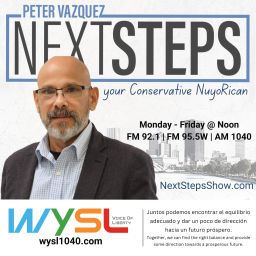
Podcast thumbnail for Next Steps Show

Next Steps Show

Claim This Podcast

by Peter Vazquez

3.0(4 reviews)
446 episodes
Updated Daily
Accepts GuestsHas SponsorsLocation 🇺🇸

Podcast Overview

<div class="flex flex-col text-sm pb-25"> <div class="text-base my-auto mx-auto pb-10 [--thread-content-margin:--spacing(4)] @w-sm/main:[--thread-content-margin:--spacing(6)] @w-lg/main:[--thread-content-margin:--spacing(16)] px-(--thread-content-margin)"> <div class="[--thread-content-max-width:40rem] @w-lg/main:[--thread-content-max-width:48rem] mx-auto max-w-(--thread-content-max-width) flex-1 group/turn-messages focus-visible:outline-hidden relative flex w-full min-w-0 flex-col agent-turn"> <div class="flex max-w-full flex-col grow"> <div class="min-h-8 text-message relative flex w-full flex-col items-end gap-2 text-start break-words whitespace-normal [.text-message+&amp;]:mt-1"> <div class="flex w-full flex-col gap-1 empty:hidden first:pt-[1px]"> <div class="markdown prose dark:prose-invert w-full break-words light markdown-new-styling"> <p>This is a gathering forged to awaken conviction and stir resolve, where Faith, Politics, and Entrepreneurship converge as pillars shaping the destiny of We the People. We educate with purpose, challenge with clarity, and equip individuals to reclaim stewardship over their lives and communities. Through fearless truth and real solutions, we restore balance in belief, governance, and enterprise. This is more than conversation. It is a summons. Juntos, podemos restaurar el equilibrio y trazar el camino hacia un futuro próspero.</p> </div> </div> </div> </div> <div class="z-0 flex min-h-[46px] justify-start"></div> <div class="mt-3 w-full empty:hidden"> <div class="text-center"></div> </div> </div> </div> </div> <div class="pointer-events-none h-px w-px absolute bottom-0"></div>

Language

🇺🇲

Publishing Since

9/12/2022

1 verified contact email on file for Next Steps Show

Pitch yourself as a guest, propose sponsorships, or reach out directly to the host.

Recent Episodes

Episode thumbnail for The Family Fight Albany Forgot

July 1, 2026

The Family Fight Albany Forgot

There are cities that remember their monuments but forget their meaning.   Rochester knows Frederick Douglass in bronze. It knows him in Mount Hope Cemetery, in speeches, in street markers, in ceremonies, in the safe applause of public memory. But Douglass was not safe.   He was not a decoration for a city’s conscience. He was a warning bell. He stood in Rochester and asked whether the great principles of political freedom and natural justice were truly extended to the people.   That question did not die in 1852. It still walks through New York.   It walks into the classroom where a parent wonders whether their child is being formed, or merely moved along. It walks into the childcare center where care is called essential, but priced like a luxury.   It walks into the home where the property-tax bill arrives whether the family had a good year or not. It walks into the voting booth where citizens are asked, again and again, to reward a system that speaks compassion while families feel managed, squeezed, and ignored.   That was the deeper ground of this conversation with Kalinda Washington, Republican and Conservative candidate for New York State Assembly District 135. This was not merely about a race. It was about the old question beneath every serious civic fight: does government exist to serve the family, or is the family expected to bend around government?   New York spends like money alone can save a child. In fiscal year 2024, the U.S. Census Bureau reported national public-school current spending at $17,619 per pupil, while New York remained the highest-spending state at $31,918 per pupil.   Yet the New York State Education Department’s 2024–25 preliminary results showed Grades 3–8 proficiency at only 53% in English Language Arts and 55% in math, with science proficiency at 44% for Grades 5 and 8. Spending is not mastery. Promotion is not readiness. A child moved forward without the ability to read is not being lifted; that child is being quietly abandoned with paperwork.   This is where the Vanbōōlzalness Crisis becomes visible. It is the sickness of systems that speak compassion while producing dependency, confusion, and lowered expectations. It is the habit of calling something equity while refusing to face the outcomes.   EdTrust-New York reported in June 2026 that New York’s graduation rate fell from 87% in 2022 to 85% in 2025, calling the drop a sign of persistent inequities in educational opportunity and outcomes. The New York Equity Coalition also reported that students of color make up 60% of New York’s K–12 enrollment, while 75% of the state’s teachers are White. The language of equity is everywhere.   The results are still fractured.   Childcare tells the same story in the language of exhaustion. The New York State Comptroller reported that 60% of New York census tracts were childcare deserts in 2023. Infant center-based care averaged $20,459 a year. Toddler center-based care averaged $17,476. Childcare is where the workday begins before the parent ever clocks in, yet New York keeps treating it like a private inconvenience instead of a family, workforce, and child-development crisis. Parents cannot work without care. Providers cannot survive without margin. Children cannot wait for Albany to discover basic arithmetic.   Then comes the property-tax bill, the quiet rent on ownership. New York’s own tax data show that property taxes support school districts, local governments, special districts such as fire districts, and other local services. Outside New York City, school taxes account for 62.2% of property-tax levies for fiscal years ending in 2025.   That means every conversation about education spending is also a conversation about whether families can afford to stay rooted. The bill comes to the house without asking whether the senior is tired, whether the young family is stretched, whether the veteran has already given enough, or whether the taxpayer is watching the dream of ownership become one m

Episode thumbnail for Rochester Fighters and America’s Future

June 26, 2026

Rochester Fighters and America’s Future

Rochester still has fighters.   Not the kind made by cameras, committees, or campaign mailers. The kind made by streets that remember your name.   The kind made by mothers who reached for the belt before the state ever reached for a program. The kind made by church basements, block clubs, boxing gyms, front porches, public markets, old bakeries, Puerto Rican kitchens, police warnings, second chances, and the stubborn belief that a neighborhood is not dead just because too many leaders have treated it like a managed failure.   This conversation carried the smell of North Clinton Avenue, the memory of St. Michael’s, the shadow of Doña Belén Colón, and the sound of a people asking whether America still has enough moral backbone to remain America.   With Mercedes Vazquez Simmons in studio, Monroe County Legislator for District 22, and her brother Jay Gonzalez beside her, the issue was never simply one campaign, one party, one ballot line, or one local dispute.   The deeper issue was whether Rochester, and the nation behind it, can still tell the truth without breaking apart.   Rochester is not suffering from a shortage of speeches. It is suffering from a shortage of earned trust.   The city has about 206,108 residents, a poverty rate of 27.8%, and a median household income of $47,213. Nearly one in five residents is Hispanic or Latino.   This is not a city of statistics on paper. This is a city of families trying to survive the numbers.   The New York State Comptroller has warned that child poverty remains a severe crisis, with Rochester, Buffalo, and Syracuse carrying some of the heaviest burdens in the state. When children grow up surrounded by poverty, violence, weak schools, fractured homes, and political theater, the crisis does not stay private. It becomes public policy. It becomes crime data. It becomes school failure. It becomes addiction. It becomes hopelessness. It becomes the quiet theft of a generation.   That is why the conversation had to begin with God, Country, and Family. Not as a slogan. As a rescue plan. The old neighborhoods understood something the modern political class keeps forgetting.   You cannot program your way out of a broken culture while mocking the foundations that once held families together.   You cannot tell young men they are victims forever and then act shocked when they never become builders.   You cannot preach compassion while keeping people dependent on systems that require their poverty to justify someone else’s paycheck.   There is money in poverty, and too many people have learned how to dress that ugly truth in beautiful language.   Mercedes said it plainly: some people want communities to remain poor because it justifies their agenda.   That is the nerve. That is the wound. That is where the Vanbōōlzalness Crisis shows its face.   It is not only deception. It is deception wearing the clothes of concern. It is calling dependency empowerment. It is calling political control community service. It is calling silence unity. It is calling a managed neighborhood a represented neighborhood. It is telling people they are seen while keeping them stuck exactly where they are.   Yet this hour did not come from bitterness. It came from love. Love for Rochester. Love for America. Love for a people whose identity is larger than party registration.   The broadcast pushed back against the small, insulting idea that Puerto Rican identity, Black identity, Hispanic identity, patriotism, conservatism, Democratic registration, or faith must fit into someone else’s approved box.   Jay Gonzalez said it with clarity: Puerto Ricans have been American citizens since 1917. The bloodline is Puerto Rican. The civic inheritance is American. The faith is real. The family is real. The patriotism is real.   That matters because America is approaching 250 years, and the question is no longer ceremonial. The question is not whether we can hang flags, sing songs, or stage public events. The question is whether

Episode thumbnail for The Bench, the Ballot, and Broken Trust

June 25, 2026

The Bench, the Ballot, and Broken Trust

In America, the republic rarely fails in one loud crash. More often, it weakens in rooms most people never enter, on ballots most people never study, inside systems most people assume somebody else is guarding.   That was the wound running through this conversation.   It began with the bench, because the bench is where politics is supposed to stop and judgment is supposed to begin.   Allegany County Judge candidate Dawn Wildrick-Cole stepped into that space not as a national figure, not as a cable-news combatant, but as a reminder that local justice is still deeply human.   County court is not abstract. It is custody. It is estates. It is criminal sentencing. It is bail. It is divorce. It is foreclosure. It is a family standing before the law on one of the hardest days of life and hoping the person in the robe has prepared, listened, and understood the weight of the decision.   That is why judicial races matter. Not because they are flashy. Because they are consequential.   Public confidence in the U.S. judicial system has fallen to a record-low 35%, according to Gallup’s 2024 polling. That is not just a statistic; it is a warning flare. When citizens stop believing courts are fair, the whole civic structure begins to shake.   Yet state courts still retain more public trust than many institutions, with the National Center for State Courts’ 2025 survey showing 62% of respondents expressing a great deal or some trust in state courts. That gap tells the story: people may distrust the national theater, but they still look to local courts for order, restraint, and fairness.   That trust must be earned. It cannot be performed.   Wildrick-Cole spoke about preparation, impartiality, independence, and integrity. Those are not soft words. They are load-bearing beams. A judge who fails in preparation risks injustice. A judge who fails in impartiality becomes political. A judge who fails in independence becomes useful to power. A judge who fails in integrity becomes dangerous. The courthouse cannot become another stage for ambition. The bench is not a trophy. It is a trust.   Then the hour turned from the courtroom to the ballot box, and the question became even sharper: what happens when the systems that choose our leaders cannot produce confidence?   Andrew Paquette, PhD, author of The Zark Files Substack, joined briefly to discuss his article, “Did the Socialists Win in NY?” The headline is provocative, but the deeper issue is not merely whether socialist-backed candidates won primaries in New York.   The deeper issue is whether voter rolls are clean enough for the public to verify outcomes with confidence.   Paquette’s claim is not casual. He has spent years studying New York voter rolls and says he has published multiple peer-reviewed articles on voter-roll structure. His analysis of the New York districts where Mamdani-backed candidates won raised concerns about clone registrations, changing voter-history data, mail-in registrations, and what he calls disappeared votes.   A clone registration, as described in the show, is a voter-roll record that shares the same name and date of birth as another record but carries a different voter ID number. In plain English, one apparent identity appears more than once in the system. That should not be treated like a paperwork quirk. If one voter ID is supposed to represent one unique voter, duplicate identities deserve an answer.   A disappeared vote, according to Paquette’s framework, is a mismatch between county and state voter-history records: the county says a voter voted, but the state record tied to that same ID says the voter did not. That is not a small contradiction. It is the kind of record conflict that cuts directly into public trust.   The numbers Paquette raised are not small. Across three districts, he identified 120,151 clone registrations and 57,781 disappeared votes in races where roughly 218,000 people voted. In NY-13, he said the margin was 2,335 votes, while clone

446 total episodes available

Deep-dive analytics for Next Steps Show

Frequently asked questions

Have a different question and can't find the answer you're looking for? Reach out to our support team by sending us an email and we'll get back to you as soon as we can.

What is Next Steps Show?
<div class="flex flex-col text-sm pb-25"> <div class="text-base my-auto mx-auto pb-10 [--thread-content-margin:--spacing(4)] @w-sm/main:[--thread-content-margin:--spacing(6)] @w-lg/main:[--thread-content-margin:--spacing(16)] px-(--thread-content-margin)"> <div class="[--thread-content-max-width:40rem] @w-lg/main:[--thread-content-max-width:48rem] mx-auto max-w-(--thread-content-max-width) flex-1 group/turn-messages focus-visible:outline-hidden relative flex w-full min-w-0 flex-col agent-turn"> <div class="flex max-w-full flex-col grow"> <div class="min-h-8 text-message relative flex w-full flex-col items-end gap-2 text-start break-words whitespace-normal [.text-message+&amp;]:mt-1"> <div class="flex w-full flex-col gap-1 empty:hidden first:pt-[1px]"> <div class="markdown prose dark:prose-invert w-full break-words light markdown-new-styling"> <p>This is a gathering forged to awaken conviction and stir resolve, where Faith, Politics, and Entrepreneurship converge as pillars shaping the destiny of We the People. We educate with purpose, challenge with clarity, and equip individuals to reclaim stewardship over their lives and communities. Through fearless truth and real solutions, we restore balance in belief, governance, and enterprise. This is more than conversation. It is a summons. Juntos, podemos restaurar el equilibrio y trazar el camino hacia un futuro próspero.</p> </div> </div> </div> </div> <div class="z-0 flex min-h-[46px] justify-start"></div> <div class="mt-3 w-full empty:hidden"> <div class="text-center"></div> </div> </div> </div> </div> <div class="pointer-events-none h-px w-px absolute bottom-0"></div>
How often does this podcast release new episodes?

This podcast updates daily.

Where can I listen to this podcast?

This podcast is available on 10 platforms including Apple Podcasts, Spotify, and more. You can also use the RSS feed directly.

Does this podcast accept guests?

No, this podcast does not typically feature guests.

Legal Disclaimer

Pod Engine is not affiliated with, endorsed by, or officially connected with any of the podcasts displayed on this platform. We operate independently as a podcast discovery and analytics service.

All podcast artwork, thumbnails, and content displayed on this page are the property of their respective owners and are protected by applicable copyright laws. This includes, but is not limited to, podcast cover art, episode artwork, show descriptions, episode titles, transcripts, audio snippets, and any other content originating from the podcast creators or their licensors.

We display this content under fair use principles and/or implied license for the purpose of podcast discovery, information, and commentary. We make no claim of ownership over any podcast content, artwork, or related materials shown on this platform. All trademarks, service marks, and trade names are the property of their respective owners.

While we strive to ensure all content usage is properly authorized, if you are a rights holder and believe your content is being used inappropriately or without proper authorization, please contact us immediately at hey@podengine.ai for prompt review and appropriate action, which may include content removal or proper attribution.

By accessing and using this platform, you acknowledge and agree to respect all applicable copyright laws and intellectual property rights of content owners. Any unauthorized reproduction, distribution, or commercial use of the content displayed on this platform is strictly prohibited.